SUBSCRIBE TO OUR FREE NEWSLETTER
Daily news & progressive opinion—funded by the people, not the corporations—delivered straight to your inbox.
5
#000000
#FFFFFF
To donate by check, phone, or other method, see our More Ways to Give page.
Daily news & progressive opinion—funded by the people, not the corporations—delivered straight to your inbox.
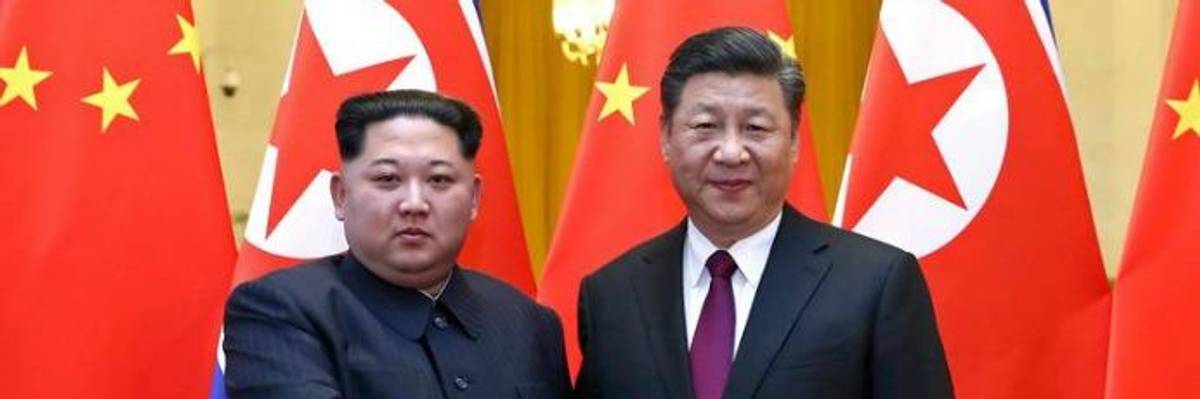
North Korea's leader, Kim Jong-un, with President Xi Jinping of China in Beijing. (Photo: Ju Peng/Xinhua via Associated Press)
During an unannounced meeting with Chinese President President Xi Jinping on Wednesday that marked his first known foreign trip since taking power in 2011, North Korean leader Kim Jong-un reaffirmed his commitment to denuclearizing the Korean Peninsula and urged the U.S. to reciprocate moves toward diplomacy by creating "an atmosphere of peace and stability."
"The issue of denuclearisation of the Korean Peninsula can be resolved, if South Korea and the United States respond to our efforts with goodwill...while taking progressive and synchronous measures for the realization of peace," Kim said, the according to the Chinese state media outlet Xinhua. "It is our consistent stand to be committed to denuclearization on the peninsula."
While the details of what was discussed during the meeting between the two leaders are unclear, China Central Television aired select clips of the visit, including Kim's arrival at the Chinese capital and a series of photo-ops.
Responding to Kim's unofficial visit to China as well as his diplomatic overtures in a series of tweets Wednesday morning, U.S. President Donald Trump--who earlier this month agreed to meet with Kim in person later this year--declared that "maximum sanctions and pressure must be maintained at all cost," despite warnings from experts that this pressure campaign could destroy the possibility of peace.
While Trump tried to claim his bellicose and belligerent approach to the situation in North Korea was the key factor in producing talks, Van Jackson, a senior lecturer at Victoria University of Wellington and expert on strategic negotiations, argues this is simply not the case.
Kim's visit to China comes just days after Trump selected John Bolton as his next national security adviser, a move many fear could reverse diplomatic progress and undermine denuclearization talks, given Bolton's previous calls for the U.S. to bomb North Korea during frequent appearances on Fox News and in right-wing editorial pages.
As CodePink co-founder Medea Benjamin pointed out in an article for Common Dreams on Tuesday, Bolton has also called attempts to negotiate with North Korea "worse than a mere waste of time."
"Instead of talks, Bolton has called for the United States to launch a preemptive strike against North Korea, a strike that could spark a nuclear war," Benjamin noted.
Dear Common Dreams reader, It’s been nearly 30 years since I co-founded Common Dreams with my late wife, Lina Newhouser. We had the radical notion that journalism should serve the public good, not corporate profits. It was clear to us from the outset what it would take to build such a project. No paid advertisements. No corporate sponsors. No millionaire publisher telling us what to think or do. Many people said we wouldn't last a year, but we proved those doubters wrong. Together with a tremendous team of journalists and dedicated staff, we built an independent media outlet free from the constraints of profits and corporate control. Our mission has always been simple: To inform. To inspire. To ignite change for the common good. Building Common Dreams was not easy. Our survival was never guaranteed. When you take on the most powerful forces—Wall Street greed, fossil fuel industry destruction, Big Tech lobbyists, and uber-rich oligarchs who have spent billions upon billions rigging the economy and democracy in their favor—the only bulwark you have is supporters who believe in your work. But here’s the urgent message from me today. It's never been this bad out there. And it's never been this hard to keep us going. At the very moment Common Dreams is most needed, the threats we face are intensifying. We need your support now more than ever. We don't accept corporate advertising and never will. We don't have a paywall because we don't think people should be blocked from critical news based on their ability to pay. Everything we do is funded by the donations of readers like you. When everyone does the little they can afford, we are strong. But if that support retreats or dries up, so do we. Will you donate now to make sure Common Dreams not only survives but thrives? —Craig Brown, Co-founder |
During an unannounced meeting with Chinese President President Xi Jinping on Wednesday that marked his first known foreign trip since taking power in 2011, North Korean leader Kim Jong-un reaffirmed his commitment to denuclearizing the Korean Peninsula and urged the U.S. to reciprocate moves toward diplomacy by creating "an atmosphere of peace and stability."
"The issue of denuclearisation of the Korean Peninsula can be resolved, if South Korea and the United States respond to our efforts with goodwill...while taking progressive and synchronous measures for the realization of peace," Kim said, the according to the Chinese state media outlet Xinhua. "It is our consistent stand to be committed to denuclearization on the peninsula."
While the details of what was discussed during the meeting between the two leaders are unclear, China Central Television aired select clips of the visit, including Kim's arrival at the Chinese capital and a series of photo-ops.
Responding to Kim's unofficial visit to China as well as his diplomatic overtures in a series of tweets Wednesday morning, U.S. President Donald Trump--who earlier this month agreed to meet with Kim in person later this year--declared that "maximum sanctions and pressure must be maintained at all cost," despite warnings from experts that this pressure campaign could destroy the possibility of peace.
While Trump tried to claim his bellicose and belligerent approach to the situation in North Korea was the key factor in producing talks, Van Jackson, a senior lecturer at Victoria University of Wellington and expert on strategic negotiations, argues this is simply not the case.
Kim's visit to China comes just days after Trump selected John Bolton as his next national security adviser, a move many fear could reverse diplomatic progress and undermine denuclearization talks, given Bolton's previous calls for the U.S. to bomb North Korea during frequent appearances on Fox News and in right-wing editorial pages.
As CodePink co-founder Medea Benjamin pointed out in an article for Common Dreams on Tuesday, Bolton has also called attempts to negotiate with North Korea "worse than a mere waste of time."
"Instead of talks, Bolton has called for the United States to launch a preemptive strike against North Korea, a strike that could spark a nuclear war," Benjamin noted.
During an unannounced meeting with Chinese President President Xi Jinping on Wednesday that marked his first known foreign trip since taking power in 2011, North Korean leader Kim Jong-un reaffirmed his commitment to denuclearizing the Korean Peninsula and urged the U.S. to reciprocate moves toward diplomacy by creating "an atmosphere of peace and stability."
"The issue of denuclearisation of the Korean Peninsula can be resolved, if South Korea and the United States respond to our efforts with goodwill...while taking progressive and synchronous measures for the realization of peace," Kim said, the according to the Chinese state media outlet Xinhua. "It is our consistent stand to be committed to denuclearization on the peninsula."
While the details of what was discussed during the meeting between the two leaders are unclear, China Central Television aired select clips of the visit, including Kim's arrival at the Chinese capital and a series of photo-ops.
Responding to Kim's unofficial visit to China as well as his diplomatic overtures in a series of tweets Wednesday morning, U.S. President Donald Trump--who earlier this month agreed to meet with Kim in person later this year--declared that "maximum sanctions and pressure must be maintained at all cost," despite warnings from experts that this pressure campaign could destroy the possibility of peace.
While Trump tried to claim his bellicose and belligerent approach to the situation in North Korea was the key factor in producing talks, Van Jackson, a senior lecturer at Victoria University of Wellington and expert on strategic negotiations, argues this is simply not the case.
Kim's visit to China comes just days after Trump selected John Bolton as his next national security adviser, a move many fear could reverse diplomatic progress and undermine denuclearization talks, given Bolton's previous calls for the U.S. to bomb North Korea during frequent appearances on Fox News and in right-wing editorial pages.
As CodePink co-founder Medea Benjamin pointed out in an article for Common Dreams on Tuesday, Bolton has also called attempts to negotiate with North Korea "worse than a mere waste of time."
"Instead of talks, Bolton has called for the United States to launch a preemptive strike against North Korea, a strike that could spark a nuclear war," Benjamin noted.