SUBSCRIBE TO OUR FREE NEWSLETTER
Daily news & progressive opinion—funded by the people, not the corporations—delivered straight to your inbox.
5
#000000
#FFFFFF
To donate by check, phone, or other method, see our More Ways to Give page.
Daily news & progressive opinion—funded by the people, not the corporations—delivered straight to your inbox.
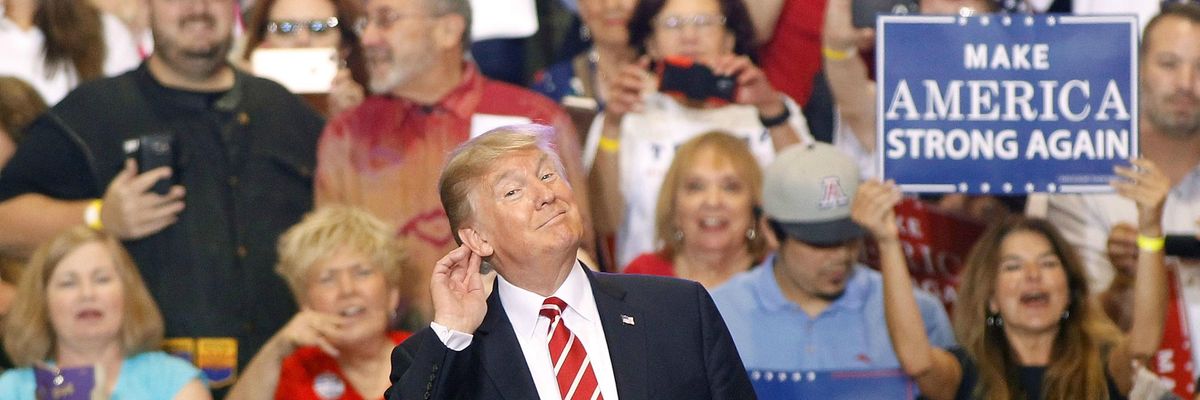
Trump's Tuesday evening speech in Phoenix, Arizona drew the latest comparisons between his campaign-style events and speeches given by autocrats like Adolf Hitler. (Photo: Ralph Freso/Getty Images)
In the wake of President Donald Trump's "unhinged" address at a campaign-style rally in Phoenix, Arizona, former British ambassador Peter Westmacott joined many Americans in expressing shock at the president's rhetoric on Wednesday--comparing the rally to one that might have been seen during the rise of the Nazi state in 1930s Germany.
The president spent much of his hour-long tirade railing against the press, declaring that most reporters "are really, really dishonest people, and they're bad people" who "don't like our country." The press coverage of the last ten days was a special focus; since last week, Trump has faced heavy criticism for his equivocation regarding a violent white supremacist rally in Charlottesville, Virginia.
Westmacott is just the latest observer to compare Trump's actions to those of autocrats like those of the Nazi regime. Last month the president's speech at the annual Boy Scout Jamboree was as focused as his Phoenix address was on Trump's ongoing battles with the free press and other adversaries, prompting comparisons to a Nazi Youth rally.
Writing in Foreign Policy In Focus on Wednesday, Adil E. Shamoo and Bonnie Bricker argue it's time to take such Nazi-Trump comparisons seriously:
For starters, both rose to power with minority support....At his peak, Hitler managed to muster just 39 percent [of the German vote]. (Contrary to myth, he never won a popular election outright.) Trump took over the Republican Party with a similar style of demagoguery and dumb luck.
Both Hitler and Trump have used bullying and threats to keep government officials in line. Nazi supporters intimidated, beat, and assassinated some of their opponents. Trump is no Hitler--not yet--but he's turned his Twitter account into an intimidation tool and managed to keep the majority of his party in line with him, even with neo-Nazis chanting "Heil Trump" in the streets.
The former ambassador's comments coincided with an urgent condemnation by a United Nations panel focused on race relations to the Trump administration's troubling response to white supremacists in the United States.
Invoking its "urgent warning procedure," The Committee on the Elimination of Racial Discrimination denounced "the failure at the highest political level of the United States of America to unequivocally reject and condemn the racist violent events and demonstrations" led by white supremacists. The group also urged the U.S. to "actively contribute to the promotion of understanding, tolerance, and diversity between ethnic groups"--values which the country has historically prided itself on promoting.
The Committee generally only gives reviews of U.N. member countries' race relations every four or five years, but its urgent warning procedure is used for cases of unrest that could "spiral into terrible events," according to its chair, Anastasia Crickley.
In an interview with the New York Times, Crickley expressed shock at the glowing reviews avowed neo-Nazis gave the president after his statements on Charlottesville. "I was horrified as well by the way leaders of [the white supremacist] movement were able to state afterwards that they felt secure in their support," she said.
The last time the panel issued such a decision was last year, when it twice criticized the government of Burundi in East Africa for not addressing its human rights abuses. Before that was in 2014, in a decision concerning the so-called Islamic State group's attacks against civilians in Iraq.
Dear Common Dreams reader, It’s been nearly 30 years since I co-founded Common Dreams with my late wife, Lina Newhouser. We had the radical notion that journalism should serve the public good, not corporate profits. It was clear to us from the outset what it would take to build such a project. No paid advertisements. No corporate sponsors. No millionaire publisher telling us what to think or do. Many people said we wouldn't last a year, but we proved those doubters wrong. Together with a tremendous team of journalists and dedicated staff, we built an independent media outlet free from the constraints of profits and corporate control. Our mission has always been simple: To inform. To inspire. To ignite change for the common good. Building Common Dreams was not easy. Our survival was never guaranteed. When you take on the most powerful forces—Wall Street greed, fossil fuel industry destruction, Big Tech lobbyists, and uber-rich oligarchs who have spent billions upon billions rigging the economy and democracy in their favor—the only bulwark you have is supporters who believe in your work. But here’s the urgent message from me today. It's never been this bad out there. And it's never been this hard to keep us going. At the very moment Common Dreams is most needed, the threats we face are intensifying. We need your support now more than ever. We don't accept corporate advertising and never will. We don't have a paywall because we don't think people should be blocked from critical news based on their ability to pay. Everything we do is funded by the donations of readers like you. When everyone does the little they can afford, we are strong. But if that support retreats or dries up, so do we. Will you donate now to make sure Common Dreams not only survives but thrives? —Craig Brown, Co-founder |
In the wake of President Donald Trump's "unhinged" address at a campaign-style rally in Phoenix, Arizona, former British ambassador Peter Westmacott joined many Americans in expressing shock at the president's rhetoric on Wednesday--comparing the rally to one that might have been seen during the rise of the Nazi state in 1930s Germany.
The president spent much of his hour-long tirade railing against the press, declaring that most reporters "are really, really dishonest people, and they're bad people" who "don't like our country." The press coverage of the last ten days was a special focus; since last week, Trump has faced heavy criticism for his equivocation regarding a violent white supremacist rally in Charlottesville, Virginia.
Westmacott is just the latest observer to compare Trump's actions to those of autocrats like those of the Nazi regime. Last month the president's speech at the annual Boy Scout Jamboree was as focused as his Phoenix address was on Trump's ongoing battles with the free press and other adversaries, prompting comparisons to a Nazi Youth rally.
Writing in Foreign Policy In Focus on Wednesday, Adil E. Shamoo and Bonnie Bricker argue it's time to take such Nazi-Trump comparisons seriously:
For starters, both rose to power with minority support....At his peak, Hitler managed to muster just 39 percent [of the German vote]. (Contrary to myth, he never won a popular election outright.) Trump took over the Republican Party with a similar style of demagoguery and dumb luck.
Both Hitler and Trump have used bullying and threats to keep government officials in line. Nazi supporters intimidated, beat, and assassinated some of their opponents. Trump is no Hitler--not yet--but he's turned his Twitter account into an intimidation tool and managed to keep the majority of his party in line with him, even with neo-Nazis chanting "Heil Trump" in the streets.
The former ambassador's comments coincided with an urgent condemnation by a United Nations panel focused on race relations to the Trump administration's troubling response to white supremacists in the United States.
Invoking its "urgent warning procedure," The Committee on the Elimination of Racial Discrimination denounced "the failure at the highest political level of the United States of America to unequivocally reject and condemn the racist violent events and demonstrations" led by white supremacists. The group also urged the U.S. to "actively contribute to the promotion of understanding, tolerance, and diversity between ethnic groups"--values which the country has historically prided itself on promoting.
The Committee generally only gives reviews of U.N. member countries' race relations every four or five years, but its urgent warning procedure is used for cases of unrest that could "spiral into terrible events," according to its chair, Anastasia Crickley.
In an interview with the New York Times, Crickley expressed shock at the glowing reviews avowed neo-Nazis gave the president after his statements on Charlottesville. "I was horrified as well by the way leaders of [the white supremacist] movement were able to state afterwards that they felt secure in their support," she said.
The last time the panel issued such a decision was last year, when it twice criticized the government of Burundi in East Africa for not addressing its human rights abuses. Before that was in 2014, in a decision concerning the so-called Islamic State group's attacks against civilians in Iraq.
In the wake of President Donald Trump's "unhinged" address at a campaign-style rally in Phoenix, Arizona, former British ambassador Peter Westmacott joined many Americans in expressing shock at the president's rhetoric on Wednesday--comparing the rally to one that might have been seen during the rise of the Nazi state in 1930s Germany.
The president spent much of his hour-long tirade railing against the press, declaring that most reporters "are really, really dishonest people, and they're bad people" who "don't like our country." The press coverage of the last ten days was a special focus; since last week, Trump has faced heavy criticism for his equivocation regarding a violent white supremacist rally in Charlottesville, Virginia.
Westmacott is just the latest observer to compare Trump's actions to those of autocrats like those of the Nazi regime. Last month the president's speech at the annual Boy Scout Jamboree was as focused as his Phoenix address was on Trump's ongoing battles with the free press and other adversaries, prompting comparisons to a Nazi Youth rally.
Writing in Foreign Policy In Focus on Wednesday, Adil E. Shamoo and Bonnie Bricker argue it's time to take such Nazi-Trump comparisons seriously:
For starters, both rose to power with minority support....At his peak, Hitler managed to muster just 39 percent [of the German vote]. (Contrary to myth, he never won a popular election outright.) Trump took over the Republican Party with a similar style of demagoguery and dumb luck.
Both Hitler and Trump have used bullying and threats to keep government officials in line. Nazi supporters intimidated, beat, and assassinated some of their opponents. Trump is no Hitler--not yet--but he's turned his Twitter account into an intimidation tool and managed to keep the majority of his party in line with him, even with neo-Nazis chanting "Heil Trump" in the streets.
The former ambassador's comments coincided with an urgent condemnation by a United Nations panel focused on race relations to the Trump administration's troubling response to white supremacists in the United States.
Invoking its "urgent warning procedure," The Committee on the Elimination of Racial Discrimination denounced "the failure at the highest political level of the United States of America to unequivocally reject and condemn the racist violent events and demonstrations" led by white supremacists. The group also urged the U.S. to "actively contribute to the promotion of understanding, tolerance, and diversity between ethnic groups"--values which the country has historically prided itself on promoting.
The Committee generally only gives reviews of U.N. member countries' race relations every four or five years, but its urgent warning procedure is used for cases of unrest that could "spiral into terrible events," according to its chair, Anastasia Crickley.
In an interview with the New York Times, Crickley expressed shock at the glowing reviews avowed neo-Nazis gave the president after his statements on Charlottesville. "I was horrified as well by the way leaders of [the white supremacist] movement were able to state afterwards that they felt secure in their support," she said.
The last time the panel issued such a decision was last year, when it twice criticized the government of Burundi in East Africa for not addressing its human rights abuses. Before that was in 2014, in a decision concerning the so-called Islamic State group's attacks against civilians in Iraq.