Nearly 50 million children have been uprooted from their homes around the world, and 28 million of those are refugees fleeing violence and conflict--and "that is a conservative estimate," according to a UNICEF report published Tuesday.
"What can the future hold for these children--denied so much of what they need?"
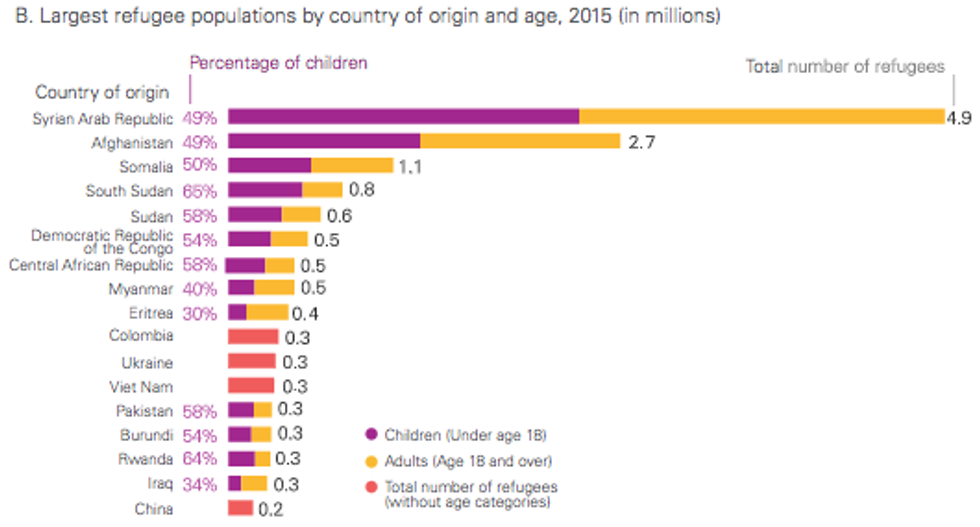
--Anthony Lake, UNICEFThe total number of child refugees doubled between 2005 and 2015, the report says, and children now comprise half of all refugees despite accounting for less than a third of the global population.
The report, "Uprooted: The Growing Crisis for Refugee and Migrant Children," (pdf) presents "for the first time, comprehensive, global data about these children," UNICEF writes.
A stunning 100,000 child refugees are traveling without their parents or families.
"Children do not bear any responsibility for the bombs and bullets, the gang violence, persecution, the shriveled crops and low family wages driving them from their homes," the United Nations agency argues in the report's executive summary. "They are, however, always the first to be affected by war, conflict, climate change and poverty."
"[T]oday, nearly 1 in every 200 children in the world is a child refugee," the report observes. "In 2005, the ratio was roughly 1 in every 350 children."
The report also examined the number of children internally displaced in their own countries by war.
Children displaced internally by the ongoing conflicts in Syria, Yemen, and Iraq account for nearly one third of all children displaced internally around the world in 2015, the report found.
And child refugees fleeing endless war in two countries, Syria and Afghanistan, represented one half of all child migrants worldwide.
"Though many communities and people around the world have welcomed refugee and migrant children, xenophobia, discrimination, and exclusion pose serious threats to their lives and futures," wrote UNICEF director Anthony Lake in his introduction to the report.
"Language barriers make it difficult for children and their families to seek the help they need. Legal barriers can prevent them from accessing education, health care and other services," Lake continued. "These obstacles are magnified for the 70,000 children who are born stateless every year, often as a result of their parents' migration."
Echoing other rights advocates urging protections for child refugees, the report also calls on the international community to create safe and legal routes for all displaced people.
"When children and their families have safe, legal routes for migration, it can offer tremendous opportunities for both the children who migrate as well as the communities they join," UNICEF writes. "When safe pathways are not available, migration and displacement continue, but with much greater risk. In these situations, it is children who face the most immediate dangers and most profound consequences."
The call flies in the face of European immigration policies, which have grown disastrously hostile toward the wave of refugees seeking asylum there, and also pushes against the anti-immigrant sentiments given a large platform by right-wing politicians in the U.S. and in Europe.
The United Nations' human rights chief condemned such "demagogues" on Tuesday, as Common Dreams reported.
"What can the future hold for these children--denied so much of what they need?" Lake wrote. "The answer depends on what we do today."
Nearly 50 million children have been uprooted from their homes around the world, and 28 million of those are refugees fleeing violence and conflict--and "that is a conservative estimate," according to a UNICEF report published Tuesday.
"What can the future hold for these children--denied so much of what they need?"
--Anthony Lake, UNICEFThe total number of child refugees doubled between 2005 and 2015, the report says, and children now comprise half of all refugees despite accounting for less than a third of the global population.
The report, "Uprooted: The Growing Crisis for Refugee and Migrant Children," (pdf) presents "for the first time, comprehensive, global data about these children," UNICEF writes.
A stunning 100,000 child refugees are traveling without their parents or families.
"Children do not bear any responsibility for the bombs and bullets, the gang violence, persecution, the shriveled crops and low family wages driving them from their homes," the United Nations agency argues in the report's executive summary. "They are, however, always the first to be affected by war, conflict, climate change and poverty."
"[T]oday, nearly 1 in every 200 children in the world is a child refugee," the report observes. "In 2005, the ratio was roughly 1 in every 350 children."
The report also examined the number of children internally displaced in their own countries by war.
Children displaced internally by the ongoing conflicts in Syria, Yemen, and Iraq account for nearly one third of all children displaced internally around the world in 2015, the report found.
And child refugees fleeing endless war in two countries, Syria and Afghanistan, represented one half of all child migrants worldwide.
"Though many communities and people around the world have welcomed refugee and migrant children, xenophobia, discrimination, and exclusion pose serious threats to their lives and futures," wrote UNICEF director Anthony Lake in his introduction to the report.
"Language barriers make it difficult for children and their families to seek the help they need. Legal barriers can prevent them from accessing education, health care and other services," Lake continued. "These obstacles are magnified for the 70,000 children who are born stateless every year, often as a result of their parents' migration."
Echoing other rights advocates urging protections for child refugees, the report also calls on the international community to create safe and legal routes for all displaced people.
"When children and their families have safe, legal routes for migration, it can offer tremendous opportunities for both the children who migrate as well as the communities they join," UNICEF writes. "When safe pathways are not available, migration and displacement continue, but with much greater risk. In these situations, it is children who face the most immediate dangers and most profound consequences."
The call flies in the face of European immigration policies, which have grown disastrously hostile toward the wave of refugees seeking asylum there, and also pushes against the anti-immigrant sentiments given a large platform by right-wing politicians in the U.S. and in Europe.
The United Nations' human rights chief condemned such "demagogues" on Tuesday, as Common Dreams reported.
"What can the future hold for these children--denied so much of what they need?" Lake wrote. "The answer depends on what we do today."
Nearly 50 million children have been uprooted from their homes around the world, and 28 million of those are refugees fleeing violence and conflict--and "that is a conservative estimate," according to a UNICEF report published Tuesday.
"What can the future hold for these children--denied so much of what they need?"
--Anthony Lake, UNICEFThe total number of child refugees doubled between 2005 and 2015, the report says, and children now comprise half of all refugees despite accounting for less than a third of the global population.
The report, "Uprooted: The Growing Crisis for Refugee and Migrant Children," (pdf) presents "for the first time, comprehensive, global data about these children," UNICEF writes.
A stunning 100,000 child refugees are traveling without their parents or families.
"Children do not bear any responsibility for the bombs and bullets, the gang violence, persecution, the shriveled crops and low family wages driving them from their homes," the United Nations agency argues in the report's executive summary. "They are, however, always the first to be affected by war, conflict, climate change and poverty."
"[T]oday, nearly 1 in every 200 children in the world is a child refugee," the report observes. "In 2005, the ratio was roughly 1 in every 350 children."
The report also examined the number of children internally displaced in their own countries by war.
Children displaced internally by the ongoing conflicts in Syria, Yemen, and Iraq account for nearly one third of all children displaced internally around the world in 2015, the report found.
And child refugees fleeing endless war in two countries, Syria and Afghanistan, represented one half of all child migrants worldwide.
"Though many communities and people around the world have welcomed refugee and migrant children, xenophobia, discrimination, and exclusion pose serious threats to their lives and futures," wrote UNICEF director Anthony Lake in his introduction to the report.
"Language barriers make it difficult for children and their families to seek the help they need. Legal barriers can prevent them from accessing education, health care and other services," Lake continued. "These obstacles are magnified for the 70,000 children who are born stateless every year, often as a result of their parents' migration."
Echoing other rights advocates urging protections for child refugees, the report also calls on the international community to create safe and legal routes for all displaced people.
"When children and their families have safe, legal routes for migration, it can offer tremendous opportunities for both the children who migrate as well as the communities they join," UNICEF writes. "When safe pathways are not available, migration and displacement continue, but with much greater risk. In these situations, it is children who face the most immediate dangers and most profound consequences."
The call flies in the face of European immigration policies, which have grown disastrously hostile toward the wave of refugees seeking asylum there, and also pushes against the anti-immigrant sentiments given a large platform by right-wing politicians in the U.S. and in Europe.
The United Nations' human rights chief condemned such "demagogues" on Tuesday, as Common Dreams reported.
"What can the future hold for these children--denied so much of what they need?" Lake wrote. "The answer depends on what we do today."