SUBSCRIBE TO OUR FREE NEWSLETTER
Daily news & progressive opinion—funded by the people, not the corporations—delivered straight to your inbox.
5
#000000
#FFFFFF
To donate by check, phone, or other method, see our More Ways to Give page.
Update (5 pm EDT):
"The scene in Athens is explosive," King's College London professor and Syriza central committee member Stathis Kouvelakis wrote for Jacobin Wednesday afternoon.
Both in and outside of Greek Parliament, tensions are running high.
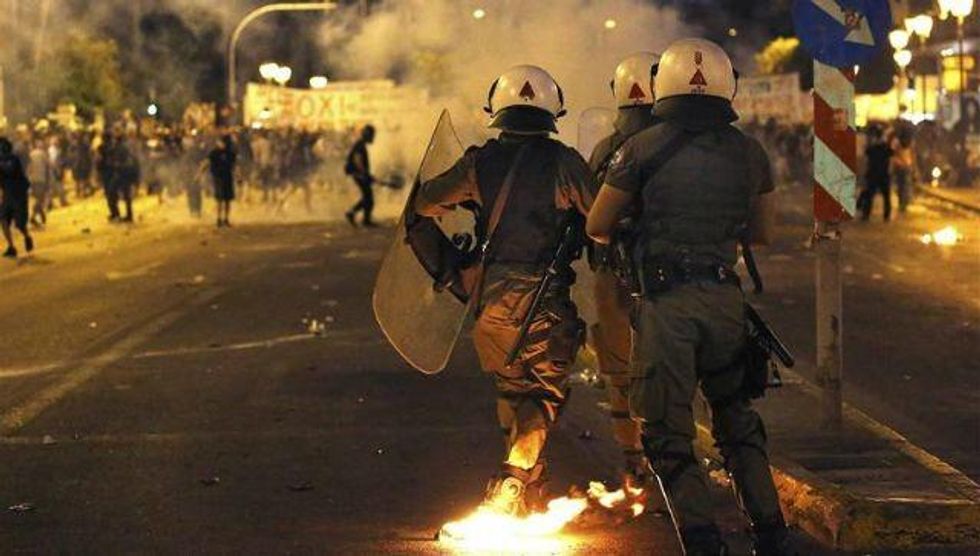
A largely peaceful anti-austerity rally was disrupted at one point by an hour-long clash between anti-austerity protesters and police, leading to about 50 arrests.
Inside, members of Parliament passionately debated the terms of the deal, with many Syriza party members--some of whom have already stepped down in protest --decrying the so-called rescue package as a "coup" meant to overthrow the government.
Greek MPs have been told that they have to vote on the reforms by midnight local time (5 pm EDT).
Meanwhile, colorful former finance minister Yanis Varoufakis, who has been outspoken about the bailout deal and Europe's bargaining tactics, released his own annotated version of the agreement, which he says ultimately "demand[s] that the victim takes all the blame in behalf of the villain."
With their requirement that Greece impose further austerity measures, Germany and European lenders are essentially demanding the nation subject itself to "fiscal waterboarding," Varoufakis said.
The Guardian, Reuters, and the Telegraph are all providing live updates on the developments.
Earlier...
With even the International Monetary Fund (IMF)--one-third of the so-called Troika--saying that Greece needs debt relief "far beyond" what European creditors have been willing to consider, and Prime Minister Alexis Tsipras struggling to win the confidence of his anti-austerity Syriza party, the EUR86 billion bailout deal struck with eurozone leaders earlier this week faces a vote in Athens on Wednesday night.
| Tweets from https://twitter.com/commondreams/lists/greek-crisis |
In a report released publicly late on Tuesday, the IMF proposed that creditors let Athens write off part of its huge eurozone debt or at least make no payments for 30 years, threatening to withdraw from the bailout agreement if such debt relief couldn't be achieved. The international lender said Greece's debt was now "highly unsustainable" and would reach "close to 200 percent of GDP in the next two years."
On Wednesday, the European Union's executive Commission echoed that analysis, saying there are "serious concerns" about the sustainability of Greece's debt.
Meanwhile, Tsipras's governing party appears to be splintering in the face of a controversial rescue package that critics say would deepen Greece's acute economic crisis through tax hikes and pension cuts.
Deputy finance minister Nadia Valavani, a Syriza member, resigned Wednesday in a letter to the prime minister. "I'm not going to vote for this amendment and this means I cannot stay in the government," Valavani told reporters.
The Athens-based Kathimerini English Edition reported other defections on Twitter:
According to the Associated Press, more than half of the party's central committee has signed a statement slamming the agreement Greece reached with its European creditors earlier this week, describing it as a coup against their nation.
"The agreement signed with the 'institutions' was the outcome of threats of immediate economic strangulation and represents a new Memorandum imposing odious and humiliating conditions of tutelage that are destructive for our country and our people," read the statement, signed by 109 of the committee's 201 members.
"On July 12 a coup was carried out in Brussels that proved that the aim of the European leadership was the exemplary annihilation of a people who envisaged that another path could be followed beyond the neoliberal model of extreme austerity," the statement continues. "A coup that goes directly against any kind of notion of democracy and popular sovereignty."
In Parliament on Wednesday, former finance minister Yanis Varoufakis--who has warned that the further austerity measures demanded by foreign creditors will strengthen the far right in Greece--repeated his assertion that the bailout agreement was essentially a "new Versailles Treaty," referring to the 1919 pact that penalized defeated Germany at the end of World War I.
Still, the Guardian's Helena Smith reported Wednesday afternoon that "Tsipras was greeted with rousing applause by the Syriza party MPs in what could be a sign that his appeal for support is working. Tellingly, house speaker Zoe Konstantopoulou, one of the party's loudest critics of austerity, rushed to embrace him as the meeting began."
Addressing members of Parliament (MPs) ahead of tonight's crucial vote, the prime minister said: "Whoever has an alternative [solution] should come and tell me."
Meanwhile, a civil servants' strike disrupted public transport and shut down state-run services across the country on Wednesday, with pharmacies joining in their own 24-hour strike to object to the austerity deal which will reportedly allow some non-prescription drugs to be sold by supermarkets.
Anti-austerity demonstrations are currently taking place in Athens, and are expected to continue into Wednesday evening. In addition, more than 70 actions are taking place around the world on Wednesday, in solidarity with the Greek people, who earlier this month voted overwhelmingly against further austerity and deeper cuts.
Nonetheless, news outlets are reporting that the bailout package is expected to pass, with support in Parliament from pro-European opposition parties.
To that end, a United Nations expert warned Wednesday that implementation of new austerity measures amid the country's deteriorating economic situation must not come at a cost to human rights.
"I am seriously concerned about voices saying that Greece is in a humanitarian crisis with shortages in medicines and food," Juan Pablo Bohoslavsky, the UN Independent Expert on foreign debt and human rights, stressed in a press statement. "Priority should be to ensure that everybody in Greece has access to core minimum levels of economic, social and cultural rights, including the right to health care, food and social security."
Update (5 pm EDT):
"The scene in Athens is explosive," King's College London professor and Syriza central committee member Stathis Kouvelakis wrote for Jacobin Wednesday afternoon.
Both in and outside of Greek Parliament, tensions are running high.
A largely peaceful anti-austerity rally was disrupted at one point by an hour-long clash between anti-austerity protesters and police, leading to about 50 arrests.
Inside, members of Parliament passionately debated the terms of the deal, with many Syriza party members--some of whom have already stepped down in protest --decrying the so-called rescue package as a "coup" meant to overthrow the government.
Greek MPs have been told that they have to vote on the reforms by midnight local time (5 pm EDT).
Meanwhile, colorful former finance minister Yanis Varoufakis, who has been outspoken about the bailout deal and Europe's bargaining tactics, released his own annotated version of the agreement, which he says ultimately "demand[s] that the victim takes all the blame in behalf of the villain."
With their requirement that Greece impose further austerity measures, Germany and European lenders are essentially demanding the nation subject itself to "fiscal waterboarding," Varoufakis said.
The Guardian, Reuters, and the Telegraph are all providing live updates on the developments.
Earlier...
With even the International Monetary Fund (IMF)--one-third of the so-called Troika--saying that Greece needs debt relief "far beyond" what European creditors have been willing to consider, and Prime Minister Alexis Tsipras struggling to win the confidence of his anti-austerity Syriza party, the EUR86 billion bailout deal struck with eurozone leaders earlier this week faces a vote in Athens on Wednesday night.
| Tweets from https://twitter.com/commondreams/lists/greek-crisis |
In a report released publicly late on Tuesday, the IMF proposed that creditors let Athens write off part of its huge eurozone debt or at least make no payments for 30 years, threatening to withdraw from the bailout agreement if such debt relief couldn't be achieved. The international lender said Greece's debt was now "highly unsustainable" and would reach "close to 200 percent of GDP in the next two years."
On Wednesday, the European Union's executive Commission echoed that analysis, saying there are "serious concerns" about the sustainability of Greece's debt.
Meanwhile, Tsipras's governing party appears to be splintering in the face of a controversial rescue package that critics say would deepen Greece's acute economic crisis through tax hikes and pension cuts.
Deputy finance minister Nadia Valavani, a Syriza member, resigned Wednesday in a letter to the prime minister. "I'm not going to vote for this amendment and this means I cannot stay in the government," Valavani told reporters.
The Athens-based Kathimerini English Edition reported other defections on Twitter:
According to the Associated Press, more than half of the party's central committee has signed a statement slamming the agreement Greece reached with its European creditors earlier this week, describing it as a coup against their nation.
"The agreement signed with the 'institutions' was the outcome of threats of immediate economic strangulation and represents a new Memorandum imposing odious and humiliating conditions of tutelage that are destructive for our country and our people," read the statement, signed by 109 of the committee's 201 members.
"On July 12 a coup was carried out in Brussels that proved that the aim of the European leadership was the exemplary annihilation of a people who envisaged that another path could be followed beyond the neoliberal model of extreme austerity," the statement continues. "A coup that goes directly against any kind of notion of democracy and popular sovereignty."
In Parliament on Wednesday, former finance minister Yanis Varoufakis--who has warned that the further austerity measures demanded by foreign creditors will strengthen the far right in Greece--repeated his assertion that the bailout agreement was essentially a "new Versailles Treaty," referring to the 1919 pact that penalized defeated Germany at the end of World War I.
Still, the Guardian's Helena Smith reported Wednesday afternoon that "Tsipras was greeted with rousing applause by the Syriza party MPs in what could be a sign that his appeal for support is working. Tellingly, house speaker Zoe Konstantopoulou, one of the party's loudest critics of austerity, rushed to embrace him as the meeting began."
Addressing members of Parliament (MPs) ahead of tonight's crucial vote, the prime minister said: "Whoever has an alternative [solution] should come and tell me."
Meanwhile, a civil servants' strike disrupted public transport and shut down state-run services across the country on Wednesday, with pharmacies joining in their own 24-hour strike to object to the austerity deal which will reportedly allow some non-prescription drugs to be sold by supermarkets.
Anti-austerity demonstrations are currently taking place in Athens, and are expected to continue into Wednesday evening. In addition, more than 70 actions are taking place around the world on Wednesday, in solidarity with the Greek people, who earlier this month voted overwhelmingly against further austerity and deeper cuts.
Nonetheless, news outlets are reporting that the bailout package is expected to pass, with support in Parliament from pro-European opposition parties.
To that end, a United Nations expert warned Wednesday that implementation of new austerity measures amid the country's deteriorating economic situation must not come at a cost to human rights.
"I am seriously concerned about voices saying that Greece is in a humanitarian crisis with shortages in medicines and food," Juan Pablo Bohoslavsky, the UN Independent Expert on foreign debt and human rights, stressed in a press statement. "Priority should be to ensure that everybody in Greece has access to core minimum levels of economic, social and cultural rights, including the right to health care, food and social security."
Update (5 pm EDT):
"The scene in Athens is explosive," King's College London professor and Syriza central committee member Stathis Kouvelakis wrote for Jacobin Wednesday afternoon.
Both in and outside of Greek Parliament, tensions are running high.
A largely peaceful anti-austerity rally was disrupted at one point by an hour-long clash between anti-austerity protesters and police, leading to about 50 arrests.
Inside, members of Parliament passionately debated the terms of the deal, with many Syriza party members--some of whom have already stepped down in protest --decrying the so-called rescue package as a "coup" meant to overthrow the government.
Greek MPs have been told that they have to vote on the reforms by midnight local time (5 pm EDT).
Meanwhile, colorful former finance minister Yanis Varoufakis, who has been outspoken about the bailout deal and Europe's bargaining tactics, released his own annotated version of the agreement, which he says ultimately "demand[s] that the victim takes all the blame in behalf of the villain."
With their requirement that Greece impose further austerity measures, Germany and European lenders are essentially demanding the nation subject itself to "fiscal waterboarding," Varoufakis said.
The Guardian, Reuters, and the Telegraph are all providing live updates on the developments.
Earlier...
With even the International Monetary Fund (IMF)--one-third of the so-called Troika--saying that Greece needs debt relief "far beyond" what European creditors have been willing to consider, and Prime Minister Alexis Tsipras struggling to win the confidence of his anti-austerity Syriza party, the EUR86 billion bailout deal struck with eurozone leaders earlier this week faces a vote in Athens on Wednesday night.
| Tweets from https://twitter.com/commondreams/lists/greek-crisis |
In a report released publicly late on Tuesday, the IMF proposed that creditors let Athens write off part of its huge eurozone debt or at least make no payments for 30 years, threatening to withdraw from the bailout agreement if such debt relief couldn't be achieved. The international lender said Greece's debt was now "highly unsustainable" and would reach "close to 200 percent of GDP in the next two years."
On Wednesday, the European Union's executive Commission echoed that analysis, saying there are "serious concerns" about the sustainability of Greece's debt.
Meanwhile, Tsipras's governing party appears to be splintering in the face of a controversial rescue package that critics say would deepen Greece's acute economic crisis through tax hikes and pension cuts.
Deputy finance minister Nadia Valavani, a Syriza member, resigned Wednesday in a letter to the prime minister. "I'm not going to vote for this amendment and this means I cannot stay in the government," Valavani told reporters.
The Athens-based Kathimerini English Edition reported other defections on Twitter:
According to the Associated Press, more than half of the party's central committee has signed a statement slamming the agreement Greece reached with its European creditors earlier this week, describing it as a coup against their nation.
"The agreement signed with the 'institutions' was the outcome of threats of immediate economic strangulation and represents a new Memorandum imposing odious and humiliating conditions of tutelage that are destructive for our country and our people," read the statement, signed by 109 of the committee's 201 members.
"On July 12 a coup was carried out in Brussels that proved that the aim of the European leadership was the exemplary annihilation of a people who envisaged that another path could be followed beyond the neoliberal model of extreme austerity," the statement continues. "A coup that goes directly against any kind of notion of democracy and popular sovereignty."
In Parliament on Wednesday, former finance minister Yanis Varoufakis--who has warned that the further austerity measures demanded by foreign creditors will strengthen the far right in Greece--repeated his assertion that the bailout agreement was essentially a "new Versailles Treaty," referring to the 1919 pact that penalized defeated Germany at the end of World War I.
Still, the Guardian's Helena Smith reported Wednesday afternoon that "Tsipras was greeted with rousing applause by the Syriza party MPs in what could be a sign that his appeal for support is working. Tellingly, house speaker Zoe Konstantopoulou, one of the party's loudest critics of austerity, rushed to embrace him as the meeting began."
Addressing members of Parliament (MPs) ahead of tonight's crucial vote, the prime minister said: "Whoever has an alternative [solution] should come and tell me."
Meanwhile, a civil servants' strike disrupted public transport and shut down state-run services across the country on Wednesday, with pharmacies joining in their own 24-hour strike to object to the austerity deal which will reportedly allow some non-prescription drugs to be sold by supermarkets.
Anti-austerity demonstrations are currently taking place in Athens, and are expected to continue into Wednesday evening. In addition, more than 70 actions are taking place around the world on Wednesday, in solidarity with the Greek people, who earlier this month voted overwhelmingly against further austerity and deeper cuts.
Nonetheless, news outlets are reporting that the bailout package is expected to pass, with support in Parliament from pro-European opposition parties.
To that end, a United Nations expert warned Wednesday that implementation of new austerity measures amid the country's deteriorating economic situation must not come at a cost to human rights.
"I am seriously concerned about voices saying that Greece is in a humanitarian crisis with shortages in medicines and food," Juan Pablo Bohoslavsky, the UN Independent Expert on foreign debt and human rights, stressed in a press statement. "Priority should be to ensure that everybody in Greece has access to core minimum levels of economic, social and cultural rights, including the right to health care, food and social security."