SUBSCRIBE TO OUR FREE NEWSLETTER
Daily news & progressive opinion—funded by the people, not the corporations—delivered straight to your inbox.
5
#000000
#FFFFFF
To donate by check, phone, or other method, see our More Ways to Give page.
Daily news & progressive opinion—funded by the people, not the corporations—delivered straight to your inbox.
Marking the one-year anniversary of the 2014 attack on Gaza, protesters in the United Kingdom and Australia on Monday shut down four drone factories owned by the biggest arms company in Israel, Elbit Systems.
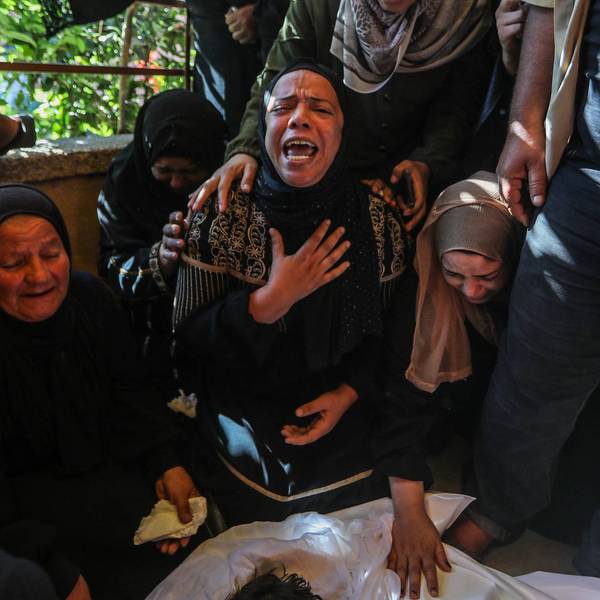
The factories produce military drones that were used in Israel's 51-day offensive last summer, which saw the deaths of more than 2,200 people--including 1,400 Palestinian civilians, one third of them children.
Actions took place in two villages in Staffordshire in central UK--Shenstone and Tamworth--as well as Broadstairs, Kent, and Melbourne, Australia. Protesters blocked the roads and entrances to factories at those sites, denouncing Elbit Systems for what they say is its complicity in the Israeli military's alleged war crimes in Gaza.
Elly Hassan, an organizer with London Palestine Action who took part in the Shenstone blockade, stated on Monday, "People have come here from all over the country to show their solidarity with the Palestinian struggle for freedom, justice and equality and to demand that the UK government imposes a two-way military embargo on Israel."
Electronic Intifada reports:
Amnesty International research into the UEL factory has indicated that components made in the factory, engines for armed unmanned aerial vehicles (UAVs, or drones), were used in Israel's 2008-2009 attack on Gaza. Code-named "Operation Cast Lead," this attack killed 1,400 Palestinians in Gaza.
The UEL factory is known to export its drone engines to Israel.
On Monday, police issued an injunction to break up the blockade in Shenstone, eventually making 10 arrests. But the actions continued elsewhere.
In Melbourne, protesters chained themselves to the gates in front of the factory; in Broadstairs, they occupied the roofs. Banners proclaiming, "Stop Arming Israel" and "This Company Kills People" were unfurled in front of the entrances.
A similar action last year reportedly caused Elbit Systems to lose $280,000 in revenue and in Scotland last September, activists blockaded the Thales UK factory in Govan, Glasgow, under the banner "Another Scotland is possible."
The issue of arms sales to Israel came under heightened scrutiny during the 2014 offensive.
Electronic Intifada continues:
A report called "Arming Apartheid," released last week by the Campaign Against the Arms Trade, War on Want and the Palestine Solidarity Campaign, found that fresh arms exports to Israel worth nearly PS4 million ($6.2 million) - including components for drones - were approved by Britain within weeks of the attack.
These deals show that despite Israel's alleged war crimes, the government's attitude to the arms trade with Israel is "business as usual," they said.
Monday's blockade was the latest in a series of actions within the growing Boycott, Divest, and Sanction (BDS) movement, which is calling on international governments to cut ties with Israel over its alleged human rights violations.
According to Electronic Intifada, "Recent successes include the announcement by Orange that it intends to leave the Israeli market and the news that foreign direct investment into Israel has dropped by almost 50 percent last year, partly due to the growth of the boycott movement."
On social media, the actions were updated under the hashtag #BlockTheFactory.
Dear Common Dreams reader, It’s been nearly 30 years since I co-founded Common Dreams with my late wife, Lina Newhouser. We had the radical notion that journalism should serve the public good, not corporate profits. It was clear to us from the outset what it would take to build such a project. No paid advertisements. No corporate sponsors. No millionaire publisher telling us what to think or do. Many people said we wouldn't last a year, but we proved those doubters wrong. Together with a tremendous team of journalists and dedicated staff, we built an independent media outlet free from the constraints of profits and corporate control. Our mission has always been simple: To inform. To inspire. To ignite change for the common good. Building Common Dreams was not easy. Our survival was never guaranteed. When you take on the most powerful forces—Wall Street greed, fossil fuel industry destruction, Big Tech lobbyists, and uber-rich oligarchs who have spent billions upon billions rigging the economy and democracy in their favor—the only bulwark you have is supporters who believe in your work. But here’s the urgent message from me today. It's never been this bad out there. And it's never been this hard to keep us going. At the very moment Common Dreams is most needed, the threats we face are intensifying. We need your support now more than ever. We don't accept corporate advertising and never will. We don't have a paywall because we don't think people should be blocked from critical news based on their ability to pay. Everything we do is funded by the donations of readers like you. When everyone does the little they can afford, we are strong. But if that support retreats or dries up, so do we. Will you donate now to make sure Common Dreams not only survives but thrives? —Craig Brown, Co-founder |
Marking the one-year anniversary of the 2014 attack on Gaza, protesters in the United Kingdom and Australia on Monday shut down four drone factories owned by the biggest arms company in Israel, Elbit Systems.
The factories produce military drones that were used in Israel's 51-day offensive last summer, which saw the deaths of more than 2,200 people--including 1,400 Palestinian civilians, one third of them children.
Actions took place in two villages in Staffordshire in central UK--Shenstone and Tamworth--as well as Broadstairs, Kent, and Melbourne, Australia. Protesters blocked the roads and entrances to factories at those sites, denouncing Elbit Systems for what they say is its complicity in the Israeli military's alleged war crimes in Gaza.
Elly Hassan, an organizer with London Palestine Action who took part in the Shenstone blockade, stated on Monday, "People have come here from all over the country to show their solidarity with the Palestinian struggle for freedom, justice and equality and to demand that the UK government imposes a two-way military embargo on Israel."
Electronic Intifada reports:
Amnesty International research into the UEL factory has indicated that components made in the factory, engines for armed unmanned aerial vehicles (UAVs, or drones), were used in Israel's 2008-2009 attack on Gaza. Code-named "Operation Cast Lead," this attack killed 1,400 Palestinians in Gaza.
The UEL factory is known to export its drone engines to Israel.
On Monday, police issued an injunction to break up the blockade in Shenstone, eventually making 10 arrests. But the actions continued elsewhere.
In Melbourne, protesters chained themselves to the gates in front of the factory; in Broadstairs, they occupied the roofs. Banners proclaiming, "Stop Arming Israel" and "This Company Kills People" were unfurled in front of the entrances.
A similar action last year reportedly caused Elbit Systems to lose $280,000 in revenue and in Scotland last September, activists blockaded the Thales UK factory in Govan, Glasgow, under the banner "Another Scotland is possible."
The issue of arms sales to Israel came under heightened scrutiny during the 2014 offensive.
Electronic Intifada continues:
A report called "Arming Apartheid," released last week by the Campaign Against the Arms Trade, War on Want and the Palestine Solidarity Campaign, found that fresh arms exports to Israel worth nearly PS4 million ($6.2 million) - including components for drones - were approved by Britain within weeks of the attack.
These deals show that despite Israel's alleged war crimes, the government's attitude to the arms trade with Israel is "business as usual," they said.
Monday's blockade was the latest in a series of actions within the growing Boycott, Divest, and Sanction (BDS) movement, which is calling on international governments to cut ties with Israel over its alleged human rights violations.
According to Electronic Intifada, "Recent successes include the announcement by Orange that it intends to leave the Israeli market and the news that foreign direct investment into Israel has dropped by almost 50 percent last year, partly due to the growth of the boycott movement."
On social media, the actions were updated under the hashtag #BlockTheFactory.
Marking the one-year anniversary of the 2014 attack on Gaza, protesters in the United Kingdom and Australia on Monday shut down four drone factories owned by the biggest arms company in Israel, Elbit Systems.
The factories produce military drones that were used in Israel's 51-day offensive last summer, which saw the deaths of more than 2,200 people--including 1,400 Palestinian civilians, one third of them children.
Actions took place in two villages in Staffordshire in central UK--Shenstone and Tamworth--as well as Broadstairs, Kent, and Melbourne, Australia. Protesters blocked the roads and entrances to factories at those sites, denouncing Elbit Systems for what they say is its complicity in the Israeli military's alleged war crimes in Gaza.
Elly Hassan, an organizer with London Palestine Action who took part in the Shenstone blockade, stated on Monday, "People have come here from all over the country to show their solidarity with the Palestinian struggle for freedom, justice and equality and to demand that the UK government imposes a two-way military embargo on Israel."
Electronic Intifada reports:
Amnesty International research into the UEL factory has indicated that components made in the factory, engines for armed unmanned aerial vehicles (UAVs, or drones), were used in Israel's 2008-2009 attack on Gaza. Code-named "Operation Cast Lead," this attack killed 1,400 Palestinians in Gaza.
The UEL factory is known to export its drone engines to Israel.
On Monday, police issued an injunction to break up the blockade in Shenstone, eventually making 10 arrests. But the actions continued elsewhere.
In Melbourne, protesters chained themselves to the gates in front of the factory; in Broadstairs, they occupied the roofs. Banners proclaiming, "Stop Arming Israel" and "This Company Kills People" were unfurled in front of the entrances.
A similar action last year reportedly caused Elbit Systems to lose $280,000 in revenue and in Scotland last September, activists blockaded the Thales UK factory in Govan, Glasgow, under the banner "Another Scotland is possible."
The issue of arms sales to Israel came under heightened scrutiny during the 2014 offensive.
Electronic Intifada continues:
A report called "Arming Apartheid," released last week by the Campaign Against the Arms Trade, War on Want and the Palestine Solidarity Campaign, found that fresh arms exports to Israel worth nearly PS4 million ($6.2 million) - including components for drones - were approved by Britain within weeks of the attack.
These deals show that despite Israel's alleged war crimes, the government's attitude to the arms trade with Israel is "business as usual," they said.
Monday's blockade was the latest in a series of actions within the growing Boycott, Divest, and Sanction (BDS) movement, which is calling on international governments to cut ties with Israel over its alleged human rights violations.
According to Electronic Intifada, "Recent successes include the announcement by Orange that it intends to leave the Israeli market and the news that foreign direct investment into Israel has dropped by almost 50 percent last year, partly due to the growth of the boycott movement."
On social media, the actions were updated under the hashtag #BlockTheFactory.