SUBSCRIBE TO OUR FREE NEWSLETTER
Daily news & progressive opinion—funded by the people, not the corporations—delivered straight to your inbox.
5
#000000
#FFFFFF
To donate by check, phone, or other method, see our More Ways to Give page.
Daily news & progressive opinion—funded by the people, not the corporations—delivered straight to your inbox.
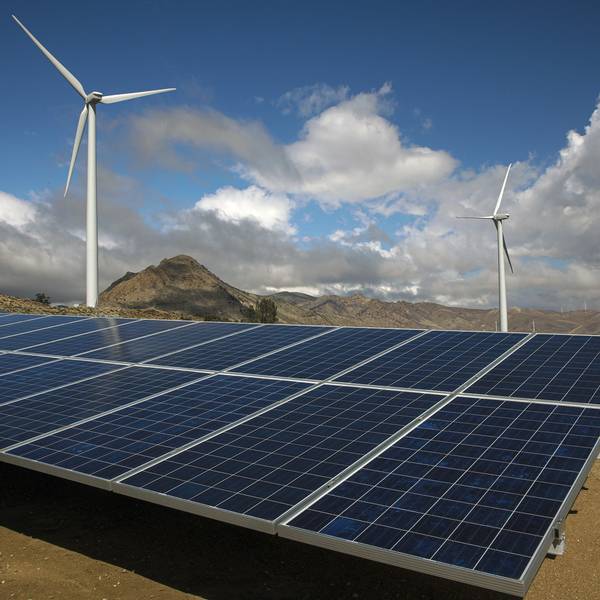
While 2014 was a record year for global warming, it was also a banner year for technologies that could help mitigate climate change.
"Spectacular" growth in the global renewable energy sector helped stave off increased greenhouse gas emissions in 2014, according to the 10th annual Renewables 2015 Global Status Report, released Thursday by the Renewable Energy Policy Network for the 21st Century (REN21).
In fact, the report states, the rise of solar, wind, and other renewable technologies has helped effect a "landmark decoupling" of economic growth and carbon emissions--as the International Energy Agency indicated earlier this year. REN21 explains that the world economy grew in 2014 without a parallel rise in CO2 emissions for the first time in four decades.
Still, the planet keeps getting hotter, and scientists warn that if global emissions continue at their current levels, the world will miss its target of keeping warming below two degrees Celsius above pre-industrial levels. The National Oceanic and Atmospheric Administration (NOAA) announced just this week that last month was the hottest May in modern history.
"Renewable energy and improved energy efficiency are key to limiting global warming to two degrees Celsius and avoiding dangerous climate change," said REN21 chair Arthouros Zervos, who released the new report at the Vienna Energy Forum.
The status report from REN21 provides further evidence that the renewables revolution is well underway. It shows leaps in renewable energy capacity and investment—renewables now account for close to 60 percent of net additions to the world's power capacity, while global new investment in such technologies jumped 17 percent from 2013 to 2014.
What's more, as Peter Bosshard of International Rivers noted in an op-ed published Friday at Common Dreams, wind and solar power capacity is growing much faster than that of large hydropower projects (whose environmental footprint is larger).
In early 2015, 164 countries had renewable energy targets, and 145 had policies to support the sector. These include many developing countries with no such targets a decade ago.
However, the renewable sector's growth "could be even greater if the more than $550 billion in annual subsidies for fossil fuel and nuclear energy were removed," REN21 said in a statement. Such subsidies "perpetuate artificially low energy prices for those sources, encouraging waste and impeding competition from renewables."
Eliminating fossil fuel subsidies would "create a level playing field," said REN21 executive secretary Christine Lins, which would "strengthen the development and use of energy efficiency and renewable energy technologies."
This week's REN21 report follows a study from Stanford University researchers released earlier this month. The study provided a road map for all 50 United States to transition to clean, renewable energy sources.
According to Phys.org, "The 50 individual state plans call for aggressive changes to both infrastructure and the ways we currently consume energy, but indicate that the conversion is technically and economically possible through the wide-scale implementation of existing technologies."
"Our plans are to change the energy infrastructure of each and every state in the United States, and, in fact, ultimately, every country of the world, to infrastructures run entirely on wind, water and solar power for all purpose," Stanford's Mark Jacobson said on Democracy Now! in early June.
Watch the full interview with Jacobson below:
Dear Common Dreams reader, It’s been nearly 30 years since I co-founded Common Dreams with my late wife, Lina Newhouser. We had the radical notion that journalism should serve the public good, not corporate profits. It was clear to us from the outset what it would take to build such a project. No paid advertisements. No corporate sponsors. No millionaire publisher telling us what to think or do. Many people said we wouldn't last a year, but we proved those doubters wrong. Together with a tremendous team of journalists and dedicated staff, we built an independent media outlet free from the constraints of profits and corporate control. Our mission has always been simple: To inform. To inspire. To ignite change for the common good. Building Common Dreams was not easy. Our survival was never guaranteed. When you take on the most powerful forces—Wall Street greed, fossil fuel industry destruction, Big Tech lobbyists, and uber-rich oligarchs who have spent billions upon billions rigging the economy and democracy in their favor—the only bulwark you have is supporters who believe in your work. But here’s the urgent message from me today. It's never been this bad out there. And it's never been this hard to keep us going. At the very moment Common Dreams is most needed, the threats we face are intensifying. We need your support now more than ever. We don't accept corporate advertising and never will. We don't have a paywall because we don't think people should be blocked from critical news based on their ability to pay. Everything we do is funded by the donations of readers like you. When everyone does the little they can afford, we are strong. But if that support retreats or dries up, so do we. Will you donate now to make sure Common Dreams not only survives but thrives? —Craig Brown, Co-founder |
While 2014 was a record year for global warming, it was also a banner year for technologies that could help mitigate climate change.
"Spectacular" growth in the global renewable energy sector helped stave off increased greenhouse gas emissions in 2014, according to the 10th annual Renewables 2015 Global Status Report, released Thursday by the Renewable Energy Policy Network for the 21st Century (REN21).
In fact, the report states, the rise of solar, wind, and other renewable technologies has helped effect a "landmark decoupling" of economic growth and carbon emissions--as the International Energy Agency indicated earlier this year. REN21 explains that the world economy grew in 2014 without a parallel rise in CO2 emissions for the first time in four decades.
Still, the planet keeps getting hotter, and scientists warn that if global emissions continue at their current levels, the world will miss its target of keeping warming below two degrees Celsius above pre-industrial levels. The National Oceanic and Atmospheric Administration (NOAA) announced just this week that last month was the hottest May in modern history.
"Renewable energy and improved energy efficiency are key to limiting global warming to two degrees Celsius and avoiding dangerous climate change," said REN21 chair Arthouros Zervos, who released the new report at the Vienna Energy Forum.
The status report from REN21 provides further evidence that the renewables revolution is well underway. It shows leaps in renewable energy capacity and investment—renewables now account for close to 60 percent of net additions to the world's power capacity, while global new investment in such technologies jumped 17 percent from 2013 to 2014.
What's more, as Peter Bosshard of International Rivers noted in an op-ed published Friday at Common Dreams, wind and solar power capacity is growing much faster than that of large hydropower projects (whose environmental footprint is larger).
In early 2015, 164 countries had renewable energy targets, and 145 had policies to support the sector. These include many developing countries with no such targets a decade ago.
However, the renewable sector's growth "could be even greater if the more than $550 billion in annual subsidies for fossil fuel and nuclear energy were removed," REN21 said in a statement. Such subsidies "perpetuate artificially low energy prices for those sources, encouraging waste and impeding competition from renewables."
Eliminating fossil fuel subsidies would "create a level playing field," said REN21 executive secretary Christine Lins, which would "strengthen the development and use of energy efficiency and renewable energy technologies."
This week's REN21 report follows a study from Stanford University researchers released earlier this month. The study provided a road map for all 50 United States to transition to clean, renewable energy sources.
According to Phys.org, "The 50 individual state plans call for aggressive changes to both infrastructure and the ways we currently consume energy, but indicate that the conversion is technically and economically possible through the wide-scale implementation of existing technologies."
"Our plans are to change the energy infrastructure of each and every state in the United States, and, in fact, ultimately, every country of the world, to infrastructures run entirely on wind, water and solar power for all purpose," Stanford's Mark Jacobson said on Democracy Now! in early June.
Watch the full interview with Jacobson below:
While 2014 was a record year for global warming, it was also a banner year for technologies that could help mitigate climate change.
"Spectacular" growth in the global renewable energy sector helped stave off increased greenhouse gas emissions in 2014, according to the 10th annual Renewables 2015 Global Status Report, released Thursday by the Renewable Energy Policy Network for the 21st Century (REN21).
In fact, the report states, the rise of solar, wind, and other renewable technologies has helped effect a "landmark decoupling" of economic growth and carbon emissions--as the International Energy Agency indicated earlier this year. REN21 explains that the world economy grew in 2014 without a parallel rise in CO2 emissions for the first time in four decades.
Still, the planet keeps getting hotter, and scientists warn that if global emissions continue at their current levels, the world will miss its target of keeping warming below two degrees Celsius above pre-industrial levels. The National Oceanic and Atmospheric Administration (NOAA) announced just this week that last month was the hottest May in modern history.
"Renewable energy and improved energy efficiency are key to limiting global warming to two degrees Celsius and avoiding dangerous climate change," said REN21 chair Arthouros Zervos, who released the new report at the Vienna Energy Forum.
The status report from REN21 provides further evidence that the renewables revolution is well underway. It shows leaps in renewable energy capacity and investment—renewables now account for close to 60 percent of net additions to the world's power capacity, while global new investment in such technologies jumped 17 percent from 2013 to 2014.
What's more, as Peter Bosshard of International Rivers noted in an op-ed published Friday at Common Dreams, wind and solar power capacity is growing much faster than that of large hydropower projects (whose environmental footprint is larger).
In early 2015, 164 countries had renewable energy targets, and 145 had policies to support the sector. These include many developing countries with no such targets a decade ago.
However, the renewable sector's growth "could be even greater if the more than $550 billion in annual subsidies for fossil fuel and nuclear energy were removed," REN21 said in a statement. Such subsidies "perpetuate artificially low energy prices for those sources, encouraging waste and impeding competition from renewables."
Eliminating fossil fuel subsidies would "create a level playing field," said REN21 executive secretary Christine Lins, which would "strengthen the development and use of energy efficiency and renewable energy technologies."
This week's REN21 report follows a study from Stanford University researchers released earlier this month. The study provided a road map for all 50 United States to transition to clean, renewable energy sources.
According to Phys.org, "The 50 individual state plans call for aggressive changes to both infrastructure and the ways we currently consume energy, but indicate that the conversion is technically and economically possible through the wide-scale implementation of existing technologies."
"Our plans are to change the energy infrastructure of each and every state in the United States, and, in fact, ultimately, every country of the world, to infrastructures run entirely on wind, water and solar power for all purpose," Stanford's Mark Jacobson said on Democracy Now! in early June.
Watch the full interview with Jacobson below: