For-Profit Healthcare Under Fire As Ebola Spreads to Second US Healthcare Worker
CDC says Dallas healthcare worker took a flight from Cleveland to Dallas the day before reporting symptoms
Update:
The Centers for Disease and Control announced Wednesday that the second Dallas healthcare worker infected with Ebola flew from Cleveland to Dallas on Monday, the day before Amber Vinson, 29, a nurse at Texas Health Presbyterian Hospital was confirmed to have Ebola. Vinson had a temperature of 99.5 Fahrenheit before she boarded her flight. The CDC said they will interview all 132 passengers on the flight, Frontier Airlines Flight 1143 from Cleveland to Dallas/Fort Worth, which landed at 8:16 p.m. CT Monday.
Earlier:
A second healthcare worker at Texas Health Presbyterian Hospital who helped treat the late Ebola patient Thomas Eric Duncan has now tested positive for the virus, state health officials confirmed on Wednesday.
The unidentified worker reported having a fever on Tuesday and was immediately isolated. A preliminary Ebola test confirmed the presence of the disease and confirmatory testing is now being conducted by the Centers for Disease Control and Prevention in Atlanta.
According to the Texas Department of State Health Services, officials are in the process of interviewing the patient to identify individuals who may have had contact or potential exposure to the virus.
News of the infection comes four days after a nurse from Texas Health Presbyterian, identified as the 26-year-old Nina Pham, also tested positive for Ebola.
A growing number of health experts are drawing a line between this gross unpreparedness and the United States' for-profit healthcare system, under which there is minimal oversight and no uniformity between healthcare providers.The National Nurses Union for months has warned that poor hospital training and oversight is putting U.S. healthcare workers at great risk of contracting the virus. The NNU conducted a recent survey of healthcare workers across the country and found that 76 percent said their hospital had not yet communicated to them any policy regarding potential admission of patients infected by Ebola.
"What concerns me is that this validated what our systems say all over the country throughout the last two months, that hospitals are not prepared to take care of Ebola patients," Deborah Burger, co-president of NNU, told ABC News.
A growing number of health experts are drawing a line between this gross unpreparedness and the United States' for-profit healthcare system, under which there is minimal oversight and no uniformity between healthcare providers.
Speaking on Democracy Now! Wednesday morning, Dr. Lawrence Gostin, faculty director at the O'Neill Institute for National & Global Health Law at Georgetown University, asked: "We call ourselves the most advanced health system in the world, but what do we meant by that?"
"I think what we mean is that we have the best of the best of the world," Gostin continued. "We also have a highly variable system: so many different hospitals, so many different emergency rooms, over 300 local health authorities with such different standards." Gostin said that the U.S. needs to "up our game," with more uniform systems in place, more uniform equipment and training at every institution.
The NNU is holding a national conference call Wednesday at 3 PM for a discussion about U.S. hospital preparedness. Over 1,000 nurses have already signed up for the call.
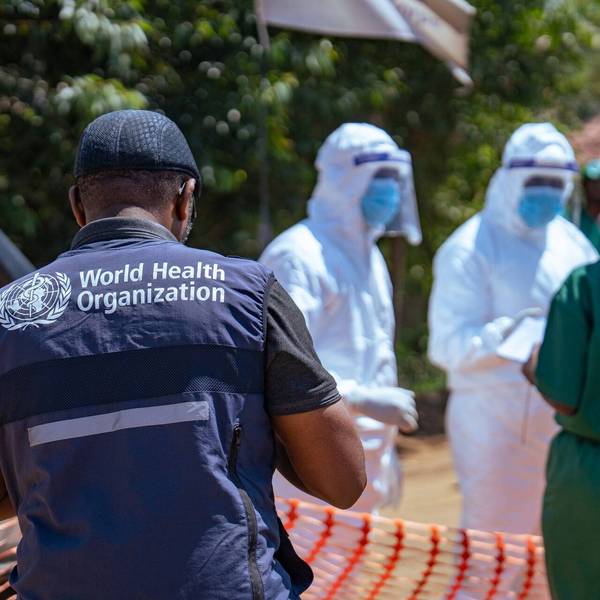
The World Health Organization on Tuesday warned that the number of cases of Ebola is growing exponentially as the global response continues to fall far short of what's needed to combat the spread of the deadly virus. WHO assistant director-general Dr. Bruce Aylward said that if efforts do not improve there could be as many as 10,000 new cases per week within two months within those hardest hit areas in West Africa. According to the WHO, over 4,400 people have now died of Ebola--the vast majority in Liberia, Sierra Leone and Guinea.
Below is the complete Ebola segment from Democracy Now!
An Urgent Message From Our Co-Founder
Dear Common Dreams reader, It’s been nearly 30 years since I co-founded Common Dreams with my late wife, Lina Newhouser. We had the radical notion that journalism should serve the public good, not corporate profits. It was clear to us from the outset what it would take to build such a project. No paid advertisements. No corporate sponsors. No millionaire publisher telling us what to think or do. Many people said we wouldn't last a year, but we proved those doubters wrong. Together with a tremendous team of journalists and dedicated staff, we built an independent media outlet free from the constraints of profits and corporate control. Our mission has always been simple: To inform. To inspire. To ignite change for the common good. Building Common Dreams was not easy. Our survival was never guaranteed. When you take on the most powerful forces—Wall Street greed, fossil fuel industry destruction, Big Tech lobbyists, and uber-rich oligarchs who have spent billions upon billions rigging the economy and democracy in their favor—the only bulwark you have is supporters who believe in your work. But here’s the urgent message from me today. It's never been this bad out there. And it's never been this hard to keep us going. At the very moment Common Dreams is most needed, the threats we face are intensifying. We need your support now more than ever. We don't accept corporate advertising and never will. We don't have a paywall because we don't think people should be blocked from critical news based on their ability to pay. Everything we do is funded by the donations of readers like you. When everyone does the little they can afford, we are strong. But if that support retreats or dries up, so do we. Will you donate now to make sure Common Dreams not only survives but thrives? —Craig Brown, Co-founder |
Update:
The Centers for Disease and Control announced Wednesday that the second Dallas healthcare worker infected with Ebola flew from Cleveland to Dallas on Monday, the day before Amber Vinson, 29, a nurse at Texas Health Presbyterian Hospital was confirmed to have Ebola. Vinson had a temperature of 99.5 Fahrenheit before she boarded her flight. The CDC said they will interview all 132 passengers on the flight, Frontier Airlines Flight 1143 from Cleveland to Dallas/Fort Worth, which landed at 8:16 p.m. CT Monday.
Earlier:
A second healthcare worker at Texas Health Presbyterian Hospital who helped treat the late Ebola patient Thomas Eric Duncan has now tested positive for the virus, state health officials confirmed on Wednesday.
The unidentified worker reported having a fever on Tuesday and was immediately isolated. A preliminary Ebola test confirmed the presence of the disease and confirmatory testing is now being conducted by the Centers for Disease Control and Prevention in Atlanta.
According to the Texas Department of State Health Services, officials are in the process of interviewing the patient to identify individuals who may have had contact or potential exposure to the virus.
News of the infection comes four days after a nurse from Texas Health Presbyterian, identified as the 26-year-old Nina Pham, also tested positive for Ebola.
A growing number of health experts are drawing a line between this gross unpreparedness and the United States' for-profit healthcare system, under which there is minimal oversight and no uniformity between healthcare providers.The National Nurses Union for months has warned that poor hospital training and oversight is putting U.S. healthcare workers at great risk of contracting the virus. The NNU conducted a recent survey of healthcare workers across the country and found that 76 percent said their hospital had not yet communicated to them any policy regarding potential admission of patients infected by Ebola.
"What concerns me is that this validated what our systems say all over the country throughout the last two months, that hospitals are not prepared to take care of Ebola patients," Deborah Burger, co-president of NNU, told ABC News.
A growing number of health experts are drawing a line between this gross unpreparedness and the United States' for-profit healthcare system, under which there is minimal oversight and no uniformity between healthcare providers.
Speaking on Democracy Now! Wednesday morning, Dr. Lawrence Gostin, faculty director at the O'Neill Institute for National & Global Health Law at Georgetown University, asked: "We call ourselves the most advanced health system in the world, but what do we meant by that?"
"I think what we mean is that we have the best of the best of the world," Gostin continued. "We also have a highly variable system: so many different hospitals, so many different emergency rooms, over 300 local health authorities with such different standards." Gostin said that the U.S. needs to "up our game," with more uniform systems in place, more uniform equipment and training at every institution.
The NNU is holding a national conference call Wednesday at 3 PM for a discussion about U.S. hospital preparedness. Over 1,000 nurses have already signed up for the call.
The World Health Organization on Tuesday warned that the number of cases of Ebola is growing exponentially as the global response continues to fall far short of what's needed to combat the spread of the deadly virus. WHO assistant director-general Dr. Bruce Aylward said that if efforts do not improve there could be as many as 10,000 new cases per week within two months within those hardest hit areas in West Africa. According to the WHO, over 4,400 people have now died of Ebola--the vast majority in Liberia, Sierra Leone and Guinea.
Below is the complete Ebola segment from Democracy Now!
Update:
The Centers for Disease and Control announced Wednesday that the second Dallas healthcare worker infected with Ebola flew from Cleveland to Dallas on Monday, the day before Amber Vinson, 29, a nurse at Texas Health Presbyterian Hospital was confirmed to have Ebola. Vinson had a temperature of 99.5 Fahrenheit before she boarded her flight. The CDC said they will interview all 132 passengers on the flight, Frontier Airlines Flight 1143 from Cleveland to Dallas/Fort Worth, which landed at 8:16 p.m. CT Monday.
Earlier:
A second healthcare worker at Texas Health Presbyterian Hospital who helped treat the late Ebola patient Thomas Eric Duncan has now tested positive for the virus, state health officials confirmed on Wednesday.
The unidentified worker reported having a fever on Tuesday and was immediately isolated. A preliminary Ebola test confirmed the presence of the disease and confirmatory testing is now being conducted by the Centers for Disease Control and Prevention in Atlanta.
According to the Texas Department of State Health Services, officials are in the process of interviewing the patient to identify individuals who may have had contact or potential exposure to the virus.
News of the infection comes four days after a nurse from Texas Health Presbyterian, identified as the 26-year-old Nina Pham, also tested positive for Ebola.
A growing number of health experts are drawing a line between this gross unpreparedness and the United States' for-profit healthcare system, under which there is minimal oversight and no uniformity between healthcare providers.The National Nurses Union for months has warned that poor hospital training and oversight is putting U.S. healthcare workers at great risk of contracting the virus. The NNU conducted a recent survey of healthcare workers across the country and found that 76 percent said their hospital had not yet communicated to them any policy regarding potential admission of patients infected by Ebola.
"What concerns me is that this validated what our systems say all over the country throughout the last two months, that hospitals are not prepared to take care of Ebola patients," Deborah Burger, co-president of NNU, told ABC News.
A growing number of health experts are drawing a line between this gross unpreparedness and the United States' for-profit healthcare system, under which there is minimal oversight and no uniformity between healthcare providers.
Speaking on Democracy Now! Wednesday morning, Dr. Lawrence Gostin, faculty director at the O'Neill Institute for National & Global Health Law at Georgetown University, asked: "We call ourselves the most advanced health system in the world, but what do we meant by that?"
"I think what we mean is that we have the best of the best of the world," Gostin continued. "We also have a highly variable system: so many different hospitals, so many different emergency rooms, over 300 local health authorities with such different standards." Gostin said that the U.S. needs to "up our game," with more uniform systems in place, more uniform equipment and training at every institution.
The NNU is holding a national conference call Wednesday at 3 PM for a discussion about U.S. hospital preparedness. Over 1,000 nurses have already signed up for the call.
The World Health Organization on Tuesday warned that the number of cases of Ebola is growing exponentially as the global response continues to fall far short of what's needed to combat the spread of the deadly virus. WHO assistant director-general Dr. Bruce Aylward said that if efforts do not improve there could be as many as 10,000 new cases per week within two months within those hardest hit areas in West Africa. According to the WHO, over 4,400 people have now died of Ebola--the vast majority in Liberia, Sierra Leone and Guinea.
Below is the complete Ebola segment from Democracy Now!