SUBSCRIBE TO OUR FREE NEWSLETTER
Daily news & progressive opinion—funded by the people, not the corporations—delivered straight to your inbox.
5
#000000
#FFFFFF
To donate by check, phone, or other method, see our More Ways to Give page.
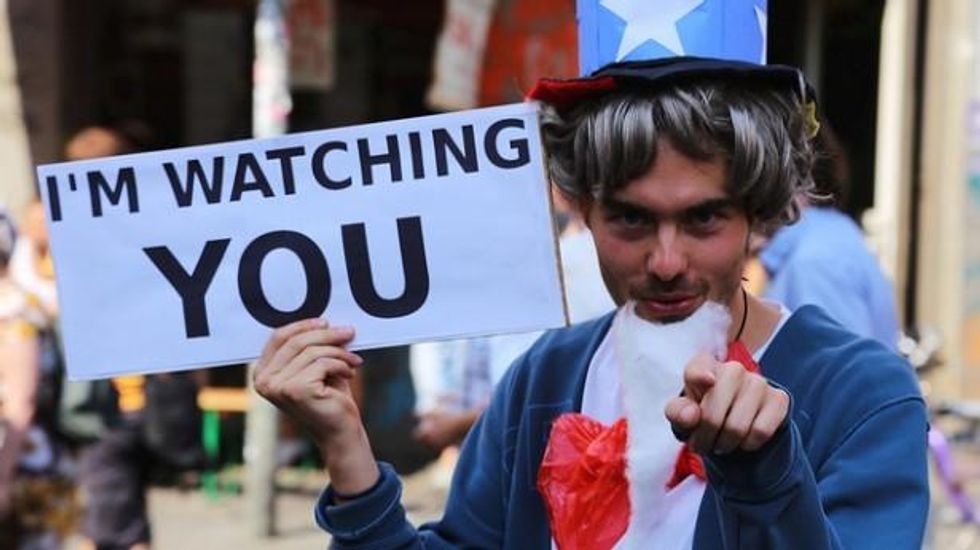
That is the message being sent by the majority of nations to the world's most powerful and aggressive surveillance states.
An effort to move forward on the United Nation's draft agreement on the right to privacy in the digital age met opposition this week from the so-called "Five Eyes" nations--which includes the U.S., U.K., Canada, Australia, and New Zealand--but the efforts to dilute the pact were largely overcome by overwhelming support from the more than one hundred nations demanding stronger protections in the wake of revelations about the behavior of the NSA and other intelligence agencies.
As the Guardian reports:
The resolution, titled 'The right to privacy in the digital age', was hammered out at a committee open to all 193 UN members. It represents the biggest show of international opinion yet in response to the revelations about mass surveillance exposed by whistleblower Edward Snowden.
Brazil and Germany co-sponsored the resolution following disclosure that the the NSA eavesdropped on Brazil's president Dilma Rousseff and German chancellor Angela Merkel.
Other sponsors include: Austria, Bolivia, North Korea, Ecuador, France, Indonesia, Lichtenstein, Peru, Switzerland, Spain, Luxembourg and Uruguay.
A vote at the UN general assembly on the resolution is scheduled for Tuesday but only if a member state calls for one. Otherwise it will pass automatically as a consensus measure. The US may decide against calling for a vote rather than find itself, as diplomats and officials based at the UN predict, in a tiny, embarrassing minority.
"There is a head of steam building up behind this draft resolution. It is a basic rights issue and these attract a lot of support," a UN official said.
This week, human rights groups online privacy advocates set a joint letter to the UN urging the stronger language and protections.
Signed by the groups Access Now, Amnesty International, Electronic Frontier Foundation, Human Rights Watch, and Privacy International, the letter read in part:
The right to privacy is central to who we are as humans and is enshrined in the Universal Declaration of Human Rights and the International Covenant on Civil and Political Rights. It protects us from unwarranted intrusions into our daily lives, allows us to speak freely without fear of retribution, and helps keep our personal information, including health records, political affiliations, sexual orientation, and familial histories, safe. Indiscriminate mass surveillance, which tramples individuals' right to privacy and undermines the social contract we all have with the State, must come to end immediately. [...]
As negotiations continue on this draft resolution, we are deeply concerned that the countries representing the "Five Eyes" surveillance alliance--the United States, Canada, New Zealand, Australia and the United Kingdom--have sought to weaken the resolution at the risk of undercutting their own longstanding public commitment to privacy and free expression.
And the groups offered these specific point to the world body:
Whether or not the draft agreement is adopted, the ability of the UN to curb the worst practices of powerful intelligence agencies from one country illegally spying on the citizens of another will remain a contentious issue.
As the Guardian reports, citing a leaked draft of a U.S. briefing paper on the UN resolution, because the U.S. "does not consider its surveillance activities illegal, it does not have a problem with condemning illegal surveillance."
_____________________________________
That is the message being sent by the majority of nations to the world's most powerful and aggressive surveillance states.
An effort to move forward on the United Nation's draft agreement on the right to privacy in the digital age met opposition this week from the so-called "Five Eyes" nations--which includes the U.S., U.K., Canada, Australia, and New Zealand--but the efforts to dilute the pact were largely overcome by overwhelming support from the more than one hundred nations demanding stronger protections in the wake of revelations about the behavior of the NSA and other intelligence agencies.
As the Guardian reports:
The resolution, titled 'The right to privacy in the digital age', was hammered out at a committee open to all 193 UN members. It represents the biggest show of international opinion yet in response to the revelations about mass surveillance exposed by whistleblower Edward Snowden.
Brazil and Germany co-sponsored the resolution following disclosure that the the NSA eavesdropped on Brazil's president Dilma Rousseff and German chancellor Angela Merkel.
Other sponsors include: Austria, Bolivia, North Korea, Ecuador, France, Indonesia, Lichtenstein, Peru, Switzerland, Spain, Luxembourg and Uruguay.
A vote at the UN general assembly on the resolution is scheduled for Tuesday but only if a member state calls for one. Otherwise it will pass automatically as a consensus measure. The US may decide against calling for a vote rather than find itself, as diplomats and officials based at the UN predict, in a tiny, embarrassing minority.
"There is a head of steam building up behind this draft resolution. It is a basic rights issue and these attract a lot of support," a UN official said.
This week, human rights groups online privacy advocates set a joint letter to the UN urging the stronger language and protections.
Signed by the groups Access Now, Amnesty International, Electronic Frontier Foundation, Human Rights Watch, and Privacy International, the letter read in part:
The right to privacy is central to who we are as humans and is enshrined in the Universal Declaration of Human Rights and the International Covenant on Civil and Political Rights. It protects us from unwarranted intrusions into our daily lives, allows us to speak freely without fear of retribution, and helps keep our personal information, including health records, political affiliations, sexual orientation, and familial histories, safe. Indiscriminate mass surveillance, which tramples individuals' right to privacy and undermines the social contract we all have with the State, must come to end immediately. [...]
As negotiations continue on this draft resolution, we are deeply concerned that the countries representing the "Five Eyes" surveillance alliance--the United States, Canada, New Zealand, Australia and the United Kingdom--have sought to weaken the resolution at the risk of undercutting their own longstanding public commitment to privacy and free expression.
And the groups offered these specific point to the world body:
Whether or not the draft agreement is adopted, the ability of the UN to curb the worst practices of powerful intelligence agencies from one country illegally spying on the citizens of another will remain a contentious issue.
As the Guardian reports, citing a leaked draft of a U.S. briefing paper on the UN resolution, because the U.S. "does not consider its surveillance activities illegal, it does not have a problem with condemning illegal surveillance."
_____________________________________
That is the message being sent by the majority of nations to the world's most powerful and aggressive surveillance states.
An effort to move forward on the United Nation's draft agreement on the right to privacy in the digital age met opposition this week from the so-called "Five Eyes" nations--which includes the U.S., U.K., Canada, Australia, and New Zealand--but the efforts to dilute the pact were largely overcome by overwhelming support from the more than one hundred nations demanding stronger protections in the wake of revelations about the behavior of the NSA and other intelligence agencies.
As the Guardian reports:
The resolution, titled 'The right to privacy in the digital age', was hammered out at a committee open to all 193 UN members. It represents the biggest show of international opinion yet in response to the revelations about mass surveillance exposed by whistleblower Edward Snowden.
Brazil and Germany co-sponsored the resolution following disclosure that the the NSA eavesdropped on Brazil's president Dilma Rousseff and German chancellor Angela Merkel.
Other sponsors include: Austria, Bolivia, North Korea, Ecuador, France, Indonesia, Lichtenstein, Peru, Switzerland, Spain, Luxembourg and Uruguay.
A vote at the UN general assembly on the resolution is scheduled for Tuesday but only if a member state calls for one. Otherwise it will pass automatically as a consensus measure. The US may decide against calling for a vote rather than find itself, as diplomats and officials based at the UN predict, in a tiny, embarrassing minority.
"There is a head of steam building up behind this draft resolution. It is a basic rights issue and these attract a lot of support," a UN official said.
This week, human rights groups online privacy advocates set a joint letter to the UN urging the stronger language and protections.
Signed by the groups Access Now, Amnesty International, Electronic Frontier Foundation, Human Rights Watch, and Privacy International, the letter read in part:
The right to privacy is central to who we are as humans and is enshrined in the Universal Declaration of Human Rights and the International Covenant on Civil and Political Rights. It protects us from unwarranted intrusions into our daily lives, allows us to speak freely without fear of retribution, and helps keep our personal information, including health records, political affiliations, sexual orientation, and familial histories, safe. Indiscriminate mass surveillance, which tramples individuals' right to privacy and undermines the social contract we all have with the State, must come to end immediately. [...]
As negotiations continue on this draft resolution, we are deeply concerned that the countries representing the "Five Eyes" surveillance alliance--the United States, Canada, New Zealand, Australia and the United Kingdom--have sought to weaken the resolution at the risk of undercutting their own longstanding public commitment to privacy and free expression.
And the groups offered these specific point to the world body:
Whether or not the draft agreement is adopted, the ability of the UN to curb the worst practices of powerful intelligence agencies from one country illegally spying on the citizens of another will remain a contentious issue.
As the Guardian reports, citing a leaked draft of a U.S. briefing paper on the UN resolution, because the U.S. "does not consider its surveillance activities illegal, it does not have a problem with condemning illegal surveillance."
_____________________________________