SUBSCRIBE TO OUR FREE NEWSLETTER
Daily news & progressive opinion—funded by the people, not the corporations—delivered straight to your inbox.
5
#000000
#FFFFFF
To donate by check, phone, or other method, see our More Ways to Give page.
Critics charge that poverty wages illustrate the deep flaws with corporate models of so-called aid. "The failure of the Caracol Industrial Park to comply with minimum wage laws is a stain on the U.S.'s post-earthquake investments in Haiti and calls into question the sustainability and effectiveness of relying on the garment industry to lead Haiti's reconstruction," said Jake Johnston of the Center for Economic and Policy Research in an interview with Common Dreams.
Caracol is just one of five garment factories profiled in this damning report, released publicly on Wednesday, which finds that "the majority of Haitian garment workers are being denied nearly a third of the wages they are legally due as a result of the factories' theft of their income." This is due to systematic employer cheating on piece-work and overtime, as well as failure to pay employees for hours worked.
WRC charges that the wage theft at these 5 factories is "typical" across the country's garment industry, leading to the suppression of national wages at deep poverty levels. As a result, workers have trouble affording food, shelter, and medical care, the report finds.
Through a series of in-depth interviews, as well as review of pay records, researchers discovered that the problem of wage theft throughout the country's garment industry is "egregious" at Northern Haiti's Caracol Industrial Park, which sits at the center of U.S. 'reconstruction' efforts and is slated to employ an estimated 20,000 people.
Financers included the Inter-American Development Bank, the U.S. State Department, and the Clinton Foundation, who invested a total of $224 million with promises to uphold high labor standards. Its anchor tenant is the Korean S&H Global factory, which sells garments to Walmart, Target, Kohl's, and Old Navy, according to the report.
The largest post-earthquake U.S. investment in Haiti, Caracol's backers have championed it as a model for privatized reconstruction. In a July press release, the U.S. State Department champions the park as a chance to "spur economic growth and bring jobs to Haiti's underserved regions."
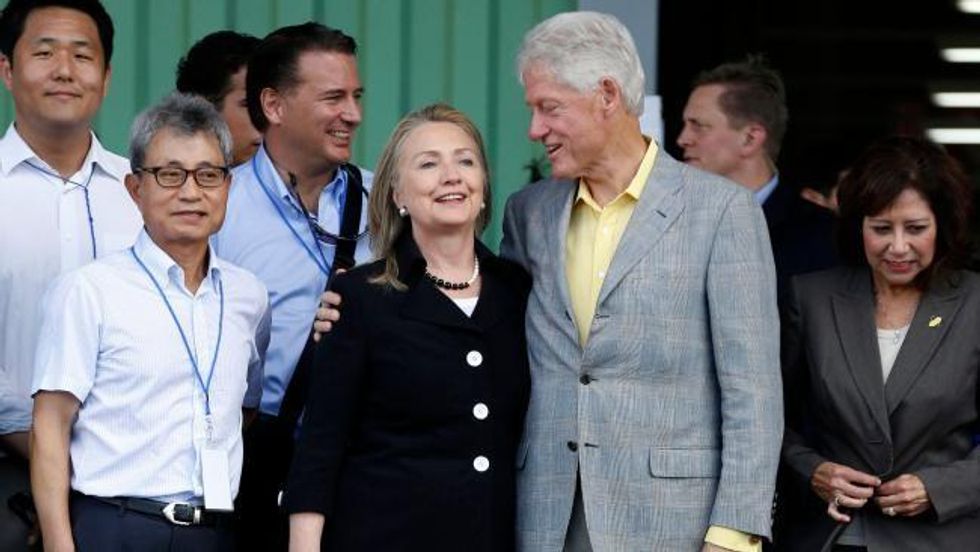
Then-U.S. Secretary of State Hillary Clinton and former U.S. President Bill Clinton attended Caracol's opening ceremony a year ago. "We're sending a message that Haiti is open for business again," Hillary Clinton declared upon the announcement of the opening.
The Clinton Foundation did not immediately respond to a request from Common Dreams for an interview.
_____________________
Critics charge that poverty wages illustrate the deep flaws with corporate models of so-called aid. "The failure of the Caracol Industrial Park to comply with minimum wage laws is a stain on the U.S.'s post-earthquake investments in Haiti and calls into question the sustainability and effectiveness of relying on the garment industry to lead Haiti's reconstruction," said Jake Johnston of the Center for Economic and Policy Research in an interview with Common Dreams.
Caracol is just one of five garment factories profiled in this damning report, released publicly on Wednesday, which finds that "the majority of Haitian garment workers are being denied nearly a third of the wages they are legally due as a result of the factories' theft of their income." This is due to systematic employer cheating on piece-work and overtime, as well as failure to pay employees for hours worked.
WRC charges that the wage theft at these 5 factories is "typical" across the country's garment industry, leading to the suppression of national wages at deep poverty levels. As a result, workers have trouble affording food, shelter, and medical care, the report finds.
Through a series of in-depth interviews, as well as review of pay records, researchers discovered that the problem of wage theft throughout the country's garment industry is "egregious" at Northern Haiti's Caracol Industrial Park, which sits at the center of U.S. 'reconstruction' efforts and is slated to employ an estimated 20,000 people.
Financers included the Inter-American Development Bank, the U.S. State Department, and the Clinton Foundation, who invested a total of $224 million with promises to uphold high labor standards. Its anchor tenant is the Korean S&H Global factory, which sells garments to Walmart, Target, Kohl's, and Old Navy, according to the report.
The largest post-earthquake U.S. investment in Haiti, Caracol's backers have championed it as a model for privatized reconstruction. In a July press release, the U.S. State Department champions the park as a chance to "spur economic growth and bring jobs to Haiti's underserved regions."
Then-U.S. Secretary of State Hillary Clinton and former U.S. President Bill Clinton attended Caracol's opening ceremony a year ago. "We're sending a message that Haiti is open for business again," Hillary Clinton declared upon the announcement of the opening.
The Clinton Foundation did not immediately respond to a request from Common Dreams for an interview.
_____________________
Critics charge that poverty wages illustrate the deep flaws with corporate models of so-called aid. "The failure of the Caracol Industrial Park to comply with minimum wage laws is a stain on the U.S.'s post-earthquake investments in Haiti and calls into question the sustainability and effectiveness of relying on the garment industry to lead Haiti's reconstruction," said Jake Johnston of the Center for Economic and Policy Research in an interview with Common Dreams.
Caracol is just one of five garment factories profiled in this damning report, released publicly on Wednesday, which finds that "the majority of Haitian garment workers are being denied nearly a third of the wages they are legally due as a result of the factories' theft of their income." This is due to systematic employer cheating on piece-work and overtime, as well as failure to pay employees for hours worked.
WRC charges that the wage theft at these 5 factories is "typical" across the country's garment industry, leading to the suppression of national wages at deep poverty levels. As a result, workers have trouble affording food, shelter, and medical care, the report finds.
Through a series of in-depth interviews, as well as review of pay records, researchers discovered that the problem of wage theft throughout the country's garment industry is "egregious" at Northern Haiti's Caracol Industrial Park, which sits at the center of U.S. 'reconstruction' efforts and is slated to employ an estimated 20,000 people.
Financers included the Inter-American Development Bank, the U.S. State Department, and the Clinton Foundation, who invested a total of $224 million with promises to uphold high labor standards. Its anchor tenant is the Korean S&H Global factory, which sells garments to Walmart, Target, Kohl's, and Old Navy, according to the report.
The largest post-earthquake U.S. investment in Haiti, Caracol's backers have championed it as a model for privatized reconstruction. In a July press release, the U.S. State Department champions the park as a chance to "spur economic growth and bring jobs to Haiti's underserved regions."
Then-U.S. Secretary of State Hillary Clinton and former U.S. President Bill Clinton attended Caracol's opening ceremony a year ago. "We're sending a message that Haiti is open for business again," Hillary Clinton declared upon the announcement of the opening.
The Clinton Foundation did not immediately respond to a request from Common Dreams for an interview.
_____________________