SUBSCRIBE TO OUR FREE NEWSLETTER
Daily news & progressive opinion—funded by the people, not the corporations—delivered straight to your inbox.
5
#000000
#FFFFFF
To donate by check, phone, or other method, see our More Ways to Give page.
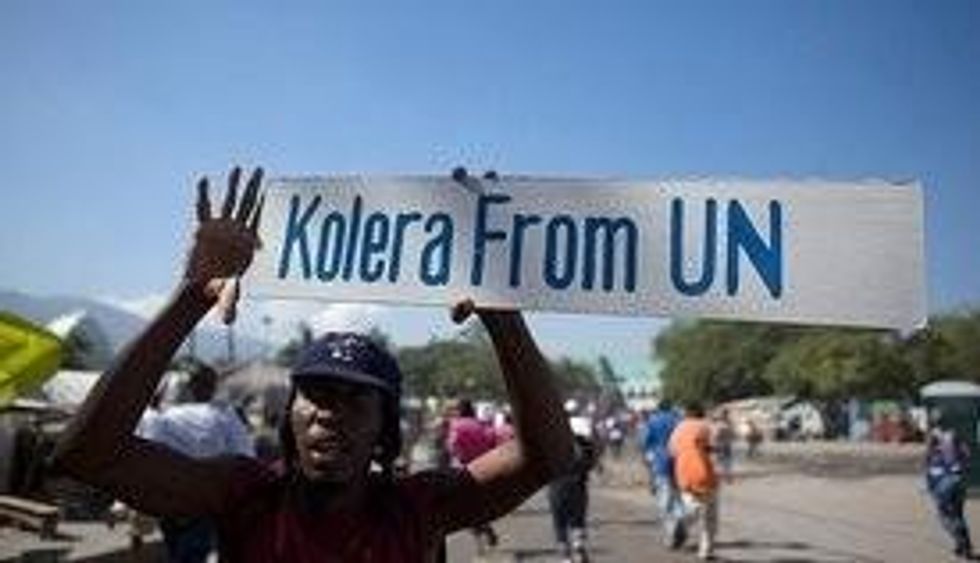
Over 8,000 Haitians have died and over 675,000 have been sickened by cholera in the last three years, and while evidence abounds that it was brought to the country by Nepalese forces deployed by the UN after the devastating earthquake, the UN has repeatedly evaded responsibility.
In February, the UN rejected a November 2011 claim for compensation on behalf of victims of the disease, stating, "claims are not receivable." In May, victims threatened to sue the UN if it did not stop evading its moral and legal obligations and provide justice and reparations.
In addition, the Center for Economic and Policy Research's Haiti Relief and Reconstruction Watch points out,
A U.N.-backed cholera elimination plan has been unable to raise the required funds to adequately address the issue, despite Secretary General Ban Ki-moon's assurance in late 2012 that he would "use every opportunity" to raise the necessary funds. A high-level donor meeting to raise funds for the plan, scheduled for early October in Washington, has now been postponed until 2014. It had been expected that Mr. Ban, as well as World Bank president Jim Yong Kim, would attend. The plan, which requires some $450 million over its first two years, remains less than half funded.
In the meantime, cholera continues to ravage the country as the response capabilities of national actors diminish. In a bulletin earlier this week, the U.N. Office for the Coordination of Humanitarian Affairs (OCHA) noted that "resources for cholera response, including funding and staff, have been in steady decline since 2012." OCHA concludes by stating that "if this trend continues, it would be virtually impossible to effectively and efficiently respond to the epidemic in the event of sudden outbreaks." The lack of adequate resources also means that detailed data on where cholera outbreaks are occurring and how many are dying is becoming harder and harder to come by. The actual toll of this imported disease could be much higher than the official numbers indicate.
In late August, members of the U.N. Security Council and countries contributing to MINUSTAH met to discuss the extension of the mission's mandate. Not a single country (PDF) raised the issue of U.N. responsibility for cholera, though many praised the Secretary General's efforts to eliminate it. MINUSTAH's proposed budget for 2013/2014 is $576,619,000, more than enough to fully fund the cholera elimination plan over its first two years.
Haiti's Prime Minister Laurent Lamothe is expected to address the UN General Assembly at 7 PM Thursday. It remains to be seen if he will use the podium to highlight the victims' call for justice.
* * *
Tweets about "#CholeraJustice"
_____________________
Over 8,000 Haitians have died and over 675,000 have been sickened by cholera in the last three years, and while evidence abounds that it was brought to the country by Nepalese forces deployed by the UN after the devastating earthquake, the UN has repeatedly evaded responsibility.
In February, the UN rejected a November 2011 claim for compensation on behalf of victims of the disease, stating, "claims are not receivable." In May, victims threatened to sue the UN if it did not stop evading its moral and legal obligations and provide justice and reparations.
In addition, the Center for Economic and Policy Research's Haiti Relief and Reconstruction Watch points out,
A U.N.-backed cholera elimination plan has been unable to raise the required funds to adequately address the issue, despite Secretary General Ban Ki-moon's assurance in late 2012 that he would "use every opportunity" to raise the necessary funds. A high-level donor meeting to raise funds for the plan, scheduled for early October in Washington, has now been postponed until 2014. It had been expected that Mr. Ban, as well as World Bank president Jim Yong Kim, would attend. The plan, which requires some $450 million over its first two years, remains less than half funded.
In the meantime, cholera continues to ravage the country as the response capabilities of national actors diminish. In a bulletin earlier this week, the U.N. Office for the Coordination of Humanitarian Affairs (OCHA) noted that "resources for cholera response, including funding and staff, have been in steady decline since 2012." OCHA concludes by stating that "if this trend continues, it would be virtually impossible to effectively and efficiently respond to the epidemic in the event of sudden outbreaks." The lack of adequate resources also means that detailed data on where cholera outbreaks are occurring and how many are dying is becoming harder and harder to come by. The actual toll of this imported disease could be much higher than the official numbers indicate.
In late August, members of the U.N. Security Council and countries contributing to MINUSTAH met to discuss the extension of the mission's mandate. Not a single country (PDF) raised the issue of U.N. responsibility for cholera, though many praised the Secretary General's efforts to eliminate it. MINUSTAH's proposed budget for 2013/2014 is $576,619,000, more than enough to fully fund the cholera elimination plan over its first two years.
Haiti's Prime Minister Laurent Lamothe is expected to address the UN General Assembly at 7 PM Thursday. It remains to be seen if he will use the podium to highlight the victims' call for justice.
* * *
Tweets about "#CholeraJustice"
_____________________
Over 8,000 Haitians have died and over 675,000 have been sickened by cholera in the last three years, and while evidence abounds that it was brought to the country by Nepalese forces deployed by the UN after the devastating earthquake, the UN has repeatedly evaded responsibility.
In February, the UN rejected a November 2011 claim for compensation on behalf of victims of the disease, stating, "claims are not receivable." In May, victims threatened to sue the UN if it did not stop evading its moral and legal obligations and provide justice and reparations.
In addition, the Center for Economic and Policy Research's Haiti Relief and Reconstruction Watch points out,
A U.N.-backed cholera elimination plan has been unable to raise the required funds to adequately address the issue, despite Secretary General Ban Ki-moon's assurance in late 2012 that he would "use every opportunity" to raise the necessary funds. A high-level donor meeting to raise funds for the plan, scheduled for early October in Washington, has now been postponed until 2014. It had been expected that Mr. Ban, as well as World Bank president Jim Yong Kim, would attend. The plan, which requires some $450 million over its first two years, remains less than half funded.
In the meantime, cholera continues to ravage the country as the response capabilities of national actors diminish. In a bulletin earlier this week, the U.N. Office for the Coordination of Humanitarian Affairs (OCHA) noted that "resources for cholera response, including funding and staff, have been in steady decline since 2012." OCHA concludes by stating that "if this trend continues, it would be virtually impossible to effectively and efficiently respond to the epidemic in the event of sudden outbreaks." The lack of adequate resources also means that detailed data on where cholera outbreaks are occurring and how many are dying is becoming harder and harder to come by. The actual toll of this imported disease could be much higher than the official numbers indicate.
In late August, members of the U.N. Security Council and countries contributing to MINUSTAH met to discuss the extension of the mission's mandate. Not a single country (PDF) raised the issue of U.N. responsibility for cholera, though many praised the Secretary General's efforts to eliminate it. MINUSTAH's proposed budget for 2013/2014 is $576,619,000, more than enough to fully fund the cholera elimination plan over its first two years.
Haiti's Prime Minister Laurent Lamothe is expected to address the UN General Assembly at 7 PM Thursday. It remains to be seen if he will use the podium to highlight the victims' call for justice.
* * *
Tweets about "#CholeraJustice"
_____________________