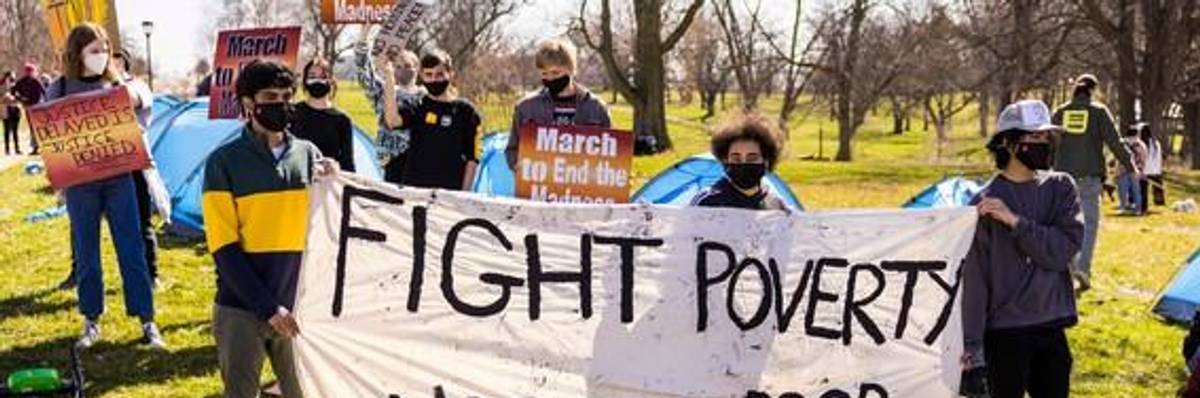
Protesters hold a sign that says, "Fight Poverty Not the Poor." (Photo: Jeremy Hogan/SOPA Images/LightRocket via Getty Images)
A Message from Fresno: No One Should Be 'Living Just to Die'
A major hurdle we must overcome in order to build power is to make people believe in the possibility of government working on behalf of everybody.
It's a weekday evening in Fresno, and I'm at a community center with a group of about 30 residents listening as they discuss what is top of mind for them when it comes to poverty and opportunity.
No matter which poor communities we visit in this state or nation, there are certain truths that are self-evident: Poor people are treated as less than fully human compared to people with more resources.
Jessica Ramirez works 10 hours a day in an Amazon warehouse and side jobs to make ends meet for her family. She describes how undocumented farmworkers like her mother "keep on working and working, pretty much living to die." No decent wage, no opportunities, inadequate healthcare. "We don't deserve to just work and work and work and not get time with our kids," she says.
Paloma Sanchez, 23, immigrated with her mother when she was 7-years-old and still doesn't have a work permit. She's now trying to start a taco business and has visited City Hall multiple times with other advocates to try to get help for herself and her community--everything from work opportunities, to playground improvements, to more resources for their children's schools. "We tell them what we need, what we want, and hear 'we'll get back to you.' My hope is gone."
Kieshaun White, 22, an environmental justice advocate, wants an "open, honest conversation with politicians" about why poor neighborhoods are poor--the history of redlining, eminent domain, and other wealth-stripping policies--and "through that we can find solutions." Many other residents speak of rising rents, a lack of affordable housing, no tenant protections, all of which can lead to them being out on the streets.
This conversation is part of End Poverty in California's statewide listening tour--we've also visited Los Angeles, Antioch, Ontario, and numerous community colleges--and once again I am struck by the fatigue people feel from their steady activism, sharing their personal stories, and not seeing fundamental change. The fact that they have turned out for yet another conversation is indeed an act of faith. As Alexandria Crowder, who has resided in Fresno for 30 years, says, "It's not easy not to give up. But if you give up, then who's left?"
No matter which poor communities we visit in this state or nation, there are certain truths that are self-evident: Poor people are treated as less than fully human compared to people with more resources. We accept that their labor and wages will usually not result in economic mobility, no matter how hard they work. We accept that their communities will be more polluted with shorter life expectancies. We accept that they do not have a right to a home. We accept that they can be priced out of continuing education. And we know that while people in poverty are disproportionately Black and Brown--making the issue easier for the establishment to ignore within a system built on white supremacy--no one of any race, gender, or ethnicity living in poverty is treated as worthy of the same investment as people in wealthier communities.
And so it is increasingly clear that achieving change is fundamentally not a policy exercise. It's about building power. How do we make ending poverty and creating equal opportunity the agenda? One that guarantees your labor, wage, and place of work is dignified and results in you and your family getting ahead? One which includes a right to housing? One which provides a guaranteed income floor so that planning and dreams are not luxury items? One that establishes a wealth floor by offering every child a baby bond--as California now does for long-term foster youth and every child who lost a parent to COVID--so they have a chance to pursue their aspirations?
It makes sense that if government works for you, you're more likely to engage in government. That's why people who own homes or have higher incomes are reliable voters. If you don't see government working for you, you are more likely to give up on the idea that it can make a difference, a kind of hopelessness that many people in Fresno are battling against. This is a major hurdle we must overcome in order to build power--to make people believe in the possibility of government working on behalf of everybody.
In the coming months, EPIC will be working with antipoverty organizations and local activists to advance a shared anti-poverty, pro-opportunity agenda for California, informed by what we are hearing on this tour and the people we are meeting. We look forward to making this available as an organizing tool for communities throughout our state and elsewhere in the nation.
We are at a crossroads
This country and this world are at a monumental crossroads. In a few short weeks, US voters will have an opportunity to beat back the forces of fascism and confront the billionaires who are rigging the economy, our media system, and our democracy, making it increasingly impossible for ordinary people to get by. We’re not just talking about the election. We’re talking about what must be done once these fascist elements are vanquished from power. We need a bolder set of solutions than what either major party has so far been willing to offer and a working-class movement ready to fight like hell for it. Trump didn't emerge from nowhere. The conditions that fueled MAGA authoritarianism were created by decades of radical neoliberal economic policies and a corrupt political system dominated by corporate interests. They slashed taxes on the super-rich, promising that the benefits would trickle down. They said giveaways to the corporate titans would make life more affordable for the rest of us. It was all bullshit. And when a bitter, betrayed populace searches for someone to blame, right-wing demagogues have little trouble finding scapegoats. People know when they're being lied to, but you won't hear any of this from the corporate media. Only independent journalism—powered and funded by people who believe in building a better world—can deliver truly trustworthy daily news. Our Fall Campaign is underway, and we need your help. To power our newsroom through the rest of the year, we need to raise $125,000 by midnight on October 31. So if you share our vision, please contribute whatever you can to sustain our work. |
It's a weekday evening in Fresno, and I'm at a community center with a group of about 30 residents listening as they discuss what is top of mind for them when it comes to poverty and opportunity.
No matter which poor communities we visit in this state or nation, there are certain truths that are self-evident: Poor people are treated as less than fully human compared to people with more resources.
Jessica Ramirez works 10 hours a day in an Amazon warehouse and side jobs to make ends meet for her family. She describes how undocumented farmworkers like her mother "keep on working and working, pretty much living to die." No decent wage, no opportunities, inadequate healthcare. "We don't deserve to just work and work and work and not get time with our kids," she says.
Paloma Sanchez, 23, immigrated with her mother when she was 7-years-old and still doesn't have a work permit. She's now trying to start a taco business and has visited City Hall multiple times with other advocates to try to get help for herself and her community--everything from work opportunities, to playground improvements, to more resources for their children's schools. "We tell them what we need, what we want, and hear 'we'll get back to you.' My hope is gone."
Kieshaun White, 22, an environmental justice advocate, wants an "open, honest conversation with politicians" about why poor neighborhoods are poor--the history of redlining, eminent domain, and other wealth-stripping policies--and "through that we can find solutions." Many other residents speak of rising rents, a lack of affordable housing, no tenant protections, all of which can lead to them being out on the streets.
This conversation is part of End Poverty in California's statewide listening tour--we've also visited Los Angeles, Antioch, Ontario, and numerous community colleges--and once again I am struck by the fatigue people feel from their steady activism, sharing their personal stories, and not seeing fundamental change. The fact that they have turned out for yet another conversation is indeed an act of faith. As Alexandria Crowder, who has resided in Fresno for 30 years, says, "It's not easy not to give up. But if you give up, then who's left?"
No matter which poor communities we visit in this state or nation, there are certain truths that are self-evident: Poor people are treated as less than fully human compared to people with more resources. We accept that their labor and wages will usually not result in economic mobility, no matter how hard they work. We accept that their communities will be more polluted with shorter life expectancies. We accept that they do not have a right to a home. We accept that they can be priced out of continuing education. And we know that while people in poverty are disproportionately Black and Brown--making the issue easier for the establishment to ignore within a system built on white supremacy--no one of any race, gender, or ethnicity living in poverty is treated as worthy of the same investment as people in wealthier communities.
And so it is increasingly clear that achieving change is fundamentally not a policy exercise. It's about building power. How do we make ending poverty and creating equal opportunity the agenda? One that guarantees your labor, wage, and place of work is dignified and results in you and your family getting ahead? One which includes a right to housing? One which provides a guaranteed income floor so that planning and dreams are not luxury items? One that establishes a wealth floor by offering every child a baby bond--as California now does for long-term foster youth and every child who lost a parent to COVID--so they have a chance to pursue their aspirations?
It makes sense that if government works for you, you're more likely to engage in government. That's why people who own homes or have higher incomes are reliable voters. If you don't see government working for you, you are more likely to give up on the idea that it can make a difference, a kind of hopelessness that many people in Fresno are battling against. This is a major hurdle we must overcome in order to build power--to make people believe in the possibility of government working on behalf of everybody.
In the coming months, EPIC will be working with antipoverty organizations and local activists to advance a shared anti-poverty, pro-opportunity agenda for California, informed by what we are hearing on this tour and the people we are meeting. We look forward to making this available as an organizing tool for communities throughout our state and elsewhere in the nation.
It's a weekday evening in Fresno, and I'm at a community center with a group of about 30 residents listening as they discuss what is top of mind for them when it comes to poverty and opportunity.
No matter which poor communities we visit in this state or nation, there are certain truths that are self-evident: Poor people are treated as less than fully human compared to people with more resources.
Jessica Ramirez works 10 hours a day in an Amazon warehouse and side jobs to make ends meet for her family. She describes how undocumented farmworkers like her mother "keep on working and working, pretty much living to die." No decent wage, no opportunities, inadequate healthcare. "We don't deserve to just work and work and work and not get time with our kids," she says.
Paloma Sanchez, 23, immigrated with her mother when she was 7-years-old and still doesn't have a work permit. She's now trying to start a taco business and has visited City Hall multiple times with other advocates to try to get help for herself and her community--everything from work opportunities, to playground improvements, to more resources for their children's schools. "We tell them what we need, what we want, and hear 'we'll get back to you.' My hope is gone."
Kieshaun White, 22, an environmental justice advocate, wants an "open, honest conversation with politicians" about why poor neighborhoods are poor--the history of redlining, eminent domain, and other wealth-stripping policies--and "through that we can find solutions." Many other residents speak of rising rents, a lack of affordable housing, no tenant protections, all of which can lead to them being out on the streets.
This conversation is part of End Poverty in California's statewide listening tour--we've also visited Los Angeles, Antioch, Ontario, and numerous community colleges--and once again I am struck by the fatigue people feel from their steady activism, sharing their personal stories, and not seeing fundamental change. The fact that they have turned out for yet another conversation is indeed an act of faith. As Alexandria Crowder, who has resided in Fresno for 30 years, says, "It's not easy not to give up. But if you give up, then who's left?"
No matter which poor communities we visit in this state or nation, there are certain truths that are self-evident: Poor people are treated as less than fully human compared to people with more resources. We accept that their labor and wages will usually not result in economic mobility, no matter how hard they work. We accept that their communities will be more polluted with shorter life expectancies. We accept that they do not have a right to a home. We accept that they can be priced out of continuing education. And we know that while people in poverty are disproportionately Black and Brown--making the issue easier for the establishment to ignore within a system built on white supremacy--no one of any race, gender, or ethnicity living in poverty is treated as worthy of the same investment as people in wealthier communities.
And so it is increasingly clear that achieving change is fundamentally not a policy exercise. It's about building power. How do we make ending poverty and creating equal opportunity the agenda? One that guarantees your labor, wage, and place of work is dignified and results in you and your family getting ahead? One which includes a right to housing? One which provides a guaranteed income floor so that planning and dreams are not luxury items? One that establishes a wealth floor by offering every child a baby bond--as California now does for long-term foster youth and every child who lost a parent to COVID--so they have a chance to pursue their aspirations?
It makes sense that if government works for you, you're more likely to engage in government. That's why people who own homes or have higher incomes are reliable voters. If you don't see government working for you, you are more likely to give up on the idea that it can make a difference, a kind of hopelessness that many people in Fresno are battling against. This is a major hurdle we must overcome in order to build power--to make people believe in the possibility of government working on behalf of everybody.
In the coming months, EPIC will be working with antipoverty organizations and local activists to advance a shared anti-poverty, pro-opportunity agenda for California, informed by what we are hearing on this tour and the people we are meeting. We look forward to making this available as an organizing tool for communities throughout our state and elsewhere in the nation.