

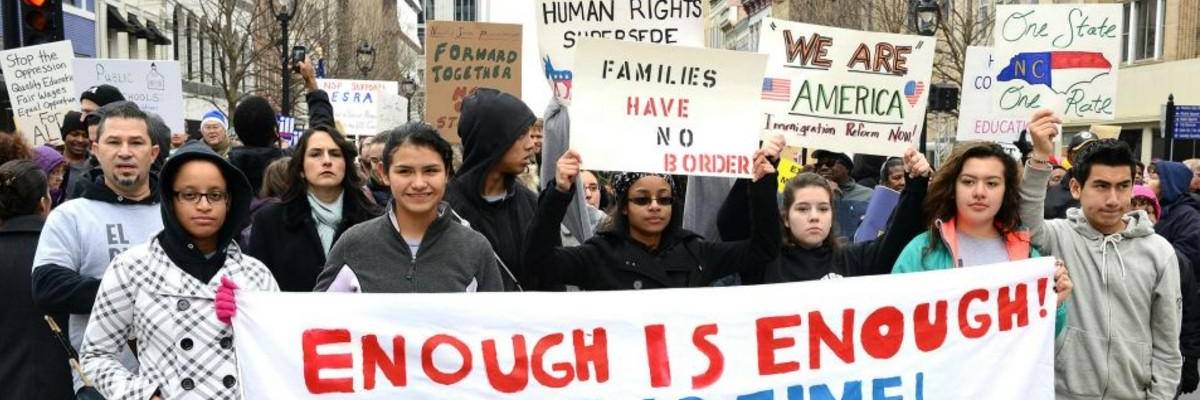
Immigration is not a crisis--but the political, economic, and environmental factors that push people out of their homes are. (Photo: Stephen Melkisethian/flickr/cc)
The War on Immigrants Is a War on All Poor and Low-Income Workers
If low-income voters stick together, they can stop politicians from turning a humanitarian crisis into political theater.
In states across the country, cynical politicians are turning a humanitarian crisis into political theater.
New Hampshire Governor John Sununu recently announced that he was deploying the state National Guard to the U.S.-Mexico border, joining around two-dozen mostly GOP-led states. Meanwhile Florida, Texas, and Arizona have been busing migrants to blue states and cities, often under fraudulent circumstances.
If poor and low-income Black, white, and Hispanic Texans turn out and stand together, they could change the outcome of Texas's gubernatorial race.
Immigration is not a crisis--but the political, economic, and environmental factors that push people out of their homes are. So is the inhumane treatment these displaced people receive.
Republicans are most brazenly exploiting these conditions, but its origins cross party lines.
When President Clinton enacted the 1996 Illegal Immigration Reform and Immigrant Responsibility Act, he made more people eligible for deportation and made it easier to deport them. This drove up the undocumented population by making it riskier to seek documentation. And it laid the groundwork for a massive infrastructure to detain people.
Every administration since has expanded that infrastructure.
Under President George W. Bush, immigration enforcement moved to the new Department of Homeland Security, transforming a justice and labor issue into one of national security. Deportations started climbing, reaching more than 5 million under President Obama, despite his introduction of DACA to protect undocumented children.
President Trump escalated this trend, spreading dangerous lies about immigrants as violent criminals and invoking emergency powers to fund a southern border wall. Although President Biden reversed that move, our immigration system has not fundamentally changed.
Hundreds of thousands of immigrants live under constant surveillance, and nearly 60,000 were deported in 2021. Last year alone, 250,000 people were detained in unsafe and overcrowded immigration detention facilities where over 200 have died, including children. Every year, hundreds more die along the border itself.
Texas is a flashpoint in this crisis.
In May 2021, Texas Governor Greg Abbot issued a disaster declaration giving himself expanded powers and funding to crack down on migrants. Under "Operation Lone Star," or OLS, he deployed thousands of state troopers and national guard troops to the border to arrest and detain migrating children, families, and refugees.
According to Fernando Garcia, director of the Border Network for Human Rights, OLS has not stemmed immigration flows. It's simply redirected them to more dangerous and isolated areas. It's also stoking antagonism against people crossing the border. In September, two men shot at a group of migrants, killing a man and wounding a woman.
I recently joined a gathering in Texas convened by RITA, a statewide alliance to reform immigration in Texas. They said it was no accident that the crackdown comes despite a host of more pressing emergencies in the state, from widespread poverty to the large number of Texans without health care.
They also described OLS as a massive expansion of Texas' carceral system. Counties are using OLS funds to build new booking facilities, expand prison and jail capacity, acquire weapons and surveillance technology, and militarize public schools, they said. This expansion of militarized law enforcement impacts the civil rights of all Texans.
All told, OLS hurts migrants, poor people, and low-income people of every background. But for Texans, ending it could be as simple as turning out in the next election. There are 7.1 million eligible poor and low-income voters in Texas. That includes 2.4 million Hispanic people, many of them potential targets of Abbott's crackdown.
They will need to overcome rampant voter suppression. But as Fernando says, "if border communities voted by just a few percentage points more, they could change everything."
If poor and low-income Black, white, and Hispanic Texans turn out and stand together, they could change the outcome of Texas's gubernatorial race. And from there, they could shift the entire political terrain--in Texas and every other state that's playing politics with people's lives.
An Urgent Message From Our Co-Founder
Dear Common Dreams reader, It’s been nearly 30 years since I co-founded Common Dreams with my late wife, Lina Newhouser. We had the radical notion that journalism should serve the public good, not corporate profits. It was clear to us from the outset what it would take to build such a project. No paid advertisements. No corporate sponsors. No millionaire publisher telling us what to think or do. Many people said we wouldn't last a year, but we proved those doubters wrong. Together with a tremendous team of journalists and dedicated staff, we built an independent media outlet free from the constraints of profits and corporate control. Our mission has always been simple: To inform. To inspire. To ignite change for the common good. Building Common Dreams was not easy. Our survival was never guaranteed. When you take on the most powerful forces—Wall Street greed, fossil fuel industry destruction, Big Tech lobbyists, and uber-rich oligarchs who have spent billions upon billions rigging the economy and democracy in their favor—the only bulwark you have is supporters who believe in your work. But here’s the urgent message from me today. It's never been this bad out there. And it's never been this hard to keep us going. At the very moment Common Dreams is most needed, the threats we face are intensifying. We need your support now more than ever. We don't accept corporate advertising and never will. We don't have a paywall because we don't think people should be blocked from critical news based on their ability to pay. Everything we do is funded by the donations of readers like you. When everyone does the little they can afford, we are strong. But if that support retreats or dries up, so do we. Will you donate now to make sure Common Dreams not only survives but thrives? —Craig Brown, Co-founder |
In states across the country, cynical politicians are turning a humanitarian crisis into political theater.
New Hampshire Governor John Sununu recently announced that he was deploying the state National Guard to the U.S.-Mexico border, joining around two-dozen mostly GOP-led states. Meanwhile Florida, Texas, and Arizona have been busing migrants to blue states and cities, often under fraudulent circumstances.
If poor and low-income Black, white, and Hispanic Texans turn out and stand together, they could change the outcome of Texas's gubernatorial race.
Immigration is not a crisis--but the political, economic, and environmental factors that push people out of their homes are. So is the inhumane treatment these displaced people receive.
Republicans are most brazenly exploiting these conditions, but its origins cross party lines.
When President Clinton enacted the 1996 Illegal Immigration Reform and Immigrant Responsibility Act, he made more people eligible for deportation and made it easier to deport them. This drove up the undocumented population by making it riskier to seek documentation. And it laid the groundwork for a massive infrastructure to detain people.
Every administration since has expanded that infrastructure.
Under President George W. Bush, immigration enforcement moved to the new Department of Homeland Security, transforming a justice and labor issue into one of national security. Deportations started climbing, reaching more than 5 million under President Obama, despite his introduction of DACA to protect undocumented children.
President Trump escalated this trend, spreading dangerous lies about immigrants as violent criminals and invoking emergency powers to fund a southern border wall. Although President Biden reversed that move, our immigration system has not fundamentally changed.
Hundreds of thousands of immigrants live under constant surveillance, and nearly 60,000 were deported in 2021. Last year alone, 250,000 people were detained in unsafe and overcrowded immigration detention facilities where over 200 have died, including children. Every year, hundreds more die along the border itself.
Texas is a flashpoint in this crisis.
In May 2021, Texas Governor Greg Abbot issued a disaster declaration giving himself expanded powers and funding to crack down on migrants. Under "Operation Lone Star," or OLS, he deployed thousands of state troopers and national guard troops to the border to arrest and detain migrating children, families, and refugees.
According to Fernando Garcia, director of the Border Network for Human Rights, OLS has not stemmed immigration flows. It's simply redirected them to more dangerous and isolated areas. It's also stoking antagonism against people crossing the border. In September, two men shot at a group of migrants, killing a man and wounding a woman.
I recently joined a gathering in Texas convened by RITA, a statewide alliance to reform immigration in Texas. They said it was no accident that the crackdown comes despite a host of more pressing emergencies in the state, from widespread poverty to the large number of Texans without health care.
They also described OLS as a massive expansion of Texas' carceral system. Counties are using OLS funds to build new booking facilities, expand prison and jail capacity, acquire weapons and surveillance technology, and militarize public schools, they said. This expansion of militarized law enforcement impacts the civil rights of all Texans.
All told, OLS hurts migrants, poor people, and low-income people of every background. But for Texans, ending it could be as simple as turning out in the next election. There are 7.1 million eligible poor and low-income voters in Texas. That includes 2.4 million Hispanic people, many of them potential targets of Abbott's crackdown.
They will need to overcome rampant voter suppression. But as Fernando says, "if border communities voted by just a few percentage points more, they could change everything."
If poor and low-income Black, white, and Hispanic Texans turn out and stand together, they could change the outcome of Texas's gubernatorial race. And from there, they could shift the entire political terrain--in Texas and every other state that's playing politics with people's lives.
In states across the country, cynical politicians are turning a humanitarian crisis into political theater.
New Hampshire Governor John Sununu recently announced that he was deploying the state National Guard to the U.S.-Mexico border, joining around two-dozen mostly GOP-led states. Meanwhile Florida, Texas, and Arizona have been busing migrants to blue states and cities, often under fraudulent circumstances.
If poor and low-income Black, white, and Hispanic Texans turn out and stand together, they could change the outcome of Texas's gubernatorial race.
Immigration is not a crisis--but the political, economic, and environmental factors that push people out of their homes are. So is the inhumane treatment these displaced people receive.
Republicans are most brazenly exploiting these conditions, but its origins cross party lines.
When President Clinton enacted the 1996 Illegal Immigration Reform and Immigrant Responsibility Act, he made more people eligible for deportation and made it easier to deport them. This drove up the undocumented population by making it riskier to seek documentation. And it laid the groundwork for a massive infrastructure to detain people.
Every administration since has expanded that infrastructure.
Under President George W. Bush, immigration enforcement moved to the new Department of Homeland Security, transforming a justice and labor issue into one of national security. Deportations started climbing, reaching more than 5 million under President Obama, despite his introduction of DACA to protect undocumented children.
President Trump escalated this trend, spreading dangerous lies about immigrants as violent criminals and invoking emergency powers to fund a southern border wall. Although President Biden reversed that move, our immigration system has not fundamentally changed.
Hundreds of thousands of immigrants live under constant surveillance, and nearly 60,000 were deported in 2021. Last year alone, 250,000 people were detained in unsafe and overcrowded immigration detention facilities where over 200 have died, including children. Every year, hundreds more die along the border itself.
Texas is a flashpoint in this crisis.
In May 2021, Texas Governor Greg Abbot issued a disaster declaration giving himself expanded powers and funding to crack down on migrants. Under "Operation Lone Star," or OLS, he deployed thousands of state troopers and national guard troops to the border to arrest and detain migrating children, families, and refugees.
According to Fernando Garcia, director of the Border Network for Human Rights, OLS has not stemmed immigration flows. It's simply redirected them to more dangerous and isolated areas. It's also stoking antagonism against people crossing the border. In September, two men shot at a group of migrants, killing a man and wounding a woman.
I recently joined a gathering in Texas convened by RITA, a statewide alliance to reform immigration in Texas. They said it was no accident that the crackdown comes despite a host of more pressing emergencies in the state, from widespread poverty to the large number of Texans without health care.
They also described OLS as a massive expansion of Texas' carceral system. Counties are using OLS funds to build new booking facilities, expand prison and jail capacity, acquire weapons and surveillance technology, and militarize public schools, they said. This expansion of militarized law enforcement impacts the civil rights of all Texans.
All told, OLS hurts migrants, poor people, and low-income people of every background. But for Texans, ending it could be as simple as turning out in the next election. There are 7.1 million eligible poor and low-income voters in Texas. That includes 2.4 million Hispanic people, many of them potential targets of Abbott's crackdown.
They will need to overcome rampant voter suppression. But as Fernando says, "if border communities voted by just a few percentage points more, they could change everything."
If poor and low-income Black, white, and Hispanic Texans turn out and stand together, they could change the outcome of Texas's gubernatorial race. And from there, they could shift the entire political terrain--in Texas and every other state that's playing politics with people's lives.