SUBSCRIBE TO OUR FREE NEWSLETTER
Daily news & progressive opinion—funded by the people, not the corporations—delivered straight to your inbox.
5
#000000
#FFFFFF
To donate by check, phone, or other method, see our More Ways to Give page.
Daily news & progressive opinion—funded by the people, not the corporations—delivered straight to your inbox.
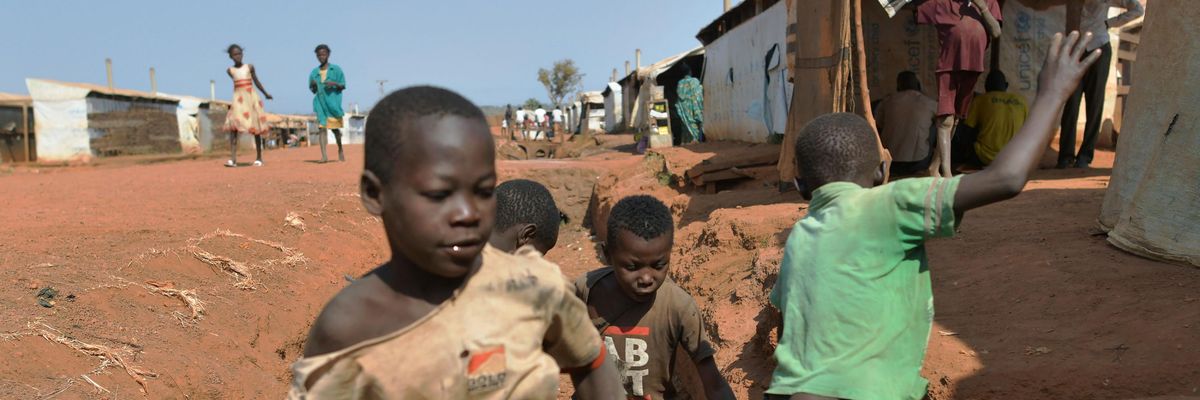
Children play in a drainage ditch in the Protection of Civilians (POC) site in Wau on February 1, 2020. 13,000 civilians shelter under UN protection at the Protection of Civilian (POC) site, adjacent to the UN Mission in South Sudan (UNMISS) field office, just outside Wau town having fled massacres and burning villages. (Photo: Tony Karumba/AFP via Getty Images)
By every conceivable measure, South Sudan is a nation in acute crisis. According to the World Bank, eighty percent of the South Sudanese population lives below the international poverty line, only one percent of people have access to electricity, and this month a UN Security Council delegation warned that another full-fledged civil war could break out at any moment.
What South Sudan has in abundance however are guns, violence, and US sanctions that are preventing the government from helping its people.
South Sudan is the embodiment of so many ills that affect the world--colonialism, militarization, civil war, climate change, famine, and sexual violence. By the mid-20th century, Sudan, encompassing what is now South Sudan and Sudan, began to fill up with firearms. By 1966, the country had received 30,000 G3 rifles from West Germany. By the late 1970s/mid-eighties, with the US-Soviet proxy wars in full swing, US arms transfers to Sudan were so large ($1.4 billion) that combined with arms transfers from other countries, the country was dubbed "Africa's arms dump."
What South Sudan has in abundance however are guns, violence, and US sanctions that are preventing the government from helping its people.
Global food security was among the priority issues discussed last week at the UN General Assembly in New York and its adjacent meetings. With the prediction that South Sudan will experience famine unless billions of dollars in aid are not obtained immediately, it is among the countries being considered for urgent action.
But, and this must be understood, the multiple crises facing South Sudan weren't of its own making.
Located along the Nile River the land that is now Sudan and South Sudan was once part of the ancient Christian Nubian kingdoms. It was renowned for its arts and culture, had its own written language, high literacy rates, and enjoyed high levels of gender equality.
Nubia eventually declined and fell to successive conquerors. Eventually, revolted against Egypt. However, only a decade later, Britain, which was the ruling power in Egypt, retook Sudan and placed it under joint Egyptian-British rule.
Sudan finally gained its independence in 1956. But, independence did not give way to peace. A civil war, which was already underway between the predominantly Muslim north and majority Christian south, would last until 72. During that time both sides were handing out arms to civilians, including children, for self-protection. By the end of a second civil war which lasted until 2005 and was largely a continuation of the first civil war, an estimated 1.9-3.2 million small arms circulating among the population, an arms culture that aspired to reach US levels, was well established.
In 2011, South Sudanese citizens voted by 99% to secede from the north and become their own country. While optimism was widespread and infectious, by the end of 2013, yet another civil war had broken out in the fledgling country after President Kiir accused Riek Machar, attempting a coup d'etat, leading to multiple sides fighting to rule the country.
By 2016, 6 million people in South Sudan were facing starvation. By 2017, the country's economy was in tatters and famine had been declared. By 2018, around 400,000 people had been killed and over 4 million displaced.
Despite the formation of a unity government in 2020, inter-community violence in South Sudan has increased. Human and civil rights are barely existent and the country has been declared one of the most dangerous places on earth for aid workers. A September 2022, joint human rights report documented 131 cases of rape and gang rape, including of girls as young as eight.
In a declared effort to "choke off war funds," the US has imposed sanctions on the South Sudanese oil industry.
Amnesty International and Human Rights Watch want an arms embargo, but US sanctions include South Sudan's oil industry.
Sanctions on South Sudan's gas industry prevent the country from using its natural resources (3.5 billion barrels of proven oil reserves) to reduce its extreme energy poverty. While one might think this is positive for the environment, without the ability to sell its gas, there are no funds for the development of renewable energy systems.
The African Energy Chamber has urged the US to remove its gas industry sanctions. The Crisis Group has stated that sanctions on South Sudan must be specific in their targets and timeframes, and have clear off-ramps.
Violent conflict isn't the only factor putting South Sudan in urgent danger of famine. Climate change has wreaked havoc on crops in the Horn of Africa and the war in Ukraine is compounding the global food security crisis. That said, as we rush to see that the necessary aid funds are raised to avoid all-out famine in time and pray for peace in the war-torn country, we must ensure that the US, and other Western countries, don't exacerbate the already dire situation and are held accountable for the role they played in creating the crisis.
Dear Common Dreams reader, It’s been nearly 30 years since I co-founded Common Dreams with my late wife, Lina Newhouser. We had the radical notion that journalism should serve the public good, not corporate profits. It was clear to us from the outset what it would take to build such a project. No paid advertisements. No corporate sponsors. No millionaire publisher telling us what to think or do. Many people said we wouldn't last a year, but we proved those doubters wrong. Together with a tremendous team of journalists and dedicated staff, we built an independent media outlet free from the constraints of profits and corporate control. Our mission has always been simple: To inform. To inspire. To ignite change for the common good. Building Common Dreams was not easy. Our survival was never guaranteed. When you take on the most powerful forces—Wall Street greed, fossil fuel industry destruction, Big Tech lobbyists, and uber-rich oligarchs who have spent billions upon billions rigging the economy and democracy in their favor—the only bulwark you have is supporters who believe in your work. But here’s the urgent message from me today. It's never been this bad out there. And it's never been this hard to keep us going. At the very moment Common Dreams is most needed, the threats we face are intensifying. We need your support now more than ever. We don't accept corporate advertising and never will. We don't have a paywall because we don't think people should be blocked from critical news based on their ability to pay. Everything we do is funded by the donations of readers like you. When everyone does the little they can afford, we are strong. But if that support retreats or dries up, so do we. Will you donate now to make sure Common Dreams not only survives but thrives? —Craig Brown, Co-founder |
By every conceivable measure, South Sudan is a nation in acute crisis. According to the World Bank, eighty percent of the South Sudanese population lives below the international poverty line, only one percent of people have access to electricity, and this month a UN Security Council delegation warned that another full-fledged civil war could break out at any moment.
What South Sudan has in abundance however are guns, violence, and US sanctions that are preventing the government from helping its people.
South Sudan is the embodiment of so many ills that affect the world--colonialism, militarization, civil war, climate change, famine, and sexual violence. By the mid-20th century, Sudan, encompassing what is now South Sudan and Sudan, began to fill up with firearms. By 1966, the country had received 30,000 G3 rifles from West Germany. By the late 1970s/mid-eighties, with the US-Soviet proxy wars in full swing, US arms transfers to Sudan were so large ($1.4 billion) that combined with arms transfers from other countries, the country was dubbed "Africa's arms dump."
What South Sudan has in abundance however are guns, violence, and US sanctions that are preventing the government from helping its people.
Global food security was among the priority issues discussed last week at the UN General Assembly in New York and its adjacent meetings. With the prediction that South Sudan will experience famine unless billions of dollars in aid are not obtained immediately, it is among the countries being considered for urgent action.
But, and this must be understood, the multiple crises facing South Sudan weren't of its own making.
Located along the Nile River the land that is now Sudan and South Sudan was once part of the ancient Christian Nubian kingdoms. It was renowned for its arts and culture, had its own written language, high literacy rates, and enjoyed high levels of gender equality.
Nubia eventually declined and fell to successive conquerors. Eventually, revolted against Egypt. However, only a decade later, Britain, which was the ruling power in Egypt, retook Sudan and placed it under joint Egyptian-British rule.
Sudan finally gained its independence in 1956. But, independence did not give way to peace. A civil war, which was already underway between the predominantly Muslim north and majority Christian south, would last until 72. During that time both sides were handing out arms to civilians, including children, for self-protection. By the end of a second civil war which lasted until 2005 and was largely a continuation of the first civil war, an estimated 1.9-3.2 million small arms circulating among the population, an arms culture that aspired to reach US levels, was well established.
In 2011, South Sudanese citizens voted by 99% to secede from the north and become their own country. While optimism was widespread and infectious, by the end of 2013, yet another civil war had broken out in the fledgling country after President Kiir accused Riek Machar, attempting a coup d'etat, leading to multiple sides fighting to rule the country.
By 2016, 6 million people in South Sudan were facing starvation. By 2017, the country's economy was in tatters and famine had been declared. By 2018, around 400,000 people had been killed and over 4 million displaced.
Despite the formation of a unity government in 2020, inter-community violence in South Sudan has increased. Human and civil rights are barely existent and the country has been declared one of the most dangerous places on earth for aid workers. A September 2022, joint human rights report documented 131 cases of rape and gang rape, including of girls as young as eight.
In a declared effort to "choke off war funds," the US has imposed sanctions on the South Sudanese oil industry.
Amnesty International and Human Rights Watch want an arms embargo, but US sanctions include South Sudan's oil industry.
Sanctions on South Sudan's gas industry prevent the country from using its natural resources (3.5 billion barrels of proven oil reserves) to reduce its extreme energy poverty. While one might think this is positive for the environment, without the ability to sell its gas, there are no funds for the development of renewable energy systems.
The African Energy Chamber has urged the US to remove its gas industry sanctions. The Crisis Group has stated that sanctions on South Sudan must be specific in their targets and timeframes, and have clear off-ramps.
Violent conflict isn't the only factor putting South Sudan in urgent danger of famine. Climate change has wreaked havoc on crops in the Horn of Africa and the war in Ukraine is compounding the global food security crisis. That said, as we rush to see that the necessary aid funds are raised to avoid all-out famine in time and pray for peace in the war-torn country, we must ensure that the US, and other Western countries, don't exacerbate the already dire situation and are held accountable for the role they played in creating the crisis.
By every conceivable measure, South Sudan is a nation in acute crisis. According to the World Bank, eighty percent of the South Sudanese population lives below the international poverty line, only one percent of people have access to electricity, and this month a UN Security Council delegation warned that another full-fledged civil war could break out at any moment.
What South Sudan has in abundance however are guns, violence, and US sanctions that are preventing the government from helping its people.
South Sudan is the embodiment of so many ills that affect the world--colonialism, militarization, civil war, climate change, famine, and sexual violence. By the mid-20th century, Sudan, encompassing what is now South Sudan and Sudan, began to fill up with firearms. By 1966, the country had received 30,000 G3 rifles from West Germany. By the late 1970s/mid-eighties, with the US-Soviet proxy wars in full swing, US arms transfers to Sudan were so large ($1.4 billion) that combined with arms transfers from other countries, the country was dubbed "Africa's arms dump."
What South Sudan has in abundance however are guns, violence, and US sanctions that are preventing the government from helping its people.
Global food security was among the priority issues discussed last week at the UN General Assembly in New York and its adjacent meetings. With the prediction that South Sudan will experience famine unless billions of dollars in aid are not obtained immediately, it is among the countries being considered for urgent action.
But, and this must be understood, the multiple crises facing South Sudan weren't of its own making.
Located along the Nile River the land that is now Sudan and South Sudan was once part of the ancient Christian Nubian kingdoms. It was renowned for its arts and culture, had its own written language, high literacy rates, and enjoyed high levels of gender equality.
Nubia eventually declined and fell to successive conquerors. Eventually, revolted against Egypt. However, only a decade later, Britain, which was the ruling power in Egypt, retook Sudan and placed it under joint Egyptian-British rule.
Sudan finally gained its independence in 1956. But, independence did not give way to peace. A civil war, which was already underway between the predominantly Muslim north and majority Christian south, would last until 72. During that time both sides were handing out arms to civilians, including children, for self-protection. By the end of a second civil war which lasted until 2005 and was largely a continuation of the first civil war, an estimated 1.9-3.2 million small arms circulating among the population, an arms culture that aspired to reach US levels, was well established.
In 2011, South Sudanese citizens voted by 99% to secede from the north and become their own country. While optimism was widespread and infectious, by the end of 2013, yet another civil war had broken out in the fledgling country after President Kiir accused Riek Machar, attempting a coup d'etat, leading to multiple sides fighting to rule the country.
By 2016, 6 million people in South Sudan were facing starvation. By 2017, the country's economy was in tatters and famine had been declared. By 2018, around 400,000 people had been killed and over 4 million displaced.
Despite the formation of a unity government in 2020, inter-community violence in South Sudan has increased. Human and civil rights are barely existent and the country has been declared one of the most dangerous places on earth for aid workers. A September 2022, joint human rights report documented 131 cases of rape and gang rape, including of girls as young as eight.
In a declared effort to "choke off war funds," the US has imposed sanctions on the South Sudanese oil industry.
Amnesty International and Human Rights Watch want an arms embargo, but US sanctions include South Sudan's oil industry.
Sanctions on South Sudan's gas industry prevent the country from using its natural resources (3.5 billion barrels of proven oil reserves) to reduce its extreme energy poverty. While one might think this is positive for the environment, without the ability to sell its gas, there are no funds for the development of renewable energy systems.
The African Energy Chamber has urged the US to remove its gas industry sanctions. The Crisis Group has stated that sanctions on South Sudan must be specific in their targets and timeframes, and have clear off-ramps.
Violent conflict isn't the only factor putting South Sudan in urgent danger of famine. Climate change has wreaked havoc on crops in the Horn of Africa and the war in Ukraine is compounding the global food security crisis. That said, as we rush to see that the necessary aid funds are raised to avoid all-out famine in time and pray for peace in the war-torn country, we must ensure that the US, and other Western countries, don't exacerbate the already dire situation and are held accountable for the role they played in creating the crisis.