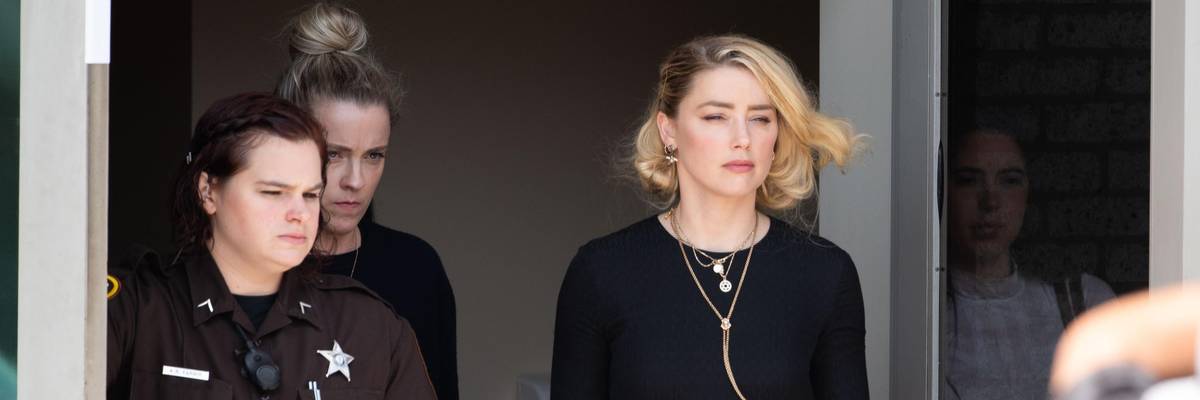
Amber Heard departs the Fairfax County Courthouse after the verdict announced_on June 1, 2022 in Fairfax, Virginia. The jury in the Johnny Depp vs. Amber Heard case awarded Depp $15 million in damages to his career over an op-ed Heard wrote in the Washington Post in 2018.(Photo: Cliff Owen/Consolidated News Pictures/Getty Images)
We Are Failing Domestic Violence Survivors
I serve domestic violence survivors as a social worker. The toxic public shaming of Amber Heard will discourage some from ever speaking up.
Now that the verdict in the Depp-Heard trial is in, the media spectacle of the case may finally begin to die down.
But the impact will stay with us for years to come. Over the past several weeks, the internet became a toxic platform for survivors of domestic abuse as people trivialized, harassed, and threatened Amber Heard.
People who identify as survivors of domestic violence can attest to the toxicity of the memes, hashtags, videos, and comments that have been shared.
As a social worker who works with survivors of gender-based violence, I often hear how difficult it is for my clients to come forward because they fear nobody will believe them. The highly public shaming of Ms. Heard could make that much worse.
In the United States, 1 one in 4 women and 1 in 10 men experience sexual violence, physical violence, and/or stalking by an intimate partner. These statistics indicate that any one of us living in this country knows at least one person who has endured some type of intimate partner violence.
In Fairfax County, Virginia, where the trial was held and where many of the survivors I serve reside, we've seen an increase in the number of calls to law enforcement about abuse--and in the severity of that abuse--during the pandemic.
Ms. Heard may have the means to protect herself and her family after this whole ordeal, but most of the survivors I serve do not. After seeing what transpired in this case, many may feel discouraged to speak out against their abusers at all.
So if you're sharing memes or jokes mocking a survivor who testified in court, please ask yourself: What if one of your loved ones is experiencing domestic violence? If they saw your "joke," would they feel safe reaching out to you when they need it most?
The public's treatment of Heard encourages the damaging notion that survivors must fit a specific mold to be believable. There is no such thing as the "perfect victim," or one way to react when one has experienced violence and trauma. People deal with trauma differently.
During this trial, many viewers simply usurped the roles of clinical and forensic psychologists, legal experts, and jurors.
Even before the trial ended, social media users were quick and eager to diagnose Ms. Heard with schizophrenia, bipolar disorder, and borderline personality disorder, among other things--further stigmatizing trauma for survivors and those who live with mental health conditions.
This narrative flies in the face of progress that's made it possible for survivors to report their abuse, seek assistance, and stand up against their aggressors.
This trial has unmasked some of the worst compulsions in our society. People who identify as survivors of domestic violence can attest to the toxicity of the memes, hashtags, videos, and comments that have been shared.
We are failing all people who've struggled with domestic violence--not only women but also men, children, and queer and nonbinary folks. This trial may have very well convinced some who are suffering in silence that the costs of speaking up and seeking help are too great to bear.
We need to be more sympathetic and make sure that we're creating a space where the people that matter to us feel safe sharing their truth when it matters most. We need to care more and judge less. We need to do better.
We are at a crossroads
This country and this world are at a monumental crossroads. In a few short weeks, US voters will have an opportunity to beat back the forces of fascism and confront the billionaires who are rigging the economy, our media system, and our democracy, making it increasingly impossible for ordinary people to get by. We’re not just talking about the election. We’re talking about what must be done once these fascist elements are vanquished from power. We need a bolder set of solutions than what either major party has so far been willing to offer and a working-class movement ready to fight like hell for it. Trump didn't emerge from nowhere. The conditions that fueled MAGA authoritarianism were created by decades of radical neoliberal economic policies and a corrupt political system dominated by corporate interests. They slashed taxes on the super-rich, promising that the benefits would trickle down. They said giveaways to the corporate titans would make life more affordable for the rest of us. It was all bullshit. And when a bitter, betrayed populace searches for someone to blame, right-wing demagogues have little trouble finding scapegoats. People know when they're being lied to, but you won't hear any of this from the corporate media. Only independent journalism—powered and funded by people who believe in building a better world—can deliver truly trustworthy daily news. Our Fall Campaign is underway, and we need your help. To power our newsroom through the rest of the year, we need to raise $125,000 by midnight on October 31. So if you share our vision, please contribute whatever you can to sustain our work. |
Now that the verdict in the Depp-Heard trial is in, the media spectacle of the case may finally begin to die down.
But the impact will stay with us for years to come. Over the past several weeks, the internet became a toxic platform for survivors of domestic abuse as people trivialized, harassed, and threatened Amber Heard.
People who identify as survivors of domestic violence can attest to the toxicity of the memes, hashtags, videos, and comments that have been shared.
As a social worker who works with survivors of gender-based violence, I often hear how difficult it is for my clients to come forward because they fear nobody will believe them. The highly public shaming of Ms. Heard could make that much worse.
In the United States, 1 one in 4 women and 1 in 10 men experience sexual violence, physical violence, and/or stalking by an intimate partner. These statistics indicate that any one of us living in this country knows at least one person who has endured some type of intimate partner violence.
In Fairfax County, Virginia, where the trial was held and where many of the survivors I serve reside, we've seen an increase in the number of calls to law enforcement about abuse--and in the severity of that abuse--during the pandemic.
Ms. Heard may have the means to protect herself and her family after this whole ordeal, but most of the survivors I serve do not. After seeing what transpired in this case, many may feel discouraged to speak out against their abusers at all.
So if you're sharing memes or jokes mocking a survivor who testified in court, please ask yourself: What if one of your loved ones is experiencing domestic violence? If they saw your "joke," would they feel safe reaching out to you when they need it most?
The public's treatment of Heard encourages the damaging notion that survivors must fit a specific mold to be believable. There is no such thing as the "perfect victim," or one way to react when one has experienced violence and trauma. People deal with trauma differently.
During this trial, many viewers simply usurped the roles of clinical and forensic psychologists, legal experts, and jurors.
Even before the trial ended, social media users were quick and eager to diagnose Ms. Heard with schizophrenia, bipolar disorder, and borderline personality disorder, among other things--further stigmatizing trauma for survivors and those who live with mental health conditions.
This narrative flies in the face of progress that's made it possible for survivors to report their abuse, seek assistance, and stand up against their aggressors.
This trial has unmasked some of the worst compulsions in our society. People who identify as survivors of domestic violence can attest to the toxicity of the memes, hashtags, videos, and comments that have been shared.
We are failing all people who've struggled with domestic violence--not only women but also men, children, and queer and nonbinary folks. This trial may have very well convinced some who are suffering in silence that the costs of speaking up and seeking help are too great to bear.
We need to be more sympathetic and make sure that we're creating a space where the people that matter to us feel safe sharing their truth when it matters most. We need to care more and judge less. We need to do better.
Now that the verdict in the Depp-Heard trial is in, the media spectacle of the case may finally begin to die down.
But the impact will stay with us for years to come. Over the past several weeks, the internet became a toxic platform for survivors of domestic abuse as people trivialized, harassed, and threatened Amber Heard.
People who identify as survivors of domestic violence can attest to the toxicity of the memes, hashtags, videos, and comments that have been shared.
As a social worker who works with survivors of gender-based violence, I often hear how difficult it is for my clients to come forward because they fear nobody will believe them. The highly public shaming of Ms. Heard could make that much worse.
In the United States, 1 one in 4 women and 1 in 10 men experience sexual violence, physical violence, and/or stalking by an intimate partner. These statistics indicate that any one of us living in this country knows at least one person who has endured some type of intimate partner violence.
In Fairfax County, Virginia, where the trial was held and where many of the survivors I serve reside, we've seen an increase in the number of calls to law enforcement about abuse--and in the severity of that abuse--during the pandemic.
Ms. Heard may have the means to protect herself and her family after this whole ordeal, but most of the survivors I serve do not. After seeing what transpired in this case, many may feel discouraged to speak out against their abusers at all.
So if you're sharing memes or jokes mocking a survivor who testified in court, please ask yourself: What if one of your loved ones is experiencing domestic violence? If they saw your "joke," would they feel safe reaching out to you when they need it most?
The public's treatment of Heard encourages the damaging notion that survivors must fit a specific mold to be believable. There is no such thing as the "perfect victim," or one way to react when one has experienced violence and trauma. People deal with trauma differently.
During this trial, many viewers simply usurped the roles of clinical and forensic psychologists, legal experts, and jurors.
Even before the trial ended, social media users were quick and eager to diagnose Ms. Heard with schizophrenia, bipolar disorder, and borderline personality disorder, among other things--further stigmatizing trauma for survivors and those who live with mental health conditions.
This narrative flies in the face of progress that's made it possible for survivors to report their abuse, seek assistance, and stand up against their aggressors.
This trial has unmasked some of the worst compulsions in our society. People who identify as survivors of domestic violence can attest to the toxicity of the memes, hashtags, videos, and comments that have been shared.
We are failing all people who've struggled with domestic violence--not only women but also men, children, and queer and nonbinary folks. This trial may have very well convinced some who are suffering in silence that the costs of speaking up and seeking help are too great to bear.
We need to be more sympathetic and make sure that we're creating a space where the people that matter to us feel safe sharing their truth when it matters most. We need to care more and judge less. We need to do better.