

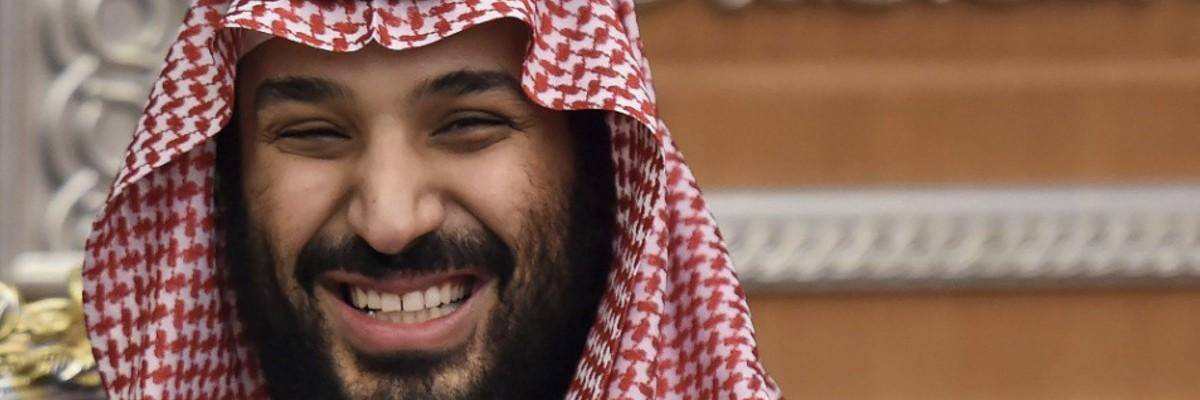
Saudi Crown Prince Mohammed bin Salman attends a meeting on November 14, 2017, in Riyadh. (Photo: Fayez Nureldine/AFP via Getty Images)
It Was a Game of Hardball and Biden Just Handed It to the Saudi Prince
MBS is playing hardball with the United States, and the White House is just letting him win. Why?
Last night, the New York Times broke the news that President Biden plans to travel this Summer to Saudi Arabia, effectively signaling the administration's intent to end its paltry efforts to correct the Kingdom's destabilizing behavior in return for limited promises on oil production.
Biden's decision to meet with Crown Prince Mohammed bin Salman (MBS) without first having secured an end to this destabilizing behavior significantly weakens the United States' hand.
Traveling to Riyadh now, hat in hand, is akin to slapping a bargain bandaid on the gaping wound that the U.S.-Saudi relationship has become.
Clearly, America should be working to build a healthier relationship with Saudi Arabia, but that simply isn't possible unless and until the United States confronts the deep dysfunction at the core of that relationship--a dysfunction defined by the blind eye the U.S. has turned to Saudi's support for Jihadi terrorism, the spread of Wahhabism, and other reckless and inexcusable actions, like the murder of Washington Post journalist Jamaal Khashoggi.
Biden's decision to meet with Crown Prince Mohammed bin Salman (MBS) without first having secured an end to this destabilizing behavior significantly weakens the United States' hand.
Applauding MBS' "courage" for supporting a ceasefire in a war the Saudi Crown Prince himself started--and to use that as a pretext for the presidential meeting--speaks to Biden's desperation to lower gas prices, as well as to our need to end this dependency on Saudi Arabia.
Let's also be clear about one thing: This is not the victory of realism over values. Such an assertion erroneously presumes that realpolitik necessitates Biden prostrating himself in front of MBS to push down oil prices. It does not. If oil prices are really the driving force behind this, then Biden should have just gone back into the Iran nuclear deal through an executive order, instead of--for all practical purposes--continuing Trump's maximum pressure strategy.
The combination of Iranian oil coming back onto the market as well as the immediate influx of more than 50 million barrels of oil that Tehran has in storage but hasn't been able to sell because of U.S. sanctions, would cause both a better short-term and long-term reduction of oil prices. All Biden needed to do is to go back to the deal his former boss Barack Obama already negotiated.
Instead, Biden has chosen to play a self-defeating game with Iran which in turn has made him desperate enough to cave into MBS. (This would also have put Europe in a much better position as it is desperately trying to reduce its dependence on Russian gas and oil).
Rather than rebuilding relations with Riyadh, Biden's approach will likely exacerbate the long-standing problems in US-Saudi relations. It will increase our dependence on the kingdom, which has long given its rulers carte blanche to act against American interests in the Middle East and beyond.
MBS is playing hardball with the United States--and Biden just let him win.
An Urgent Message From Our Co-Founder
Dear Common Dreams reader, It’s been nearly 30 years since I co-founded Common Dreams with my late wife, Lina Newhouser. We had the radical notion that journalism should serve the public good, not corporate profits. It was clear to us from the outset what it would take to build such a project. No paid advertisements. No corporate sponsors. No millionaire publisher telling us what to think or do. Many people said we wouldn't last a year, but we proved those doubters wrong. Together with a tremendous team of journalists and dedicated staff, we built an independent media outlet free from the constraints of profits and corporate control. Our mission has always been simple: To inform. To inspire. To ignite change for the common good. Building Common Dreams was not easy. Our survival was never guaranteed. When you take on the most powerful forces—Wall Street greed, fossil fuel industry destruction, Big Tech lobbyists, and uber-rich oligarchs who have spent billions upon billions rigging the economy and democracy in their favor—the only bulwark you have is supporters who believe in your work. But here’s the urgent message from me today. It's never been this bad out there. And it's never been this hard to keep us going. At the very moment Common Dreams is most needed, the threats we face are intensifying. We need your support now more than ever. We don't accept corporate advertising and never will. We don't have a paywall because we don't think people should be blocked from critical news based on their ability to pay. Everything we do is funded by the donations of readers like you. When everyone does the little they can afford, we are strong. But if that support retreats or dries up, so do we. Will you donate now to make sure Common Dreams not only survives but thrives? —Craig Brown, Co-founder |
Last night, the New York Times broke the news that President Biden plans to travel this Summer to Saudi Arabia, effectively signaling the administration's intent to end its paltry efforts to correct the Kingdom's destabilizing behavior in return for limited promises on oil production.
Biden's decision to meet with Crown Prince Mohammed bin Salman (MBS) without first having secured an end to this destabilizing behavior significantly weakens the United States' hand.
Traveling to Riyadh now, hat in hand, is akin to slapping a bargain bandaid on the gaping wound that the U.S.-Saudi relationship has become.
Clearly, America should be working to build a healthier relationship with Saudi Arabia, but that simply isn't possible unless and until the United States confronts the deep dysfunction at the core of that relationship--a dysfunction defined by the blind eye the U.S. has turned to Saudi's support for Jihadi terrorism, the spread of Wahhabism, and other reckless and inexcusable actions, like the murder of Washington Post journalist Jamaal Khashoggi.
Biden's decision to meet with Crown Prince Mohammed bin Salman (MBS) without first having secured an end to this destabilizing behavior significantly weakens the United States' hand.
Applauding MBS' "courage" for supporting a ceasefire in a war the Saudi Crown Prince himself started--and to use that as a pretext for the presidential meeting--speaks to Biden's desperation to lower gas prices, as well as to our need to end this dependency on Saudi Arabia.
Let's also be clear about one thing: This is not the victory of realism over values. Such an assertion erroneously presumes that realpolitik necessitates Biden prostrating himself in front of MBS to push down oil prices. It does not. If oil prices are really the driving force behind this, then Biden should have just gone back into the Iran nuclear deal through an executive order, instead of--for all practical purposes--continuing Trump's maximum pressure strategy.
The combination of Iranian oil coming back onto the market as well as the immediate influx of more than 50 million barrels of oil that Tehran has in storage but hasn't been able to sell because of U.S. sanctions, would cause both a better short-term and long-term reduction of oil prices. All Biden needed to do is to go back to the deal his former boss Barack Obama already negotiated.
Instead, Biden has chosen to play a self-defeating game with Iran which in turn has made him desperate enough to cave into MBS. (This would also have put Europe in a much better position as it is desperately trying to reduce its dependence on Russian gas and oil).
Rather than rebuilding relations with Riyadh, Biden's approach will likely exacerbate the long-standing problems in US-Saudi relations. It will increase our dependence on the kingdom, which has long given its rulers carte blanche to act against American interests in the Middle East and beyond.
MBS is playing hardball with the United States--and Biden just let him win.
Last night, the New York Times broke the news that President Biden plans to travel this Summer to Saudi Arabia, effectively signaling the administration's intent to end its paltry efforts to correct the Kingdom's destabilizing behavior in return for limited promises on oil production.
Biden's decision to meet with Crown Prince Mohammed bin Salman (MBS) without first having secured an end to this destabilizing behavior significantly weakens the United States' hand.
Traveling to Riyadh now, hat in hand, is akin to slapping a bargain bandaid on the gaping wound that the U.S.-Saudi relationship has become.
Clearly, America should be working to build a healthier relationship with Saudi Arabia, but that simply isn't possible unless and until the United States confronts the deep dysfunction at the core of that relationship--a dysfunction defined by the blind eye the U.S. has turned to Saudi's support for Jihadi terrorism, the spread of Wahhabism, and other reckless and inexcusable actions, like the murder of Washington Post journalist Jamaal Khashoggi.
Biden's decision to meet with Crown Prince Mohammed bin Salman (MBS) without first having secured an end to this destabilizing behavior significantly weakens the United States' hand.
Applauding MBS' "courage" for supporting a ceasefire in a war the Saudi Crown Prince himself started--and to use that as a pretext for the presidential meeting--speaks to Biden's desperation to lower gas prices, as well as to our need to end this dependency on Saudi Arabia.
Let's also be clear about one thing: This is not the victory of realism over values. Such an assertion erroneously presumes that realpolitik necessitates Biden prostrating himself in front of MBS to push down oil prices. It does not. If oil prices are really the driving force behind this, then Biden should have just gone back into the Iran nuclear deal through an executive order, instead of--for all practical purposes--continuing Trump's maximum pressure strategy.
The combination of Iranian oil coming back onto the market as well as the immediate influx of more than 50 million barrels of oil that Tehran has in storage but hasn't been able to sell because of U.S. sanctions, would cause both a better short-term and long-term reduction of oil prices. All Biden needed to do is to go back to the deal his former boss Barack Obama already negotiated.
Instead, Biden has chosen to play a self-defeating game with Iran which in turn has made him desperate enough to cave into MBS. (This would also have put Europe in a much better position as it is desperately trying to reduce its dependence on Russian gas and oil).
Rather than rebuilding relations with Riyadh, Biden's approach will likely exacerbate the long-standing problems in US-Saudi relations. It will increase our dependence on the kingdom, which has long given its rulers carte blanche to act against American interests in the Middle East and beyond.
MBS is playing hardball with the United States--and Biden just let him win.