SUBSCRIBE TO OUR FREE NEWSLETTER
Daily news & progressive opinion—funded by the people, not the corporations—delivered straight to your inbox.
5
#000000
#FFFFFF
To donate by check, phone, or other method, see our More Ways to Give page.
Daily news & progressive opinion—funded by the people, not the corporations—delivered straight to your inbox.
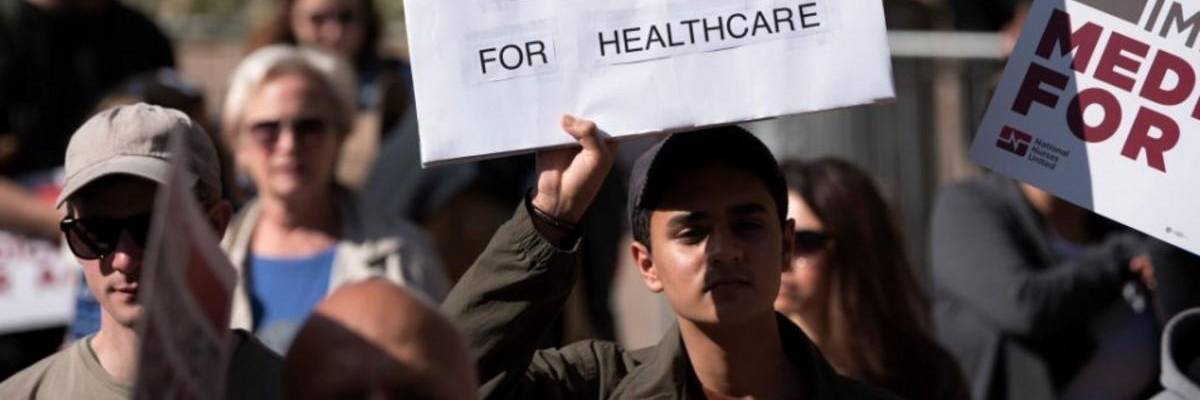
People with insurance have so much trouble navigating and paying for medical services that a fifth of households that make over $120,000 have avoided seeking medical care because of the associated costs. (Photo: Ronen Tivony/NurPhoto via Getty Images)
There's a talking point that often dominates the debate around health care reform: The majority of Americans like their health care plan. That's why when Barack Obama was running for president -- and when he rallied Congress to pass the Affordable Care Act -- he repeatedly assured people that there was nothing to worry about. If you liked your health care plan, he promised unconvincingly, you could keep it.
More Americans actually fear the cost of treating an illness than the illness itself.
Joe Biden followed the same logic when he campaigned against Medicare for All in the 2020 Democratic presidential primaries, insisting that "160 million people like their private insurance." But his opponent, Senator Elizabeth Warren, questioned that statistic. "I've actually never met anybody who likes their health insurance company," she said during one of the Democratic debates.
The reality is that polls of Americans' feelings about health care policy are all over the place. The majority of Americans do indeed say that they like their health care plans. But the majority of Americans also favor a single-payer system. And the same Kaiser Family Foundation poll that found that most people are "generally satisfied" with their health coverage also found that 40 percent of people with employer-sponsored insurance still said that they had trouble paying out-of-pocket medical expenses.
So what, exactly, is going on? I'm willing to bet that insured people are more likely to report that they are happy with their health care plan when they're not actually using it. And I say that because I'm one of the people for whom the American health care system is supposed to work at its best and most seamless -- I'm young, relatively healthy, and have decent employer-sponsored coverage -- and I still hate interacting with my insurer.
Let me explain why. Last summer, I had a seizure for the first (and hopefully last) time, and I dislocated and fractured my shoulder as a result. Despite having what is apparently considered good coverage, the months that followed were a bureaucratic nightmare.
There was a wait for essentially every part of the recovery process. Getting appointments to see doctors sometimes took weeks, and probably would have taken longer had I not been lucky enough to have a friend with a family of doctors who could help me find the right people. I had to start physical therapy several weeks late because the available therapists in my network were booked. I couldn't get an MRI until my insurer -- not my neurologist -- deemed it a necessary expense. (Some of these delays may have been exacerbated by the stress COVID imposed on the health care system, but they also aren't out of the ordinary.)
That is to say nothing of the out-of-pocket fees. The two-mile ambulance ride cost $1,000. The MRI was $600. Physical therapy had a $40 copay attached to each visit, with a recommended minimum of two sessions per week for several months. In the end, I got over a dozen bills, ranging from $14 to $1,050, making it hard to keep track of what I owed and to whom. (I still worry that I have missed a payment that will haunt my credit score sometime in the future.) When all is said and done, a single unfortunate and completely unpredictable incident ended up costing me over $3,000.
I'm not the only insured American who's had a terrible experience dealing with the health care system. People with insurance have so much trouble navigating and paying for medical services that a fifth of households that make over $120,000 have avoided seeking medical care because of the associated costs. More Americans actually fear the cost of treating an illness than the illness itself. Clearly, this system is not working as it should, and yet the idea that most Americans are satisfied with their health coverage continues to stunt many politicians' imagination of what health care in America could look like.
Unfortunately, a major health care overhaul is not on the Democrats' agenda for now, despite the fact that it occupied much of the debate in the 2020 elections. That's in part because of the party's extremely narrow majority, but also because more moderate Democrats are afraid of thinking bigger.
But there's no reason to be so timid. I can complain only so much about my health care, because I'm one of the lucky ones -- lucky for having insurance in the first place and for having enough savings and a family to lean on to help cover out-of-pocket expenses in the event of an emergency. But when a system relies on good fortune, then it's not a system worth defending, because it can fail almost anyone, especially the people who need it most.
Dear Common Dreams reader, It’s been nearly 30 years since I co-founded Common Dreams with my late wife, Lina Newhouser. We had the radical notion that journalism should serve the public good, not corporate profits. It was clear to us from the outset what it would take to build such a project. No paid advertisements. No corporate sponsors. No millionaire publisher telling us what to think or do. Many people said we wouldn't last a year, but we proved those doubters wrong. Together with a tremendous team of journalists and dedicated staff, we built an independent media outlet free from the constraints of profits and corporate control. Our mission has always been simple: To inform. To inspire. To ignite change for the common good. Building Common Dreams was not easy. Our survival was never guaranteed. When you take on the most powerful forces—Wall Street greed, fossil fuel industry destruction, Big Tech lobbyists, and uber-rich oligarchs who have spent billions upon billions rigging the economy and democracy in their favor—the only bulwark you have is supporters who believe in your work. But here’s the urgent message from me today. It's never been this bad out there. And it's never been this hard to keep us going. At the very moment Common Dreams is most needed, the threats we face are intensifying. We need your support now more than ever. We don't accept corporate advertising and never will. We don't have a paywall because we don't think people should be blocked from critical news based on their ability to pay. Everything we do is funded by the donations of readers like you. When everyone does the little they can afford, we are strong. But if that support retreats or dries up, so do we. Will you donate now to make sure Common Dreams not only survives but thrives? —Craig Brown, Co-founder |
There's a talking point that often dominates the debate around health care reform: The majority of Americans like their health care plan. That's why when Barack Obama was running for president -- and when he rallied Congress to pass the Affordable Care Act -- he repeatedly assured people that there was nothing to worry about. If you liked your health care plan, he promised unconvincingly, you could keep it.
More Americans actually fear the cost of treating an illness than the illness itself.
Joe Biden followed the same logic when he campaigned against Medicare for All in the 2020 Democratic presidential primaries, insisting that "160 million people like their private insurance." But his opponent, Senator Elizabeth Warren, questioned that statistic. "I've actually never met anybody who likes their health insurance company," she said during one of the Democratic debates.
The reality is that polls of Americans' feelings about health care policy are all over the place. The majority of Americans do indeed say that they like their health care plans. But the majority of Americans also favor a single-payer system. And the same Kaiser Family Foundation poll that found that most people are "generally satisfied" with their health coverage also found that 40 percent of people with employer-sponsored insurance still said that they had trouble paying out-of-pocket medical expenses.
So what, exactly, is going on? I'm willing to bet that insured people are more likely to report that they are happy with their health care plan when they're not actually using it. And I say that because I'm one of the people for whom the American health care system is supposed to work at its best and most seamless -- I'm young, relatively healthy, and have decent employer-sponsored coverage -- and I still hate interacting with my insurer.
Let me explain why. Last summer, I had a seizure for the first (and hopefully last) time, and I dislocated and fractured my shoulder as a result. Despite having what is apparently considered good coverage, the months that followed were a bureaucratic nightmare.
There was a wait for essentially every part of the recovery process. Getting appointments to see doctors sometimes took weeks, and probably would have taken longer had I not been lucky enough to have a friend with a family of doctors who could help me find the right people. I had to start physical therapy several weeks late because the available therapists in my network were booked. I couldn't get an MRI until my insurer -- not my neurologist -- deemed it a necessary expense. (Some of these delays may have been exacerbated by the stress COVID imposed on the health care system, but they also aren't out of the ordinary.)
That is to say nothing of the out-of-pocket fees. The two-mile ambulance ride cost $1,000. The MRI was $600. Physical therapy had a $40 copay attached to each visit, with a recommended minimum of two sessions per week for several months. In the end, I got over a dozen bills, ranging from $14 to $1,050, making it hard to keep track of what I owed and to whom. (I still worry that I have missed a payment that will haunt my credit score sometime in the future.) When all is said and done, a single unfortunate and completely unpredictable incident ended up costing me over $3,000.
I'm not the only insured American who's had a terrible experience dealing with the health care system. People with insurance have so much trouble navigating and paying for medical services that a fifth of households that make over $120,000 have avoided seeking medical care because of the associated costs. More Americans actually fear the cost of treating an illness than the illness itself. Clearly, this system is not working as it should, and yet the idea that most Americans are satisfied with their health coverage continues to stunt many politicians' imagination of what health care in America could look like.
Unfortunately, a major health care overhaul is not on the Democrats' agenda for now, despite the fact that it occupied much of the debate in the 2020 elections. That's in part because of the party's extremely narrow majority, but also because more moderate Democrats are afraid of thinking bigger.
But there's no reason to be so timid. I can complain only so much about my health care, because I'm one of the lucky ones -- lucky for having insurance in the first place and for having enough savings and a family to lean on to help cover out-of-pocket expenses in the event of an emergency. But when a system relies on good fortune, then it's not a system worth defending, because it can fail almost anyone, especially the people who need it most.
There's a talking point that often dominates the debate around health care reform: The majority of Americans like their health care plan. That's why when Barack Obama was running for president -- and when he rallied Congress to pass the Affordable Care Act -- he repeatedly assured people that there was nothing to worry about. If you liked your health care plan, he promised unconvincingly, you could keep it.
More Americans actually fear the cost of treating an illness than the illness itself.
Joe Biden followed the same logic when he campaigned against Medicare for All in the 2020 Democratic presidential primaries, insisting that "160 million people like their private insurance." But his opponent, Senator Elizabeth Warren, questioned that statistic. "I've actually never met anybody who likes their health insurance company," she said during one of the Democratic debates.
The reality is that polls of Americans' feelings about health care policy are all over the place. The majority of Americans do indeed say that they like their health care plans. But the majority of Americans also favor a single-payer system. And the same Kaiser Family Foundation poll that found that most people are "generally satisfied" with their health coverage also found that 40 percent of people with employer-sponsored insurance still said that they had trouble paying out-of-pocket medical expenses.
So what, exactly, is going on? I'm willing to bet that insured people are more likely to report that they are happy with their health care plan when they're not actually using it. And I say that because I'm one of the people for whom the American health care system is supposed to work at its best and most seamless -- I'm young, relatively healthy, and have decent employer-sponsored coverage -- and I still hate interacting with my insurer.
Let me explain why. Last summer, I had a seizure for the first (and hopefully last) time, and I dislocated and fractured my shoulder as a result. Despite having what is apparently considered good coverage, the months that followed were a bureaucratic nightmare.
There was a wait for essentially every part of the recovery process. Getting appointments to see doctors sometimes took weeks, and probably would have taken longer had I not been lucky enough to have a friend with a family of doctors who could help me find the right people. I had to start physical therapy several weeks late because the available therapists in my network were booked. I couldn't get an MRI until my insurer -- not my neurologist -- deemed it a necessary expense. (Some of these delays may have been exacerbated by the stress COVID imposed on the health care system, but they also aren't out of the ordinary.)
That is to say nothing of the out-of-pocket fees. The two-mile ambulance ride cost $1,000. The MRI was $600. Physical therapy had a $40 copay attached to each visit, with a recommended minimum of two sessions per week for several months. In the end, I got over a dozen bills, ranging from $14 to $1,050, making it hard to keep track of what I owed and to whom. (I still worry that I have missed a payment that will haunt my credit score sometime in the future.) When all is said and done, a single unfortunate and completely unpredictable incident ended up costing me over $3,000.
I'm not the only insured American who's had a terrible experience dealing with the health care system. People with insurance have so much trouble navigating and paying for medical services that a fifth of households that make over $120,000 have avoided seeking medical care because of the associated costs. More Americans actually fear the cost of treating an illness than the illness itself. Clearly, this system is not working as it should, and yet the idea that most Americans are satisfied with their health coverage continues to stunt many politicians' imagination of what health care in America could look like.
Unfortunately, a major health care overhaul is not on the Democrats' agenda for now, despite the fact that it occupied much of the debate in the 2020 elections. That's in part because of the party's extremely narrow majority, but also because more moderate Democrats are afraid of thinking bigger.
But there's no reason to be so timid. I can complain only so much about my health care, because I'm one of the lucky ones -- lucky for having insurance in the first place and for having enough savings and a family to lean on to help cover out-of-pocket expenses in the event of an emergency. But when a system relies on good fortune, then it's not a system worth defending, because it can fail almost anyone, especially the people who need it most.