SUBSCRIBE TO OUR FREE NEWSLETTER
Daily news & progressive opinion—funded by the people, not the corporations—delivered straight to your inbox.
5
#000000
#FFFFFF
To donate by check, phone, or other method, see our More Ways to Give page.
Daily news & progressive opinion—funded by the people, not the corporations—delivered straight to your inbox.
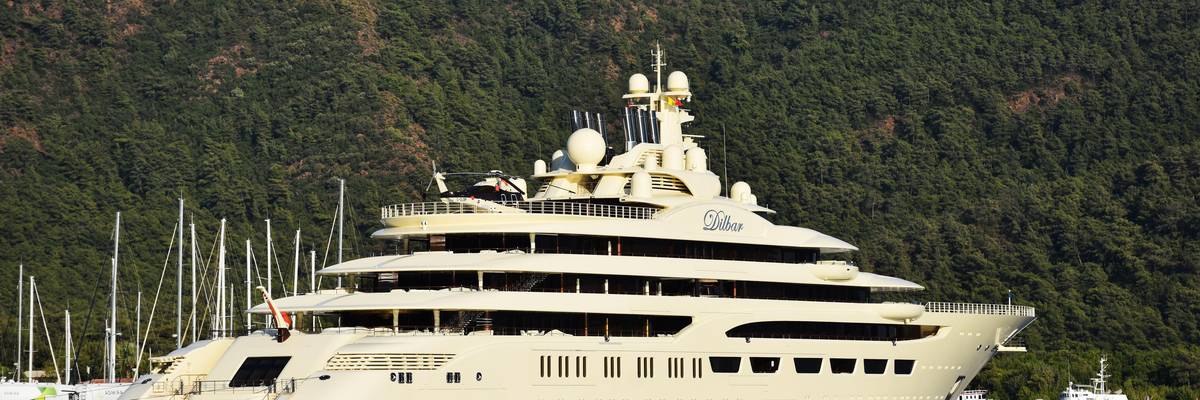
A file photo dated September 10, 2018 shows mega yacht named "Dilbar" belonging to Uzbek-born Russian billionaire Alisher Usmanov as it refuels by a tanker in Mugla, Turkiye. Germany seizes Russian billionaire Usmanov's yacht at Port of Hamburg. (Photo: Sabri Kesen/Anadolu Agency via Getty Images)
During his State of the Union address to Congress on Tuesday, President Biden reiterated his pledge to "go after the crimes of Russian oligarchs" in response to Vladimir Putin's invasion of Ukraine. "We are joining with our European allies to find and seize your yachts, your luxury apartments, your private jets. We are coming for your ill-begotten gains," he warned.
Biden's plan draws a clear link between U.S. and global security and a massive accumulation of high-profile assets within the U.S. financial system. Sanctioned individuals "sit atop Russia's largest financial institutions and are responsible for providing the resources necessary to support Putin's further invasion of Ukraine," said a senior administration official on Sunday.
In doing so, the Biden White House was furthering the case already repeatedly made, and all too often ignored, that Western financial systems were welcoming cash from kleptocrats and oligarchs at the expense of their own national security.
Warnings about the ties between kleptocrats and oligarchs' hidden wealth in the U.S. financial system and authoritarian abuses abroad were sounded well before Russia's invasion of Ukraine. Congressional hearings, media reports, and the Panama Papers revelations have all pointed to the connection between national security and the United States -- and other Western global financial hubs -- welcoming funds generated by kleptocracies around the world into "tax havens," jurisdictions allowing vehicles to hide ownership of assets. It's a term often associated with sleepy Caribbean backwaters, but increasingly the United States, led by investor-friendly financial secrecy laws in states like South Dakota and Delaware, has emerged as a global center for hiding illicit wealth.
It's a highly lucrative business, backed by convoluted laws and an army of lobbyists writing legislation and fighting back against efforts to crack down on the industry.
"If you are a Russian oligarch, a Chinese billionaire, or a dictator from a resource-rich nation in the Global South, and you need to get your money out of your home country, the USA is now your destination to park and hide large amounts of wealth," wrote Chuck Collins, director of the Program on Inequality and the Common Good at the Institute for Policy Studies, and author of "The Wealth Hoarders: How Billionaires Pay Millions to Hide Trillions."
Last week's sanctioning of Russian oligarchs and Putin's inner circle by the United States and European countries, brought heightened awareness to a vast network of assets spanning the globe. News outlets and Twitter accounts suddenly sprang to life, tracking the locations of yachts worth hundreds of millions of dollars owned by oligarchs. Surprisingly, many of the yachts, which the White House has highlighted as a target of the sanctions regime, were moored in jurisdictions outside Russia. Monaco, Hamburg, Saint Maarten, Nice, Panama, the Maldives, and Barcelona were all identified as locations where Russia's oligarchs -- many of whom accumulated vast fortunes following rapid privatization of Russian state-owned assets following the dissolution of the Soviet Union and, in the 2000s, due to their political alignment with Putin -- moored their nine-figure floating mansions.
None of the oligarchs, it seemed, saw risk with parking their extremely valuable assets in countries that are targeting or may target their assets for seizure after the Russian invasion of Ukraine, which NATO countries perceive as a threat to geopolitical stability, international law, human rights, and their own national security.
There were attempts to sound the alarm about the U.S. national security risks incurred by weak anti-money laundering obligations on the private investment industry, many of which went unheeded.
A joint report published in December by a group of anti-corruption and financial transparency groups -- the Financial Accountability & Corporate Transparency Coalition, Global Financial Integrity, and Transparency International -- found:
A growing body of evidence suggests that this gap -- the absence of requirements that investment funds and investment advisers establish anti-money laundering programs and conduct reviews to understand with whom they are doing business -- is a significant vulnerability that negatively impacts U.S. national security and the lives of ordinary Americans.
The report provided examples of Russian and Chinese attempts to access sensitive U.S. technology via private investment vehicles, opaque ownership by a Russian oligarch in a U.S. voting management firm, and "[a] leaked FBI intelligence bulletin included examples of illicit financial schemes using pooled investment vehicles involving Mexican drug cartels, Russian organized crime, and U.S. sanctioned countries."
In an even more blunt warning, Sen. Bernie Sanders (I-Vt.) issued a warning about a "new authoritarian axis" in September 2018, citing authoritarian governments in Russia, Saudi Arabia, Hungary and Israel.
"While these regimes may differ in some respects, they share key attributes: hostility toward democratic norms, antagonism toward a free press, intolerance toward ethnic and religious minorities, and a belief that government should benefit their own selfish financial interests," he said. "These leaders are also deeply connected to a network of multi-billionaire oligarchs who see the world as their economic plaything."
Judging by the global network of yachts, luxury houses and apartments, and other expensive assets linked to oligarchs in Putin's inner orbit, it's worth looking back on the warnings about how welcoming the assets of oligarchs supports authoritarianism abroad and poses national security liabilities at home.
With the invasion of Ukraine, the media and punditry have a renewed interest in these assets and U.S. and European sanctions on oligarchs threaten to impose consequences on those perceived to enable Putin's military adventurism.
Whether the sanctions will be successful in enticing Putin to change course is far from a sure thing.
But no real progress will be made in addressing the longer-term national security threat of the U.S. and European role as bankers for oligarchs and kleptocrats if two of the enabling factors -- legal structures that favor opaque ownership of assets and lax implementation of anti-money-laundering programs -- aren't also implemented as a response to a problem that only jumped onto the headlines over the past week.
Dear Common Dreams reader, It’s been nearly 30 years since I co-founded Common Dreams with my late wife, Lina Newhouser. We had the radical notion that journalism should serve the public good, not corporate profits. It was clear to us from the outset what it would take to build such a project. No paid advertisements. No corporate sponsors. No millionaire publisher telling us what to think or do. Many people said we wouldn't last a year, but we proved those doubters wrong. Together with a tremendous team of journalists and dedicated staff, we built an independent media outlet free from the constraints of profits and corporate control. Our mission has always been simple: To inform. To inspire. To ignite change for the common good. Building Common Dreams was not easy. Our survival was never guaranteed. When you take on the most powerful forces—Wall Street greed, fossil fuel industry destruction, Big Tech lobbyists, and uber-rich oligarchs who have spent billions upon billions rigging the economy and democracy in their favor—the only bulwark you have is supporters who believe in your work. But here’s the urgent message from me today. It's never been this bad out there. And it's never been this hard to keep us going. At the very moment Common Dreams is most needed, the threats we face are intensifying. We need your support now more than ever. We don't accept corporate advertising and never will. We don't have a paywall because we don't think people should be blocked from critical news based on their ability to pay. Everything we do is funded by the donations of readers like you. When everyone does the little they can afford, we are strong. But if that support retreats or dries up, so do we. Will you donate now to make sure Common Dreams not only survives but thrives? —Craig Brown, Co-founder |
During his State of the Union address to Congress on Tuesday, President Biden reiterated his pledge to "go after the crimes of Russian oligarchs" in response to Vladimir Putin's invasion of Ukraine. "We are joining with our European allies to find and seize your yachts, your luxury apartments, your private jets. We are coming for your ill-begotten gains," he warned.
Biden's plan draws a clear link between U.S. and global security and a massive accumulation of high-profile assets within the U.S. financial system. Sanctioned individuals "sit atop Russia's largest financial institutions and are responsible for providing the resources necessary to support Putin's further invasion of Ukraine," said a senior administration official on Sunday.
In doing so, the Biden White House was furthering the case already repeatedly made, and all too often ignored, that Western financial systems were welcoming cash from kleptocrats and oligarchs at the expense of their own national security.
Warnings about the ties between kleptocrats and oligarchs' hidden wealth in the U.S. financial system and authoritarian abuses abroad were sounded well before Russia's invasion of Ukraine. Congressional hearings, media reports, and the Panama Papers revelations have all pointed to the connection between national security and the United States -- and other Western global financial hubs -- welcoming funds generated by kleptocracies around the world into "tax havens," jurisdictions allowing vehicles to hide ownership of assets. It's a term often associated with sleepy Caribbean backwaters, but increasingly the United States, led by investor-friendly financial secrecy laws in states like South Dakota and Delaware, has emerged as a global center for hiding illicit wealth.
It's a highly lucrative business, backed by convoluted laws and an army of lobbyists writing legislation and fighting back against efforts to crack down on the industry.
"If you are a Russian oligarch, a Chinese billionaire, or a dictator from a resource-rich nation in the Global South, and you need to get your money out of your home country, the USA is now your destination to park and hide large amounts of wealth," wrote Chuck Collins, director of the Program on Inequality and the Common Good at the Institute for Policy Studies, and author of "The Wealth Hoarders: How Billionaires Pay Millions to Hide Trillions."
Last week's sanctioning of Russian oligarchs and Putin's inner circle by the United States and European countries, brought heightened awareness to a vast network of assets spanning the globe. News outlets and Twitter accounts suddenly sprang to life, tracking the locations of yachts worth hundreds of millions of dollars owned by oligarchs. Surprisingly, many of the yachts, which the White House has highlighted as a target of the sanctions regime, were moored in jurisdictions outside Russia. Monaco, Hamburg, Saint Maarten, Nice, Panama, the Maldives, and Barcelona were all identified as locations where Russia's oligarchs -- many of whom accumulated vast fortunes following rapid privatization of Russian state-owned assets following the dissolution of the Soviet Union and, in the 2000s, due to their political alignment with Putin -- moored their nine-figure floating mansions.
None of the oligarchs, it seemed, saw risk with parking their extremely valuable assets in countries that are targeting or may target their assets for seizure after the Russian invasion of Ukraine, which NATO countries perceive as a threat to geopolitical stability, international law, human rights, and their own national security.
There were attempts to sound the alarm about the U.S. national security risks incurred by weak anti-money laundering obligations on the private investment industry, many of which went unheeded.
A joint report published in December by a group of anti-corruption and financial transparency groups -- the Financial Accountability & Corporate Transparency Coalition, Global Financial Integrity, and Transparency International -- found:
A growing body of evidence suggests that this gap -- the absence of requirements that investment funds and investment advisers establish anti-money laundering programs and conduct reviews to understand with whom they are doing business -- is a significant vulnerability that negatively impacts U.S. national security and the lives of ordinary Americans.
The report provided examples of Russian and Chinese attempts to access sensitive U.S. technology via private investment vehicles, opaque ownership by a Russian oligarch in a U.S. voting management firm, and "[a] leaked FBI intelligence bulletin included examples of illicit financial schemes using pooled investment vehicles involving Mexican drug cartels, Russian organized crime, and U.S. sanctioned countries."
In an even more blunt warning, Sen. Bernie Sanders (I-Vt.) issued a warning about a "new authoritarian axis" in September 2018, citing authoritarian governments in Russia, Saudi Arabia, Hungary and Israel.
"While these regimes may differ in some respects, they share key attributes: hostility toward democratic norms, antagonism toward a free press, intolerance toward ethnic and religious minorities, and a belief that government should benefit their own selfish financial interests," he said. "These leaders are also deeply connected to a network of multi-billionaire oligarchs who see the world as their economic plaything."
Judging by the global network of yachts, luxury houses and apartments, and other expensive assets linked to oligarchs in Putin's inner orbit, it's worth looking back on the warnings about how welcoming the assets of oligarchs supports authoritarianism abroad and poses national security liabilities at home.
With the invasion of Ukraine, the media and punditry have a renewed interest in these assets and U.S. and European sanctions on oligarchs threaten to impose consequences on those perceived to enable Putin's military adventurism.
Whether the sanctions will be successful in enticing Putin to change course is far from a sure thing.
But no real progress will be made in addressing the longer-term national security threat of the U.S. and European role as bankers for oligarchs and kleptocrats if two of the enabling factors -- legal structures that favor opaque ownership of assets and lax implementation of anti-money-laundering programs -- aren't also implemented as a response to a problem that only jumped onto the headlines over the past week.
During his State of the Union address to Congress on Tuesday, President Biden reiterated his pledge to "go after the crimes of Russian oligarchs" in response to Vladimir Putin's invasion of Ukraine. "We are joining with our European allies to find and seize your yachts, your luxury apartments, your private jets. We are coming for your ill-begotten gains," he warned.
Biden's plan draws a clear link between U.S. and global security and a massive accumulation of high-profile assets within the U.S. financial system. Sanctioned individuals "sit atop Russia's largest financial institutions and are responsible for providing the resources necessary to support Putin's further invasion of Ukraine," said a senior administration official on Sunday.
In doing so, the Biden White House was furthering the case already repeatedly made, and all too often ignored, that Western financial systems were welcoming cash from kleptocrats and oligarchs at the expense of their own national security.
Warnings about the ties between kleptocrats and oligarchs' hidden wealth in the U.S. financial system and authoritarian abuses abroad were sounded well before Russia's invasion of Ukraine. Congressional hearings, media reports, and the Panama Papers revelations have all pointed to the connection between national security and the United States -- and other Western global financial hubs -- welcoming funds generated by kleptocracies around the world into "tax havens," jurisdictions allowing vehicles to hide ownership of assets. It's a term often associated with sleepy Caribbean backwaters, but increasingly the United States, led by investor-friendly financial secrecy laws in states like South Dakota and Delaware, has emerged as a global center for hiding illicit wealth.
It's a highly lucrative business, backed by convoluted laws and an army of lobbyists writing legislation and fighting back against efforts to crack down on the industry.
"If you are a Russian oligarch, a Chinese billionaire, or a dictator from a resource-rich nation in the Global South, and you need to get your money out of your home country, the USA is now your destination to park and hide large amounts of wealth," wrote Chuck Collins, director of the Program on Inequality and the Common Good at the Institute for Policy Studies, and author of "The Wealth Hoarders: How Billionaires Pay Millions to Hide Trillions."
Last week's sanctioning of Russian oligarchs and Putin's inner circle by the United States and European countries, brought heightened awareness to a vast network of assets spanning the globe. News outlets and Twitter accounts suddenly sprang to life, tracking the locations of yachts worth hundreds of millions of dollars owned by oligarchs. Surprisingly, many of the yachts, which the White House has highlighted as a target of the sanctions regime, were moored in jurisdictions outside Russia. Monaco, Hamburg, Saint Maarten, Nice, Panama, the Maldives, and Barcelona were all identified as locations where Russia's oligarchs -- many of whom accumulated vast fortunes following rapid privatization of Russian state-owned assets following the dissolution of the Soviet Union and, in the 2000s, due to their political alignment with Putin -- moored their nine-figure floating mansions.
None of the oligarchs, it seemed, saw risk with parking their extremely valuable assets in countries that are targeting or may target their assets for seizure after the Russian invasion of Ukraine, which NATO countries perceive as a threat to geopolitical stability, international law, human rights, and their own national security.
There were attempts to sound the alarm about the U.S. national security risks incurred by weak anti-money laundering obligations on the private investment industry, many of which went unheeded.
A joint report published in December by a group of anti-corruption and financial transparency groups -- the Financial Accountability & Corporate Transparency Coalition, Global Financial Integrity, and Transparency International -- found:
A growing body of evidence suggests that this gap -- the absence of requirements that investment funds and investment advisers establish anti-money laundering programs and conduct reviews to understand with whom they are doing business -- is a significant vulnerability that negatively impacts U.S. national security and the lives of ordinary Americans.
The report provided examples of Russian and Chinese attempts to access sensitive U.S. technology via private investment vehicles, opaque ownership by a Russian oligarch in a U.S. voting management firm, and "[a] leaked FBI intelligence bulletin included examples of illicit financial schemes using pooled investment vehicles involving Mexican drug cartels, Russian organized crime, and U.S. sanctioned countries."
In an even more blunt warning, Sen. Bernie Sanders (I-Vt.) issued a warning about a "new authoritarian axis" in September 2018, citing authoritarian governments in Russia, Saudi Arabia, Hungary and Israel.
"While these regimes may differ in some respects, they share key attributes: hostility toward democratic norms, antagonism toward a free press, intolerance toward ethnic and religious minorities, and a belief that government should benefit their own selfish financial interests," he said. "These leaders are also deeply connected to a network of multi-billionaire oligarchs who see the world as their economic plaything."
Judging by the global network of yachts, luxury houses and apartments, and other expensive assets linked to oligarchs in Putin's inner orbit, it's worth looking back on the warnings about how welcoming the assets of oligarchs supports authoritarianism abroad and poses national security liabilities at home.
With the invasion of Ukraine, the media and punditry have a renewed interest in these assets and U.S. and European sanctions on oligarchs threaten to impose consequences on those perceived to enable Putin's military adventurism.
Whether the sanctions will be successful in enticing Putin to change course is far from a sure thing.
But no real progress will be made in addressing the longer-term national security threat of the U.S. and European role as bankers for oligarchs and kleptocrats if two of the enabling factors -- legal structures that favor opaque ownership of assets and lax implementation of anti-money-laundering programs -- aren't also implemented as a response to a problem that only jumped onto the headlines over the past week.