SUBSCRIBE TO OUR FREE NEWSLETTER
Daily news & progressive opinion—funded by the people, not the corporations—delivered straight to your inbox.
5
#000000
#FFFFFF
To donate by check, phone, or other method, see our More Ways to Give page.
Daily news & progressive opinion—funded by the people, not the corporations—delivered straight to your inbox.
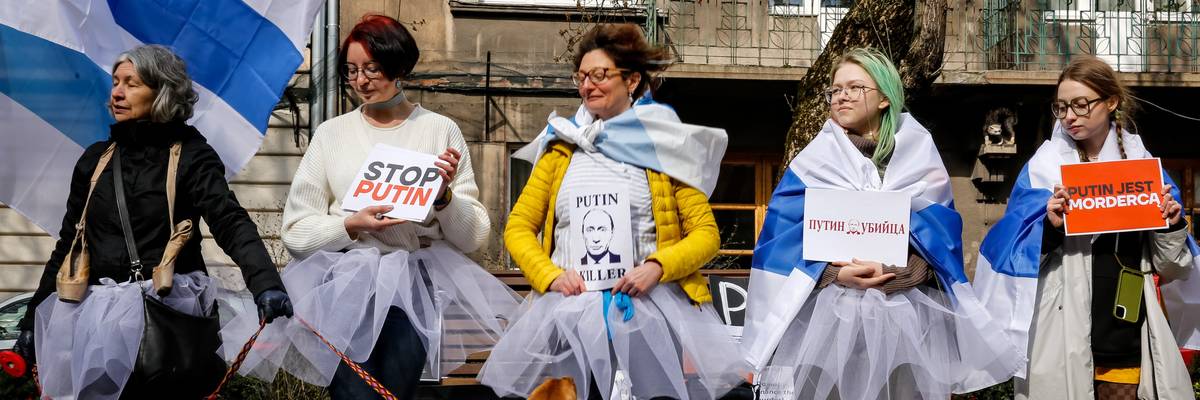
A group of protesters in ballerina white skirts, to symbolize purity and confinement, hold anti-government placards (calling President Putin a killer) and Russian opposition flags (white-blue-white) during a protest in front of the Russian Consulate on the third day of Russian presidential elections on March 17, 2024 in Krakow, Poland.
The controversial leader won a record number of votes for a post-Soviet candidate even as opponents organized a protest at noon on the election's third and last day.
Despite protests on Sunday, Russian President Vladimir Putin won reelection with more votes than any candidate since the fall of the Soviet Union.
Exit poll the Public Opinion Foundation (POF) put the final tally after three days of voting at 87.8%, the Russian Public Opinion Research Center (VCIOM) at 87%, and Russia's Central Election Commission (CEC) at 87.3%. Putin will now serve another six-year term, meaning he will have been at the helm of the Russian state for longer than any leader since Catherine the Great, surpassing Josef Stalin.
The election comes less than a month after the second anniversary of Russia's invasion of Ukraine and is likely to lead to more tensions between the Russian and U.S. governments.
"It gives me some hope to see how many people are not happy with the dictatorship, the war, with what's happening in Russia."
"For a U.S. administration that hoped Putin's Ukraine adventure would be wrapped up by now with a decisive setback to Moscow's interests, the election is a reminder that Putin expects that there will be many more rounds in the geopolitical boxing ring," Nikolas Gvosdev, director of the National Security Program at the Foreign Policy Research Institute, told the Russia Matters project.
With most of Putin's prominent opponents either dead, imprisoned, or in exile, the elections results were considered a foregone conclusion by both friends and foes of his administration.
A Putin spokesperson said in 2023 that the election was "not really democracy" but instead "costly bureaucracy," according to CNN. Meanwhile, a spokesperson for the White House National Security Council said the election was "obviously not free nor fair."
However, Russian opponents of Putin did find a way to demonstrate their position with a protest called "Noon Against Putin." The protest was called for by St. Petersburg politician Maxim Reznik, according to The Guardian. Participants were instructed to head to a polling place at noon and cast a paper ballot for one of the candidates running against Putin, or to write-in another candidate or spoil their ballot.
Russian opposition leader Alexei Navalny had endorsed the protest before his death last month in a Russian prison, leading the Independent Novaya Gazeta newspaper to dub it "Navalny's political testament."
The action drew crowds to polling places both in Russian cities like Moscow, St. Petersburg, and Yekaterinburg and at Russian embassies around the world.
"This is the first time in my life I have ever seen a queue for elections," one woman waiting in line in Moscow told
CNN. Russian journalists reported that the lines at some stations within the country reached the thousands, according to Reuters.
Navalny's widow, Yulia Navalnaya, who had also endorsed the protest, voted at the embassy in Berlin, while several protesters gathered outside the embassy in London.
"I expected there to be a lot of people, but not this many," London-based participant Maria Dorofeyeva told The Guardian, adding, "It gives me some hope to see how many people are not happy with the dictatorship, the war, with what's happening in Russia. And we want to stop it."
Ruslan Shaveddinov of Navalny's Anti-Corruption Foundation told Reuters:
"We showed ourselves, all of Russia and the whole world that Putin is not Russia (and) that Putin has seized power in Russia."
"Our victory is that we, the people, defeated fear, we defeated solitude—many people saw they were not alone," Shaveddinov said
Dear Common Dreams reader, It’s been nearly 30 years since I co-founded Common Dreams with my late wife, Lina Newhouser. We had the radical notion that journalism should serve the public good, not corporate profits. It was clear to us from the outset what it would take to build such a project. No paid advertisements. No corporate sponsors. No millionaire publisher telling us what to think or do. Many people said we wouldn't last a year, but we proved those doubters wrong. Together with a tremendous team of journalists and dedicated staff, we built an independent media outlet free from the constraints of profits and corporate control. Our mission has always been simple: To inform. To inspire. To ignite change for the common good. Building Common Dreams was not easy. Our survival was never guaranteed. When you take on the most powerful forces—Wall Street greed, fossil fuel industry destruction, Big Tech lobbyists, and uber-rich oligarchs who have spent billions upon billions rigging the economy and democracy in their favor—the only bulwark you have is supporters who believe in your work. But here’s the urgent message from me today. It's never been this bad out there. And it's never been this hard to keep us going. At the very moment Common Dreams is most needed, the threats we face are intensifying. We need your support now more than ever. We don't accept corporate advertising and never will. We don't have a paywall because we don't think people should be blocked from critical news based on their ability to pay. Everything we do is funded by the donations of readers like you. When everyone does the little they can afford, we are strong. But if that support retreats or dries up, so do we. Will you donate now to make sure Common Dreams not only survives but thrives? —Craig Brown, Co-founder |
Despite protests on Sunday, Russian President Vladimir Putin won reelection with more votes than any candidate since the fall of the Soviet Union.
Exit poll the Public Opinion Foundation (POF) put the final tally after three days of voting at 87.8%, the Russian Public Opinion Research Center (VCIOM) at 87%, and Russia's Central Election Commission (CEC) at 87.3%. Putin will now serve another six-year term, meaning he will have been at the helm of the Russian state for longer than any leader since Catherine the Great, surpassing Josef Stalin.
The election comes less than a month after the second anniversary of Russia's invasion of Ukraine and is likely to lead to more tensions between the Russian and U.S. governments.
"It gives me some hope to see how many people are not happy with the dictatorship, the war, with what's happening in Russia."
"For a U.S. administration that hoped Putin's Ukraine adventure would be wrapped up by now with a decisive setback to Moscow's interests, the election is a reminder that Putin expects that there will be many more rounds in the geopolitical boxing ring," Nikolas Gvosdev, director of the National Security Program at the Foreign Policy Research Institute, told the Russia Matters project.
With most of Putin's prominent opponents either dead, imprisoned, or in exile, the elections results were considered a foregone conclusion by both friends and foes of his administration.
A Putin spokesperson said in 2023 that the election was "not really democracy" but instead "costly bureaucracy," according to CNN. Meanwhile, a spokesperson for the White House National Security Council said the election was "obviously not free nor fair."
However, Russian opponents of Putin did find a way to demonstrate their position with a protest called "Noon Against Putin." The protest was called for by St. Petersburg politician Maxim Reznik, according to The Guardian. Participants were instructed to head to a polling place at noon and cast a paper ballot for one of the candidates running against Putin, or to write-in another candidate or spoil their ballot.
Russian opposition leader Alexei Navalny had endorsed the protest before his death last month in a Russian prison, leading the Independent Novaya Gazeta newspaper to dub it "Navalny's political testament."
The action drew crowds to polling places both in Russian cities like Moscow, St. Petersburg, and Yekaterinburg and at Russian embassies around the world.
"This is the first time in my life I have ever seen a queue for elections," one woman waiting in line in Moscow told
CNN. Russian journalists reported that the lines at some stations within the country reached the thousands, according to Reuters.
Navalny's widow, Yulia Navalnaya, who had also endorsed the protest, voted at the embassy in Berlin, while several protesters gathered outside the embassy in London.
"I expected there to be a lot of people, but not this many," London-based participant Maria Dorofeyeva told The Guardian, adding, "It gives me some hope to see how many people are not happy with the dictatorship, the war, with what's happening in Russia. And we want to stop it."
Ruslan Shaveddinov of Navalny's Anti-Corruption Foundation told Reuters:
"We showed ourselves, all of Russia and the whole world that Putin is not Russia (and) that Putin has seized power in Russia."
"Our victory is that we, the people, defeated fear, we defeated solitude—many people saw they were not alone," Shaveddinov said
Despite protests on Sunday, Russian President Vladimir Putin won reelection with more votes than any candidate since the fall of the Soviet Union.
Exit poll the Public Opinion Foundation (POF) put the final tally after three days of voting at 87.8%, the Russian Public Opinion Research Center (VCIOM) at 87%, and Russia's Central Election Commission (CEC) at 87.3%. Putin will now serve another six-year term, meaning he will have been at the helm of the Russian state for longer than any leader since Catherine the Great, surpassing Josef Stalin.
The election comes less than a month after the second anniversary of Russia's invasion of Ukraine and is likely to lead to more tensions between the Russian and U.S. governments.
"It gives me some hope to see how many people are not happy with the dictatorship, the war, with what's happening in Russia."
"For a U.S. administration that hoped Putin's Ukraine adventure would be wrapped up by now with a decisive setback to Moscow's interests, the election is a reminder that Putin expects that there will be many more rounds in the geopolitical boxing ring," Nikolas Gvosdev, director of the National Security Program at the Foreign Policy Research Institute, told the Russia Matters project.
With most of Putin's prominent opponents either dead, imprisoned, or in exile, the elections results were considered a foregone conclusion by both friends and foes of his administration.
A Putin spokesperson said in 2023 that the election was "not really democracy" but instead "costly bureaucracy," according to CNN. Meanwhile, a spokesperson for the White House National Security Council said the election was "obviously not free nor fair."
However, Russian opponents of Putin did find a way to demonstrate their position with a protest called "Noon Against Putin." The protest was called for by St. Petersburg politician Maxim Reznik, according to The Guardian. Participants were instructed to head to a polling place at noon and cast a paper ballot for one of the candidates running against Putin, or to write-in another candidate or spoil their ballot.
Russian opposition leader Alexei Navalny had endorsed the protest before his death last month in a Russian prison, leading the Independent Novaya Gazeta newspaper to dub it "Navalny's political testament."
The action drew crowds to polling places both in Russian cities like Moscow, St. Petersburg, and Yekaterinburg and at Russian embassies around the world.
"This is the first time in my life I have ever seen a queue for elections," one woman waiting in line in Moscow told
CNN. Russian journalists reported that the lines at some stations within the country reached the thousands, according to Reuters.
Navalny's widow, Yulia Navalnaya, who had also endorsed the protest, voted at the embassy in Berlin, while several protesters gathered outside the embassy in London.
"I expected there to be a lot of people, but not this many," London-based participant Maria Dorofeyeva told The Guardian, adding, "It gives me some hope to see how many people are not happy with the dictatorship, the war, with what's happening in Russia. And we want to stop it."
Ruslan Shaveddinov of Navalny's Anti-Corruption Foundation told Reuters:
"We showed ourselves, all of Russia and the whole world that Putin is not Russia (and) that Putin has seized power in Russia."
"Our victory is that we, the people, defeated fear, we defeated solitude—many people saw they were not alone," Shaveddinov said