SUBSCRIBE TO OUR FREE NEWSLETTER
Daily news & progressive opinion—funded by the people, not the corporations—delivered straight to your inbox.
5
#000000
#FFFFFF
To donate by check, phone, or other method, see our More Ways to Give page.
Daily news & progressive opinion—funded by the people, not the corporations—delivered straight to your inbox.
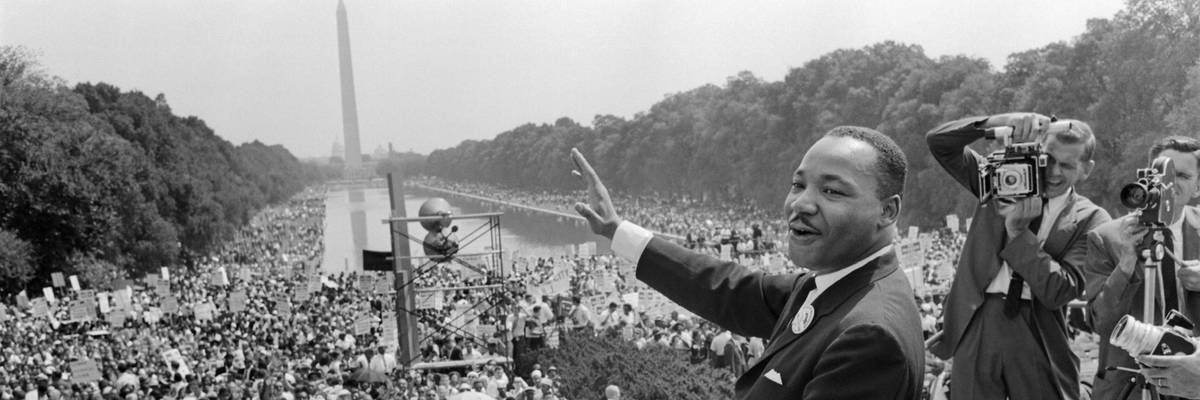
The civil rights leader Martin Luther King waves to supporters 28 August 1963 on the Mall in Washington DC (Washington Monument in background) during the "March on Washington." (Photo: AFP via Getty Images)
2022 has begun with melancholy, as our country sees the pandemic reach new heights. Meanwhile our crises of climate, democracy, and inequality seem more entrenched than ever.
All this uncertainty is taking a toll, but uncertain times are far from unprecedented. Dr. Martin Luther King, Jr. spoke to an equally uncertain time and found hope in recognizing the necessity of radical change.
Rather than return to our dysfunctional past, King's "Testament of Hope" points to the need to embrace and advance that change.
As we celebrate the national holiday dedicated to King, I always encourage people to take some time to look at his writings--and I especially do this year. In moments like these, I like to revisit one of King's last essays, "A Testament of Hope," which sounds as relevant today as the day he wrote it.
"Whenever I am asked my opinion of the current state, I am forced to pause," King wrote. "It is not easy to describe a crisis so profound that it has caused the most powerful nation in the world to stagger in confusion and bewilderment."
Sound familiar?
"Today's problems are so acute because the tragic evasions and defaults of several centuries have accumulated to disaster proportions," King continued. These interrelated problems, he continued, have "now merged into a social crisis of almost stupefying complexity."
King specifically named "war, inflation, urban decay, white backlash, and a climate of violence" alongside "race relations and poverty" as the cascading crises of his day. To that list we could add the pandemic and climate crisis today.
Even more than half a century ago, King believed that the time for small, incremental changes had passed. "The luxury of a leisurely approach to urgent solutions--the ease of gradualism--was forfeited by ignoring the issues for too long," he wrote.
"When millions of people have been cheated for centuries, restitution is a costly process. Inferior education, poor housing, unemployment, inadequate health care--each will require billions to correct," King warned. "Justice so long deferred has accumulated interest and its cost for this society will be substantial in financial as well as human terms."
But for a country weighed down by segregation, inequality, and the Vietnam War, King also knew that the costs of injustice were greater--something that feels even more true today.
"If we look honestly at the realities of our national life, it is clear that we are not marching forward," he wrote. "We are groping and stumbling; we are divided and confused."
In the face of these "deeply rooted evils" and "systemic rather than superficial flaws," King offered a remedy: the "radical reconstruction of society itself"--which King was actually hopeful about, although he knew it wouldn't be easy.
"Humanity has the capacity to do right as well as wrong," King affirmed. "The past is strewn with the ruins of the empires of tyranny, and each is a monument not merely to our blunders but to our capacity to overcome them... That's why I remain an optimist, though I am also a realist, about the barriers before us."
King's "Testament of Hope" is based on a realist's assessment of the need for political, economic, and moral change. King is clear-eyed that America must embrace radical change--which won't come from the powerful but from the "naive and unsophisticated."
Hope in radical change, for many of us, seems out of place during this time of tension. Yet there has been incredible change over the last few years. Rather than return to our dysfunctional past, King's "Testament of Hope" points to the need to embrace and advance that change.
As we begin 2022 I find this message as important as ever.
Dear Common Dreams reader, It’s been nearly 30 years since I co-founded Common Dreams with my late wife, Lina Newhouser. We had the radical notion that journalism should serve the public good, not corporate profits. It was clear to us from the outset what it would take to build such a project. No paid advertisements. No corporate sponsors. No millionaire publisher telling us what to think or do. Many people said we wouldn't last a year, but we proved those doubters wrong. Together with a tremendous team of journalists and dedicated staff, we built an independent media outlet free from the constraints of profits and corporate control. Our mission has always been simple: To inform. To inspire. To ignite change for the common good. Building Common Dreams was not easy. Our survival was never guaranteed. When you take on the most powerful forces—Wall Street greed, fossil fuel industry destruction, Big Tech lobbyists, and uber-rich oligarchs who have spent billions upon billions rigging the economy and democracy in their favor—the only bulwark you have is supporters who believe in your work. But here’s the urgent message from me today. It's never been this bad out there. And it's never been this hard to keep us going. At the very moment Common Dreams is most needed, the threats we face are intensifying. We need your support now more than ever. We don't accept corporate advertising and never will. We don't have a paywall because we don't think people should be blocked from critical news based on their ability to pay. Everything we do is funded by the donations of readers like you. When everyone does the little they can afford, we are strong. But if that support retreats or dries up, so do we. Will you donate now to make sure Common Dreams not only survives but thrives? —Craig Brown, Co-founder |
2022 has begun with melancholy, as our country sees the pandemic reach new heights. Meanwhile our crises of climate, democracy, and inequality seem more entrenched than ever.
All this uncertainty is taking a toll, but uncertain times are far from unprecedented. Dr. Martin Luther King, Jr. spoke to an equally uncertain time and found hope in recognizing the necessity of radical change.
Rather than return to our dysfunctional past, King's "Testament of Hope" points to the need to embrace and advance that change.
As we celebrate the national holiday dedicated to King, I always encourage people to take some time to look at his writings--and I especially do this year. In moments like these, I like to revisit one of King's last essays, "A Testament of Hope," which sounds as relevant today as the day he wrote it.
"Whenever I am asked my opinion of the current state, I am forced to pause," King wrote. "It is not easy to describe a crisis so profound that it has caused the most powerful nation in the world to stagger in confusion and bewilderment."
Sound familiar?
"Today's problems are so acute because the tragic evasions and defaults of several centuries have accumulated to disaster proportions," King continued. These interrelated problems, he continued, have "now merged into a social crisis of almost stupefying complexity."
King specifically named "war, inflation, urban decay, white backlash, and a climate of violence" alongside "race relations and poverty" as the cascading crises of his day. To that list we could add the pandemic and climate crisis today.
Even more than half a century ago, King believed that the time for small, incremental changes had passed. "The luxury of a leisurely approach to urgent solutions--the ease of gradualism--was forfeited by ignoring the issues for too long," he wrote.
"When millions of people have been cheated for centuries, restitution is a costly process. Inferior education, poor housing, unemployment, inadequate health care--each will require billions to correct," King warned. "Justice so long deferred has accumulated interest and its cost for this society will be substantial in financial as well as human terms."
But for a country weighed down by segregation, inequality, and the Vietnam War, King also knew that the costs of injustice were greater--something that feels even more true today.
"If we look honestly at the realities of our national life, it is clear that we are not marching forward," he wrote. "We are groping and stumbling; we are divided and confused."
In the face of these "deeply rooted evils" and "systemic rather than superficial flaws," King offered a remedy: the "radical reconstruction of society itself"--which King was actually hopeful about, although he knew it wouldn't be easy.
"Humanity has the capacity to do right as well as wrong," King affirmed. "The past is strewn with the ruins of the empires of tyranny, and each is a monument not merely to our blunders but to our capacity to overcome them... That's why I remain an optimist, though I am also a realist, about the barriers before us."
King's "Testament of Hope" is based on a realist's assessment of the need for political, economic, and moral change. King is clear-eyed that America must embrace radical change--which won't come from the powerful but from the "naive and unsophisticated."
Hope in radical change, for many of us, seems out of place during this time of tension. Yet there has been incredible change over the last few years. Rather than return to our dysfunctional past, King's "Testament of Hope" points to the need to embrace and advance that change.
As we begin 2022 I find this message as important as ever.
2022 has begun with melancholy, as our country sees the pandemic reach new heights. Meanwhile our crises of climate, democracy, and inequality seem more entrenched than ever.
All this uncertainty is taking a toll, but uncertain times are far from unprecedented. Dr. Martin Luther King, Jr. spoke to an equally uncertain time and found hope in recognizing the necessity of radical change.
Rather than return to our dysfunctional past, King's "Testament of Hope" points to the need to embrace and advance that change.
As we celebrate the national holiday dedicated to King, I always encourage people to take some time to look at his writings--and I especially do this year. In moments like these, I like to revisit one of King's last essays, "A Testament of Hope," which sounds as relevant today as the day he wrote it.
"Whenever I am asked my opinion of the current state, I am forced to pause," King wrote. "It is not easy to describe a crisis so profound that it has caused the most powerful nation in the world to stagger in confusion and bewilderment."
Sound familiar?
"Today's problems are so acute because the tragic evasions and defaults of several centuries have accumulated to disaster proportions," King continued. These interrelated problems, he continued, have "now merged into a social crisis of almost stupefying complexity."
King specifically named "war, inflation, urban decay, white backlash, and a climate of violence" alongside "race relations and poverty" as the cascading crises of his day. To that list we could add the pandemic and climate crisis today.
Even more than half a century ago, King believed that the time for small, incremental changes had passed. "The luxury of a leisurely approach to urgent solutions--the ease of gradualism--was forfeited by ignoring the issues for too long," he wrote.
"When millions of people have been cheated for centuries, restitution is a costly process. Inferior education, poor housing, unemployment, inadequate health care--each will require billions to correct," King warned. "Justice so long deferred has accumulated interest and its cost for this society will be substantial in financial as well as human terms."
But for a country weighed down by segregation, inequality, and the Vietnam War, King also knew that the costs of injustice were greater--something that feels even more true today.
"If we look honestly at the realities of our national life, it is clear that we are not marching forward," he wrote. "We are groping and stumbling; we are divided and confused."
In the face of these "deeply rooted evils" and "systemic rather than superficial flaws," King offered a remedy: the "radical reconstruction of society itself"--which King was actually hopeful about, although he knew it wouldn't be easy.
"Humanity has the capacity to do right as well as wrong," King affirmed. "The past is strewn with the ruins of the empires of tyranny, and each is a monument not merely to our blunders but to our capacity to overcome them... That's why I remain an optimist, though I am also a realist, about the barriers before us."
King's "Testament of Hope" is based on a realist's assessment of the need for political, economic, and moral change. King is clear-eyed that America must embrace radical change--which won't come from the powerful but from the "naive and unsophisticated."
Hope in radical change, for many of us, seems out of place during this time of tension. Yet there has been incredible change over the last few years. Rather than return to our dysfunctional past, King's "Testament of Hope" points to the need to embrace and advance that change.
As we begin 2022 I find this message as important as ever.