SUBSCRIBE TO OUR FREE NEWSLETTER
Daily news & progressive opinion—funded by the people, not the corporations—delivered straight to your inbox.
5
#000000
#FFFFFF
To donate by check, phone, or other method, see our More Ways to Give page.
Daily news & progressive opinion—funded by the people, not the corporations—delivered straight to your inbox.
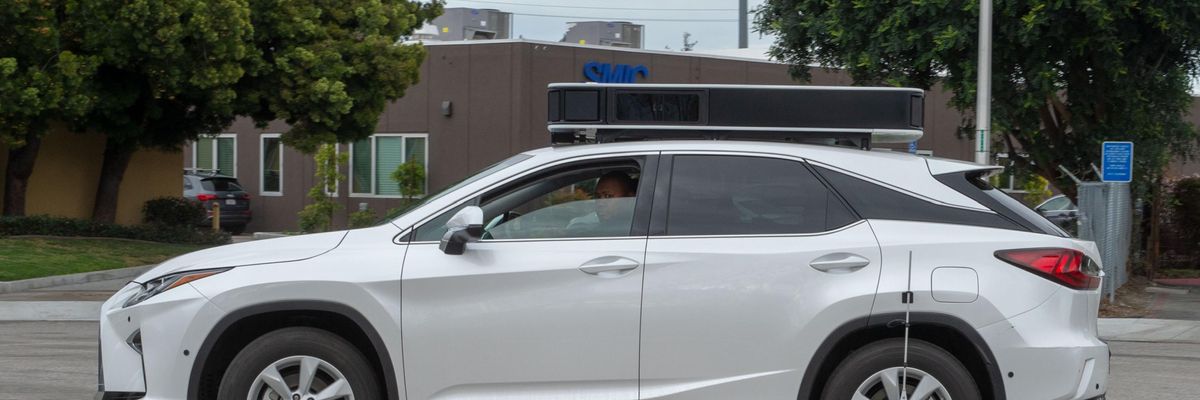
A Lexus SUV converted by Apple into a robot car is on its way on a test drive. (to dpa "Apple gets specialists for electric drives from Tesla") Photo: Andrej Sokolow/dpa (Photo: Andrej Sokolow/picture alliance via Getty Images)
From healthcare to agriculture, tech industry giants seem intent on expanding their influence across every sector of the global economy. Left unchecked by the powers that be in Washington, the big four tech companies--Amazon, Google, Apple, and Facebook--will continue to swallow up vast new swaths of the economy, and this is precisely what is at stake in Biden era antitrust policy and enforcement.
Big Tech's obsession with expanding into that future market--and further entrenching their monopoly power--is well-documented but hasn't received much attention.
If you want to see where things are headed and the risks ahead, just look at the trajectory of the automotive industry as it transitions to the electric and autonomous vehicles likely to dominate the market in the future. Big Tech's obsession with expanding into that future market--and further entrenching their monopoly power--is well-documented but hasn't received much attention.
In fact, far from a fantasy of tech executives, Big Tech already has made a considerable mark. Apple has worked tirelessly to develop the "Apple Car," going so far as to seek active consultation from the likes of Nissan and Hyundai. Waymo (formerly the "Google Self-Driving Car Project") remains a priority of Google parent company Alphabet. Outside the realm of autonomous vehicle technology, Google's Android operating system is now a widespread feature in new cars. Amazon is one of Rivian's largest investors. And many analysts even expect Facebook to enter the industry sooner or later.
After decades of declining antitrust enforcement, Big Tech giants have little incentive not to leverage their platform dominance to occupy a larger part of the industry. Indeed, the autonomous taxi market alone is projected to become a $2 trillion market by 2030, and tech giants are keen on dominating this sector first.
While "the merging of electric, autonomous vehicles with ride-hailing to create a radically different car economy" may sound exciting in the abstract, Big Tech's record of mistreating workers and undermining competition should be of grave concern to observers. Should Big Tech run its tried and true playbook to go after the auto industry, workers will inevitably suffer.
Google has already proved itself to be stridently anti-labor in its approach to dissenting employees. If Google has no qualms with firing the employees in its core enterprise, there's little reason to believe the tech giant will treat auto industry workers any better. Similarly, Apple's well-documented history of mistreating factory workers--and relying primarily on Chinese production - should be of grave concern as the company develops the "Apple Car". In its iPhone factory in Zhengzhou, China, to name one infamous example, workers were robbed of bonus payments and adequate safety training.
The prospect of a Big Tech-dominated auto industry isn't just concerning owing to tech giants' disregard for workers' welfare. In a time when corporate concentration is at critical levels, the American economy cannot afford to let Big Tech giants further entrench their economic and political power.
Even at their current sizes, Big Tech giants have violated federal law to relentlessly stifle competition. Amazon once willfully took $200 million in losses to crush a startup rival that refused to be acquired by the company. Facebook built its empire through acquisitions of services such as Instagram and WhatsApp in an all-but-explicit effort to curb the emergence of any real competitors. Imagine how they would act if they get dramatically bigger.
And then there are the data privacy and security implications. Big Tech already profits enough off of knowing where you go and what you search for. Gaining a foothold in the auto industry means they can turn actions as basic as how hard you break or when you turn headlights on into profitable data points. Big Tech's disregard for privacy can be seen in accusations that Apple's Siri records users without consent and that Amazon records children who use Echo Dot Kids. Amazon reportedly stores the resulting data in the cloud and prevents parents from deleting it, similar to how Google continues to track Android users' locations when location services are disabled. Apple and Google have both stayed silent after users' data was compromised, and Amazon insiders have sounded the alarm on the possibility the company's negligence could lead to users' data being exposed.
Big Tech's foray into the auto industry is one example of many of where things are headed if these companies are left unchecked. Regulators should keep these concerns in mind before approving any future mergers or acquisitions, and they should pursue vigorous antitrust policies before things get even more out of hand. Enough is enough.
Dear Common Dreams reader, It’s been nearly 30 years since I co-founded Common Dreams with my late wife, Lina Newhouser. We had the radical notion that journalism should serve the public good, not corporate profits. It was clear to us from the outset what it would take to build such a project. No paid advertisements. No corporate sponsors. No millionaire publisher telling us what to think or do. Many people said we wouldn't last a year, but we proved those doubters wrong. Together with a tremendous team of journalists and dedicated staff, we built an independent media outlet free from the constraints of profits and corporate control. Our mission has always been simple: To inform. To inspire. To ignite change for the common good. Building Common Dreams was not easy. Our survival was never guaranteed. When you take on the most powerful forces—Wall Street greed, fossil fuel industry destruction, Big Tech lobbyists, and uber-rich oligarchs who have spent billions upon billions rigging the economy and democracy in their favor—the only bulwark you have is supporters who believe in your work. But here’s the urgent message from me today. It's never been this bad out there. And it's never been this hard to keep us going. At the very moment Common Dreams is most needed, the threats we face are intensifying. We need your support now more than ever. We don't accept corporate advertising and never will. We don't have a paywall because we don't think people should be blocked from critical news based on their ability to pay. Everything we do is funded by the donations of readers like you. When everyone does the little they can afford, we are strong. But if that support retreats or dries up, so do we. Will you donate now to make sure Common Dreams not only survives but thrives? —Craig Brown, Co-founder |
From healthcare to agriculture, tech industry giants seem intent on expanding their influence across every sector of the global economy. Left unchecked by the powers that be in Washington, the big four tech companies--Amazon, Google, Apple, and Facebook--will continue to swallow up vast new swaths of the economy, and this is precisely what is at stake in Biden era antitrust policy and enforcement.
Big Tech's obsession with expanding into that future market--and further entrenching their monopoly power--is well-documented but hasn't received much attention.
If you want to see where things are headed and the risks ahead, just look at the trajectory of the automotive industry as it transitions to the electric and autonomous vehicles likely to dominate the market in the future. Big Tech's obsession with expanding into that future market--and further entrenching their monopoly power--is well-documented but hasn't received much attention.
In fact, far from a fantasy of tech executives, Big Tech already has made a considerable mark. Apple has worked tirelessly to develop the "Apple Car," going so far as to seek active consultation from the likes of Nissan and Hyundai. Waymo (formerly the "Google Self-Driving Car Project") remains a priority of Google parent company Alphabet. Outside the realm of autonomous vehicle technology, Google's Android operating system is now a widespread feature in new cars. Amazon is one of Rivian's largest investors. And many analysts even expect Facebook to enter the industry sooner or later.
After decades of declining antitrust enforcement, Big Tech giants have little incentive not to leverage their platform dominance to occupy a larger part of the industry. Indeed, the autonomous taxi market alone is projected to become a $2 trillion market by 2030, and tech giants are keen on dominating this sector first.
While "the merging of electric, autonomous vehicles with ride-hailing to create a radically different car economy" may sound exciting in the abstract, Big Tech's record of mistreating workers and undermining competition should be of grave concern to observers. Should Big Tech run its tried and true playbook to go after the auto industry, workers will inevitably suffer.
Google has already proved itself to be stridently anti-labor in its approach to dissenting employees. If Google has no qualms with firing the employees in its core enterprise, there's little reason to believe the tech giant will treat auto industry workers any better. Similarly, Apple's well-documented history of mistreating factory workers--and relying primarily on Chinese production - should be of grave concern as the company develops the "Apple Car". In its iPhone factory in Zhengzhou, China, to name one infamous example, workers were robbed of bonus payments and adequate safety training.
The prospect of a Big Tech-dominated auto industry isn't just concerning owing to tech giants' disregard for workers' welfare. In a time when corporate concentration is at critical levels, the American economy cannot afford to let Big Tech giants further entrench their economic and political power.
Even at their current sizes, Big Tech giants have violated federal law to relentlessly stifle competition. Amazon once willfully took $200 million in losses to crush a startup rival that refused to be acquired by the company. Facebook built its empire through acquisitions of services such as Instagram and WhatsApp in an all-but-explicit effort to curb the emergence of any real competitors. Imagine how they would act if they get dramatically bigger.
And then there are the data privacy and security implications. Big Tech already profits enough off of knowing where you go and what you search for. Gaining a foothold in the auto industry means they can turn actions as basic as how hard you break or when you turn headlights on into profitable data points. Big Tech's disregard for privacy can be seen in accusations that Apple's Siri records users without consent and that Amazon records children who use Echo Dot Kids. Amazon reportedly stores the resulting data in the cloud and prevents parents from deleting it, similar to how Google continues to track Android users' locations when location services are disabled. Apple and Google have both stayed silent after users' data was compromised, and Amazon insiders have sounded the alarm on the possibility the company's negligence could lead to users' data being exposed.
Big Tech's foray into the auto industry is one example of many of where things are headed if these companies are left unchecked. Regulators should keep these concerns in mind before approving any future mergers or acquisitions, and they should pursue vigorous antitrust policies before things get even more out of hand. Enough is enough.
From healthcare to agriculture, tech industry giants seem intent on expanding their influence across every sector of the global economy. Left unchecked by the powers that be in Washington, the big four tech companies--Amazon, Google, Apple, and Facebook--will continue to swallow up vast new swaths of the economy, and this is precisely what is at stake in Biden era antitrust policy and enforcement.
Big Tech's obsession with expanding into that future market--and further entrenching their monopoly power--is well-documented but hasn't received much attention.
If you want to see where things are headed and the risks ahead, just look at the trajectory of the automotive industry as it transitions to the electric and autonomous vehicles likely to dominate the market in the future. Big Tech's obsession with expanding into that future market--and further entrenching their monopoly power--is well-documented but hasn't received much attention.
In fact, far from a fantasy of tech executives, Big Tech already has made a considerable mark. Apple has worked tirelessly to develop the "Apple Car," going so far as to seek active consultation from the likes of Nissan and Hyundai. Waymo (formerly the "Google Self-Driving Car Project") remains a priority of Google parent company Alphabet. Outside the realm of autonomous vehicle technology, Google's Android operating system is now a widespread feature in new cars. Amazon is one of Rivian's largest investors. And many analysts even expect Facebook to enter the industry sooner or later.
After decades of declining antitrust enforcement, Big Tech giants have little incentive not to leverage their platform dominance to occupy a larger part of the industry. Indeed, the autonomous taxi market alone is projected to become a $2 trillion market by 2030, and tech giants are keen on dominating this sector first.
While "the merging of electric, autonomous vehicles with ride-hailing to create a radically different car economy" may sound exciting in the abstract, Big Tech's record of mistreating workers and undermining competition should be of grave concern to observers. Should Big Tech run its tried and true playbook to go after the auto industry, workers will inevitably suffer.
Google has already proved itself to be stridently anti-labor in its approach to dissenting employees. If Google has no qualms with firing the employees in its core enterprise, there's little reason to believe the tech giant will treat auto industry workers any better. Similarly, Apple's well-documented history of mistreating factory workers--and relying primarily on Chinese production - should be of grave concern as the company develops the "Apple Car". In its iPhone factory in Zhengzhou, China, to name one infamous example, workers were robbed of bonus payments and adequate safety training.
The prospect of a Big Tech-dominated auto industry isn't just concerning owing to tech giants' disregard for workers' welfare. In a time when corporate concentration is at critical levels, the American economy cannot afford to let Big Tech giants further entrench their economic and political power.
Even at their current sizes, Big Tech giants have violated federal law to relentlessly stifle competition. Amazon once willfully took $200 million in losses to crush a startup rival that refused to be acquired by the company. Facebook built its empire through acquisitions of services such as Instagram and WhatsApp in an all-but-explicit effort to curb the emergence of any real competitors. Imagine how they would act if they get dramatically bigger.
And then there are the data privacy and security implications. Big Tech already profits enough off of knowing where you go and what you search for. Gaining a foothold in the auto industry means they can turn actions as basic as how hard you break or when you turn headlights on into profitable data points. Big Tech's disregard for privacy can be seen in accusations that Apple's Siri records users without consent and that Amazon records children who use Echo Dot Kids. Amazon reportedly stores the resulting data in the cloud and prevents parents from deleting it, similar to how Google continues to track Android users' locations when location services are disabled. Apple and Google have both stayed silent after users' data was compromised, and Amazon insiders have sounded the alarm on the possibility the company's negligence could lead to users' data being exposed.
Big Tech's foray into the auto industry is one example of many of where things are headed if these companies are left unchecked. Regulators should keep these concerns in mind before approving any future mergers or acquisitions, and they should pursue vigorous antitrust policies before things get even more out of hand. Enough is enough.