SUBSCRIBE TO OUR FREE NEWSLETTER
Daily news & progressive opinion—funded by the people, not the corporations—delivered straight to your inbox.
5
#000000
#FFFFFF
To donate by check, phone, or other method, see our More Ways to Give page.
Daily news & progressive opinion—funded by the people, not the corporations—delivered straight to your inbox.
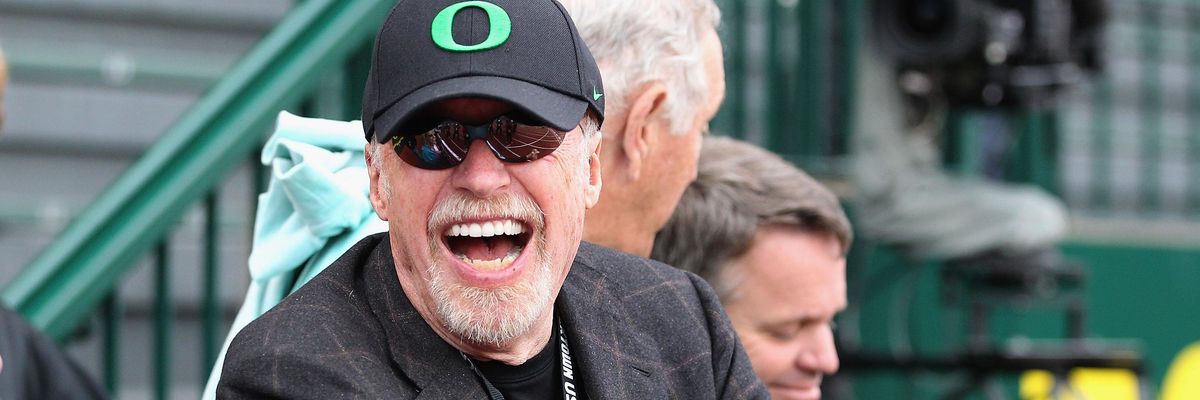
Co-founder and chairman of Nike, Phil Knight attends day nine of the U.S. Olympic Track & Field Team Trials at the Hayward Field on June 30, 2012 in Eugene, Oregon. (Photo: Christian Petersen/Getty Images)
Nike founder and billionaire Phil Knight, worth an estimated $58 billion according to Forbes, is the subject of an expose informed by research conducted by IPS associate fellow Bob Lord, published by Bloomberg Businessweek, along with terrific explanatory graphics.
Using public SEC filings and other publicly available data, Lord "reverse engineered" an analysis of Knight's tax planning techniques. Knight has already transferred about $10 billion in wealth free of estate and gift tax (avoiding roughly $3.6 billion in tax) and could avoid estate tax on up to an additional $9 billion if he died today, according to Bob Lord, in an interview with Inequality.org
The Bloomberg Businessweek article is "The Hidden Ways the Ultrarich Pass Wealth to Their Heirs Tax Free." While Knight has declared he intends to give most of his wealth to charity, the Bloomberg expose documents that for years, Knight has "been using a range of legal techniques to ensure his heirs keep control of most of his assets and profit from them in the process, quietly transferring vast piles of money in a textbook example of how the rich avoid taxes."
"Phil Knight's estate plan demonstrates beyond doubt that loopholes in America's estate and gift tax have rendered it useless," said Bob Lord in a statement to IPS and Inequality.org. "But this story is not about Phil Knight, it's about the abject failure of Congress to address this situation for several decades now. With Bloomberg's expose going to press at the same moment Congress is considering tax reform to fund vital social needs, we'll either see the loopholes closed once and for all or know the system is irreparably broken."
Knight has seen his fortunes almost double during the pandemic, according to an analysis of Forbes data by Americans for Tax Fairness and the Institute for Policy Studies. The value of Knight's assets increased from $29.5 billion in March 2020 to $57.9 billion on October 15, 2021, an increase of 96.4 percent.
Knight's wealth defense industry advisors created a series of Granter Retained Annuity Trusts (GRATs), a popular tax avoidance mechanism deployed by many of the super-wealthy, according to a recent expose by ProPublica.
As the Bloomberg article observes, GRATs "have the basic goal of making wealth look much smaller than it really is. It's possible to have your gifts appear to be worth almost nothing, even as you move millions or even billions of dollars tax-free." They "construct a legal fiction that this is a normal transaction and not a taxable gift to the trust."
IPS and Inequality.org feature an exclusive interview here with Bob Lord about this research (for the full extensive interview, see here).
Helen Flannery and I point out in this blog post how Knight's philanthropic activity mostly takes the form of donations to his own private family foundation of highly appreciated Nike stock. Billionaires like Phil Knight are the largest beneficiaries of the tax reductions provided in our tax code. As we've documented, for every dollar a billionaire like Phil Knight gives to charity, taxpayers chip in 74 cents in lost tax revenue. Yet for billionaires like Knight, charitable giving becomes an extension of their tax reduction planning and power and influence.
Phil Knight is the latest in a wave of disclosures, from the Pandora Papers to ProPublica's expose on billionaire tax avoidance, that point to the urgent need for Congressional lawmakers to ensure the wealthy pay their fair share.
Dear Common Dreams reader, It’s been nearly 30 years since I co-founded Common Dreams with my late wife, Lina Newhouser. We had the radical notion that journalism should serve the public good, not corporate profits. It was clear to us from the outset what it would take to build such a project. No paid advertisements. No corporate sponsors. No millionaire publisher telling us what to think or do. Many people said we wouldn't last a year, but we proved those doubters wrong. Together with a tremendous team of journalists and dedicated staff, we built an independent media outlet free from the constraints of profits and corporate control. Our mission has always been simple: To inform. To inspire. To ignite change for the common good. Building Common Dreams was not easy. Our survival was never guaranteed. When you take on the most powerful forces—Wall Street greed, fossil fuel industry destruction, Big Tech lobbyists, and uber-rich oligarchs who have spent billions upon billions rigging the economy and democracy in their favor—the only bulwark you have is supporters who believe in your work. But here’s the urgent message from me today. It's never been this bad out there. And it's never been this hard to keep us going. At the very moment Common Dreams is most needed, the threats we face are intensifying. We need your support now more than ever. We don't accept corporate advertising and never will. We don't have a paywall because we don't think people should be blocked from critical news based on their ability to pay. Everything we do is funded by the donations of readers like you. When everyone does the little they can afford, we are strong. But if that support retreats or dries up, so do we. Will you donate now to make sure Common Dreams not only survives but thrives? —Craig Brown, Co-founder |
Nike founder and billionaire Phil Knight, worth an estimated $58 billion according to Forbes, is the subject of an expose informed by research conducted by IPS associate fellow Bob Lord, published by Bloomberg Businessweek, along with terrific explanatory graphics.
Using public SEC filings and other publicly available data, Lord "reverse engineered" an analysis of Knight's tax planning techniques. Knight has already transferred about $10 billion in wealth free of estate and gift tax (avoiding roughly $3.6 billion in tax) and could avoid estate tax on up to an additional $9 billion if he died today, according to Bob Lord, in an interview with Inequality.org
The Bloomberg Businessweek article is "The Hidden Ways the Ultrarich Pass Wealth to Their Heirs Tax Free." While Knight has declared he intends to give most of his wealth to charity, the Bloomberg expose documents that for years, Knight has "been using a range of legal techniques to ensure his heirs keep control of most of his assets and profit from them in the process, quietly transferring vast piles of money in a textbook example of how the rich avoid taxes."
"Phil Knight's estate plan demonstrates beyond doubt that loopholes in America's estate and gift tax have rendered it useless," said Bob Lord in a statement to IPS and Inequality.org. "But this story is not about Phil Knight, it's about the abject failure of Congress to address this situation for several decades now. With Bloomberg's expose going to press at the same moment Congress is considering tax reform to fund vital social needs, we'll either see the loopholes closed once and for all or know the system is irreparably broken."
Knight has seen his fortunes almost double during the pandemic, according to an analysis of Forbes data by Americans for Tax Fairness and the Institute for Policy Studies. The value of Knight's assets increased from $29.5 billion in March 2020 to $57.9 billion on October 15, 2021, an increase of 96.4 percent.
Knight's wealth defense industry advisors created a series of Granter Retained Annuity Trusts (GRATs), a popular tax avoidance mechanism deployed by many of the super-wealthy, according to a recent expose by ProPublica.
As the Bloomberg article observes, GRATs "have the basic goal of making wealth look much smaller than it really is. It's possible to have your gifts appear to be worth almost nothing, even as you move millions or even billions of dollars tax-free." They "construct a legal fiction that this is a normal transaction and not a taxable gift to the trust."
IPS and Inequality.org feature an exclusive interview here with Bob Lord about this research (for the full extensive interview, see here).
Helen Flannery and I point out in this blog post how Knight's philanthropic activity mostly takes the form of donations to his own private family foundation of highly appreciated Nike stock. Billionaires like Phil Knight are the largest beneficiaries of the tax reductions provided in our tax code. As we've documented, for every dollar a billionaire like Phil Knight gives to charity, taxpayers chip in 74 cents in lost tax revenue. Yet for billionaires like Knight, charitable giving becomes an extension of their tax reduction planning and power and influence.
Phil Knight is the latest in a wave of disclosures, from the Pandora Papers to ProPublica's expose on billionaire tax avoidance, that point to the urgent need for Congressional lawmakers to ensure the wealthy pay their fair share.
Nike founder and billionaire Phil Knight, worth an estimated $58 billion according to Forbes, is the subject of an expose informed by research conducted by IPS associate fellow Bob Lord, published by Bloomberg Businessweek, along with terrific explanatory graphics.
Using public SEC filings and other publicly available data, Lord "reverse engineered" an analysis of Knight's tax planning techniques. Knight has already transferred about $10 billion in wealth free of estate and gift tax (avoiding roughly $3.6 billion in tax) and could avoid estate tax on up to an additional $9 billion if he died today, according to Bob Lord, in an interview with Inequality.org
The Bloomberg Businessweek article is "The Hidden Ways the Ultrarich Pass Wealth to Their Heirs Tax Free." While Knight has declared he intends to give most of his wealth to charity, the Bloomberg expose documents that for years, Knight has "been using a range of legal techniques to ensure his heirs keep control of most of his assets and profit from them in the process, quietly transferring vast piles of money in a textbook example of how the rich avoid taxes."
"Phil Knight's estate plan demonstrates beyond doubt that loopholes in America's estate and gift tax have rendered it useless," said Bob Lord in a statement to IPS and Inequality.org. "But this story is not about Phil Knight, it's about the abject failure of Congress to address this situation for several decades now. With Bloomberg's expose going to press at the same moment Congress is considering tax reform to fund vital social needs, we'll either see the loopholes closed once and for all or know the system is irreparably broken."
Knight has seen his fortunes almost double during the pandemic, according to an analysis of Forbes data by Americans for Tax Fairness and the Institute for Policy Studies. The value of Knight's assets increased from $29.5 billion in March 2020 to $57.9 billion on October 15, 2021, an increase of 96.4 percent.
Knight's wealth defense industry advisors created a series of Granter Retained Annuity Trusts (GRATs), a popular tax avoidance mechanism deployed by many of the super-wealthy, according to a recent expose by ProPublica.
As the Bloomberg article observes, GRATs "have the basic goal of making wealth look much smaller than it really is. It's possible to have your gifts appear to be worth almost nothing, even as you move millions or even billions of dollars tax-free." They "construct a legal fiction that this is a normal transaction and not a taxable gift to the trust."
IPS and Inequality.org feature an exclusive interview here with Bob Lord about this research (for the full extensive interview, see here).
Helen Flannery and I point out in this blog post how Knight's philanthropic activity mostly takes the form of donations to his own private family foundation of highly appreciated Nike stock. Billionaires like Phil Knight are the largest beneficiaries of the tax reductions provided in our tax code. As we've documented, for every dollar a billionaire like Phil Knight gives to charity, taxpayers chip in 74 cents in lost tax revenue. Yet for billionaires like Knight, charitable giving becomes an extension of their tax reduction planning and power and influence.
Phil Knight is the latest in a wave of disclosures, from the Pandora Papers to ProPublica's expose on billionaire tax avoidance, that point to the urgent need for Congressional lawmakers to ensure the wealthy pay their fair share.