SUBSCRIBE TO OUR FREE NEWSLETTER
Daily news & progressive opinion—funded by the people, not the corporations—delivered straight to your inbox.
5
#000000
#FFFFFF
To donate by check, phone, or other method, see our More Ways to Give page.
Daily news & progressive opinion—funded by the people, not the corporations—delivered straight to your inbox.
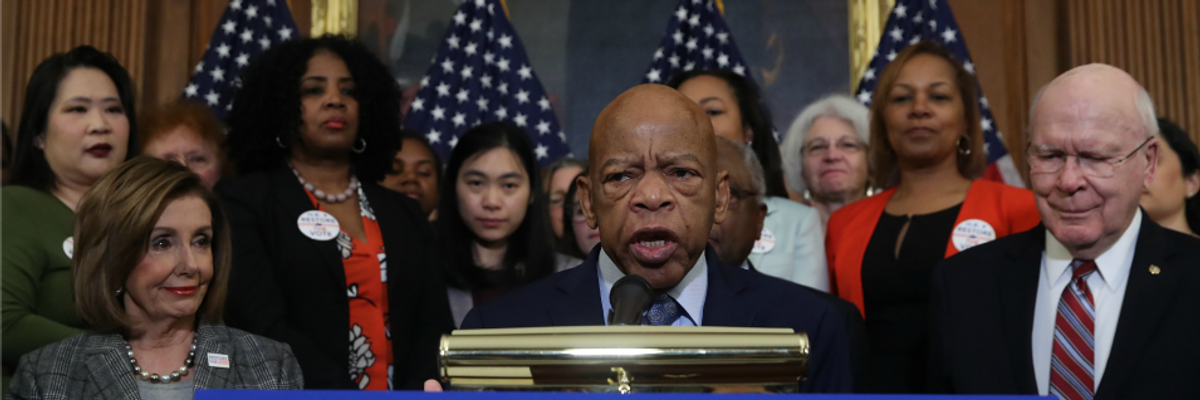
Rep. John Lewis (D-Ga.) speaks to the media ahead of the House voting on the H.R. 4, the Voting Rights Advancement Act, on December 6, 2019 in Washington, D.C. (Photo: Mark Wilson/Getty Images)
On Tuesday, Sens. Patrick Leahy (D-VT) and Dick Durbin (D-IL) introduced the John R. Lewis Voting Rights Advancement Act. In August, the House passed its version of this critical bill to shield American voters from racial discrimination at the ballot box. The goal of the legislation is to restore the Voting Rights Act of 1965 to its full protective glory. Right now, that landmark law's effectiveness has been undermined by two Supreme Court decisions.
The Senate now must do what the House already has--pass the bill. And once it clears Congress, President Biden should sign it immediately.
In 2013, the Court gutted the law's most powerful provision. Under Section 5, jurisdictions with a history of racial discrimination in voting had to get federal approval, or preclearance, before implementing changes to their voting policies. In Shelby County v. Holder, a majority of the Court said that the criteria for determining which jurisdictions engaged in discriminatory voting practices was outdated and didn't reflect the racial progress the country had made. Immediately afterward, jurisdictions once covered under preclearance started to aggressively implement new restrictive voting policies.
Then this summer, the Court also made it harder to challenge discriminatory voting laws under Section 2 of the Voting Rights Act. The majority did this by setting aside decades of precedent. Rather than examining the way that centuries of discrimination interact with a particular voting policy to produce discrimination at the ballot box (as courts have done for decades), the Supreme Court instead created new "guideposts" to determine if discrimination was serious enough for judges to get involved. These guideposts are skewed in a way that makes it much harder for courts to root out voting discrimination, chalking up real burdens to "mere inconveniences."
Despite these disastrous rulings, the Court in both instances said Congress could update and clarify Section 5 and Section 2 to root out race discrimination in voting. That's exactly what the John Lewis Voting Rights Act does, and it couldn't come at a more pivotal time.
This week, we updated our list of states that have enacted voting restrictions over the last year. At least 19 states have passed 33 laws in 2021 that make it harder to vote. Before Shelby, some of these states--Georgia and Texas, for example--had to clear their changes with the Justice Department or a federal judge before putting them into practice. These laws are on top of laws enacted since the Shelby decision that create layers upon layers of voting restrictions, many of which probably wouldn't have survived preclearance. These barriers once again add up to what President Lyndon Johnson described as "ingenious discrimination" when he called on Congress to pass the Voting Rights Act of 1965.
The John Lewis Voting Rights Act is crafted to put an end to this nonsense. First, the new preclearance formula only targets jurisdictions with a current, persistent, and pervasive history of racial discrimination in voting proven by repeated violations of federal law. Second, by strengthening Section 2, the bill restores the ability of voters to challenge racially discriminatory voting practices in jurisdictions not covered by the new preclearance formula.
When the Shelby ruling came down, the late great Justice Ruth Bader Ginsburg famously wrote in dissent: "Throwing out preclearance when it has worked and is continuing to work to stop discriminatory changes is like throwing away your umbrella in a rainstorm because you are not getting wet." With the John Lewis Voting Rights Act, Congress has written legislation that gives the courts an improved tool to help protect voters of color from the deluge of voter suppression laws that are now commonplace across the country.
The Senate now must do what the House already has--pass the bill. And once it clears Congress, President Biden should sign it immediately. Otherwise, our election rules will once again make a mockery of our democracy's most sacred promise: one person, one vote.
Dear Common Dreams reader, It’s been nearly 30 years since I co-founded Common Dreams with my late wife, Lina Newhouser. We had the radical notion that journalism should serve the public good, not corporate profits. It was clear to us from the outset what it would take to build such a project. No paid advertisements. No corporate sponsors. No millionaire publisher telling us what to think or do. Many people said we wouldn't last a year, but we proved those doubters wrong. Together with a tremendous team of journalists and dedicated staff, we built an independent media outlet free from the constraints of profits and corporate control. Our mission has always been simple: To inform. To inspire. To ignite change for the common good. Building Common Dreams was not easy. Our survival was never guaranteed. When you take on the most powerful forces—Wall Street greed, fossil fuel industry destruction, Big Tech lobbyists, and uber-rich oligarchs who have spent billions upon billions rigging the economy and democracy in their favor—the only bulwark you have is supporters who believe in your work. But here’s the urgent message from me today. It's never been this bad out there. And it's never been this hard to keep us going. At the very moment Common Dreams is most needed, the threats we face are intensifying. We need your support now more than ever. We don't accept corporate advertising and never will. We don't have a paywall because we don't think people should be blocked from critical news based on their ability to pay. Everything we do is funded by the donations of readers like you. When everyone does the little they can afford, we are strong. But if that support retreats or dries up, so do we. Will you donate now to make sure Common Dreams not only survives but thrives? —Craig Brown, Co-founder |
On Tuesday, Sens. Patrick Leahy (D-VT) and Dick Durbin (D-IL) introduced the John R. Lewis Voting Rights Advancement Act. In August, the House passed its version of this critical bill to shield American voters from racial discrimination at the ballot box. The goal of the legislation is to restore the Voting Rights Act of 1965 to its full protective glory. Right now, that landmark law's effectiveness has been undermined by two Supreme Court decisions.
The Senate now must do what the House already has--pass the bill. And once it clears Congress, President Biden should sign it immediately.
In 2013, the Court gutted the law's most powerful provision. Under Section 5, jurisdictions with a history of racial discrimination in voting had to get federal approval, or preclearance, before implementing changes to their voting policies. In Shelby County v. Holder, a majority of the Court said that the criteria for determining which jurisdictions engaged in discriminatory voting practices was outdated and didn't reflect the racial progress the country had made. Immediately afterward, jurisdictions once covered under preclearance started to aggressively implement new restrictive voting policies.
Then this summer, the Court also made it harder to challenge discriminatory voting laws under Section 2 of the Voting Rights Act. The majority did this by setting aside decades of precedent. Rather than examining the way that centuries of discrimination interact with a particular voting policy to produce discrimination at the ballot box (as courts have done for decades), the Supreme Court instead created new "guideposts" to determine if discrimination was serious enough for judges to get involved. These guideposts are skewed in a way that makes it much harder for courts to root out voting discrimination, chalking up real burdens to "mere inconveniences."
Despite these disastrous rulings, the Court in both instances said Congress could update and clarify Section 5 and Section 2 to root out race discrimination in voting. That's exactly what the John Lewis Voting Rights Act does, and it couldn't come at a more pivotal time.
This week, we updated our list of states that have enacted voting restrictions over the last year. At least 19 states have passed 33 laws in 2021 that make it harder to vote. Before Shelby, some of these states--Georgia and Texas, for example--had to clear their changes with the Justice Department or a federal judge before putting them into practice. These laws are on top of laws enacted since the Shelby decision that create layers upon layers of voting restrictions, many of which probably wouldn't have survived preclearance. These barriers once again add up to what President Lyndon Johnson described as "ingenious discrimination" when he called on Congress to pass the Voting Rights Act of 1965.
The John Lewis Voting Rights Act is crafted to put an end to this nonsense. First, the new preclearance formula only targets jurisdictions with a current, persistent, and pervasive history of racial discrimination in voting proven by repeated violations of federal law. Second, by strengthening Section 2, the bill restores the ability of voters to challenge racially discriminatory voting practices in jurisdictions not covered by the new preclearance formula.
When the Shelby ruling came down, the late great Justice Ruth Bader Ginsburg famously wrote in dissent: "Throwing out preclearance when it has worked and is continuing to work to stop discriminatory changes is like throwing away your umbrella in a rainstorm because you are not getting wet." With the John Lewis Voting Rights Act, Congress has written legislation that gives the courts an improved tool to help protect voters of color from the deluge of voter suppression laws that are now commonplace across the country.
The Senate now must do what the House already has--pass the bill. And once it clears Congress, President Biden should sign it immediately. Otherwise, our election rules will once again make a mockery of our democracy's most sacred promise: one person, one vote.
On Tuesday, Sens. Patrick Leahy (D-VT) and Dick Durbin (D-IL) introduced the John R. Lewis Voting Rights Advancement Act. In August, the House passed its version of this critical bill to shield American voters from racial discrimination at the ballot box. The goal of the legislation is to restore the Voting Rights Act of 1965 to its full protective glory. Right now, that landmark law's effectiveness has been undermined by two Supreme Court decisions.
The Senate now must do what the House already has--pass the bill. And once it clears Congress, President Biden should sign it immediately.
In 2013, the Court gutted the law's most powerful provision. Under Section 5, jurisdictions with a history of racial discrimination in voting had to get federal approval, or preclearance, before implementing changes to their voting policies. In Shelby County v. Holder, a majority of the Court said that the criteria for determining which jurisdictions engaged in discriminatory voting practices was outdated and didn't reflect the racial progress the country had made. Immediately afterward, jurisdictions once covered under preclearance started to aggressively implement new restrictive voting policies.
Then this summer, the Court also made it harder to challenge discriminatory voting laws under Section 2 of the Voting Rights Act. The majority did this by setting aside decades of precedent. Rather than examining the way that centuries of discrimination interact with a particular voting policy to produce discrimination at the ballot box (as courts have done for decades), the Supreme Court instead created new "guideposts" to determine if discrimination was serious enough for judges to get involved. These guideposts are skewed in a way that makes it much harder for courts to root out voting discrimination, chalking up real burdens to "mere inconveniences."
Despite these disastrous rulings, the Court in both instances said Congress could update and clarify Section 5 and Section 2 to root out race discrimination in voting. That's exactly what the John Lewis Voting Rights Act does, and it couldn't come at a more pivotal time.
This week, we updated our list of states that have enacted voting restrictions over the last year. At least 19 states have passed 33 laws in 2021 that make it harder to vote. Before Shelby, some of these states--Georgia and Texas, for example--had to clear their changes with the Justice Department or a federal judge before putting them into practice. These laws are on top of laws enacted since the Shelby decision that create layers upon layers of voting restrictions, many of which probably wouldn't have survived preclearance. These barriers once again add up to what President Lyndon Johnson described as "ingenious discrimination" when he called on Congress to pass the Voting Rights Act of 1965.
The John Lewis Voting Rights Act is crafted to put an end to this nonsense. First, the new preclearance formula only targets jurisdictions with a current, persistent, and pervasive history of racial discrimination in voting proven by repeated violations of federal law. Second, by strengthening Section 2, the bill restores the ability of voters to challenge racially discriminatory voting practices in jurisdictions not covered by the new preclearance formula.
When the Shelby ruling came down, the late great Justice Ruth Bader Ginsburg famously wrote in dissent: "Throwing out preclearance when it has worked and is continuing to work to stop discriminatory changes is like throwing away your umbrella in a rainstorm because you are not getting wet." With the John Lewis Voting Rights Act, Congress has written legislation that gives the courts an improved tool to help protect voters of color from the deluge of voter suppression laws that are now commonplace across the country.
The Senate now must do what the House already has--pass the bill. And once it clears Congress, President Biden should sign it immediately. Otherwise, our election rules will once again make a mockery of our democracy's most sacred promise: one person, one vote.