SUBSCRIBE TO OUR FREE NEWSLETTER
Daily news & progressive opinion—funded by the people, not the corporations—delivered straight to your inbox.
5
#000000
#FFFFFF
To donate by check, phone, or other method, see our More Ways to Give page.
Daily news & progressive opinion—funded by the people, not the corporations—delivered straight to your inbox.

Nearly 70 years after the vampire-infested dystopian book I Am Legend was written, writes Eskow, "a global epidemic has taken millions of lives and created long-term health problems in millions of other people." (Photo: Shutterstock)
Richard Matheson's 1954 novel I Am Legend imagines a world where a global epidemic has turned every human being on Earth except one into a vampire. The novel's scientist-hero hides by night and roams the countryside by day, when the vampires are asleep, searching for a cure and killing them wherever he finds them.
Nearly 70 years after that book was written, a global epidemic has taken millions of lives and created long-term health problems in millions of other people. But the innocent infected aren't the vampires in this story. We are. We hold the ability to save millions of people from the ravages of this disease. Instead, our political leaders are in the thrall of pharmaceutical interests who have blocked efforts to share lifesaving vaccines with the world. They, and we, are draining wealth and life from the poorer countries of this planet in the relentless pursuit of profit.
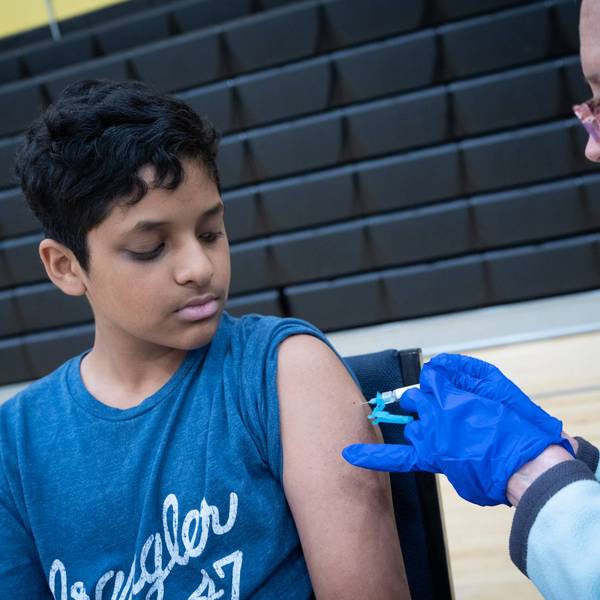
A recent report shows that only 1.9 percent of people in low-income countries--less than one in 50--had received at least one dose of a Covid-19 vaccine, versus 63 percent of people in the U.S. and 71 percent in the United Kingdom. (The U.S. figures would be higher if not for vaccine misinformation.) As a result, 100 million vaccine doses are due to expire in wealthy countries while poorer nations do without. Vaccine hoarding is draining the life from the less wealthy peoples of the world.
Months ago, the Biden Administration made the surprising and welcome announcement that it wanted to lift patent waivers on Covid-19 vaccines, making their technology available to other nations so they could manufacture them for themselves. This was not a reckless idea, as some industry spokespeople have claimed. Both India and South Africa already manufacture medications for other countries. And yet, as Cole Stanger reports for the Daily Poster, four months later the administration has taken no action to back up its pledge--even though, as Sam Mellins reports, it may have the right to do so unilaterally.
Biden's global vaccination goals are "woefully inadequate," according to experts, and "downplay the obligations of rich countries to reverse the horrific consequences of vaccine, testing, and therapeutics apartheid that they--and the biopharmaceutical industry--have engendered."
In a speech to the UN General Assembly, Peruvian President Pedro Castillo called for "equity in access to vaccines and an agreement "between heads of state and the owners of patents to guarantee universal access to vaccines for all people on the planet, with no discrimination on the basis of privilege."
Rep. Mark Pocan has introduced a bill that would redirect 1.3 percent of the US military budget, or $9.6 billion, to vaccinating another 30 percent of the world's population in the coming year. That is a good first step. It's also a reminder that our national security is strengthened more by this kind of effort than it is by buying costly weapons systems.
Reps. Pramila Jayapal, Tom Malinowski, and Raja Krishnamoorthi have introduced a bill with Sens. Jeff Merkley, Elizabeth Warren, and Ed Markey which would provide as much as $34 billion to "significantly accelerate the production of COVID-19 vaccines for global distribution."
This figure is roughly consistent with the conclusions reached by Public Citizen, whose report found that "a $25 billion investment in vaccine production by the U.S. government would produce enough vaccine for low- and middle-income countries (within) one year."
After the UN summit, Nick Dearden of the U.K.-based group Global Justice Now, said "the Global South demanded vaccine justice in stark terms at the U.N. today."
At the conclusion of Matheson's novel, the protagonist finally sees that the world has changed and he hasn't. With that, he realizes that he is the villain of the story. Children of the new era will be told his story--the story of a frightening creature who hunted innocent people and killed them while they slept.
For now, Dearden gets the last word on our vaccine hoarding. "This obscene inequality will not be forgotten quickly," he said. He's right. Unless we act now, we will be remembered like Matheson's protagonist in the story, haunting the dreams of the future and cursed by generations to come.
Dear Common Dreams reader, It’s been nearly 30 years since I co-founded Common Dreams with my late wife, Lina Newhouser. We had the radical notion that journalism should serve the public good, not corporate profits. It was clear to us from the outset what it would take to build such a project. No paid advertisements. No corporate sponsors. No millionaire publisher telling us what to think or do. Many people said we wouldn't last a year, but we proved those doubters wrong. Together with a tremendous team of journalists and dedicated staff, we built an independent media outlet free from the constraints of profits and corporate control. Our mission has always been simple: To inform. To inspire. To ignite change for the common good. Building Common Dreams was not easy. Our survival was never guaranteed. When you take on the most powerful forces—Wall Street greed, fossil fuel industry destruction, Big Tech lobbyists, and uber-rich oligarchs who have spent billions upon billions rigging the economy and democracy in their favor—the only bulwark you have is supporters who believe in your work. But here’s the urgent message from me today. It's never been this bad out there. And it's never been this hard to keep us going. At the very moment Common Dreams is most needed, the threats we face are intensifying. We need your support now more than ever. We don't accept corporate advertising and never will. We don't have a paywall because we don't think people should be blocked from critical news based on their ability to pay. Everything we do is funded by the donations of readers like you. When everyone does the little they can afford, we are strong. But if that support retreats or dries up, so do we. Will you donate now to make sure Common Dreams not only survives but thrives? —Craig Brown, Co-founder |
Richard (RJ) Eskow is a journalist who has written for a number of major publications. His weekly program, The Zero Hour, can be found on cable television, radio, Spotify, and podcast media.
Richard Matheson's 1954 novel I Am Legend imagines a world where a global epidemic has turned every human being on Earth except one into a vampire. The novel's scientist-hero hides by night and roams the countryside by day, when the vampires are asleep, searching for a cure and killing them wherever he finds them.
Nearly 70 years after that book was written, a global epidemic has taken millions of lives and created long-term health problems in millions of other people. But the innocent infected aren't the vampires in this story. We are. We hold the ability to save millions of people from the ravages of this disease. Instead, our political leaders are in the thrall of pharmaceutical interests who have blocked efforts to share lifesaving vaccines with the world. They, and we, are draining wealth and life from the poorer countries of this planet in the relentless pursuit of profit.
A recent report shows that only 1.9 percent of people in low-income countries--less than one in 50--had received at least one dose of a Covid-19 vaccine, versus 63 percent of people in the U.S. and 71 percent in the United Kingdom. (The U.S. figures would be higher if not for vaccine misinformation.) As a result, 100 million vaccine doses are due to expire in wealthy countries while poorer nations do without. Vaccine hoarding is draining the life from the less wealthy peoples of the world.
Months ago, the Biden Administration made the surprising and welcome announcement that it wanted to lift patent waivers on Covid-19 vaccines, making their technology available to other nations so they could manufacture them for themselves. This was not a reckless idea, as some industry spokespeople have claimed. Both India and South Africa already manufacture medications for other countries. And yet, as Cole Stanger reports for the Daily Poster, four months later the administration has taken no action to back up its pledge--even though, as Sam Mellins reports, it may have the right to do so unilaterally.
Biden's global vaccination goals are "woefully inadequate," according to experts, and "downplay the obligations of rich countries to reverse the horrific consequences of vaccine, testing, and therapeutics apartheid that they--and the biopharmaceutical industry--have engendered."
In a speech to the UN General Assembly, Peruvian President Pedro Castillo called for "equity in access to vaccines and an agreement "between heads of state and the owners of patents to guarantee universal access to vaccines for all people on the planet, with no discrimination on the basis of privilege."
Rep. Mark Pocan has introduced a bill that would redirect 1.3 percent of the US military budget, or $9.6 billion, to vaccinating another 30 percent of the world's population in the coming year. That is a good first step. It's also a reminder that our national security is strengthened more by this kind of effort than it is by buying costly weapons systems.
Reps. Pramila Jayapal, Tom Malinowski, and Raja Krishnamoorthi have introduced a bill with Sens. Jeff Merkley, Elizabeth Warren, and Ed Markey which would provide as much as $34 billion to "significantly accelerate the production of COVID-19 vaccines for global distribution."
This figure is roughly consistent with the conclusions reached by Public Citizen, whose report found that "a $25 billion investment in vaccine production by the U.S. government would produce enough vaccine for low- and middle-income countries (within) one year."
After the UN summit, Nick Dearden of the U.K.-based group Global Justice Now, said "the Global South demanded vaccine justice in stark terms at the U.N. today."
At the conclusion of Matheson's novel, the protagonist finally sees that the world has changed and he hasn't. With that, he realizes that he is the villain of the story. Children of the new era will be told his story--the story of a frightening creature who hunted innocent people and killed them while they slept.
For now, Dearden gets the last word on our vaccine hoarding. "This obscene inequality will not be forgotten quickly," he said. He's right. Unless we act now, we will be remembered like Matheson's protagonist in the story, haunting the dreams of the future and cursed by generations to come.
Richard (RJ) Eskow is a journalist who has written for a number of major publications. His weekly program, The Zero Hour, can be found on cable television, radio, Spotify, and podcast media.
Richard Matheson's 1954 novel I Am Legend imagines a world where a global epidemic has turned every human being on Earth except one into a vampire. The novel's scientist-hero hides by night and roams the countryside by day, when the vampires are asleep, searching for a cure and killing them wherever he finds them.
Nearly 70 years after that book was written, a global epidemic has taken millions of lives and created long-term health problems in millions of other people. But the innocent infected aren't the vampires in this story. We are. We hold the ability to save millions of people from the ravages of this disease. Instead, our political leaders are in the thrall of pharmaceutical interests who have blocked efforts to share lifesaving vaccines with the world. They, and we, are draining wealth and life from the poorer countries of this planet in the relentless pursuit of profit.
A recent report shows that only 1.9 percent of people in low-income countries--less than one in 50--had received at least one dose of a Covid-19 vaccine, versus 63 percent of people in the U.S. and 71 percent in the United Kingdom. (The U.S. figures would be higher if not for vaccine misinformation.) As a result, 100 million vaccine doses are due to expire in wealthy countries while poorer nations do without. Vaccine hoarding is draining the life from the less wealthy peoples of the world.
Months ago, the Biden Administration made the surprising and welcome announcement that it wanted to lift patent waivers on Covid-19 vaccines, making their technology available to other nations so they could manufacture them for themselves. This was not a reckless idea, as some industry spokespeople have claimed. Both India and South Africa already manufacture medications for other countries. And yet, as Cole Stanger reports for the Daily Poster, four months later the administration has taken no action to back up its pledge--even though, as Sam Mellins reports, it may have the right to do so unilaterally.
Biden's global vaccination goals are "woefully inadequate," according to experts, and "downplay the obligations of rich countries to reverse the horrific consequences of vaccine, testing, and therapeutics apartheid that they--and the biopharmaceutical industry--have engendered."
In a speech to the UN General Assembly, Peruvian President Pedro Castillo called for "equity in access to vaccines and an agreement "between heads of state and the owners of patents to guarantee universal access to vaccines for all people on the planet, with no discrimination on the basis of privilege."
Rep. Mark Pocan has introduced a bill that would redirect 1.3 percent of the US military budget, or $9.6 billion, to vaccinating another 30 percent of the world's population in the coming year. That is a good first step. It's also a reminder that our national security is strengthened more by this kind of effort than it is by buying costly weapons systems.
Reps. Pramila Jayapal, Tom Malinowski, and Raja Krishnamoorthi have introduced a bill with Sens. Jeff Merkley, Elizabeth Warren, and Ed Markey which would provide as much as $34 billion to "significantly accelerate the production of COVID-19 vaccines for global distribution."
This figure is roughly consistent with the conclusions reached by Public Citizen, whose report found that "a $25 billion investment in vaccine production by the U.S. government would produce enough vaccine for low- and middle-income countries (within) one year."
After the UN summit, Nick Dearden of the U.K.-based group Global Justice Now, said "the Global South demanded vaccine justice in stark terms at the U.N. today."
At the conclusion of Matheson's novel, the protagonist finally sees that the world has changed and he hasn't. With that, he realizes that he is the villain of the story. Children of the new era will be told his story--the story of a frightening creature who hunted innocent people and killed them while they slept.
For now, Dearden gets the last word on our vaccine hoarding. "This obscene inequality will not be forgotten quickly," he said. He's right. Unless we act now, we will be remembered like Matheson's protagonist in the story, haunting the dreams of the future and cursed by generations to come.