SUBSCRIBE TO OUR FREE NEWSLETTER
Daily news & progressive opinion—funded by the people, not the corporations—delivered straight to your inbox.
5
#000000
#FFFFFF
To donate by check, phone, or other method, see our More Ways to Give page.


Daily news & progressive opinion—funded by the people, not the corporations—delivered straight to your inbox.

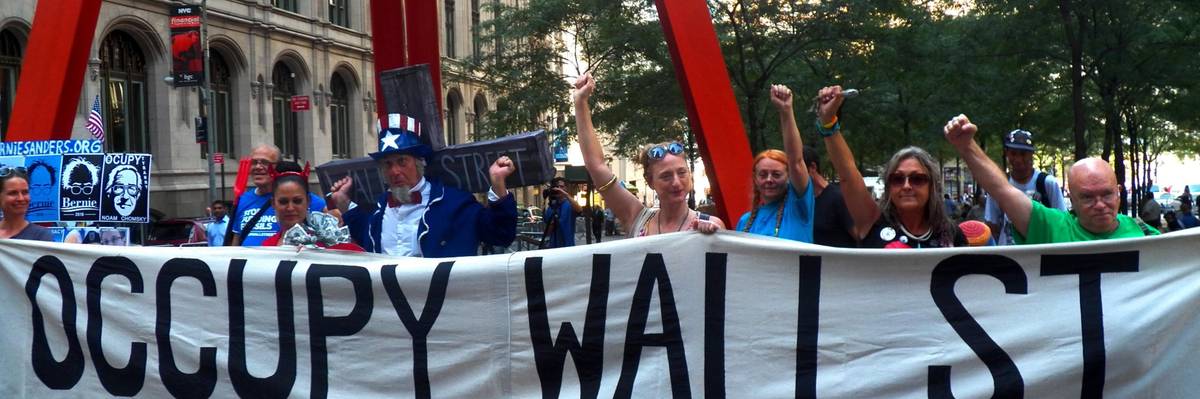
The activists bring banner and shout slogans as they gather during the 4th Anniversary of Occupy Wall Street. Occupy Wall Street is a cultural and social movement started in 2011, to offer alternatives to what is seen as the corrosive influences of the current global financial architecture and multinational corporate policy over the democratic process. (Photo: Mark Apollo/Pacific Press/LightRocket via Getty Images)
Ten years ago, young people set up camp in New York City's Zuccotti Park to protest rampant economic inequality and outsized corporate influence on our democracy. The Occupy Wall Street movement quickly spread to other U.S. cities but lost steam before it made a meaningful mark on policy.
Still, its enduring legacy--the slogan "We Are the 99 percent," -- heightened awareness of gross inequities in our political and economic systems.
Progressive taxation enables a public sector that can deliver us from the economic, health and climate emergencies that scream from the headlines every day in 2021.
The country emerged from the 2007-2009 recession to a long, slow recovery. At the time of the Occupy movement in 2011, unemployment was still rising, the poverty rate hovered at 15 percent and people were losing their homes. The typical family lost 40 percent of its wealth, with much deeper pain for poorer households and communities of color. All while Wall Street came roaring back.
Occupy protesters look prescient now. During the early days of the pandemic and recession, unemployment spiked faster than in any year since 1939. Yet billionaires added $1.8 trillion to their wealth from March 2020 to August 2021.
This systemic unfairness was at the heart of the Occupy protests in the fall of 2011. The financial industry helped wreck the economy, and our government worked to make them whole with no real strings attached. They didn't have to pay their workers better. They didn't have to curb executive compensation. We, collectively, didn't demand better corporate citizenship.
In 2017, elected officials made the same mistake. The Republican Congress gave enormous corporate tax cuts and promised--it turned out falsely--that companies would use their tax breaks to invest in America. Instead, these companies largely rewarded their shareholders and executives. Stock buybacks reached record levels in 2018 and 2019, and corporate tax payments shrunk. My colleagues released a report this year that found 39 profitable Fortune 500 corporations paid zero in taxes on average from 2018 to 2020 despite earning $122 billion over that period. Fifty-five profitable corporations avoided federal income tax in 2020.
In 2021, many people better understand the crucial role of government and what it means when it works and when it doesn't. Government action made poverty go down in 2020 (when measured after benefits) in the face of an unemployment spike at Depression levels. Government funding delivered a vaccine at "warp speed" and government action ensured that millions of adults who wanted the vaccine could get it within months after it became available.
We need an economy that works for all of us. And we need a government that can tackle our problems. This starts with tax policy that raises resources from the millionaires and billionaires who continue to thrive in an increasingly unequal America.
Progressive taxation enables a public sector that can deliver us from the economic, health and climate emergencies that scream from the headlines every day in 2021. President Biden has put forth a tax plan that begins to do that. Congress must deliver.

Dear Common Dreams reader, It’s been nearly 30 years since I co-founded Common Dreams with my late wife, Lina Newhouser. We had the radical notion that journalism should serve the public good, not corporate profits. It was clear to us from the outset what it would take to build such a project. No paid advertisements. No corporate sponsors. No millionaire publisher telling us what to think or do. Many people said we wouldn't last a year, but we proved those doubters wrong. Together with a tremendous team of journalists and dedicated staff, we built an independent media outlet free from the constraints of profits and corporate control. Our mission has always been simple: To inform. To inspire. To ignite change for the common good. Building Common Dreams was not easy. Our survival was never guaranteed. When you take on the most powerful forces—Wall Street greed, fossil fuel industry destruction, Big Tech lobbyists, and uber-rich oligarchs who have spent billions upon billions rigging the economy and democracy in their favor—the only bulwark you have is supporters who believe in your work. But here’s the urgent message from me today. It's never been this bad out there. And it's never been this hard to keep us going. At the very moment Common Dreams is most needed, the threats we face are intensifying. We need your support now more than ever. We don't accept corporate advertising and never will. We don't have a paywall because we don't think people should be blocked from critical news based on their ability to pay. Everything we do is funded by the donations of readers like you. When everyone does the little they can afford, we are strong. But if that support retreats or dries up, so do we. Will you donate now to make sure Common Dreams not only survives but thrives? —Craig Brown, Co-founder |
Ten years ago, young people set up camp in New York City's Zuccotti Park to protest rampant economic inequality and outsized corporate influence on our democracy. The Occupy Wall Street movement quickly spread to other U.S. cities but lost steam before it made a meaningful mark on policy.
Still, its enduring legacy--the slogan "We Are the 99 percent," -- heightened awareness of gross inequities in our political and economic systems.
Progressive taxation enables a public sector that can deliver us from the economic, health and climate emergencies that scream from the headlines every day in 2021.
The country emerged from the 2007-2009 recession to a long, slow recovery. At the time of the Occupy movement in 2011, unemployment was still rising, the poverty rate hovered at 15 percent and people were losing their homes. The typical family lost 40 percent of its wealth, with much deeper pain for poorer households and communities of color. All while Wall Street came roaring back.
Occupy protesters look prescient now. During the early days of the pandemic and recession, unemployment spiked faster than in any year since 1939. Yet billionaires added $1.8 trillion to their wealth from March 2020 to August 2021.
This systemic unfairness was at the heart of the Occupy protests in the fall of 2011. The financial industry helped wreck the economy, and our government worked to make them whole with no real strings attached. They didn't have to pay their workers better. They didn't have to curb executive compensation. We, collectively, didn't demand better corporate citizenship.
In 2017, elected officials made the same mistake. The Republican Congress gave enormous corporate tax cuts and promised--it turned out falsely--that companies would use their tax breaks to invest in America. Instead, these companies largely rewarded their shareholders and executives. Stock buybacks reached record levels in 2018 and 2019, and corporate tax payments shrunk. My colleagues released a report this year that found 39 profitable Fortune 500 corporations paid zero in taxes on average from 2018 to 2020 despite earning $122 billion over that period. Fifty-five profitable corporations avoided federal income tax in 2020.
In 2021, many people better understand the crucial role of government and what it means when it works and when it doesn't. Government action made poverty go down in 2020 (when measured after benefits) in the face of an unemployment spike at Depression levels. Government funding delivered a vaccine at "warp speed" and government action ensured that millions of adults who wanted the vaccine could get it within months after it became available.
We need an economy that works for all of us. And we need a government that can tackle our problems. This starts with tax policy that raises resources from the millionaires and billionaires who continue to thrive in an increasingly unequal America.
Progressive taxation enables a public sector that can deliver us from the economic, health and climate emergencies that scream from the headlines every day in 2021. President Biden has put forth a tax plan that begins to do that. Congress must deliver.
Ten years ago, young people set up camp in New York City's Zuccotti Park to protest rampant economic inequality and outsized corporate influence on our democracy. The Occupy Wall Street movement quickly spread to other U.S. cities but lost steam before it made a meaningful mark on policy.
Still, its enduring legacy--the slogan "We Are the 99 percent," -- heightened awareness of gross inequities in our political and economic systems.
Progressive taxation enables a public sector that can deliver us from the economic, health and climate emergencies that scream from the headlines every day in 2021.
The country emerged from the 2007-2009 recession to a long, slow recovery. At the time of the Occupy movement in 2011, unemployment was still rising, the poverty rate hovered at 15 percent and people were losing their homes. The typical family lost 40 percent of its wealth, with much deeper pain for poorer households and communities of color. All while Wall Street came roaring back.
Occupy protesters look prescient now. During the early days of the pandemic and recession, unemployment spiked faster than in any year since 1939. Yet billionaires added $1.8 trillion to their wealth from March 2020 to August 2021.
This systemic unfairness was at the heart of the Occupy protests in the fall of 2011. The financial industry helped wreck the economy, and our government worked to make them whole with no real strings attached. They didn't have to pay their workers better. They didn't have to curb executive compensation. We, collectively, didn't demand better corporate citizenship.
In 2017, elected officials made the same mistake. The Republican Congress gave enormous corporate tax cuts and promised--it turned out falsely--that companies would use their tax breaks to invest in America. Instead, these companies largely rewarded their shareholders and executives. Stock buybacks reached record levels in 2018 and 2019, and corporate tax payments shrunk. My colleagues released a report this year that found 39 profitable Fortune 500 corporations paid zero in taxes on average from 2018 to 2020 despite earning $122 billion over that period. Fifty-five profitable corporations avoided federal income tax in 2020.
In 2021, many people better understand the crucial role of government and what it means when it works and when it doesn't. Government action made poverty go down in 2020 (when measured after benefits) in the face of an unemployment spike at Depression levels. Government funding delivered a vaccine at "warp speed" and government action ensured that millions of adults who wanted the vaccine could get it within months after it became available.
We need an economy that works for all of us. And we need a government that can tackle our problems. This starts with tax policy that raises resources from the millionaires and billionaires who continue to thrive in an increasingly unequal America.
Progressive taxation enables a public sector that can deliver us from the economic, health and climate emergencies that scream from the headlines every day in 2021. President Biden has put forth a tax plan that begins to do that. Congress must deliver.