

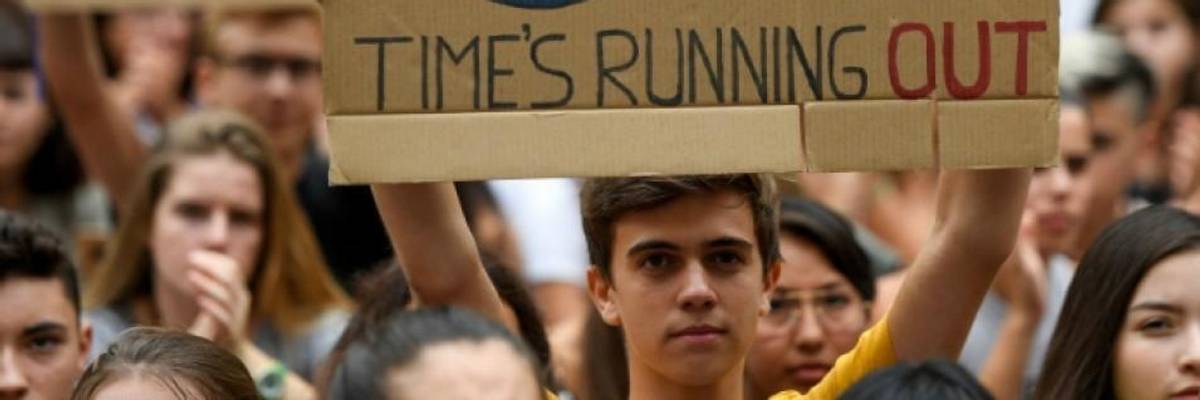
A demonstrator holds a placard reading "time is running out" during a global youth climate action strike in Barcelona, on September 27, 2019 at the end of a global climate change week. (Photo: Josep Lago/AFP via Getty Images)
Children Around the World Are Suffering From Climate Anxiety
Largest scientific study of its kind finds climate anxiety affects the daily life and functioning of nearly half of children and young people surveyed globally.
Climate anxiety and distress is affecting the daily lives and functioning of nearly half of global youth surveyed, according to the largest scientific study.
A total of 75 percent of young respondents believe 'the future is frightening,' according to a report currently under peer review in the scientific journal Lancet Planetary Health. This includes 72 percent of youth in the UK but jumping to 81 percent in Portugal and 92 percent in the Philippines.
The inaugural study, based on surveys with 10,000 children and young people aged between 16 and 25 across 10 countries. Further, 38 percent of young respondents from the UK said they were "hesitant to have children," while 57 percent said governments were "betraying me and/or future generations."
Distress
Mitzi Tan, 23, from the Philippines, said: "I grew up being afraid of drowning in my own bedroom. Society tells me that this anxiety is an irrational fear that needs to be overcome--one that meditation and healthy coping mechanisms will 'fix.'
"At its root, our climate anxiety comes from this deep-set feeling of betrayal because of government inaction. To truly address our growing climate anxiety, we need justice."
The study, carried out by academics from a range of institutions has been released weeks before the UK hosts the UN Climate Change Conference of the Parties (COP26) in Glasgow.
It found--for the first time--that climate distress and anxiety is significantly related to perceived government inaction and associated feelings of betrayal.
Caroline Hickman, from the University of Bath, Climate Psychology Alliance and co-lead author on the study said: "This study paints a horrific picture of widespread climate anxiety in our children and young people. It suggests for the first time that high levels of psychological distress in youth is linked to government inaction."
Damaging
The study found widespread psychological distress among children and young people globally and warns "such high levels of distress, functional impact and feelings of betrayal will negatively affect the mental health of children and young people."
More than half of respondents said they had felt afraid, sad, anxious, angry, powerless, helpless, and/or guilty.
Beth Irving, a 19-year-old climate activist from Cardiff, said: "When I was 16... I went through phases of feeling utterly helpless in face of this immense problem, and then would launch myself into organising protests or changing things within my school.
"To put so much energy into something and then see so little real life impact was exhausting; I had many occasions where I would hide myself away and think "None of this is enough."
"It's so damaging to put this problem on the shoulders of young people--hope needs to come instead from palpable structural action."
Violation
Experts warn that because continued government inaction on climate change is psychologically damaging, it potentially amounts to a violation of international human rights law.
The study concludes that governments must respond to "protect the mental health of children and young people by engaging in ethical, collective, policy-based action against climate change."
The research comes after UNICEF released a report into the physical threat climate change poses to children, with one billion children at 'extremely high risk' of the impacts of the climate crisis.
Dr Liz Marks, from the University of Bath and co-lead author on the study, said: "It's shocking to hear how so many young people from around the world feel betrayed by those who are supposed to protect them.
"Now is the time to face the truth, listen to young people, and take urgent action against climate change."
An Urgent Message From Our Co-Founder
Dear Common Dreams reader, It’s been nearly 30 years since I co-founded Common Dreams with my late wife, Lina Newhouser. We had the radical notion that journalism should serve the public good, not corporate profits. It was clear to us from the outset what it would take to build such a project. No paid advertisements. No corporate sponsors. No millionaire publisher telling us what to think or do. Many people said we wouldn't last a year, but we proved those doubters wrong. Together with a tremendous team of journalists and dedicated staff, we built an independent media outlet free from the constraints of profits and corporate control. Our mission has always been simple: To inform. To inspire. To ignite change for the common good. Building Common Dreams was not easy. Our survival was never guaranteed. When you take on the most powerful forces—Wall Street greed, fossil fuel industry destruction, Big Tech lobbyists, and uber-rich oligarchs who have spent billions upon billions rigging the economy and democracy in their favor—the only bulwark you have is supporters who believe in your work. But here’s the urgent message from me today. It's never been this bad out there. And it's never been this hard to keep us going. At the very moment Common Dreams is most needed, the threats we face are intensifying. We need your support now more than ever. We don't accept corporate advertising and never will. We don't have a paywall because we don't think people should be blocked from critical news based on their ability to pay. Everything we do is funded by the donations of readers like you. When everyone does the little they can afford, we are strong. But if that support retreats or dries up, so do we. Will you donate now to make sure Common Dreams not only survives but thrives? —Craig Brown, Co-founder |
Climate anxiety and distress is affecting the daily lives and functioning of nearly half of global youth surveyed, according to the largest scientific study.
A total of 75 percent of young respondents believe 'the future is frightening,' according to a report currently under peer review in the scientific journal Lancet Planetary Health. This includes 72 percent of youth in the UK but jumping to 81 percent in Portugal and 92 percent in the Philippines.
The inaugural study, based on surveys with 10,000 children and young people aged between 16 and 25 across 10 countries. Further, 38 percent of young respondents from the UK said they were "hesitant to have children," while 57 percent said governments were "betraying me and/or future generations."
Distress
Mitzi Tan, 23, from the Philippines, said: "I grew up being afraid of drowning in my own bedroom. Society tells me that this anxiety is an irrational fear that needs to be overcome--one that meditation and healthy coping mechanisms will 'fix.'
"At its root, our climate anxiety comes from this deep-set feeling of betrayal because of government inaction. To truly address our growing climate anxiety, we need justice."
The study, carried out by academics from a range of institutions has been released weeks before the UK hosts the UN Climate Change Conference of the Parties (COP26) in Glasgow.
It found--for the first time--that climate distress and anxiety is significantly related to perceived government inaction and associated feelings of betrayal.
Caroline Hickman, from the University of Bath, Climate Psychology Alliance and co-lead author on the study said: "This study paints a horrific picture of widespread climate anxiety in our children and young people. It suggests for the first time that high levels of psychological distress in youth is linked to government inaction."
Damaging
The study found widespread psychological distress among children and young people globally and warns "such high levels of distress, functional impact and feelings of betrayal will negatively affect the mental health of children and young people."
More than half of respondents said they had felt afraid, sad, anxious, angry, powerless, helpless, and/or guilty.
Beth Irving, a 19-year-old climate activist from Cardiff, said: "When I was 16... I went through phases of feeling utterly helpless in face of this immense problem, and then would launch myself into organising protests or changing things within my school.
"To put so much energy into something and then see so little real life impact was exhausting; I had many occasions where I would hide myself away and think "None of this is enough."
"It's so damaging to put this problem on the shoulders of young people--hope needs to come instead from palpable structural action."
Violation
Experts warn that because continued government inaction on climate change is psychologically damaging, it potentially amounts to a violation of international human rights law.
The study concludes that governments must respond to "protect the mental health of children and young people by engaging in ethical, collective, policy-based action against climate change."
The research comes after UNICEF released a report into the physical threat climate change poses to children, with one billion children at 'extremely high risk' of the impacts of the climate crisis.
Dr Liz Marks, from the University of Bath and co-lead author on the study, said: "It's shocking to hear how so many young people from around the world feel betrayed by those who are supposed to protect them.
"Now is the time to face the truth, listen to young people, and take urgent action against climate change."
Climate anxiety and distress is affecting the daily lives and functioning of nearly half of global youth surveyed, according to the largest scientific study.
A total of 75 percent of young respondents believe 'the future is frightening,' according to a report currently under peer review in the scientific journal Lancet Planetary Health. This includes 72 percent of youth in the UK but jumping to 81 percent in Portugal and 92 percent in the Philippines.
The inaugural study, based on surveys with 10,000 children and young people aged between 16 and 25 across 10 countries. Further, 38 percent of young respondents from the UK said they were "hesitant to have children," while 57 percent said governments were "betraying me and/or future generations."
Distress
Mitzi Tan, 23, from the Philippines, said: "I grew up being afraid of drowning in my own bedroom. Society tells me that this anxiety is an irrational fear that needs to be overcome--one that meditation and healthy coping mechanisms will 'fix.'
"At its root, our climate anxiety comes from this deep-set feeling of betrayal because of government inaction. To truly address our growing climate anxiety, we need justice."
The study, carried out by academics from a range of institutions has been released weeks before the UK hosts the UN Climate Change Conference of the Parties (COP26) in Glasgow.
It found--for the first time--that climate distress and anxiety is significantly related to perceived government inaction and associated feelings of betrayal.
Caroline Hickman, from the University of Bath, Climate Psychology Alliance and co-lead author on the study said: "This study paints a horrific picture of widespread climate anxiety in our children and young people. It suggests for the first time that high levels of psychological distress in youth is linked to government inaction."
Damaging
The study found widespread psychological distress among children and young people globally and warns "such high levels of distress, functional impact and feelings of betrayal will negatively affect the mental health of children and young people."
More than half of respondents said they had felt afraid, sad, anxious, angry, powerless, helpless, and/or guilty.
Beth Irving, a 19-year-old climate activist from Cardiff, said: "When I was 16... I went through phases of feeling utterly helpless in face of this immense problem, and then would launch myself into organising protests or changing things within my school.
"To put so much energy into something and then see so little real life impact was exhausting; I had many occasions where I would hide myself away and think "None of this is enough."
"It's so damaging to put this problem on the shoulders of young people--hope needs to come instead from palpable structural action."
Violation
Experts warn that because continued government inaction on climate change is psychologically damaging, it potentially amounts to a violation of international human rights law.
The study concludes that governments must respond to "protect the mental health of children and young people by engaging in ethical, collective, policy-based action against climate change."
The research comes after UNICEF released a report into the physical threat climate change poses to children, with one billion children at 'extremely high risk' of the impacts of the climate crisis.
Dr Liz Marks, from the University of Bath and co-lead author on the study, said: "It's shocking to hear how so many young people from around the world feel betrayed by those who are supposed to protect them.
"Now is the time to face the truth, listen to young people, and take urgent action against climate change."