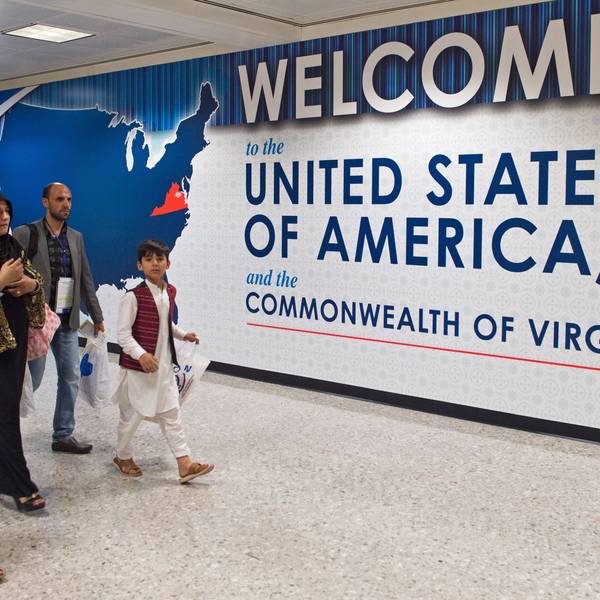
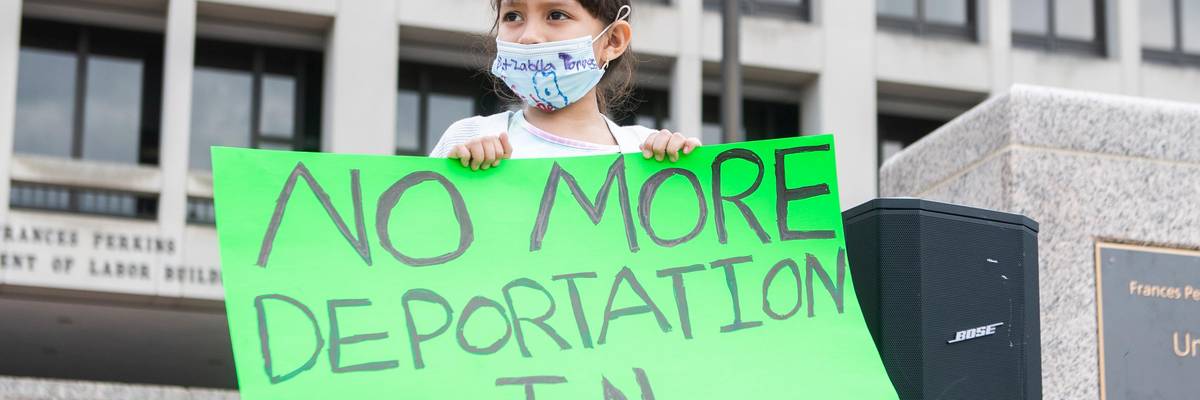
Itzabella Torres, 6, participates in a demonstration with the Immigrant Alliance for Justice and Equity of Mississippi, outside the Department of Labor on Monday, May 3, 2021, after delivering a petition calling on Secretary Marty Walsh and President Joe Biden to visit workers impacted by workplace raids that were conducted by U.S. Immigration and Customs Enforcement in Mississippi in August of 2019. The National Day Laborer Organizing Network also participated. (Photo: Tom Williams/CQ-Roll Call, Inc via Getty Images)
A Path to Citizenship Could Soon Be Within Grasp for Millions of Undocumented Workers
Two years after the largest workplace raid in U.S. history, Democrats just passed a budget framework that could make millions of immigrant workers less vulnerable to exploitation.
Immigration agents arrested over 600 undocumented workers at a poultry plant in Jackson, Mississippi two years ago in what remains the largest workplace raid in U.S. history.
On the two-year anniversary of that raid, immigrant rights advocates are demanding that U.S. officials take action to repair the harms inflicted on the workers and their communities.
Some 230 of the workers have already been deported but another 400 are still waiting for their day in court. And while they wait, many are unable to provide for themselves because they don't have access to work permits or have been deeply impacted by Covid-19.
"Two years later, the pain is ongoing, and the threat of deportation is constant," said Erika Vazquez with Immigrant Alliance for Justice and Equity of Mississippi. "It's time now to undo the harm, and to protect these workers."
Vazquez's alliance partnered with the National Day Laborer Organizing Network to file a formal request with the Department of Labor to provide deportation protections and work permits for the affected workers.
Aura and other advocates speak at a press conference in Mississippi.
At a press conference in Jackson, a Mississippi poultry worker named Aura shared the memory of Edgar Lopez, a grandfather who was among those detained and deported. After his deportation, he was tragically kidnapped and murdered in northern Mexico, as he sought to return to his family in Mississippi.
"I've never seen something happen like what happened here on August 7, 2019," said Aura. "Many children came home from school that day to no parents [...] There are still many people that will not come out to the streets because of the fear of deportation. There are still many people who are out of work because of the pandemic, and those who are working are doing hard labor for little wages and protections."
While there is still much to be done to repair the damage caused by the current U.S. immigration system, a path to citizenship could soon be within grasp for millions of undocumented workers.
Last week, the Senate passed a $3.5 trillion budget resolution to finance a wide range of infrastructure projects and social programs, including a pathway to citizenship for approximately 10 million undocumented immigrants living and working in the United States.
Immigrant rights advocates that have been calling for such a pathway for decades celebrated this mark of progress, underscoring the dangers undocumented workers face every day.
"For more than a year, immigrants like me have kept our country running during this pandemic despite living under the constant threat of deportation and family separation," said Hina Naveed, Co-Director of DRM Action Coalition and an advocate for the New York Immigration Coalition. "The inclusion of a pathway to citizenship in the budget reconciliation package that just passed the Senate is a testament to the courage of Dreamers, TPS (Temporary Protected Status) holders, and essential workers who mobilized their communities and demanded this long-awaited action."
Throughout the pandemic, undocumented workers have been on the frontlines, working in farm and agriculture jobs, meatpacking plants, and as grocery store clerks, providing essential services to keep the country running during a global pandemic. According to the Center for Law and Social Policy, approximately 69 percent of all immigrant workers and 74 percent of all undocumented workers are employed in essential industries.
These undocumented workers risked not only their health on the frontlines, but their livelihood as well. Those out of work during the pandemic are by and large ineligible to collect unemployment insurance. Because undocumented community members do not have Social Security Cards, millions did not receive any of the federal stimulus checks.
The pandemic disparities between these essential frontline workers and top corporate executives are staggering. An Institute for Policy Studies report found that the CEOs of the 100 largest low-wage employers earned an average of $14 million last year.
While billionaires and corporate executives have largely come out of this pandemic even wealthier than before, Congress now has an opportunity to pave a pathway for essential, undocumented workers to share in the benefits of economic recovery.
"Seventy-two percent of American voters support immigration, and reconciliation may be the last chance we have to provide certainty for immigrant workers and employers," said Rebecca Shi, Executive Director of the American Business Immigration Coalition. "Adding immigration in reconciliation is the only vehicle in sight, and legalization would add $31 billion in federal and state tax dollars and bring about $121 billion dollars in U.S. economic growth."
The budget framework laid out by the Senate is just that: a framework. Immigration advocates and their allies in Congress face an uphill battle to ensure that a pathway to citizenship for undocumented workers and their families stays in the deal and passes.

Urgent. It's never been this bad.
Dear Common Dreams reader, It’s been nearly 30 years since I co-founded Common Dreams with my late wife, Lina Newhouser. We had the radical notion that journalism should serve the public good, not corporate profits. It was clear to us from the outset what it would take to build such a project. No paid advertisements. No corporate sponsors. No millionaire publisher telling us what to think or do. Many people said we wouldn't last a year, but we proved those doubters wrong. Together with a tremendous team of journalists and dedicated staff, we built an independent media outlet free from the constraints of profits and corporate control. Our mission from the outset was simple. To inform. To inspire. To ignite change for the common good. Building Common Dreams was not easy. Our survival was never guaranteed. When you take on the most powerful forces—Wall Street greed, fossil fuel industry destruction, Big Tech lobbyists, and uber-rich oligarchs who have spent billions upon billions rigging the economy and democracy in their favor—the only bulwark you have is supporters who believe in your work. But here’s the urgent message from me today. It’s never been this bad out there. And it’s never been this hard to keep us going. At the very moment Common Dreams is most needed and doing some of its best and most important work, the threats we face are intensifying. Right now, with just four days to go in our Spring Campaign, we are not even halfway to our goal. When everyone does the little they can afford, we are strong. But if that support retreats or dries up, so do we. Can you make a gift right now to make sure Common Dreams not only survives but thrives? There is no backup plan or rainy day fund. There is only you. —Craig Brown, Co-founder |
Immigration agents arrested over 600 undocumented workers at a poultry plant in Jackson, Mississippi two years ago in what remains the largest workplace raid in U.S. history.
On the two-year anniversary of that raid, immigrant rights advocates are demanding that U.S. officials take action to repair the harms inflicted on the workers and their communities.
Some 230 of the workers have already been deported but another 400 are still waiting for their day in court. And while they wait, many are unable to provide for themselves because they don't have access to work permits or have been deeply impacted by Covid-19.
"Two years later, the pain is ongoing, and the threat of deportation is constant," said Erika Vazquez with Immigrant Alliance for Justice and Equity of Mississippi. "It's time now to undo the harm, and to protect these workers."
Vazquez's alliance partnered with the National Day Laborer Organizing Network to file a formal request with the Department of Labor to provide deportation protections and work permits for the affected workers.
Aura and other advocates speak at a press conference in Mississippi.
At a press conference in Jackson, a Mississippi poultry worker named Aura shared the memory of Edgar Lopez, a grandfather who was among those detained and deported. After his deportation, he was tragically kidnapped and murdered in northern Mexico, as he sought to return to his family in Mississippi.
"I've never seen something happen like what happened here on August 7, 2019," said Aura. "Many children came home from school that day to no parents [...] There are still many people that will not come out to the streets because of the fear of deportation. There are still many people who are out of work because of the pandemic, and those who are working are doing hard labor for little wages and protections."
While there is still much to be done to repair the damage caused by the current U.S. immigration system, a path to citizenship could soon be within grasp for millions of undocumented workers.
Last week, the Senate passed a $3.5 trillion budget resolution to finance a wide range of infrastructure projects and social programs, including a pathway to citizenship for approximately 10 million undocumented immigrants living and working in the United States.
Immigrant rights advocates that have been calling for such a pathway for decades celebrated this mark of progress, underscoring the dangers undocumented workers face every day.
"For more than a year, immigrants like me have kept our country running during this pandemic despite living under the constant threat of deportation and family separation," said Hina Naveed, Co-Director of DRM Action Coalition and an advocate for the New York Immigration Coalition. "The inclusion of a pathway to citizenship in the budget reconciliation package that just passed the Senate is a testament to the courage of Dreamers, TPS (Temporary Protected Status) holders, and essential workers who mobilized their communities and demanded this long-awaited action."
Throughout the pandemic, undocumented workers have been on the frontlines, working in farm and agriculture jobs, meatpacking plants, and as grocery store clerks, providing essential services to keep the country running during a global pandemic. According to the Center for Law and Social Policy, approximately 69 percent of all immigrant workers and 74 percent of all undocumented workers are employed in essential industries.
These undocumented workers risked not only their health on the frontlines, but their livelihood as well. Those out of work during the pandemic are by and large ineligible to collect unemployment insurance. Because undocumented community members do not have Social Security Cards, millions did not receive any of the federal stimulus checks.
The pandemic disparities between these essential frontline workers and top corporate executives are staggering. An Institute for Policy Studies report found that the CEOs of the 100 largest low-wage employers earned an average of $14 million last year.
While billionaires and corporate executives have largely come out of this pandemic even wealthier than before, Congress now has an opportunity to pave a pathway for essential, undocumented workers to share in the benefits of economic recovery.
"Seventy-two percent of American voters support immigration, and reconciliation may be the last chance we have to provide certainty for immigrant workers and employers," said Rebecca Shi, Executive Director of the American Business Immigration Coalition. "Adding immigration in reconciliation is the only vehicle in sight, and legalization would add $31 billion in federal and state tax dollars and bring about $121 billion dollars in U.S. economic growth."
The budget framework laid out by the Senate is just that: a framework. Immigration advocates and their allies in Congress face an uphill battle to ensure that a pathway to citizenship for undocumented workers and their families stays in the deal and passes.
Immigration agents arrested over 600 undocumented workers at a poultry plant in Jackson, Mississippi two years ago in what remains the largest workplace raid in U.S. history.
On the two-year anniversary of that raid, immigrant rights advocates are demanding that U.S. officials take action to repair the harms inflicted on the workers and their communities.
Some 230 of the workers have already been deported but another 400 are still waiting for their day in court. And while they wait, many are unable to provide for themselves because they don't have access to work permits or have been deeply impacted by Covid-19.
"Two years later, the pain is ongoing, and the threat of deportation is constant," said Erika Vazquez with Immigrant Alliance for Justice and Equity of Mississippi. "It's time now to undo the harm, and to protect these workers."
Vazquez's alliance partnered with the National Day Laborer Organizing Network to file a formal request with the Department of Labor to provide deportation protections and work permits for the affected workers.
Aura and other advocates speak at a press conference in Mississippi.
At a press conference in Jackson, a Mississippi poultry worker named Aura shared the memory of Edgar Lopez, a grandfather who was among those detained and deported. After his deportation, he was tragically kidnapped and murdered in northern Mexico, as he sought to return to his family in Mississippi.
"I've never seen something happen like what happened here on August 7, 2019," said Aura. "Many children came home from school that day to no parents [...] There are still many people that will not come out to the streets because of the fear of deportation. There are still many people who are out of work because of the pandemic, and those who are working are doing hard labor for little wages and protections."
While there is still much to be done to repair the damage caused by the current U.S. immigration system, a path to citizenship could soon be within grasp for millions of undocumented workers.
Last week, the Senate passed a $3.5 trillion budget resolution to finance a wide range of infrastructure projects and social programs, including a pathway to citizenship for approximately 10 million undocumented immigrants living and working in the United States.
Immigrant rights advocates that have been calling for such a pathway for decades celebrated this mark of progress, underscoring the dangers undocumented workers face every day.
"For more than a year, immigrants like me have kept our country running during this pandemic despite living under the constant threat of deportation and family separation," said Hina Naveed, Co-Director of DRM Action Coalition and an advocate for the New York Immigration Coalition. "The inclusion of a pathway to citizenship in the budget reconciliation package that just passed the Senate is a testament to the courage of Dreamers, TPS (Temporary Protected Status) holders, and essential workers who mobilized their communities and demanded this long-awaited action."
Throughout the pandemic, undocumented workers have been on the frontlines, working in farm and agriculture jobs, meatpacking plants, and as grocery store clerks, providing essential services to keep the country running during a global pandemic. According to the Center for Law and Social Policy, approximately 69 percent of all immigrant workers and 74 percent of all undocumented workers are employed in essential industries.
These undocumented workers risked not only their health on the frontlines, but their livelihood as well. Those out of work during the pandemic are by and large ineligible to collect unemployment insurance. Because undocumented community members do not have Social Security Cards, millions did not receive any of the federal stimulus checks.
The pandemic disparities between these essential frontline workers and top corporate executives are staggering. An Institute for Policy Studies report found that the CEOs of the 100 largest low-wage employers earned an average of $14 million last year.
While billionaires and corporate executives have largely come out of this pandemic even wealthier than before, Congress now has an opportunity to pave a pathway for essential, undocumented workers to share in the benefits of economic recovery.
"Seventy-two percent of American voters support immigration, and reconciliation may be the last chance we have to provide certainty for immigrant workers and employers," said Rebecca Shi, Executive Director of the American Business Immigration Coalition. "Adding immigration in reconciliation is the only vehicle in sight, and legalization would add $31 billion in federal and state tax dollars and bring about $121 billion dollars in U.S. economic growth."
The budget framework laid out by the Senate is just that: a framework. Immigration advocates and their allies in Congress face an uphill battle to ensure that a pathway to citizenship for undocumented workers and their families stays in the deal and passes.