SUBSCRIBE TO OUR FREE NEWSLETTER
Daily news & progressive opinion—funded by the people, not the corporations—delivered straight to your inbox.
5
#000000
#FFFFFF
To donate by check, phone, or other method, see our More Ways to Give page.
Daily news & progressive opinion—funded by the people, not the corporations—delivered straight to your inbox.
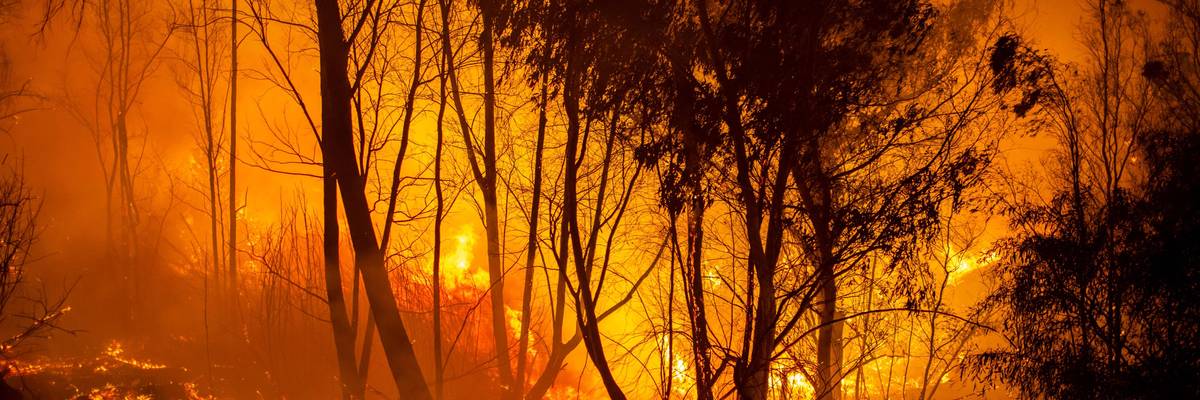
Trees burn in a forest on the slopes of the Troodos mountain chain, as a giant fire rages on the Mediterranean island of Cyprus, during the night of July 3, 2021. - A huge forest blaze in Cyprus has killed four people, destroyed homes and forced evacuations of villages as Greece and other countries deployed fire-fighting planes to the Mediterranean island. The fire began in the afternoon of July 3 and swept through districts in the southern foothills of the Troodos mountains as the country grapples with a blistering heatwave. (Photo: GEORGIOS LEFKOU PAPAPETROU/AFP via Getty Images)
We're out of time. It's as simple as that.
If the world immediately takes bold, coordinated action to curb climate change, we face a future of punishing heat waves, deadly wildfires and devastating floods--and that's the optimistic scenario, according to an alarming new U.N. report. If, on the other hand, we continue down the road of half-measures and denial that we've been stuck on since scientists first raised the alarm, the hellscape we leave to our grandchildren will be unrecognizable.
At the rate we're going, the world could warm by nearly 8 degrees Fahrenheit--by the end of this century, according to the IPCC. Relatively few of us who are alive today would still be around to witness what we have wrought.
Almost 30 years ago, I covered the first "Earth Summit" of world leaders in Rio de Janeiro, at which the U.N.-sponsored Intergovernmental Panel on Climate Change issued its initial assessment of what our spewing of carbon dioxide and other greenhouse gases into the atmosphere was doing to the planet.
That 1992 document is modest about what researchers, at the time, could not be sure of. They admitted there was a chance they might be seeing "natural climate variability." They thought "episodes of high temperatures" would become more frequent, but they couldn't be sure. The "unequivocal detection of the enhanced greenhouse effect" was still in the future.
The IPCC's Sixth Assessment Report, released Monday, makes clear there is no longer any reason to use such guarded language--and no longer any fig leaf of scientific uncertainty to shield governments or individuals who would continue to temporize.
"It is unequivocal that human influence has warmed the atmosphere, ocean and land," the report says in its summary for policymakers. "Widespread and rapid changes in the atmosphere, ocean, cryosphere and biosphere have occurred... Human-induced climate change is already affecting many weather and climate extremes in every region across the globe." There is now strong evidence of "observed changes in extremes such as heat waves, heavy precipitation, droughts, and tropical cyclones, and, in particular, their attribution to human influence."
As if you didn't already know that.
The second-biggest wildfire in California's recorded history is now burning out of control, having destroyed the Gold Rush town of Greenville, the latest in a string of fires in the state. An apocalyptic fire season is plaguing not just western North America but southern Europe as well, including blazes that are devastating Greece's second-largest island. Earlier this summer, an unprecedented "heat dome" set astonishing new temperature records in the Pacific Northwest and western Canada, including an all-time high for anywhere in Canada: 121 degrees in Lytton, British Columbia, a town that was mostly destroyed the following day by wildfire.
Last month, an almost biblical deluge caused flooding in Germany and Belgium that swept away picturesque towns and killed more than 200 people. Coastal megacities such as Lagos, Nigeria, are struggling to cope with frequent and widespread flooding--caused by an average rise in sea levels, according to the new IPCC report, of nearly 8 inches since the beginning of the 20th century. Oceans are rising because glaciers and ice sheets are melting and because warmer water occupies more volume than cooler water.
All of this is the result of about 2 degrees Fahrenheit of global warming--caused by human activity that has boosted the concentration of carbon dioxide in the atmosphere by 47 percent and vastly increased the concentration of methane, an even more powerful greenhouse gas. And we are stuck with the consequences of our irresponsibility: "Global surface temperature will continue to increase until at least the mid-century under all emissions scenarios considered," the IPCC says.
So we have no choice but to adapt to the warmer world we have created and now must live in. We don't know what caused the shocking and deadly Surfside, Fla., condominium collapse, for example, but we would be foolish not to reexamine oceanside building codes to account for rising seas. We would be foolish not to revise our methods of forest management to cope with extreme heat, drought and fire.
That is why massive investment in new technologies, such as solar power and energy storage, has to be such an urgent priority. At the rate we're going, the world could warm by nearly 8 degrees Fahrenheit--by the end of this century, according to the IPCC. Relatively few of us who are alive today would still be around to witness what we have wrought. But we know we need to change our ways. Our descendants will curse our memory if we fail to act.
Dear Common Dreams reader, It’s been nearly 30 years since I co-founded Common Dreams with my late wife, Lina Newhouser. We had the radical notion that journalism should serve the public good, not corporate profits. It was clear to us from the outset what it would take to build such a project. No paid advertisements. No corporate sponsors. No millionaire publisher telling us what to think or do. Many people said we wouldn't last a year, but we proved those doubters wrong. Together with a tremendous team of journalists and dedicated staff, we built an independent media outlet free from the constraints of profits and corporate control. Our mission has always been simple: To inform. To inspire. To ignite change for the common good. Building Common Dreams was not easy. Our survival was never guaranteed. When you take on the most powerful forces—Wall Street greed, fossil fuel industry destruction, Big Tech lobbyists, and uber-rich oligarchs who have spent billions upon billions rigging the economy and democracy in their favor—the only bulwark you have is supporters who believe in your work. But here’s the urgent message from me today. It's never been this bad out there. And it's never been this hard to keep us going. At the very moment Common Dreams is most needed, the threats we face are intensifying. We need your support now more than ever. We don't accept corporate advertising and never will. We don't have a paywall because we don't think people should be blocked from critical news based on their ability to pay. Everything we do is funded by the donations of readers like you. When everyone does the little they can afford, we are strong. But if that support retreats or dries up, so do we. Will you donate now to make sure Common Dreams not only survives but thrives? —Craig Brown, Co-founder |
We're out of time. It's as simple as that.
If the world immediately takes bold, coordinated action to curb climate change, we face a future of punishing heat waves, deadly wildfires and devastating floods--and that's the optimistic scenario, according to an alarming new U.N. report. If, on the other hand, we continue down the road of half-measures and denial that we've been stuck on since scientists first raised the alarm, the hellscape we leave to our grandchildren will be unrecognizable.
At the rate we're going, the world could warm by nearly 8 degrees Fahrenheit--by the end of this century, according to the IPCC. Relatively few of us who are alive today would still be around to witness what we have wrought.
Almost 30 years ago, I covered the first "Earth Summit" of world leaders in Rio de Janeiro, at which the U.N.-sponsored Intergovernmental Panel on Climate Change issued its initial assessment of what our spewing of carbon dioxide and other greenhouse gases into the atmosphere was doing to the planet.
That 1992 document is modest about what researchers, at the time, could not be sure of. They admitted there was a chance they might be seeing "natural climate variability." They thought "episodes of high temperatures" would become more frequent, but they couldn't be sure. The "unequivocal detection of the enhanced greenhouse effect" was still in the future.
The IPCC's Sixth Assessment Report, released Monday, makes clear there is no longer any reason to use such guarded language--and no longer any fig leaf of scientific uncertainty to shield governments or individuals who would continue to temporize.
"It is unequivocal that human influence has warmed the atmosphere, ocean and land," the report says in its summary for policymakers. "Widespread and rapid changes in the atmosphere, ocean, cryosphere and biosphere have occurred... Human-induced climate change is already affecting many weather and climate extremes in every region across the globe." There is now strong evidence of "observed changes in extremes such as heat waves, heavy precipitation, droughts, and tropical cyclones, and, in particular, their attribution to human influence."
As if you didn't already know that.
The second-biggest wildfire in California's recorded history is now burning out of control, having destroyed the Gold Rush town of Greenville, the latest in a string of fires in the state. An apocalyptic fire season is plaguing not just western North America but southern Europe as well, including blazes that are devastating Greece's second-largest island. Earlier this summer, an unprecedented "heat dome" set astonishing new temperature records in the Pacific Northwest and western Canada, including an all-time high for anywhere in Canada: 121 degrees in Lytton, British Columbia, a town that was mostly destroyed the following day by wildfire.
Last month, an almost biblical deluge caused flooding in Germany and Belgium that swept away picturesque towns and killed more than 200 people. Coastal megacities such as Lagos, Nigeria, are struggling to cope with frequent and widespread flooding--caused by an average rise in sea levels, according to the new IPCC report, of nearly 8 inches since the beginning of the 20th century. Oceans are rising because glaciers and ice sheets are melting and because warmer water occupies more volume than cooler water.
All of this is the result of about 2 degrees Fahrenheit of global warming--caused by human activity that has boosted the concentration of carbon dioxide in the atmosphere by 47 percent and vastly increased the concentration of methane, an even more powerful greenhouse gas. And we are stuck with the consequences of our irresponsibility: "Global surface temperature will continue to increase until at least the mid-century under all emissions scenarios considered," the IPCC says.
So we have no choice but to adapt to the warmer world we have created and now must live in. We don't know what caused the shocking and deadly Surfside, Fla., condominium collapse, for example, but we would be foolish not to reexamine oceanside building codes to account for rising seas. We would be foolish not to revise our methods of forest management to cope with extreme heat, drought and fire.
That is why massive investment in new technologies, such as solar power and energy storage, has to be such an urgent priority. At the rate we're going, the world could warm by nearly 8 degrees Fahrenheit--by the end of this century, according to the IPCC. Relatively few of us who are alive today would still be around to witness what we have wrought. But we know we need to change our ways. Our descendants will curse our memory if we fail to act.
We're out of time. It's as simple as that.
If the world immediately takes bold, coordinated action to curb climate change, we face a future of punishing heat waves, deadly wildfires and devastating floods--and that's the optimistic scenario, according to an alarming new U.N. report. If, on the other hand, we continue down the road of half-measures and denial that we've been stuck on since scientists first raised the alarm, the hellscape we leave to our grandchildren will be unrecognizable.
At the rate we're going, the world could warm by nearly 8 degrees Fahrenheit--by the end of this century, according to the IPCC. Relatively few of us who are alive today would still be around to witness what we have wrought.
Almost 30 years ago, I covered the first "Earth Summit" of world leaders in Rio de Janeiro, at which the U.N.-sponsored Intergovernmental Panel on Climate Change issued its initial assessment of what our spewing of carbon dioxide and other greenhouse gases into the atmosphere was doing to the planet.
That 1992 document is modest about what researchers, at the time, could not be sure of. They admitted there was a chance they might be seeing "natural climate variability." They thought "episodes of high temperatures" would become more frequent, but they couldn't be sure. The "unequivocal detection of the enhanced greenhouse effect" was still in the future.
The IPCC's Sixth Assessment Report, released Monday, makes clear there is no longer any reason to use such guarded language--and no longer any fig leaf of scientific uncertainty to shield governments or individuals who would continue to temporize.
"It is unequivocal that human influence has warmed the atmosphere, ocean and land," the report says in its summary for policymakers. "Widespread and rapid changes in the atmosphere, ocean, cryosphere and biosphere have occurred... Human-induced climate change is already affecting many weather and climate extremes in every region across the globe." There is now strong evidence of "observed changes in extremes such as heat waves, heavy precipitation, droughts, and tropical cyclones, and, in particular, their attribution to human influence."
As if you didn't already know that.
The second-biggest wildfire in California's recorded history is now burning out of control, having destroyed the Gold Rush town of Greenville, the latest in a string of fires in the state. An apocalyptic fire season is plaguing not just western North America but southern Europe as well, including blazes that are devastating Greece's second-largest island. Earlier this summer, an unprecedented "heat dome" set astonishing new temperature records in the Pacific Northwest and western Canada, including an all-time high for anywhere in Canada: 121 degrees in Lytton, British Columbia, a town that was mostly destroyed the following day by wildfire.
Last month, an almost biblical deluge caused flooding in Germany and Belgium that swept away picturesque towns and killed more than 200 people. Coastal megacities such as Lagos, Nigeria, are struggling to cope with frequent and widespread flooding--caused by an average rise in sea levels, according to the new IPCC report, of nearly 8 inches since the beginning of the 20th century. Oceans are rising because glaciers and ice sheets are melting and because warmer water occupies more volume than cooler water.
All of this is the result of about 2 degrees Fahrenheit of global warming--caused by human activity that has boosted the concentration of carbon dioxide in the atmosphere by 47 percent and vastly increased the concentration of methane, an even more powerful greenhouse gas. And we are stuck with the consequences of our irresponsibility: "Global surface temperature will continue to increase until at least the mid-century under all emissions scenarios considered," the IPCC says.
So we have no choice but to adapt to the warmer world we have created and now must live in. We don't know what caused the shocking and deadly Surfside, Fla., condominium collapse, for example, but we would be foolish not to reexamine oceanside building codes to account for rising seas. We would be foolish not to revise our methods of forest management to cope with extreme heat, drought and fire.
That is why massive investment in new technologies, such as solar power and energy storage, has to be such an urgent priority. At the rate we're going, the world could warm by nearly 8 degrees Fahrenheit--by the end of this century, according to the IPCC. Relatively few of us who are alive today would still be around to witness what we have wrought. But we know we need to change our ways. Our descendants will curse our memory if we fail to act.