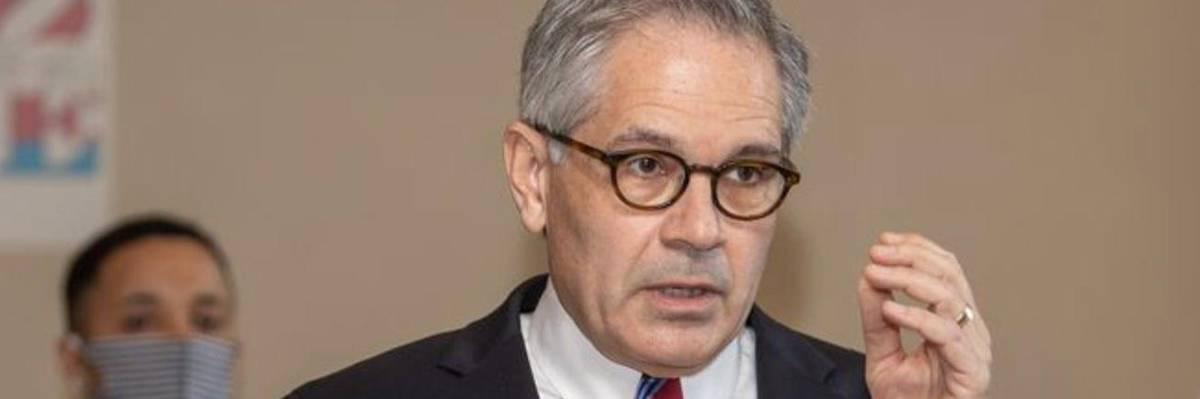
Philadelphia District Attorney Larry Krasner. (Photo: Creative Commons)
Philadelphia's DA Election Is a Test for Progressives and Criminal Justice Reform
The results of the city's district attorney election will highlight the left's growing influence—or how far they still have to go.
Philadelphia's district attorney race has been a mudslinging battle between current District Attorney Larry Krasner--the choice of progressive organizers across the city--and Carlos Vega, a former city prosecutor fired by Krasner when he took office in 2018 and swept out the previous staff.
Republicans and police alike blame Krasner for a spike in gun violence in the city, though that spike is consistent with other cities nationwide during the COVID-19 pandemic. Vega's platform revolves around his belief that Krasner has gone too far to the left, while actual progressives in the city say Krasner still hasn't gone far enough.
Krasner's bid for re-election is the first in which the progressive people power that elected those prosecutors is being directly challenged by the police.
Meanwhile, progressives are fighting to maintain control of the race, acknowledging that Krasner isn't their own perfect candidate. It's expected that Krasner will defeat Vega in today's May 18 primary-- which in a Democratic stronghold like Philly ensures a win in the general election--but insiders told The Inquirer that the race has been closer than Krasner hoped.
This election has far-reaching implications beyond Philly's borders. Krasner's election in 2017 kicked off the spate of "progressive prosecutors," so-called due to their willingness to overhaul the traditional role of a prosecutor in support of criminal justice reform. Other recently elected leftwing district attorneys include Chicago's Kim Foxx, San Francisco's Chesa Boudin, and Los Angeles's George Gascon.
But Krasner's bid for re-election is the first in which the progressive people power that elected those prosecutors is being directly challenged by the police. Philly's Fraternal Order of Police, which represents local law enforcement, is actively campaigning against Krasner, who ran on an adversarial platform against police in his first term.
The FOP claims it has successfully registered thousands of GOP voters as Democrats to vote against Krasner. (Anecdotally, driving through Northeast Philly, there are "Fire Krasner" yard signs for miles on the busiest thoroughfare; the Northeast is one of Philly's heaviest cop-residing areas.)
While this isn't the first time that Philly police have gone up against a candidate for district attorney, it is happening in a broader moment of pushback against police impunity; their response to Krasner proves it's causing fear in their ranks. As The Inquirer's Chris Brennan and Mike Newall put it, "The race between Krasner and Vega is as much a showdown between Krasner and the police."
In addition to the police backlash, 153 former assistant district attorneys published a letter calling for Krasner's ouster and endorsing Vega. "Homicides, violent crime, and illegal gun possessions in the city of Philadelphia have rapidly increased under the current administration," they wrote.
The Innocence Project, meanwhile, endorsed Krasner and took aim at Vega for his role in a wrongful conviction while working in Philadelphia's district attorney office office. The melee over that conviction has had ricocheting effects on the campaign battleground. Shaun King, a controversial figure who is campaigning for Krasner, was served papers during a Saturday pre-election event when Vega made good on a promise to sue King, his PAC, and Krasner's campaign for libel.
To be clear, Krasner himself is to the right of many of his supporters; he told The Appeal he does not identify as an abolitionist, for example.
In an interview with The Appeal, Krasner described his first term's legacy as "promises made, promises kept." In the years since winning the 2017 primary, Philly's jail population has dropped by almost 30 percent, cash bail and overall prosecutions have been reduced, and he's refused to pursue the death penalty (with one exception in 2018, when he threatened to, but ultimately did not).
"That doesn't mean everything got fixed but promises made, promises kept," Krasner said.
Among the things left to fix: The city's cash bail system, which critics from the left and right agree remains problematic; and the hotly contested issue of gun violence, for which the right places the responsibility squarely upon Krasner's shoulders.
To be clear, Krasner himself is to the right of many of his supporters; he told The Appeal he does not identify as an abolitionist, for example. But local organizers like Saleem Holbrook, executive director of the Abolitionist Law Project, are presenting his leadership as harm reduction.
"I have to look at the big picture here," Holbrook told The Appeal. "It's a culture change. Is it a culture that I want? No, I'm an abolitionist. Krasner is still going to prosecute, and I don't agree with a lot of his prosecution. But, when I look at this office from a harm reduction [perspective], I see how it has changed."
A recent poll conducted in advance of the primary by Data for Progress found that Pennsylvania voters largely support the direction that Krasner has taken Philadelphia; 60 percent of respondents support eliminating criminal penalties for drug possession, 64 percent support limiting cash bail, and 75 percent support sentence reductions for good behavior.
Following the uprisings for Black lives in 2020, and as we approach the one-year anniversary of the murder of George Floyd, all eyes are on the spaces for reform carved out by the progressive movement. Today's election will show how far it's come--or how far there is left to go.
We are at a crossroads
This country and this world are at a monumental crossroads. In a few short weeks, US voters will have an opportunity to beat back the forces of fascism and confront the billionaires who are rigging the economy, our media system, and our democracy, making it increasingly impossible for ordinary people to get by. We’re not just talking about the election. We’re talking about what must be done once these fascist elements are vanquished from power. We need a bolder set of solutions than what either major party has so far been willing to offer and a working-class movement ready to fight like hell for it. Trump didn't emerge from nowhere. The conditions that fueled MAGA authoritarianism were created by decades of radical neoliberal economic policies and a corrupt political system dominated by corporate interests. They slashed taxes on the super-rich, promising that the benefits would trickle down. They said giveaways to the corporate titans would make life more affordable for the rest of us. It was all bullshit. And when a bitter, betrayed populace searches for someone to blame, right-wing demagogues have little trouble finding scapegoats. People know when they're being lied to, but you won't hear any of this from the corporate media. Only independent journalism—powered and funded by people who believe in building a better world—can deliver truly trustworthy daily news. Our Fall Campaign is underway, and we need your help. To power our newsroom through the rest of the year, we need to raise $125,000 by midnight on October 31. So if you share our vision, please contribute whatever you can to sustain our work. |
Philadelphia's district attorney race has been a mudslinging battle between current District Attorney Larry Krasner--the choice of progressive organizers across the city--and Carlos Vega, a former city prosecutor fired by Krasner when he took office in 2018 and swept out the previous staff.
Republicans and police alike blame Krasner for a spike in gun violence in the city, though that spike is consistent with other cities nationwide during the COVID-19 pandemic. Vega's platform revolves around his belief that Krasner has gone too far to the left, while actual progressives in the city say Krasner still hasn't gone far enough.
Krasner's bid for re-election is the first in which the progressive people power that elected those prosecutors is being directly challenged by the police.
Meanwhile, progressives are fighting to maintain control of the race, acknowledging that Krasner isn't their own perfect candidate. It's expected that Krasner will defeat Vega in today's May 18 primary-- which in a Democratic stronghold like Philly ensures a win in the general election--but insiders told The Inquirer that the race has been closer than Krasner hoped.
This election has far-reaching implications beyond Philly's borders. Krasner's election in 2017 kicked off the spate of "progressive prosecutors," so-called due to their willingness to overhaul the traditional role of a prosecutor in support of criminal justice reform. Other recently elected leftwing district attorneys include Chicago's Kim Foxx, San Francisco's Chesa Boudin, and Los Angeles's George Gascon.
But Krasner's bid for re-election is the first in which the progressive people power that elected those prosecutors is being directly challenged by the police. Philly's Fraternal Order of Police, which represents local law enforcement, is actively campaigning against Krasner, who ran on an adversarial platform against police in his first term.
The FOP claims it has successfully registered thousands of GOP voters as Democrats to vote against Krasner. (Anecdotally, driving through Northeast Philly, there are "Fire Krasner" yard signs for miles on the busiest thoroughfare; the Northeast is one of Philly's heaviest cop-residing areas.)
While this isn't the first time that Philly police have gone up against a candidate for district attorney, it is happening in a broader moment of pushback against police impunity; their response to Krasner proves it's causing fear in their ranks. As The Inquirer's Chris Brennan and Mike Newall put it, "The race between Krasner and Vega is as much a showdown between Krasner and the police."
In addition to the police backlash, 153 former assistant district attorneys published a letter calling for Krasner's ouster and endorsing Vega. "Homicides, violent crime, and illegal gun possessions in the city of Philadelphia have rapidly increased under the current administration," they wrote.
The Innocence Project, meanwhile, endorsed Krasner and took aim at Vega for his role in a wrongful conviction while working in Philadelphia's district attorney office office. The melee over that conviction has had ricocheting effects on the campaign battleground. Shaun King, a controversial figure who is campaigning for Krasner, was served papers during a Saturday pre-election event when Vega made good on a promise to sue King, his PAC, and Krasner's campaign for libel.
To be clear, Krasner himself is to the right of many of his supporters; he told The Appeal he does not identify as an abolitionist, for example.
In an interview with The Appeal, Krasner described his first term's legacy as "promises made, promises kept." In the years since winning the 2017 primary, Philly's jail population has dropped by almost 30 percent, cash bail and overall prosecutions have been reduced, and he's refused to pursue the death penalty (with one exception in 2018, when he threatened to, but ultimately did not).
"That doesn't mean everything got fixed but promises made, promises kept," Krasner said.
Among the things left to fix: The city's cash bail system, which critics from the left and right agree remains problematic; and the hotly contested issue of gun violence, for which the right places the responsibility squarely upon Krasner's shoulders.
To be clear, Krasner himself is to the right of many of his supporters; he told The Appeal he does not identify as an abolitionist, for example. But local organizers like Saleem Holbrook, executive director of the Abolitionist Law Project, are presenting his leadership as harm reduction.
"I have to look at the big picture here," Holbrook told The Appeal. "It's a culture change. Is it a culture that I want? No, I'm an abolitionist. Krasner is still going to prosecute, and I don't agree with a lot of his prosecution. But, when I look at this office from a harm reduction [perspective], I see how it has changed."
A recent poll conducted in advance of the primary by Data for Progress found that Pennsylvania voters largely support the direction that Krasner has taken Philadelphia; 60 percent of respondents support eliminating criminal penalties for drug possession, 64 percent support limiting cash bail, and 75 percent support sentence reductions for good behavior.
Following the uprisings for Black lives in 2020, and as we approach the one-year anniversary of the murder of George Floyd, all eyes are on the spaces for reform carved out by the progressive movement. Today's election will show how far it's come--or how far there is left to go.