

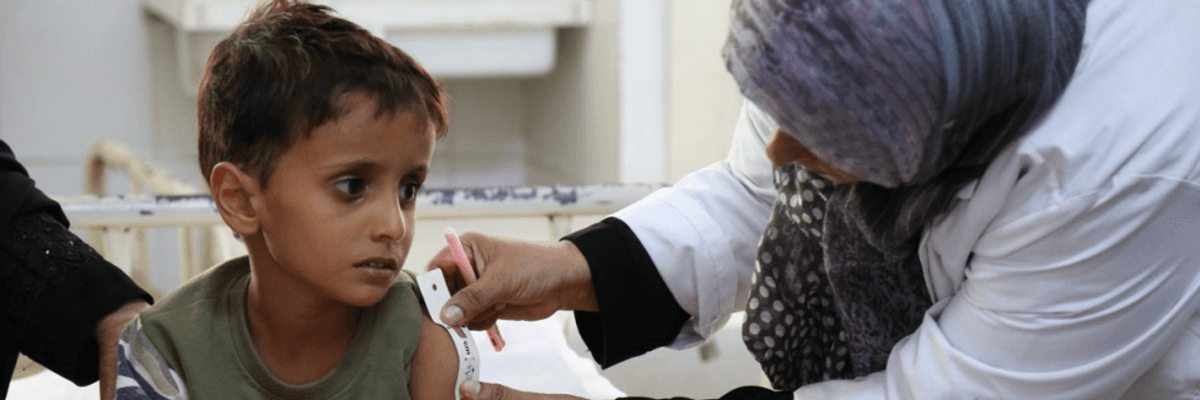
A Saudi-imposed blockade in Yemen, in the midst of a civil war has left civilians without medicine, food, and clean water, exacerbating famine and widespread suffering as the Covid-19 pandemic continues and the nation continues to be considered the location of the world's most dire humanitarian crisis. (Photo: @nfcinereporter/Twitter)
No, Biden Is Not Pushing the Saudis Hard Enough to End Yemen Blockade
The Biden administration has multiple avenues of leverage over Riyadh that can be used to press for an unconditional lifting of the blockade. It must use them.
Amidst growing reports of the devastation caused by the Saudi blockade of Yemen, a letter from a coalition of over 70 groups* representing tens of millions of people is calling on the Biden administration to do everything in its power to press Riyadh to bring that blockade to an end and open the way to distribution of fuel, food, and medical supplies to all parts of the country.
The coalition is stressing that the time to end the blockade is now, not as part of peace talks which may drag on for an uncertain period of time. As Aisha Jumaan, the director of the Yemen Relief and Reconstruction Foundation, has noted "It is unethical to use food, medicine, and fuel as bargaining chips. Yemeni civilians should not be held hostages to the lengthy and rocky negotiations between warring parties."
The stakes could not be higher. According to the United Nations, 400,000 children under the age of five could die this year without urgent action on multiple fronts. The consequences of the blockade are underscored in heartbreaking detail in the Oscar-nominated documentary Hunger Ward, which displays the conditions that prevail in a Yemeni hospital that has been deprived of basic supplies by the blockade. The co-creators of the film are signatories of the letter to the Biden administration, along with celebrities like Mark Ruffalo, Joaquin Phoenix, Amy Schumer and Sarah Silverman.
"It is unethical to use food, medicine, and fuel as bargaining chips. Yemeni civilians should not be held hostages to the lengthy and rocky negotiations between warring parties."
--Aisha Jumaan, Yemen Relief and Reconstruction Foundation
A March 10 investigative report by Nima Elbagir of CNN provided conclusive, filmed evidence of the impacts of the Saudi blockade-- long lines of fuel trucks stalled at the Yemeni port of Hodeidah and dozens of ships waiting in vain to dock and unload their cargo. According to the UN World Food Program, over a dozen ships carrying 350,000 tons of commercial fuel have been prevented from entering Yemen for over two months. Despite this reality, no U.S. official has publicly acknowledged the devastating implications of the six-year long Saudi-imposed blockade. In response to a question from CNN reporter Elbagir, U.S. special envoy Tim Lenderking described the situation as "complex" and claimed that port access could be addressed in short order as part of peace negotiations. After hearing Lenderking's answer, Elbagir concluded: "How is (peace) possible when you are not acknowledging the full impact of that U.S.-backed Saudi embargo on the people of Yemen?"
The coalition that sent the letter to the Biden administration acknowledged that it has taken some "critical first steps toward peace and food security in Yemen," including announcing an end to U.S. support for offensive operations in Yemen and relevant arms sales and revoking President Trump's terrorist designations against the Houthi rebels, designations which threatened to block the provision of humanitarian aid to large parts of the country and provoke a hunger crisis the country. But unless those steps are followed up with strong pressure on Saudi Arabia to end the blockade, there could be an unprecedented crisis in a country already reeling from the impacts of six years of war.
Brookings Institution Senior Fellow Bruce Riedel has described the ongoing Saudi blockade as "an offensive military operation that kills civilians," a situation that belies administration claims that the Saudi regime is "committed and eager to find a solution to the conflict."
The Biden administration has multiple avenues of leverage over Riyadh that can be used to press for an unconditional lifting of the blockade. There are billions of U.S. weapons transfers to Saudi Arabia in the pipeline, and the Saudi Air Force could not function for long without U.S.-supplied maintenance and spare parts. The time to use this leverage is now, not as part of a protracted peace process that could leave hundreds of thousands of Yemenis at risk of starvation and death from preventable causes. As the coalition that is pressing the Biden administration over the Saudi blockade has noted, the ultimate goal should be "a comprehensive political settlement that addresses the conflict's myriad issues, including a nationwide ceasefire, currency stabilization, and payment of government salaries." But while efforts are being made on those fronts, the blockade must be lifted, immediately. Yemen can't wait.
*Responsible Statecraft Editor's Note: The Quincy Institute is a signatory to the letter.
An Urgent Message From Our Co-Founder
Dear Common Dreams reader, It’s been nearly 30 years since I co-founded Common Dreams with my late wife, Lina Newhouser. We had the radical notion that journalism should serve the public good, not corporate profits. It was clear to us from the outset what it would take to build such a project. No paid advertisements. No corporate sponsors. No millionaire publisher telling us what to think or do. Many people said we wouldn't last a year, but we proved those doubters wrong. Together with a tremendous team of journalists and dedicated staff, we built an independent media outlet free from the constraints of profits and corporate control. Our mission has always been simple: To inform. To inspire. To ignite change for the common good. Building Common Dreams was not easy. Our survival was never guaranteed. When you take on the most powerful forces—Wall Street greed, fossil fuel industry destruction, Big Tech lobbyists, and uber-rich oligarchs who have spent billions upon billions rigging the economy and democracy in their favor—the only bulwark you have is supporters who believe in your work. But here’s the urgent message from me today. It's never been this bad out there. And it's never been this hard to keep us going. At the very moment Common Dreams is most needed, the threats we face are intensifying. We need your support now more than ever. We don't accept corporate advertising and never will. We don't have a paywall because we don't think people should be blocked from critical news based on their ability to pay. Everything we do is funded by the donations of readers like you. When everyone does the little they can afford, we are strong. But if that support retreats or dries up, so do we. Will you donate now to make sure Common Dreams not only survives but thrives? —Craig Brown, Co-founder |
Amidst growing reports of the devastation caused by the Saudi blockade of Yemen, a letter from a coalition of over 70 groups* representing tens of millions of people is calling on the Biden administration to do everything in its power to press Riyadh to bring that blockade to an end and open the way to distribution of fuel, food, and medical supplies to all parts of the country.
The coalition is stressing that the time to end the blockade is now, not as part of peace talks which may drag on for an uncertain period of time. As Aisha Jumaan, the director of the Yemen Relief and Reconstruction Foundation, has noted "It is unethical to use food, medicine, and fuel as bargaining chips. Yemeni civilians should not be held hostages to the lengthy and rocky negotiations between warring parties."
The stakes could not be higher. According to the United Nations, 400,000 children under the age of five could die this year without urgent action on multiple fronts. The consequences of the blockade are underscored in heartbreaking detail in the Oscar-nominated documentary Hunger Ward, which displays the conditions that prevail in a Yemeni hospital that has been deprived of basic supplies by the blockade. The co-creators of the film are signatories of the letter to the Biden administration, along with celebrities like Mark Ruffalo, Joaquin Phoenix, Amy Schumer and Sarah Silverman.
"It is unethical to use food, medicine, and fuel as bargaining chips. Yemeni civilians should not be held hostages to the lengthy and rocky negotiations between warring parties."
--Aisha Jumaan, Yemen Relief and Reconstruction Foundation
A March 10 investigative report by Nima Elbagir of CNN provided conclusive, filmed evidence of the impacts of the Saudi blockade-- long lines of fuel trucks stalled at the Yemeni port of Hodeidah and dozens of ships waiting in vain to dock and unload their cargo. According to the UN World Food Program, over a dozen ships carrying 350,000 tons of commercial fuel have been prevented from entering Yemen for over two months. Despite this reality, no U.S. official has publicly acknowledged the devastating implications of the six-year long Saudi-imposed blockade. In response to a question from CNN reporter Elbagir, U.S. special envoy Tim Lenderking described the situation as "complex" and claimed that port access could be addressed in short order as part of peace negotiations. After hearing Lenderking's answer, Elbagir concluded: "How is (peace) possible when you are not acknowledging the full impact of that U.S.-backed Saudi embargo on the people of Yemen?"
The coalition that sent the letter to the Biden administration acknowledged that it has taken some "critical first steps toward peace and food security in Yemen," including announcing an end to U.S. support for offensive operations in Yemen and relevant arms sales and revoking President Trump's terrorist designations against the Houthi rebels, designations which threatened to block the provision of humanitarian aid to large parts of the country and provoke a hunger crisis the country. But unless those steps are followed up with strong pressure on Saudi Arabia to end the blockade, there could be an unprecedented crisis in a country already reeling from the impacts of six years of war.
Brookings Institution Senior Fellow Bruce Riedel has described the ongoing Saudi blockade as "an offensive military operation that kills civilians," a situation that belies administration claims that the Saudi regime is "committed and eager to find a solution to the conflict."
The Biden administration has multiple avenues of leverage over Riyadh that can be used to press for an unconditional lifting of the blockade. There are billions of U.S. weapons transfers to Saudi Arabia in the pipeline, and the Saudi Air Force could not function for long without U.S.-supplied maintenance and spare parts. The time to use this leverage is now, not as part of a protracted peace process that could leave hundreds of thousands of Yemenis at risk of starvation and death from preventable causes. As the coalition that is pressing the Biden administration over the Saudi blockade has noted, the ultimate goal should be "a comprehensive political settlement that addresses the conflict's myriad issues, including a nationwide ceasefire, currency stabilization, and payment of government salaries." But while efforts are being made on those fronts, the blockade must be lifted, immediately. Yemen can't wait.
*Responsible Statecraft Editor's Note: The Quincy Institute is a signatory to the letter.
Amidst growing reports of the devastation caused by the Saudi blockade of Yemen, a letter from a coalition of over 70 groups* representing tens of millions of people is calling on the Biden administration to do everything in its power to press Riyadh to bring that blockade to an end and open the way to distribution of fuel, food, and medical supplies to all parts of the country.
The coalition is stressing that the time to end the blockade is now, not as part of peace talks which may drag on for an uncertain period of time. As Aisha Jumaan, the director of the Yemen Relief and Reconstruction Foundation, has noted "It is unethical to use food, medicine, and fuel as bargaining chips. Yemeni civilians should not be held hostages to the lengthy and rocky negotiations between warring parties."
The stakes could not be higher. According to the United Nations, 400,000 children under the age of five could die this year without urgent action on multiple fronts. The consequences of the blockade are underscored in heartbreaking detail in the Oscar-nominated documentary Hunger Ward, which displays the conditions that prevail in a Yemeni hospital that has been deprived of basic supplies by the blockade. The co-creators of the film are signatories of the letter to the Biden administration, along with celebrities like Mark Ruffalo, Joaquin Phoenix, Amy Schumer and Sarah Silverman.
"It is unethical to use food, medicine, and fuel as bargaining chips. Yemeni civilians should not be held hostages to the lengthy and rocky negotiations between warring parties."
--Aisha Jumaan, Yemen Relief and Reconstruction Foundation
A March 10 investigative report by Nima Elbagir of CNN provided conclusive, filmed evidence of the impacts of the Saudi blockade-- long lines of fuel trucks stalled at the Yemeni port of Hodeidah and dozens of ships waiting in vain to dock and unload their cargo. According to the UN World Food Program, over a dozen ships carrying 350,000 tons of commercial fuel have been prevented from entering Yemen for over two months. Despite this reality, no U.S. official has publicly acknowledged the devastating implications of the six-year long Saudi-imposed blockade. In response to a question from CNN reporter Elbagir, U.S. special envoy Tim Lenderking described the situation as "complex" and claimed that port access could be addressed in short order as part of peace negotiations. After hearing Lenderking's answer, Elbagir concluded: "How is (peace) possible when you are not acknowledging the full impact of that U.S.-backed Saudi embargo on the people of Yemen?"
The coalition that sent the letter to the Biden administration acknowledged that it has taken some "critical first steps toward peace and food security in Yemen," including announcing an end to U.S. support for offensive operations in Yemen and relevant arms sales and revoking President Trump's terrorist designations against the Houthi rebels, designations which threatened to block the provision of humanitarian aid to large parts of the country and provoke a hunger crisis the country. But unless those steps are followed up with strong pressure on Saudi Arabia to end the blockade, there could be an unprecedented crisis in a country already reeling from the impacts of six years of war.
Brookings Institution Senior Fellow Bruce Riedel has described the ongoing Saudi blockade as "an offensive military operation that kills civilians," a situation that belies administration claims that the Saudi regime is "committed and eager to find a solution to the conflict."
The Biden administration has multiple avenues of leverage over Riyadh that can be used to press for an unconditional lifting of the blockade. There are billions of U.S. weapons transfers to Saudi Arabia in the pipeline, and the Saudi Air Force could not function for long without U.S.-supplied maintenance and spare parts. The time to use this leverage is now, not as part of a protracted peace process that could leave hundreds of thousands of Yemenis at risk of starvation and death from preventable causes. As the coalition that is pressing the Biden administration over the Saudi blockade has noted, the ultimate goal should be "a comprehensive political settlement that addresses the conflict's myriad issues, including a nationwide ceasefire, currency stabilization, and payment of government salaries." But while efforts are being made on those fronts, the blockade must be lifted, immediately. Yemen can't wait.
*Responsible Statecraft Editor's Note: The Quincy Institute is a signatory to the letter.