SUBSCRIBE TO OUR FREE NEWSLETTER
Daily news & progressive opinion—funded by the people, not the corporations—delivered straight to your inbox.
5
#000000
#FFFFFF
To donate by check, phone, or other method, see our More Ways to Give page.
Daily news & progressive opinion—funded by the people, not the corporations—delivered straight to your inbox.
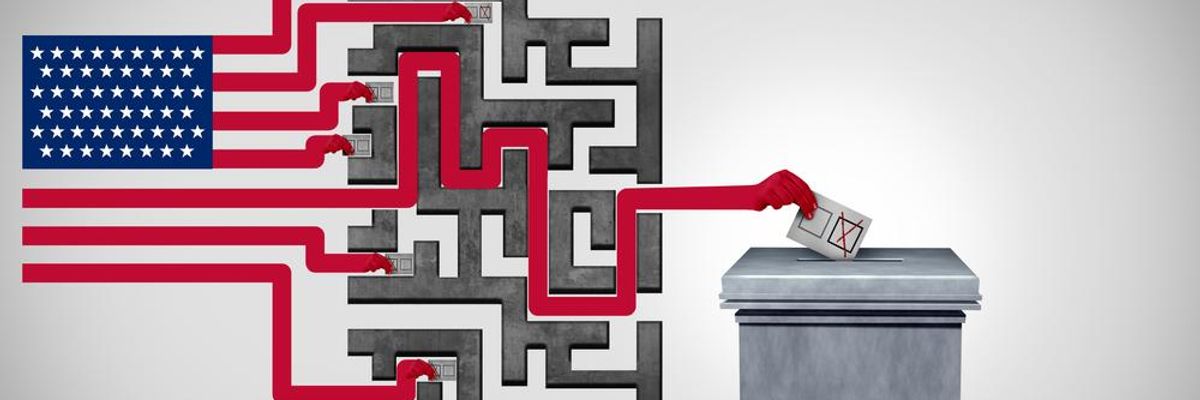
Even if you don't live in Georgia, these unprecedented assaults on voting rights are most likely happening in your state, too. (Photo: Shutterstock)
Last November, despite a global pandemic, voter intimidation, and an unprecedented disinformation campaign, a record number of Americans cast a ballot in the 2020 election.
Expanded voting by mail, no-excuse absentee voting, curbside voting, and early voting made the ballot box more accessible. But now, Republican lawmakers in 43 states are introducing hundreds of restrictive "voting rights" bills to roll back these measures.
In my home state of Georgia, Republicans have introduced a package of restrictive bills to increase red tape, roll back voting rights, and silence the voices of millions of voters. These attacks are unmistakably in response to the state's record voter turnout to elect President Joe Biden and Senators Rafael Warnock and Jon Ossoff.
The 11 bills in Georgia are grounded in baseless and racist claims of election irregularities. They aim to silence the voices of voters of color, young people, and older voters by directly repealing the measures that made last election cycle the most inclusive ever.
Just like during Jim Crow, Georgia is taking special aim at Black voters, who overcame decades of draconian voting measures to demonstrate their power at the ballot box last November.
Experts put it bluntly: Georgia's current efforts to restrict voting access are "the most sustained effort" to silence voters "since the Jim Crow era."
Just like during Jim Crow, Georgia is taking special aim at Black voters, who overcame decades of draconian voting measures to demonstrate their power at the ballot box last November.
GOP lawmakers have proposed a ban on Sunday early voting, for example--a direct attack on "souls to the polls" events, which usher congregations of primarily Black churches to polling places after services. They're even trying to prohibit giving food and water to people waiting in line to vote, even after many Black voters were forced to wait in 10 or 11 hour lines in the last election.
Even if you don't live in Georgia, these unprecedented assaults on voting rights are most likely happening in your state, too.
As of March, the Brennan Center calculated that GOP lawmakers had introduced 253 such bills in 43 states. Many of these bills resemble Georgia's proposals--enacting even stricter voter ID requirements, slashing voter registration opportunities, and limiting vote by mail. Others go even further by enabling aggressive voter roll purging or even overturning election results altogether.
No matter who they voted for, an overwhelming majority of Americans support pro-voter policies--including expanding early voting, enacting online and automatic voter registration, allowing universal absentee voting, and including a pre-paid postage stamp on mail-in ballots. The majority of us agree that we need to improve our elections to ensure secure, accurate voting for every eligible resident in every state.
Throughout our nation's history, we've fought to expand voting access to all eligible residents, but a handful of politicians want to erase this legacy. To move forward together, we must ensure that every eligible American has the freedom to cast a ballot and have it counted accurately so that the outcomes of our elections reflect the will of the people.
To start, we must reject state-level anti-voter policies and pass common sense federal legislation like the For the People Act (HR1) and the John Lewis Voting Rights Act (HR4), which will not only restore the voter protections laid out in the Voting Rights Act of 1965 but strengthen those protections and and our democracy.
By expanding access to voting, we can ensure that our elected officials are accountable for delivering real solutions to the people. Tell your senators: Fix our broken democracy and pass the "For The People Act."
Dear Common Dreams reader, It’s been nearly 30 years since I co-founded Common Dreams with my late wife, Lina Newhouser. We had the radical notion that journalism should serve the public good, not corporate profits. It was clear to us from the outset what it would take to build such a project. No paid advertisements. No corporate sponsors. No millionaire publisher telling us what to think or do. Many people said we wouldn't last a year, but we proved those doubters wrong. Together with a tremendous team of journalists and dedicated staff, we built an independent media outlet free from the constraints of profits and corporate control. Our mission has always been simple: To inform. To inspire. To ignite change for the common good. Building Common Dreams was not easy. Our survival was never guaranteed. When you take on the most powerful forces—Wall Street greed, fossil fuel industry destruction, Big Tech lobbyists, and uber-rich oligarchs who have spent billions upon billions rigging the economy and democracy in their favor—the only bulwark you have is supporters who believe in your work. But here’s the urgent message from me today. It's never been this bad out there. And it's never been this hard to keep us going. At the very moment Common Dreams is most needed, the threats we face are intensifying. We need your support now more than ever. We don't accept corporate advertising and never will. We don't have a paywall because we don't think people should be blocked from critical news based on their ability to pay. Everything we do is funded by the donations of readers like you. When everyone does the little they can afford, we are strong. But if that support retreats or dries up, so do we. Will you donate now to make sure Common Dreams not only survives but thrives? —Craig Brown, Co-founder |
Last November, despite a global pandemic, voter intimidation, and an unprecedented disinformation campaign, a record number of Americans cast a ballot in the 2020 election.
Expanded voting by mail, no-excuse absentee voting, curbside voting, and early voting made the ballot box more accessible. But now, Republican lawmakers in 43 states are introducing hundreds of restrictive "voting rights" bills to roll back these measures.
In my home state of Georgia, Republicans have introduced a package of restrictive bills to increase red tape, roll back voting rights, and silence the voices of millions of voters. These attacks are unmistakably in response to the state's record voter turnout to elect President Joe Biden and Senators Rafael Warnock and Jon Ossoff.
The 11 bills in Georgia are grounded in baseless and racist claims of election irregularities. They aim to silence the voices of voters of color, young people, and older voters by directly repealing the measures that made last election cycle the most inclusive ever.
Just like during Jim Crow, Georgia is taking special aim at Black voters, who overcame decades of draconian voting measures to demonstrate their power at the ballot box last November.
Experts put it bluntly: Georgia's current efforts to restrict voting access are "the most sustained effort" to silence voters "since the Jim Crow era."
Just like during Jim Crow, Georgia is taking special aim at Black voters, who overcame decades of draconian voting measures to demonstrate their power at the ballot box last November.
GOP lawmakers have proposed a ban on Sunday early voting, for example--a direct attack on "souls to the polls" events, which usher congregations of primarily Black churches to polling places after services. They're even trying to prohibit giving food and water to people waiting in line to vote, even after many Black voters were forced to wait in 10 or 11 hour lines in the last election.
Even if you don't live in Georgia, these unprecedented assaults on voting rights are most likely happening in your state, too.
As of March, the Brennan Center calculated that GOP lawmakers had introduced 253 such bills in 43 states. Many of these bills resemble Georgia's proposals--enacting even stricter voter ID requirements, slashing voter registration opportunities, and limiting vote by mail. Others go even further by enabling aggressive voter roll purging or even overturning election results altogether.
No matter who they voted for, an overwhelming majority of Americans support pro-voter policies--including expanding early voting, enacting online and automatic voter registration, allowing universal absentee voting, and including a pre-paid postage stamp on mail-in ballots. The majority of us agree that we need to improve our elections to ensure secure, accurate voting for every eligible resident in every state.
Throughout our nation's history, we've fought to expand voting access to all eligible residents, but a handful of politicians want to erase this legacy. To move forward together, we must ensure that every eligible American has the freedom to cast a ballot and have it counted accurately so that the outcomes of our elections reflect the will of the people.
To start, we must reject state-level anti-voter policies and pass common sense federal legislation like the For the People Act (HR1) and the John Lewis Voting Rights Act (HR4), which will not only restore the voter protections laid out in the Voting Rights Act of 1965 but strengthen those protections and and our democracy.
By expanding access to voting, we can ensure that our elected officials are accountable for delivering real solutions to the people. Tell your senators: Fix our broken democracy and pass the "For The People Act."
Last November, despite a global pandemic, voter intimidation, and an unprecedented disinformation campaign, a record number of Americans cast a ballot in the 2020 election.
Expanded voting by mail, no-excuse absentee voting, curbside voting, and early voting made the ballot box more accessible. But now, Republican lawmakers in 43 states are introducing hundreds of restrictive "voting rights" bills to roll back these measures.
In my home state of Georgia, Republicans have introduced a package of restrictive bills to increase red tape, roll back voting rights, and silence the voices of millions of voters. These attacks are unmistakably in response to the state's record voter turnout to elect President Joe Biden and Senators Rafael Warnock and Jon Ossoff.
The 11 bills in Georgia are grounded in baseless and racist claims of election irregularities. They aim to silence the voices of voters of color, young people, and older voters by directly repealing the measures that made last election cycle the most inclusive ever.
Just like during Jim Crow, Georgia is taking special aim at Black voters, who overcame decades of draconian voting measures to demonstrate their power at the ballot box last November.
Experts put it bluntly: Georgia's current efforts to restrict voting access are "the most sustained effort" to silence voters "since the Jim Crow era."
Just like during Jim Crow, Georgia is taking special aim at Black voters, who overcame decades of draconian voting measures to demonstrate their power at the ballot box last November.
GOP lawmakers have proposed a ban on Sunday early voting, for example--a direct attack on "souls to the polls" events, which usher congregations of primarily Black churches to polling places after services. They're even trying to prohibit giving food and water to people waiting in line to vote, even after many Black voters were forced to wait in 10 or 11 hour lines in the last election.
Even if you don't live in Georgia, these unprecedented assaults on voting rights are most likely happening in your state, too.
As of March, the Brennan Center calculated that GOP lawmakers had introduced 253 such bills in 43 states. Many of these bills resemble Georgia's proposals--enacting even stricter voter ID requirements, slashing voter registration opportunities, and limiting vote by mail. Others go even further by enabling aggressive voter roll purging or even overturning election results altogether.
No matter who they voted for, an overwhelming majority of Americans support pro-voter policies--including expanding early voting, enacting online and automatic voter registration, allowing universal absentee voting, and including a pre-paid postage stamp on mail-in ballots. The majority of us agree that we need to improve our elections to ensure secure, accurate voting for every eligible resident in every state.
Throughout our nation's history, we've fought to expand voting access to all eligible residents, but a handful of politicians want to erase this legacy. To move forward together, we must ensure that every eligible American has the freedom to cast a ballot and have it counted accurately so that the outcomes of our elections reflect the will of the people.
To start, we must reject state-level anti-voter policies and pass common sense federal legislation like the For the People Act (HR1) and the John Lewis Voting Rights Act (HR4), which will not only restore the voter protections laid out in the Voting Rights Act of 1965 but strengthen those protections and and our democracy.
By expanding access to voting, we can ensure that our elected officials are accountable for delivering real solutions to the people. Tell your senators: Fix our broken democracy and pass the "For The People Act."