SUBSCRIBE TO OUR FREE NEWSLETTER
Daily news & progressive opinion—funded by the people, not the corporations—delivered straight to your inbox.
5
#000000
#FFFFFF
To donate by check, phone, or other method, see our More Ways to Give page.
Daily news & progressive opinion—funded by the people, not the corporations—delivered straight to your inbox.
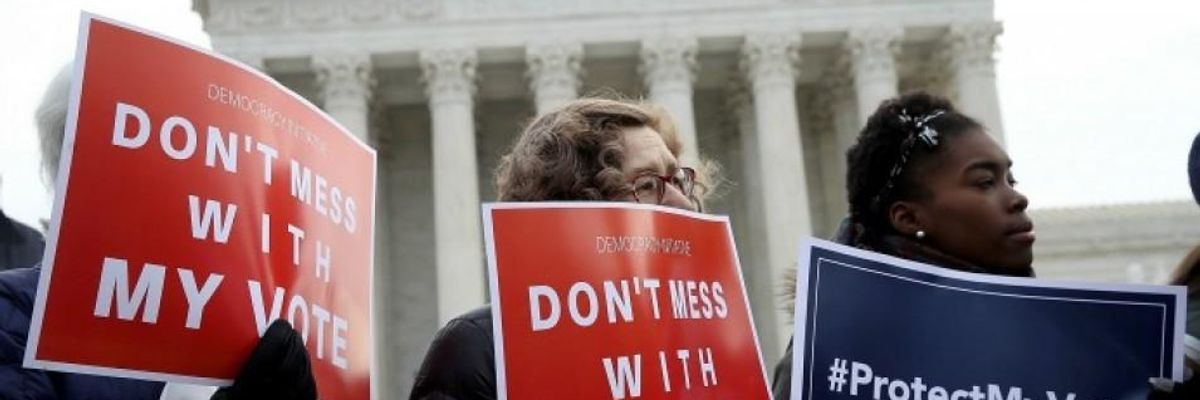
Protesters gather during a rally in front of the U.S. Supreme Court on January 10, 2018 in Washington, D.C. (Photo: Win McNamee/Getty Images)
The right to vote is the essential foundation of democracy. Yet today, across America, there is a systematic campaign by one party to curtail the right to vote, targeted particularly at minorities and the young.
As the Brennan Center for Justice reports, Republicans have introduced more than 250 legislative bills in 43 states that would make voting more difficult.
The campaign is propelled by the big lie spread by Donald Trump that the 2020 presidential election was stolen from him. Republicans claim to be intent on restoring people's confidence in the election system. In fact, Trump's lies were refuted by state Republican election officials, by federal courts, many presided over by Trump-appointed judges, and by Trump's own attorney general.
Republican senators and legislators and elected state officials do not question the legitimacy of their victories. Yet they are now using Trump's big lie as the rationale for suppressing the right to vote.
Many of the legislative changes are surgically targeted to impact Black and minority voters. In Georgia, for example, Republicans are pushing legislation to limit early in-person voting days, to end no-excuse mail voting (except for voters over 65, who tend to vote Republican), and to limit the hours that mail ballot drop boxes will be open. They even seek to end Sunday in-person voting in the weeks leading up to the election, to curtail the "souls to the polls" efforts by Black churches to encourage civic participation.
Georgia election officials notoriously cut the number of polling stations, particularly in Fulton County, where Black voters are concentrated. That forced voters to wait for hours in long lines to cast a vote. That, of course, made it more difficult for workers and those who were ailing to vote. Now to make it even harder, Republican legislators seek to prohibit volunteers from giving water and food to those waiting in line. Lines themselves are a national disgrace. The ban on water and food is an offense against basic decency.
One of the first objectives of the civil rights movement was passage of the Voting Rights Act, mandating federal protection of the right to vote, and prior federal review of changes that would discriminate against African Americans.
Today's Republicans--the modern-day Confederates--are brazen in their efforts to ensure that only the "right" people vote. The gang of five right-wing justices on the Supreme Court gutted the Voting Rights Act, opening the floodgates to discriminatory state restrictions. The election in 2022 will be the first post-census election since the gutting of the Voting Rights Act. And Republicans are once more intent on making it harder for minorities to vote.
The U.S. House of Representatives passed essential legislation--H.R. 1, the For the People Act--to provide federal standards to elections to federal office. H.R. 1 (labeled S1 in the Senate) would provide for automatic voter registration and same-day voter registration. It would mandate a minimum of 15 days for early voting, with polls open at least 10 hours per day so that workers might have a chance to vote. It would limit purges of voting rolls.
The new law would require nonpartisan citizen commissions to do redistricting after a new census. It would require super PACs and "dark money" operations to disclose their donors. It would provide matching grants for small donations, reducing the force of big money in our elections.
These are simply common-sense standards for a clean election system. Yet Republicans furiously denounce them, and Senate Republicans promise to filibuster against the act, blocking its passage unless Democrats can unify around suspending the filibuster in order to allow the majority to pass it.
Over the last years, America has become increasingly polarized politically. But democracy--and the right to vote--must be above partisanship. There ought to be universal support for creating an election system that makes voting easy, limits big money and requires nonpartisan redistricting. It is shameful that the efforts to suppress the vote of African Americans and others that were perfected under segregation are being revived in a new guise in the 21st century.
Americans must mobilize to demand that the Senate pass H.R. 1 to protect the right to vote. And whether it passes or not, African Americans, Latinos, the young should see the efforts to suppress their vote as the insult that it is. And we should mobilize to vote in large numbers--overcoming whatever barriers are put in our way--to reaffirm our democratic rights, and to hold accountable those who would try to trample them.
Dear Common Dreams reader, It’s been nearly 30 years since I co-founded Common Dreams with my late wife, Lina Newhouser. We had the radical notion that journalism should serve the public good, not corporate profits. It was clear to us from the outset what it would take to build such a project. No paid advertisements. No corporate sponsors. No millionaire publisher telling us what to think or do. Many people said we wouldn't last a year, but we proved those doubters wrong. Together with a tremendous team of journalists and dedicated staff, we built an independent media outlet free from the constraints of profits and corporate control. Our mission has always been simple: To inform. To inspire. To ignite change for the common good. Building Common Dreams was not easy. Our survival was never guaranteed. When you take on the most powerful forces—Wall Street greed, fossil fuel industry destruction, Big Tech lobbyists, and uber-rich oligarchs who have spent billions upon billions rigging the economy and democracy in their favor—the only bulwark you have is supporters who believe in your work. But here’s the urgent message from me today. It's never been this bad out there. And it's never been this hard to keep us going. At the very moment Common Dreams is most needed, the threats we face are intensifying. We need your support now more than ever. We don't accept corporate advertising and never will. We don't have a paywall because we don't think people should be blocked from critical news based on their ability to pay. Everything we do is funded by the donations of readers like you. When everyone does the little they can afford, we are strong. But if that support retreats or dries up, so do we. Will you donate now to make sure Common Dreams not only survives but thrives? —Craig Brown, Co-founder |
The right to vote is the essential foundation of democracy. Yet today, across America, there is a systematic campaign by one party to curtail the right to vote, targeted particularly at minorities and the young.
As the Brennan Center for Justice reports, Republicans have introduced more than 250 legislative bills in 43 states that would make voting more difficult.
The campaign is propelled by the big lie spread by Donald Trump that the 2020 presidential election was stolen from him. Republicans claim to be intent on restoring people's confidence in the election system. In fact, Trump's lies were refuted by state Republican election officials, by federal courts, many presided over by Trump-appointed judges, and by Trump's own attorney general.
Republican senators and legislators and elected state officials do not question the legitimacy of their victories. Yet they are now using Trump's big lie as the rationale for suppressing the right to vote.
Many of the legislative changes are surgically targeted to impact Black and minority voters. In Georgia, for example, Republicans are pushing legislation to limit early in-person voting days, to end no-excuse mail voting (except for voters over 65, who tend to vote Republican), and to limit the hours that mail ballot drop boxes will be open. They even seek to end Sunday in-person voting in the weeks leading up to the election, to curtail the "souls to the polls" efforts by Black churches to encourage civic participation.
Georgia election officials notoriously cut the number of polling stations, particularly in Fulton County, where Black voters are concentrated. That forced voters to wait for hours in long lines to cast a vote. That, of course, made it more difficult for workers and those who were ailing to vote. Now to make it even harder, Republican legislators seek to prohibit volunteers from giving water and food to those waiting in line. Lines themselves are a national disgrace. The ban on water and food is an offense against basic decency.
One of the first objectives of the civil rights movement was passage of the Voting Rights Act, mandating federal protection of the right to vote, and prior federal review of changes that would discriminate against African Americans.
Today's Republicans--the modern-day Confederates--are brazen in their efforts to ensure that only the "right" people vote. The gang of five right-wing justices on the Supreme Court gutted the Voting Rights Act, opening the floodgates to discriminatory state restrictions. The election in 2022 will be the first post-census election since the gutting of the Voting Rights Act. And Republicans are once more intent on making it harder for minorities to vote.
The U.S. House of Representatives passed essential legislation--H.R. 1, the For the People Act--to provide federal standards to elections to federal office. H.R. 1 (labeled S1 in the Senate) would provide for automatic voter registration and same-day voter registration. It would mandate a minimum of 15 days for early voting, with polls open at least 10 hours per day so that workers might have a chance to vote. It would limit purges of voting rolls.
The new law would require nonpartisan citizen commissions to do redistricting after a new census. It would require super PACs and "dark money" operations to disclose their donors. It would provide matching grants for small donations, reducing the force of big money in our elections.
These are simply common-sense standards for a clean election system. Yet Republicans furiously denounce them, and Senate Republicans promise to filibuster against the act, blocking its passage unless Democrats can unify around suspending the filibuster in order to allow the majority to pass it.
Over the last years, America has become increasingly polarized politically. But democracy--and the right to vote--must be above partisanship. There ought to be universal support for creating an election system that makes voting easy, limits big money and requires nonpartisan redistricting. It is shameful that the efforts to suppress the vote of African Americans and others that were perfected under segregation are being revived in a new guise in the 21st century.
Americans must mobilize to demand that the Senate pass H.R. 1 to protect the right to vote. And whether it passes or not, African Americans, Latinos, the young should see the efforts to suppress their vote as the insult that it is. And we should mobilize to vote in large numbers--overcoming whatever barriers are put in our way--to reaffirm our democratic rights, and to hold accountable those who would try to trample them.
The right to vote is the essential foundation of democracy. Yet today, across America, there is a systematic campaign by one party to curtail the right to vote, targeted particularly at minorities and the young.
As the Brennan Center for Justice reports, Republicans have introduced more than 250 legislative bills in 43 states that would make voting more difficult.
The campaign is propelled by the big lie spread by Donald Trump that the 2020 presidential election was stolen from him. Republicans claim to be intent on restoring people's confidence in the election system. In fact, Trump's lies were refuted by state Republican election officials, by federal courts, many presided over by Trump-appointed judges, and by Trump's own attorney general.
Republican senators and legislators and elected state officials do not question the legitimacy of their victories. Yet they are now using Trump's big lie as the rationale for suppressing the right to vote.
Many of the legislative changes are surgically targeted to impact Black and minority voters. In Georgia, for example, Republicans are pushing legislation to limit early in-person voting days, to end no-excuse mail voting (except for voters over 65, who tend to vote Republican), and to limit the hours that mail ballot drop boxes will be open. They even seek to end Sunday in-person voting in the weeks leading up to the election, to curtail the "souls to the polls" efforts by Black churches to encourage civic participation.
Georgia election officials notoriously cut the number of polling stations, particularly in Fulton County, where Black voters are concentrated. That forced voters to wait for hours in long lines to cast a vote. That, of course, made it more difficult for workers and those who were ailing to vote. Now to make it even harder, Republican legislators seek to prohibit volunteers from giving water and food to those waiting in line. Lines themselves are a national disgrace. The ban on water and food is an offense against basic decency.
One of the first objectives of the civil rights movement was passage of the Voting Rights Act, mandating federal protection of the right to vote, and prior federal review of changes that would discriminate against African Americans.
Today's Republicans--the modern-day Confederates--are brazen in their efforts to ensure that only the "right" people vote. The gang of five right-wing justices on the Supreme Court gutted the Voting Rights Act, opening the floodgates to discriminatory state restrictions. The election in 2022 will be the first post-census election since the gutting of the Voting Rights Act. And Republicans are once more intent on making it harder for minorities to vote.
The U.S. House of Representatives passed essential legislation--H.R. 1, the For the People Act--to provide federal standards to elections to federal office. H.R. 1 (labeled S1 in the Senate) would provide for automatic voter registration and same-day voter registration. It would mandate a minimum of 15 days for early voting, with polls open at least 10 hours per day so that workers might have a chance to vote. It would limit purges of voting rolls.
The new law would require nonpartisan citizen commissions to do redistricting after a new census. It would require super PACs and "dark money" operations to disclose their donors. It would provide matching grants for small donations, reducing the force of big money in our elections.
These are simply common-sense standards for a clean election system. Yet Republicans furiously denounce them, and Senate Republicans promise to filibuster against the act, blocking its passage unless Democrats can unify around suspending the filibuster in order to allow the majority to pass it.
Over the last years, America has become increasingly polarized politically. But democracy--and the right to vote--must be above partisanship. There ought to be universal support for creating an election system that makes voting easy, limits big money and requires nonpartisan redistricting. It is shameful that the efforts to suppress the vote of African Americans and others that were perfected under segregation are being revived in a new guise in the 21st century.
Americans must mobilize to demand that the Senate pass H.R. 1 to protect the right to vote. And whether it passes or not, African Americans, Latinos, the young should see the efforts to suppress their vote as the insult that it is. And we should mobilize to vote in large numbers--overcoming whatever barriers are put in our way--to reaffirm our democratic rights, and to hold accountable those who would try to trample them.