SUBSCRIBE TO OUR FREE NEWSLETTER
Daily news & progressive opinion—funded by the people, not the corporations—delivered straight to your inbox.
5
#000000
#FFFFFF
To donate by check, phone, or other method, see our More Ways to Give page.
Daily news & progressive opinion—funded by the people, not the corporations—delivered straight to your inbox.
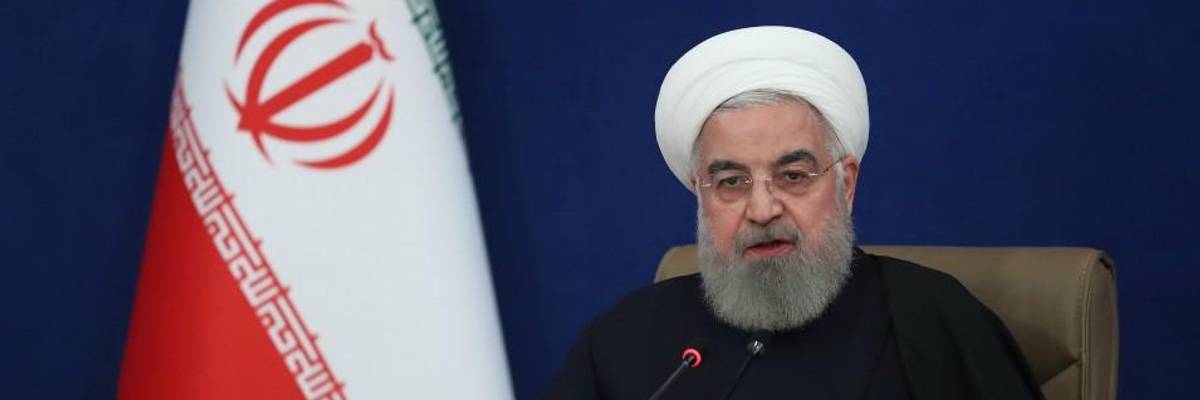
Iranian President Hassan Rouhani speaks during a press conference in Tehran, Iran on December 14, 2020. (Photo: Iranian Presidency/Handout/Anadolu Agency via Getty Images)
Sunday's news that Iran has rejected a European Union invitation to host talks with the United States is a truly negative and problematic development -- complicating already difficult challenges further and jeopardizing the fate of the 2015 nuclear deal.
But it is not surprising. Here's why:
As I wrote yesterday in The Guardian, the idea that Iran would talk directly with the United States while Washington maintained its current level of sanctions was tried by President Trump for three years. It didn't work then, and it likely won't work now.
Don't take my word for it. This is what Wendy Sherman, Biden's nominee for deputy secretary of state, said about it in 2019: I "would be shocked if Iran agreed to a meeting without some sanctions relief." Sherman was right. Iran's calculation is more simple than one might think. If Tehran agrees to talks while Biden essentially continues Trump's "maximum pressure" policy, and those talks fail, Iran will be blamed -- even though the United States has done nothing to rectify what caused this crisis in the first place: Trump's 2018 exit from the Joint Comprehensive Plan of Action, or JCPOA.
So, without changing any of the dynamics that Biden inherited from Trump, the United States will have succeeded in hitting the ball, and the blame, to Iran's court, if future discussions collapse. Sure, the new administration has stated that it intends to re-enter the JCPOA, something Trump never signaled, and that change in public intent is not inconsequential. But, in a relationship mired in mistrust, publicly stated intent means little if actions fail to match the intent. This is where the last month of childish, trust-eroding squabbles over who must make the first step toward renewed compliance with the JCPOA first comes in.
Washington's public insistence that Iran take action first by curbing its enrichment activities while at the same time pushing the EU to punish Iran at the International Atomic Energy Agency -- even though the United States formally remains outside of the deal and has yet to be sanctioned for it -- all erode confidence in Tehran that Biden is serious. It makes the move of joining the talks before receiving any significant sanctions relief all the more risky for the Iranian leadership.
Biden even refuses to allow Iran access to its own money in South Korea, even though the situation has created major problems for Seoul and was the result of an inhumane policy Biden previously lambasted as something that should just not have been done when Iran is coping with the COVID pandemic.
The Biden team of course knows this quite well. So what explains their conduct? It appears to be Biden's own decision, driven by a refusal to be "pressured by Iran" to give something before talks can begin and the fear that he'll lose the support of hawkish Democrats whose votes he needs for the COVID relief package. The attacks in Iraq by groups aligned with Iran further hardened Biden's attitude, which is quite understandable. What we're witnessing is Biden's instinctive resistance to pressure, and the fear of coming under attack by hawks in his own party if he was perceived as backing down.
This is precisely why, from the outset, the Biden team should have done their utmost to avoid engaging in public fights over "who goes first." This is the inevitable outcome: everything becomes more politically costly. Even before real talks have begun.
So is there a way out of this deadlock? If the political will exists on both sides, they can overcome this. But political will erodes if there's a constant fear of "looking weak." Obama was relentlessly attacked for his Iran policy. He was falsely accused of bending over backwards for the Iranians. In the end, he didn't care. He was focused on the prize -the unquestionable national security imperative of preventing an Iranian bomb and avoiding war. He prioritized what would make diplomacy work, rather than on what would score political points with Republicans, Saudis, or Israelis. And guess what -- he secured a great deal -- something no other American president was able to do in the last 40 years.
What could potentially break the deadlock now is if Washington urges the EU to walk back from its threatened IAEA censure, and releases the Iranian funds in South Korea, while Iran joins the talks and reverses one or more of its recent moves to accelerate its uranium enrichment program.
Admittedly, this is an imperfect solution, but there is no perfect solution to this imperfect situation. Both sides will have to swallow some pride and pay a political cost. And the longer they wait, the higher that cost will be. Time is of the essence.
Dear Common Dreams reader, It’s been nearly 30 years since I co-founded Common Dreams with my late wife, Lina Newhouser. We had the radical notion that journalism should serve the public good, not corporate profits. It was clear to us from the outset what it would take to build such a project. No paid advertisements. No corporate sponsors. No millionaire publisher telling us what to think or do. Many people said we wouldn't last a year, but we proved those doubters wrong. Together with a tremendous team of journalists and dedicated staff, we built an independent media outlet free from the constraints of profits and corporate control. Our mission has always been simple: To inform. To inspire. To ignite change for the common good. Building Common Dreams was not easy. Our survival was never guaranteed. When you take on the most powerful forces—Wall Street greed, fossil fuel industry destruction, Big Tech lobbyists, and uber-rich oligarchs who have spent billions upon billions rigging the economy and democracy in their favor—the only bulwark you have is supporters who believe in your work. But here’s the urgent message from me today. It's never been this bad out there. And it's never been this hard to keep us going. At the very moment Common Dreams is most needed, the threats we face are intensifying. We need your support now more than ever. We don't accept corporate advertising and never will. We don't have a paywall because we don't think people should be blocked from critical news based on their ability to pay. Everything we do is funded by the donations of readers like you. When everyone does the little they can afford, we are strong. But if that support retreats or dries up, so do we. Will you donate now to make sure Common Dreams not only survives but thrives? —Craig Brown, Co-founder |
Sunday's news that Iran has rejected a European Union invitation to host talks with the United States is a truly negative and problematic development -- complicating already difficult challenges further and jeopardizing the fate of the 2015 nuclear deal.
But it is not surprising. Here's why:
As I wrote yesterday in The Guardian, the idea that Iran would talk directly with the United States while Washington maintained its current level of sanctions was tried by President Trump for three years. It didn't work then, and it likely won't work now.
Don't take my word for it. This is what Wendy Sherman, Biden's nominee for deputy secretary of state, said about it in 2019: I "would be shocked if Iran agreed to a meeting without some sanctions relief." Sherman was right. Iran's calculation is more simple than one might think. If Tehran agrees to talks while Biden essentially continues Trump's "maximum pressure" policy, and those talks fail, Iran will be blamed -- even though the United States has done nothing to rectify what caused this crisis in the first place: Trump's 2018 exit from the Joint Comprehensive Plan of Action, or JCPOA.
So, without changing any of the dynamics that Biden inherited from Trump, the United States will have succeeded in hitting the ball, and the blame, to Iran's court, if future discussions collapse. Sure, the new administration has stated that it intends to re-enter the JCPOA, something Trump never signaled, and that change in public intent is not inconsequential. But, in a relationship mired in mistrust, publicly stated intent means little if actions fail to match the intent. This is where the last month of childish, trust-eroding squabbles over who must make the first step toward renewed compliance with the JCPOA first comes in.
Washington's public insistence that Iran take action first by curbing its enrichment activities while at the same time pushing the EU to punish Iran at the International Atomic Energy Agency -- even though the United States formally remains outside of the deal and has yet to be sanctioned for it -- all erode confidence in Tehran that Biden is serious. It makes the move of joining the talks before receiving any significant sanctions relief all the more risky for the Iranian leadership.
Biden even refuses to allow Iran access to its own money in South Korea, even though the situation has created major problems for Seoul and was the result of an inhumane policy Biden previously lambasted as something that should just not have been done when Iran is coping with the COVID pandemic.
The Biden team of course knows this quite well. So what explains their conduct? It appears to be Biden's own decision, driven by a refusal to be "pressured by Iran" to give something before talks can begin and the fear that he'll lose the support of hawkish Democrats whose votes he needs for the COVID relief package. The attacks in Iraq by groups aligned with Iran further hardened Biden's attitude, which is quite understandable. What we're witnessing is Biden's instinctive resistance to pressure, and the fear of coming under attack by hawks in his own party if he was perceived as backing down.
This is precisely why, from the outset, the Biden team should have done their utmost to avoid engaging in public fights over "who goes first." This is the inevitable outcome: everything becomes more politically costly. Even before real talks have begun.
So is there a way out of this deadlock? If the political will exists on both sides, they can overcome this. But political will erodes if there's a constant fear of "looking weak." Obama was relentlessly attacked for his Iran policy. He was falsely accused of bending over backwards for the Iranians. In the end, he didn't care. He was focused on the prize -the unquestionable national security imperative of preventing an Iranian bomb and avoiding war. He prioritized what would make diplomacy work, rather than on what would score political points with Republicans, Saudis, or Israelis. And guess what -- he secured a great deal -- something no other American president was able to do in the last 40 years.
What could potentially break the deadlock now is if Washington urges the EU to walk back from its threatened IAEA censure, and releases the Iranian funds in South Korea, while Iran joins the talks and reverses one or more of its recent moves to accelerate its uranium enrichment program.
Admittedly, this is an imperfect solution, but there is no perfect solution to this imperfect situation. Both sides will have to swallow some pride and pay a political cost. And the longer they wait, the higher that cost will be. Time is of the essence.
Sunday's news that Iran has rejected a European Union invitation to host talks with the United States is a truly negative and problematic development -- complicating already difficult challenges further and jeopardizing the fate of the 2015 nuclear deal.
But it is not surprising. Here's why:
As I wrote yesterday in The Guardian, the idea that Iran would talk directly with the United States while Washington maintained its current level of sanctions was tried by President Trump for three years. It didn't work then, and it likely won't work now.
Don't take my word for it. This is what Wendy Sherman, Biden's nominee for deputy secretary of state, said about it in 2019: I "would be shocked if Iran agreed to a meeting without some sanctions relief." Sherman was right. Iran's calculation is more simple than one might think. If Tehran agrees to talks while Biden essentially continues Trump's "maximum pressure" policy, and those talks fail, Iran will be blamed -- even though the United States has done nothing to rectify what caused this crisis in the first place: Trump's 2018 exit from the Joint Comprehensive Plan of Action, or JCPOA.
So, without changing any of the dynamics that Biden inherited from Trump, the United States will have succeeded in hitting the ball, and the blame, to Iran's court, if future discussions collapse. Sure, the new administration has stated that it intends to re-enter the JCPOA, something Trump never signaled, and that change in public intent is not inconsequential. But, in a relationship mired in mistrust, publicly stated intent means little if actions fail to match the intent. This is where the last month of childish, trust-eroding squabbles over who must make the first step toward renewed compliance with the JCPOA first comes in.
Washington's public insistence that Iran take action first by curbing its enrichment activities while at the same time pushing the EU to punish Iran at the International Atomic Energy Agency -- even though the United States formally remains outside of the deal and has yet to be sanctioned for it -- all erode confidence in Tehran that Biden is serious. It makes the move of joining the talks before receiving any significant sanctions relief all the more risky for the Iranian leadership.
Biden even refuses to allow Iran access to its own money in South Korea, even though the situation has created major problems for Seoul and was the result of an inhumane policy Biden previously lambasted as something that should just not have been done when Iran is coping with the COVID pandemic.
The Biden team of course knows this quite well. So what explains their conduct? It appears to be Biden's own decision, driven by a refusal to be "pressured by Iran" to give something before talks can begin and the fear that he'll lose the support of hawkish Democrats whose votes he needs for the COVID relief package. The attacks in Iraq by groups aligned with Iran further hardened Biden's attitude, which is quite understandable. What we're witnessing is Biden's instinctive resistance to pressure, and the fear of coming under attack by hawks in his own party if he was perceived as backing down.
This is precisely why, from the outset, the Biden team should have done their utmost to avoid engaging in public fights over "who goes first." This is the inevitable outcome: everything becomes more politically costly. Even before real talks have begun.
So is there a way out of this deadlock? If the political will exists on both sides, they can overcome this. But political will erodes if there's a constant fear of "looking weak." Obama was relentlessly attacked for his Iran policy. He was falsely accused of bending over backwards for the Iranians. In the end, he didn't care. He was focused on the prize -the unquestionable national security imperative of preventing an Iranian bomb and avoiding war. He prioritized what would make diplomacy work, rather than on what would score political points with Republicans, Saudis, or Israelis. And guess what -- he secured a great deal -- something no other American president was able to do in the last 40 years.
What could potentially break the deadlock now is if Washington urges the EU to walk back from its threatened IAEA censure, and releases the Iranian funds in South Korea, while Iran joins the talks and reverses one or more of its recent moves to accelerate its uranium enrichment program.
Admittedly, this is an imperfect solution, but there is no perfect solution to this imperfect situation. Both sides will have to swallow some pride and pay a political cost. And the longer they wait, the higher that cost will be. Time is of the essence.