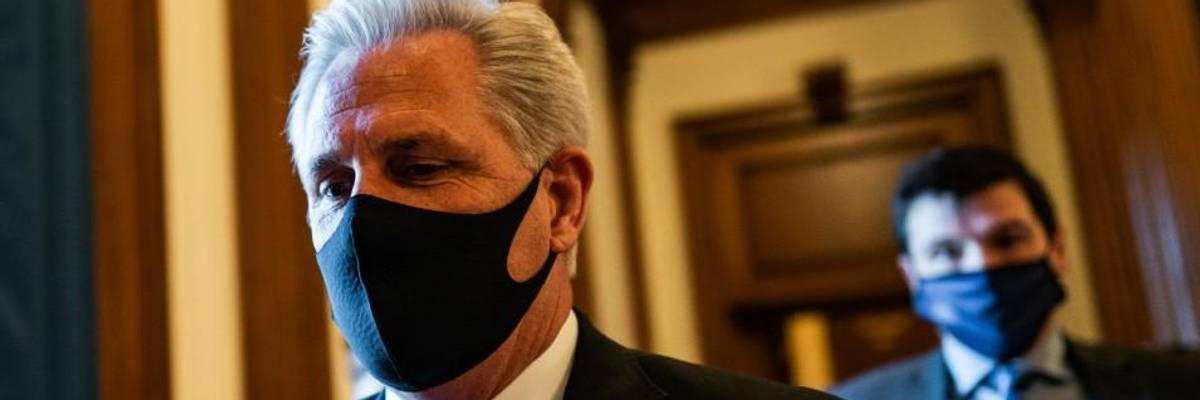
House Minority Leader Kevin McCarthy (R-Calif.) walks back to his office from the Senate floor on U.S. Capitol Hill in Washington, D.C. on Thursday, February 4, 2021. (Photo: Salwan Georges/The Washington Post via Getty Images)
Profiles of "Courage" During the Trump Impeachment Trial
Sycophantic antics of Republican members who opposed Trump's impeachment.
They believed liberty to be the secret of happiness and courage to be the secret of liberty. -Louis Dembitz Brandeis, Whitney vs. California (1927)
For profiles in courage, two of the 43 Republican senators who opposed impeachment stood out-Mitch McConnell and Kevin McCarthy. One other Senator stood out for his apparent ignorance of how jurors are supposed to behave. His behavior belied his impeccable legal credentials of which he is justly proud-Harvard law school and a U.S. Supreme Court clerkship. The ignoramus was none other than Ted Cruz.
During one of the breaks in the second impeachment trial of the Trump, Ted Cruz, was seen entering the room in which the Trump defense counsel was gathered. He was apparently unaware of the fact that during trials, jurors do not interact with the prosecution or the defense, the idea being that the jurors are to keep open minds until all the evidence has been heard. In ordinary circumstances the Cruz behavior would have been inappropriate but in the impeachment proceedings it was simply frosting on the cake of non-impartiality. That is because before the trial even began, Juror Cruz met with the Trump defense team and told its members that they'd already won their case. In his weekly podcast that aired on the Friday before the Senate voted, Cruz told listeners that he met with the defense team and: "I said, look, you've gotta remember you've already won." Since he'd already let them know how he intended to vote there was, of course, nothing inappropriate in his going into their conference room during the trial itself.
Cruz's confessed lack of impartiality was nothing compared to two profiles in courage that were in full display during, and following the conclusion of the trial. The first was presented by Kevin McCarthy, the House Republican leader.
During the attack on the Capitol that precipitated the second impeachment trial, Kevin was in his office as the marauders were about to break in. According to CNN, as that was happening McCarthy was on the phone with the Trump begging him to call off the rioters. The Trump ignored the peril facing McCarthy, and said the mob was more upset about the election than McCarthy, to which McCarthy asked the Trump to whom the Trump thought he was speaking, using an expletive for emphasis. The conversation ended abruptly as McCarthy fled.
Before the end of January McCarthy showed of what stuff he is made. He went to Florida, ostensibly as part of a fund-raising trip. He showed his courage by finding time to meet with the Trump to assure him there were no hard feelings for the Trump having taken no steps to protect him from the howling mob. He further showed the stuff of which he's made by not disclosing, during the impeachment trial, his conversation with the Trump during the break-in lest he once again offend the Trump. He left that to Rep. Jamie Herrera Beutler, a member of Congress from Washington State, who was, of course, only able to report what she'd been told by him. Her information was entered into the record in the form of a written statement. A description of the verbal encounter between McCarthy and the Trump would have been more forceful had it come from one of the participants instead of from hearsay reported by one of McCarthy's colleagues. It would have even more meaningful had it not been preceded by a sycophantic visit from McCarthy to the Trump following the verbal encounter.
The other profile in courage was forcefully presented by former Senate Majority Leader, Mitch McConnell. Throughout the Trump presidency, Mitch has shown his obsequious loyalty to the Trump irrespective of what the Trump has done. At the second impeachment trial, however, he outdid himself. The Democrats wanted the trial to begin while the Trump still lived in the White House and, was, therefore, still the president. That would have gotten the impeachment over with before the change in administration, and would have eliminated the argument that the proceedings were unconstitutional since the Trump was no longer in office. Exercising the prerogatives he enjoyed as Majority Leader in the Senate, however, Mitch made sure the impeachment proceedings would not begin until the Trump was out of office. At the conclusion of the hearing Mitch said the Trump could not be convicted because, thanks to Mitch's own actions, the proceedings took place after the Trump had left office and the purpose of impeachment was to remove someone from office. Since the Trump no longer held office, a vote for impeachment was improper.
Following his explanation of why he voted against conviction of the Trump, Mitch went into an expansive description of the Trump's obnoxious behavior while enjoying the position that permitted him to live in the White House. Had the trial taken place while the Trump was still entitled to live there, those acts would have been ample reason to impeach the Trump.
The foregoing is not meant to suggest that Mitch And Kevin were the only profiles in courage that day. They were joined by 41 of their Republican colleagues whose profiles in courage will be an inspiration to those who love Trump long after the trial is nothing but a dismal footnote in the history of the country.

Urgent. It's never been this bad.
Dear Common Dreams reader, It’s been nearly 30 years since I co-founded Common Dreams with my late wife, Lina Newhouser. We had the radical notion that journalism should serve the public good, not corporate profits. It was clear to us from the outset what it would take to build such a project. No paid advertisements. No corporate sponsors. No millionaire publisher telling us what to think or do. Many people said we wouldn't last a year, but we proved those doubters wrong. Together with a tremendous team of journalists and dedicated staff, we built an independent media outlet free from the constraints of profits and corporate control. Our mission from the outset was simple. To inform. To inspire. To ignite change for the common good. Building Common Dreams was not easy. Our survival was never guaranteed. When you take on the most powerful forces—Wall Street greed, fossil fuel industry destruction, Big Tech lobbyists, and uber-rich oligarchs who have spent billions upon billions rigging the economy and democracy in their favor—the only bulwark you have is supporters who believe in your work. But here’s the urgent message from me today. It’s never been this bad out there. And it’s never been this hard to keep us going. At the very moment Common Dreams is most needed and doing some of its best and most important work, the threats we face are intensifying. Right now, with just four days to go in our Spring Campaign, we are not even halfway to our goal. When everyone does the little they can afford, we are strong. But if that support retreats or dries up, so do we. Can you make a gift right now to make sure Common Dreams not only survives but thrives? There is no backup plan or rainy day fund. There is only you. —Craig Brown, Co-founder |
They believed liberty to be the secret of happiness and courage to be the secret of liberty. -Louis Dembitz Brandeis, Whitney vs. California (1927)
For profiles in courage, two of the 43 Republican senators who opposed impeachment stood out-Mitch McConnell and Kevin McCarthy. One other Senator stood out for his apparent ignorance of how jurors are supposed to behave. His behavior belied his impeccable legal credentials of which he is justly proud-Harvard law school and a U.S. Supreme Court clerkship. The ignoramus was none other than Ted Cruz.
During one of the breaks in the second impeachment trial of the Trump, Ted Cruz, was seen entering the room in which the Trump defense counsel was gathered. He was apparently unaware of the fact that during trials, jurors do not interact with the prosecution or the defense, the idea being that the jurors are to keep open minds until all the evidence has been heard. In ordinary circumstances the Cruz behavior would have been inappropriate but in the impeachment proceedings it was simply frosting on the cake of non-impartiality. That is because before the trial even began, Juror Cruz met with the Trump defense team and told its members that they'd already won their case. In his weekly podcast that aired on the Friday before the Senate voted, Cruz told listeners that he met with the defense team and: "I said, look, you've gotta remember you've already won." Since he'd already let them know how he intended to vote there was, of course, nothing inappropriate in his going into their conference room during the trial itself.
Cruz's confessed lack of impartiality was nothing compared to two profiles in courage that were in full display during, and following the conclusion of the trial. The first was presented by Kevin McCarthy, the House Republican leader.
During the attack on the Capitol that precipitated the second impeachment trial, Kevin was in his office as the marauders were about to break in. According to CNN, as that was happening McCarthy was on the phone with the Trump begging him to call off the rioters. The Trump ignored the peril facing McCarthy, and said the mob was more upset about the election than McCarthy, to which McCarthy asked the Trump to whom the Trump thought he was speaking, using an expletive for emphasis. The conversation ended abruptly as McCarthy fled.
Before the end of January McCarthy showed of what stuff he is made. He went to Florida, ostensibly as part of a fund-raising trip. He showed his courage by finding time to meet with the Trump to assure him there were no hard feelings for the Trump having taken no steps to protect him from the howling mob. He further showed the stuff of which he's made by not disclosing, during the impeachment trial, his conversation with the Trump during the break-in lest he once again offend the Trump. He left that to Rep. Jamie Herrera Beutler, a member of Congress from Washington State, who was, of course, only able to report what she'd been told by him. Her information was entered into the record in the form of a written statement. A description of the verbal encounter between McCarthy and the Trump would have been more forceful had it come from one of the participants instead of from hearsay reported by one of McCarthy's colleagues. It would have even more meaningful had it not been preceded by a sycophantic visit from McCarthy to the Trump following the verbal encounter.
The other profile in courage was forcefully presented by former Senate Majority Leader, Mitch McConnell. Throughout the Trump presidency, Mitch has shown his obsequious loyalty to the Trump irrespective of what the Trump has done. At the second impeachment trial, however, he outdid himself. The Democrats wanted the trial to begin while the Trump still lived in the White House and, was, therefore, still the president. That would have gotten the impeachment over with before the change in administration, and would have eliminated the argument that the proceedings were unconstitutional since the Trump was no longer in office. Exercising the prerogatives he enjoyed as Majority Leader in the Senate, however, Mitch made sure the impeachment proceedings would not begin until the Trump was out of office. At the conclusion of the hearing Mitch said the Trump could not be convicted because, thanks to Mitch's own actions, the proceedings took place after the Trump had left office and the purpose of impeachment was to remove someone from office. Since the Trump no longer held office, a vote for impeachment was improper.
Following his explanation of why he voted against conviction of the Trump, Mitch went into an expansive description of the Trump's obnoxious behavior while enjoying the position that permitted him to live in the White House. Had the trial taken place while the Trump was still entitled to live there, those acts would have been ample reason to impeach the Trump.
The foregoing is not meant to suggest that Mitch And Kevin were the only profiles in courage that day. They were joined by 41 of their Republican colleagues whose profiles in courage will be an inspiration to those who love Trump long after the trial is nothing but a dismal footnote in the history of the country.
They believed liberty to be the secret of happiness and courage to be the secret of liberty. -Louis Dembitz Brandeis, Whitney vs. California (1927)
For profiles in courage, two of the 43 Republican senators who opposed impeachment stood out-Mitch McConnell and Kevin McCarthy. One other Senator stood out for his apparent ignorance of how jurors are supposed to behave. His behavior belied his impeccable legal credentials of which he is justly proud-Harvard law school and a U.S. Supreme Court clerkship. The ignoramus was none other than Ted Cruz.
During one of the breaks in the second impeachment trial of the Trump, Ted Cruz, was seen entering the room in which the Trump defense counsel was gathered. He was apparently unaware of the fact that during trials, jurors do not interact with the prosecution or the defense, the idea being that the jurors are to keep open minds until all the evidence has been heard. In ordinary circumstances the Cruz behavior would have been inappropriate but in the impeachment proceedings it was simply frosting on the cake of non-impartiality. That is because before the trial even began, Juror Cruz met with the Trump defense team and told its members that they'd already won their case. In his weekly podcast that aired on the Friday before the Senate voted, Cruz told listeners that he met with the defense team and: "I said, look, you've gotta remember you've already won." Since he'd already let them know how he intended to vote there was, of course, nothing inappropriate in his going into their conference room during the trial itself.
Cruz's confessed lack of impartiality was nothing compared to two profiles in courage that were in full display during, and following the conclusion of the trial. The first was presented by Kevin McCarthy, the House Republican leader.
During the attack on the Capitol that precipitated the second impeachment trial, Kevin was in his office as the marauders were about to break in. According to CNN, as that was happening McCarthy was on the phone with the Trump begging him to call off the rioters. The Trump ignored the peril facing McCarthy, and said the mob was more upset about the election than McCarthy, to which McCarthy asked the Trump to whom the Trump thought he was speaking, using an expletive for emphasis. The conversation ended abruptly as McCarthy fled.
Before the end of January McCarthy showed of what stuff he is made. He went to Florida, ostensibly as part of a fund-raising trip. He showed his courage by finding time to meet with the Trump to assure him there were no hard feelings for the Trump having taken no steps to protect him from the howling mob. He further showed the stuff of which he's made by not disclosing, during the impeachment trial, his conversation with the Trump during the break-in lest he once again offend the Trump. He left that to Rep. Jamie Herrera Beutler, a member of Congress from Washington State, who was, of course, only able to report what she'd been told by him. Her information was entered into the record in the form of a written statement. A description of the verbal encounter between McCarthy and the Trump would have been more forceful had it come from one of the participants instead of from hearsay reported by one of McCarthy's colleagues. It would have even more meaningful had it not been preceded by a sycophantic visit from McCarthy to the Trump following the verbal encounter.
The other profile in courage was forcefully presented by former Senate Majority Leader, Mitch McConnell. Throughout the Trump presidency, Mitch has shown his obsequious loyalty to the Trump irrespective of what the Trump has done. At the second impeachment trial, however, he outdid himself. The Democrats wanted the trial to begin while the Trump still lived in the White House and, was, therefore, still the president. That would have gotten the impeachment over with before the change in administration, and would have eliminated the argument that the proceedings were unconstitutional since the Trump was no longer in office. Exercising the prerogatives he enjoyed as Majority Leader in the Senate, however, Mitch made sure the impeachment proceedings would not begin until the Trump was out of office. At the conclusion of the hearing Mitch said the Trump could not be convicted because, thanks to Mitch's own actions, the proceedings took place after the Trump had left office and the purpose of impeachment was to remove someone from office. Since the Trump no longer held office, a vote for impeachment was improper.
Following his explanation of why he voted against conviction of the Trump, Mitch went into an expansive description of the Trump's obnoxious behavior while enjoying the position that permitted him to live in the White House. Had the trial taken place while the Trump was still entitled to live there, those acts would have been ample reason to impeach the Trump.
The foregoing is not meant to suggest that Mitch And Kevin were the only profiles in courage that day. They were joined by 41 of their Republican colleagues whose profiles in courage will be an inspiration to those who love Trump long after the trial is nothing but a dismal footnote in the history of the country.