SUBSCRIBE TO OUR FREE NEWSLETTER
Daily news & progressive opinion—funded by the people, not the corporations—delivered straight to your inbox.
5
#000000
#FFFFFF
To donate by check, phone, or other method, see our More Ways to Give page.
Daily news & progressive opinion—funded by the people, not the corporations—delivered straight to your inbox.
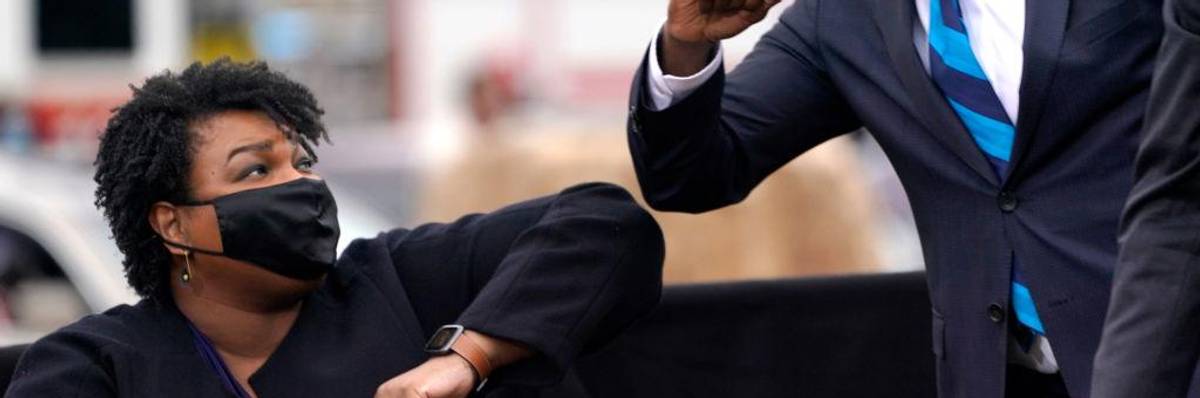
U.S. Democratic Senate candidate Raphael Warnock (R) bumps elbows with Stacey Abrams (L) during a campaign rally with U.S. President-elect Joe Biden at Pullman Yard on December 15, 2020 in Atlanta, Georgia. (Photo by Drew Angerer/Getty Images)
The answer to what happened in Washington last Wednesday is what happened in Georgia last Tuesday.
The answer to the yell and the noose of white macho supremacy is the slow, hard labor of making society democratic.
The debate over Amazon dropping Parler and Twitter and Facebook dropping Donald Trump misses the point. Megaphones for snake oil salesmen will exist for as long our media runs off snake oil sales. The answer to the mobster who riles up the lynch mob is media that's moral, which ours is not. Our media is motivated by money, and money, as we also saw this week, has no morals.
A society run for financial gain will never care that much about democracy; because that sort of society doesn't care--except about profit. It has no morals.
The stock market's boom has withstood a global pandemic, a worldwide recession, long bread lines, long voting lines, and a deadly display of white supremacy in the nation's capital. The financial markets rose on all of it.
Which is why a society run for financial gain will never care that much about democracy; because that sort of society doesn't care--except about profit. It has no morals.
Which takes us back to why we need to study Georgia. Arguably America's most brutal slave state, enslaved African Americans in plantation Georgia built the modern United States, and much of the entire capitalist world, in the service of money, driven by rape and the whip, herded in coffles, and traded for cash.
The returns from cotton fueled the rest of the economy, the financial markets, and shaped every aspect of American society, our media, and our politics.
Just how did a majority of Georgians come together against that? Poor people mostly, led by African American women and the young--people long policed and written off. Over slow generations, they built a broad enough "we" and an effective bottom up force that formed not just a victorious voting block this year, but a caring community dedicated explicitly to dismantling white supremacy.
How did they do that? That's what we need to know, and we need media that will tell that story.
This country and this world are at a monumental crossroads. US voters have an opportunity to beat back the forces of fascism and confront the billionaires who are rigging the economy, our media system, and our democracy, making it increasingly impossible for ordinary people to get by. We’re not just talking about the election. We’re talking about what must be done once these fascist elements are vanquished from power. We need a bolder set of solutions than what either major party has so far been willing to offer and a working-class movement ready to fight like hell for it. Trump didn't emerge from nowhere. The conditions that fueled MAGA authoritarianism were created by decades of radical neoliberal economic policies and a corrupt political system dominated by corporate interests. They slashed taxes on the super-rich, promising that the benefits would trickle down. They said giveaways to the corporate titans would make life more affordable for the rest of us. It was all bullshit. And when a bitter, betrayed populace searches for someone to blame, right-wing demagogues have little trouble finding scapegoats. People know when they're being lied to, but you won't hear any of this from the corporate media. Only independent journalism—powered and funded by people who believe in building a better world—can deliver truly trustworthy daily news. If you share our vision, please contribute whatever you can to sustain our work. |
The answer to what happened in Washington last Wednesday is what happened in Georgia last Tuesday.
The answer to the yell and the noose of white macho supremacy is the slow, hard labor of making society democratic.
The debate over Amazon dropping Parler and Twitter and Facebook dropping Donald Trump misses the point. Megaphones for snake oil salesmen will exist for as long our media runs off snake oil sales. The answer to the mobster who riles up the lynch mob is media that's moral, which ours is not. Our media is motivated by money, and money, as we also saw this week, has no morals.
A society run for financial gain will never care that much about democracy; because that sort of society doesn't care--except about profit. It has no morals.
The stock market's boom has withstood a global pandemic, a worldwide recession, long bread lines, long voting lines, and a deadly display of white supremacy in the nation's capital. The financial markets rose on all of it.
Which is why a society run for financial gain will never care that much about democracy; because that sort of society doesn't care--except about profit. It has no morals.
Which takes us back to why we need to study Georgia. Arguably America's most brutal slave state, enslaved African Americans in plantation Georgia built the modern United States, and much of the entire capitalist world, in the service of money, driven by rape and the whip, herded in coffles, and traded for cash.
The returns from cotton fueled the rest of the economy, the financial markets, and shaped every aspect of American society, our media, and our politics.
Just how did a majority of Georgians come together against that? Poor people mostly, led by African American women and the young--people long policed and written off. Over slow generations, they built a broad enough "we" and an effective bottom up force that formed not just a victorious voting block this year, but a caring community dedicated explicitly to dismantling white supremacy.
How did they do that? That's what we need to know, and we need media that will tell that story.