SUBSCRIBE TO OUR FREE NEWSLETTER
Daily news & progressive opinion—funded by the people, not the corporations—delivered straight to your inbox.
5
#000000
#FFFFFF
To donate by check, phone, or other method, see our More Ways to Give page.
Daily news & progressive opinion—funded by the people, not the corporations—delivered straight to your inbox.
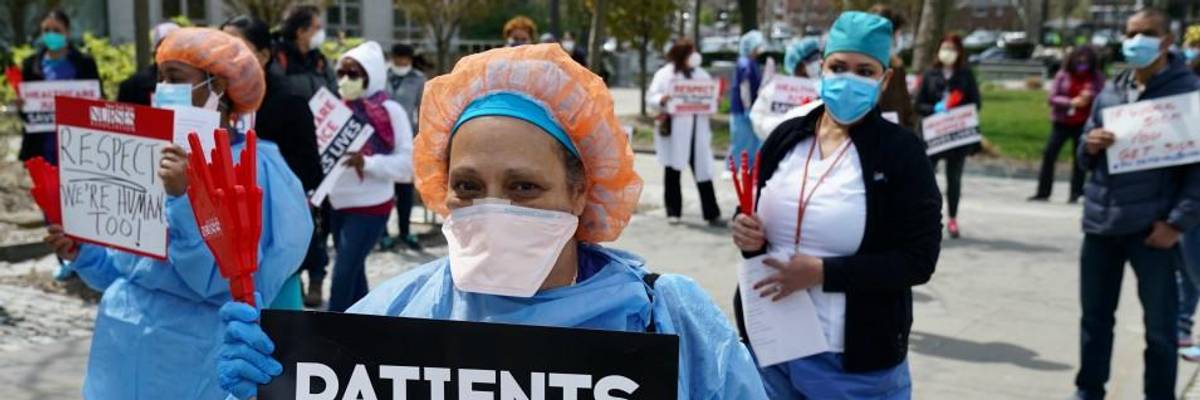
Public health workers, doctors, and nurses protest over lack of sick pay and personal protective equipment outside a hospital in the Bronx on April 17, 2020. (Photo: Giles Clarke/Getty Images)
Americans today have a life expectancy of 78.5 years. People in other high-income nations lead longer lives. Japan and Hong Kong, for instance, enjoy a life expectancy of 84 years. The United States has also fared poorly with Covid-19, with some of the highest caseloads in the world. All this raises an obvious question: Why can't the United States achieve better health outcomes?
Worldwide, the wealth of a country clearly seems to determine a large part of the variation in life expectancy. High-income nations rank at the top of our global life expectancy tables, and low-income countries lag at the bottom. Wealthier countries, the broad argument goes, achieve their higher life expectancies through more resourced and effective health systems and higher standards of living. They have the wherewithal to invest in societal factors that influence health, everything from housing and education to sanitation and social security.
"The United States provides the lowest level of unemployment, sickness, and public pension benefits in the high-income world."
The U.S. economist Samuel Preston described all these relationships back in 1975. But he also noted that some countries sat above the trendline. They achieved higher life expectancy than what we would expect from their income. Other countries fell below the trendline. They achieved lower life expectancies than what their income would predict.
At any level of economic development, in short, some countries translate their wealth into health more successfully than others. The "Punching Above Their Weight Network," an international collaboration of leading public health researchers and policy actors co-founded by Australia's Fran Baum and South Africa's David Sanders, has been working since 2017 to investigate why some countries are doing so well relative to their income. The goal: to better turn wealth into good population health outcomes.
Toward this end, we recently conducted case studies of three countries: Ethiopia, Brazil, and the United States. Ethiopia punches above its weight, achieving three extra years of life expectancy than we would expect given the nation's modest income. Brazil also punches above weight, by two years of life expectancy. The United States, by contrast, punches almost three years below weight.
Our analysis highlighted four factors we feel are driving population health performance. With the new Biden-Harris administration about to take office in United States, our findings have clear implications for how the United States could add years to the life expectancy of the American people.
Our first finding: Adequate welfare and social security systems rate as fundamentally important. Ethiopia and Brazil have both instituted strong social security policies. Brazil's renowned "Bolsa Familia" program, introduced by then-president Lula da Silva in 2003, transfers cash to poor families that send their children to school and have them properly vaccinated.
The United States, meanwhile, provides the lowest level of unemployment, sickness, and public pension benefits in the high-income world. In 2016, analysts Jason Beckfield and Clare Bambra's 2016 study found that the United States could extend its life expectancy by almost four years by lifting its social security outlays merely to the average for other high-income countries. Taking this step alone would have the United States punching above its weight relative to wealth.
"The United States spends more on health care, overall, than any other nation in the world. Despite this spending, large inequities in access to health care still exist across the United States."
Our second finding focused on the contribution of inequities within a country. The British epidemiologists Richard Wilkinson and Kate Pickett have demonstrated how more unequal societies have worse health and social outcomes. Inequities, they argue, affect health through various pathways, among them the lack of social cohesion and trust in unequal societies and the corrosive dissatisfaction with their own social status that people feel in deeply stratified societies. Ethiopia and Brazil have both sought to act on socioeconomic and racial inequities, the United States not nearly as much. The excess Covid death rates among Black Americans testify to the sharp and continuing inequity built into the American social order.
Our third finding looks at the role of a nation's health system. In the United States, health care remains partly a state responsibility, and that leads to a systematic diversity in health care spending and performance across the nation. The United States spends more on health care, overall, than any other nation in the world. Despite this spending, large inequities in access to health care still exist across the United States. The Biden and Harris commitment to expand the Affordable Care Act has the potential to begin to redress these existing health inequities.
The fourth and final finding: Civil society plays a crucial role in promoting health and equity. We found strong civil society organization and participation in Ethiopia and Brazil, factors that contributed to the better health outcomes in these countries. In the United States, civil society plays a less evident role. The United States has the lowest voting participation rates of high-income countries and extremely low levels of trade union membership.
Covid-19 has laid bare the health inequities between and within countries and highlights the urgency of addressing inequities to improve the health of populations. Several countries such as New Zealand and Iceland have instituted "well-being budgets" that prioritize those functions of government that promote health. Biden and Harris have an opportunity to pursue a similar path.
Dear Common Dreams reader, It’s been nearly 30 years since I co-founded Common Dreams with my late wife, Lina Newhouser. We had the radical notion that journalism should serve the public good, not corporate profits. It was clear to us from the outset what it would take to build such a project. No paid advertisements. No corporate sponsors. No millionaire publisher telling us what to think or do. Many people said we wouldn't last a year, but we proved those doubters wrong. Together with a tremendous team of journalists and dedicated staff, we built an independent media outlet free from the constraints of profits and corporate control. Our mission has always been simple: To inform. To inspire. To ignite change for the common good. Building Common Dreams was not easy. Our survival was never guaranteed. When you take on the most powerful forces—Wall Street greed, fossil fuel industry destruction, Big Tech lobbyists, and uber-rich oligarchs who have spent billions upon billions rigging the economy and democracy in their favor—the only bulwark you have is supporters who believe in your work. But here’s the urgent message from me today. It's never been this bad out there. And it's never been this hard to keep us going. At the very moment Common Dreams is most needed, the threats we face are intensifying. We need your support now more than ever. We don't accept corporate advertising and never will. We don't have a paywall because we don't think people should be blocked from critical news based on their ability to pay. Everything we do is funded by the donations of readers like you. When everyone does the little they can afford, we are strong. But if that support retreats or dries up, so do we. Will you donate now to make sure Common Dreams not only survives but thrives? —Craig Brown, Co-founder |
Americans today have a life expectancy of 78.5 years. People in other high-income nations lead longer lives. Japan and Hong Kong, for instance, enjoy a life expectancy of 84 years. The United States has also fared poorly with Covid-19, with some of the highest caseloads in the world. All this raises an obvious question: Why can't the United States achieve better health outcomes?
Worldwide, the wealth of a country clearly seems to determine a large part of the variation in life expectancy. High-income nations rank at the top of our global life expectancy tables, and low-income countries lag at the bottom. Wealthier countries, the broad argument goes, achieve their higher life expectancies through more resourced and effective health systems and higher standards of living. They have the wherewithal to invest in societal factors that influence health, everything from housing and education to sanitation and social security.
"The United States provides the lowest level of unemployment, sickness, and public pension benefits in the high-income world."
The U.S. economist Samuel Preston described all these relationships back in 1975. But he also noted that some countries sat above the trendline. They achieved higher life expectancy than what we would expect from their income. Other countries fell below the trendline. They achieved lower life expectancies than what their income would predict.
At any level of economic development, in short, some countries translate their wealth into health more successfully than others. The "Punching Above Their Weight Network," an international collaboration of leading public health researchers and policy actors co-founded by Australia's Fran Baum and South Africa's David Sanders, has been working since 2017 to investigate why some countries are doing so well relative to their income. The goal: to better turn wealth into good population health outcomes.
Toward this end, we recently conducted case studies of three countries: Ethiopia, Brazil, and the United States. Ethiopia punches above its weight, achieving three extra years of life expectancy than we would expect given the nation's modest income. Brazil also punches above weight, by two years of life expectancy. The United States, by contrast, punches almost three years below weight.
Our analysis highlighted four factors we feel are driving population health performance. With the new Biden-Harris administration about to take office in United States, our findings have clear implications for how the United States could add years to the life expectancy of the American people.
Our first finding: Adequate welfare and social security systems rate as fundamentally important. Ethiopia and Brazil have both instituted strong social security policies. Brazil's renowned "Bolsa Familia" program, introduced by then-president Lula da Silva in 2003, transfers cash to poor families that send their children to school and have them properly vaccinated.
The United States, meanwhile, provides the lowest level of unemployment, sickness, and public pension benefits in the high-income world. In 2016, analysts Jason Beckfield and Clare Bambra's 2016 study found that the United States could extend its life expectancy by almost four years by lifting its social security outlays merely to the average for other high-income countries. Taking this step alone would have the United States punching above its weight relative to wealth.
"The United States spends more on health care, overall, than any other nation in the world. Despite this spending, large inequities in access to health care still exist across the United States."
Our second finding focused on the contribution of inequities within a country. The British epidemiologists Richard Wilkinson and Kate Pickett have demonstrated how more unequal societies have worse health and social outcomes. Inequities, they argue, affect health through various pathways, among them the lack of social cohesion and trust in unequal societies and the corrosive dissatisfaction with their own social status that people feel in deeply stratified societies. Ethiopia and Brazil have both sought to act on socioeconomic and racial inequities, the United States not nearly as much. The excess Covid death rates among Black Americans testify to the sharp and continuing inequity built into the American social order.
Our third finding looks at the role of a nation's health system. In the United States, health care remains partly a state responsibility, and that leads to a systematic diversity in health care spending and performance across the nation. The United States spends more on health care, overall, than any other nation in the world. Despite this spending, large inequities in access to health care still exist across the United States. The Biden and Harris commitment to expand the Affordable Care Act has the potential to begin to redress these existing health inequities.
The fourth and final finding: Civil society plays a crucial role in promoting health and equity. We found strong civil society organization and participation in Ethiopia and Brazil, factors that contributed to the better health outcomes in these countries. In the United States, civil society plays a less evident role. The United States has the lowest voting participation rates of high-income countries and extremely low levels of trade union membership.
Covid-19 has laid bare the health inequities between and within countries and highlights the urgency of addressing inequities to improve the health of populations. Several countries such as New Zealand and Iceland have instituted "well-being budgets" that prioritize those functions of government that promote health. Biden and Harris have an opportunity to pursue a similar path.
Americans today have a life expectancy of 78.5 years. People in other high-income nations lead longer lives. Japan and Hong Kong, for instance, enjoy a life expectancy of 84 years. The United States has also fared poorly with Covid-19, with some of the highest caseloads in the world. All this raises an obvious question: Why can't the United States achieve better health outcomes?
Worldwide, the wealth of a country clearly seems to determine a large part of the variation in life expectancy. High-income nations rank at the top of our global life expectancy tables, and low-income countries lag at the bottom. Wealthier countries, the broad argument goes, achieve their higher life expectancies through more resourced and effective health systems and higher standards of living. They have the wherewithal to invest in societal factors that influence health, everything from housing and education to sanitation and social security.
"The United States provides the lowest level of unemployment, sickness, and public pension benefits in the high-income world."
The U.S. economist Samuel Preston described all these relationships back in 1975. But he also noted that some countries sat above the trendline. They achieved higher life expectancy than what we would expect from their income. Other countries fell below the trendline. They achieved lower life expectancies than what their income would predict.
At any level of economic development, in short, some countries translate their wealth into health more successfully than others. The "Punching Above Their Weight Network," an international collaboration of leading public health researchers and policy actors co-founded by Australia's Fran Baum and South Africa's David Sanders, has been working since 2017 to investigate why some countries are doing so well relative to their income. The goal: to better turn wealth into good population health outcomes.
Toward this end, we recently conducted case studies of three countries: Ethiopia, Brazil, and the United States. Ethiopia punches above its weight, achieving three extra years of life expectancy than we would expect given the nation's modest income. Brazil also punches above weight, by two years of life expectancy. The United States, by contrast, punches almost three years below weight.
Our analysis highlighted four factors we feel are driving population health performance. With the new Biden-Harris administration about to take office in United States, our findings have clear implications for how the United States could add years to the life expectancy of the American people.
Our first finding: Adequate welfare and social security systems rate as fundamentally important. Ethiopia and Brazil have both instituted strong social security policies. Brazil's renowned "Bolsa Familia" program, introduced by then-president Lula da Silva in 2003, transfers cash to poor families that send their children to school and have them properly vaccinated.
The United States, meanwhile, provides the lowest level of unemployment, sickness, and public pension benefits in the high-income world. In 2016, analysts Jason Beckfield and Clare Bambra's 2016 study found that the United States could extend its life expectancy by almost four years by lifting its social security outlays merely to the average for other high-income countries. Taking this step alone would have the United States punching above its weight relative to wealth.
"The United States spends more on health care, overall, than any other nation in the world. Despite this spending, large inequities in access to health care still exist across the United States."
Our second finding focused on the contribution of inequities within a country. The British epidemiologists Richard Wilkinson and Kate Pickett have demonstrated how more unequal societies have worse health and social outcomes. Inequities, they argue, affect health through various pathways, among them the lack of social cohesion and trust in unequal societies and the corrosive dissatisfaction with their own social status that people feel in deeply stratified societies. Ethiopia and Brazil have both sought to act on socioeconomic and racial inequities, the United States not nearly as much. The excess Covid death rates among Black Americans testify to the sharp and continuing inequity built into the American social order.
Our third finding looks at the role of a nation's health system. In the United States, health care remains partly a state responsibility, and that leads to a systematic diversity in health care spending and performance across the nation. The United States spends more on health care, overall, than any other nation in the world. Despite this spending, large inequities in access to health care still exist across the United States. The Biden and Harris commitment to expand the Affordable Care Act has the potential to begin to redress these existing health inequities.
The fourth and final finding: Civil society plays a crucial role in promoting health and equity. We found strong civil society organization and participation in Ethiopia and Brazil, factors that contributed to the better health outcomes in these countries. In the United States, civil society plays a less evident role. The United States has the lowest voting participation rates of high-income countries and extremely low levels of trade union membership.
Covid-19 has laid bare the health inequities between and within countries and highlights the urgency of addressing inequities to improve the health of populations. Several countries such as New Zealand and Iceland have instituted "well-being budgets" that prioritize those functions of government that promote health. Biden and Harris have an opportunity to pursue a similar path.