SUBSCRIBE TO OUR FREE NEWSLETTER
Daily news & progressive opinion—funded by the people, not the corporations—delivered straight to your inbox.
5
#000000
#FFFFFF
To donate by check, phone, or other method, see our More Ways to Give page.
Daily news & progressive opinion—funded by the people, not the corporations—delivered straight to your inbox.
To ensure that the global economy is not only resilient but also conducive to social progress, governments must restore the social contract by rebuilding trust in democracy and a fair and equitable economy.(Photo: Scott Lewis/Flickr/cc)
he Covid-19 pandemic has once again exposed the fragility of global supply chains and business models built on non-standard forms of employment and informality. Following the global drop in demand as a result of the pandemic, many companies resorted to abruptly ending the procurement of goods and services and even to defaulting on prior commitments made--with the consequence of a disastrous impact for workers in global supply chains.
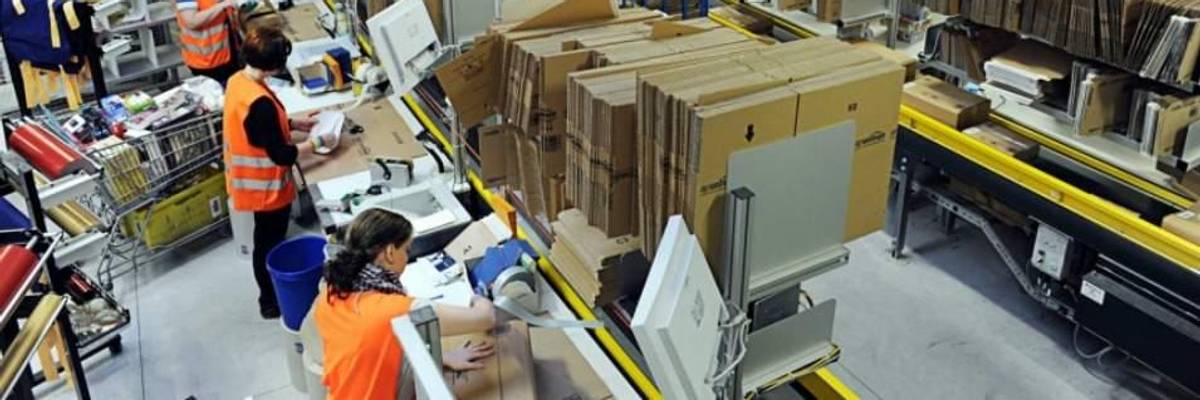
Simultaneously, others designated as key workers in the crisis, including seafarers and workers in packing and distribution centers, continue to work tirelessly to keep global supply chains afloat at huge personal risk of exposure and often without adequate personal protective equipment.
Not for the first time, workers have learned the hard way that our global economy is not governed by the rule of law. It is therefore unsurprising that a recent Global Poll conducted by the International Trade Union Confederation found that almost three-quarters (71 percent) of people believe that their country's economic system favors the wealthy. Sixty-one percent of people surveyed said that they would trust governments more if they held companies to account for how they treat workers and the environment. And a whopping 66 percent said they want their governments to adopt new rules for multinationals to end abuse through their supply chains.
To ensure that the global economy is not only resilient but also conducive to social progress, governments must restore the social contract by rebuilding trust in democracy and a fair and equitable economy. This has to start with the regulation of highly exploitative global supply chains--the heartbeat of our current trading system. Indications are that governments and business are starting to listen.
The European Commission, for example, has conceded that voluntary measures are insufficient to change the way businesses manage their human rights and environmental impacts. Large multinational enterprises are now also openly calling for human rights due diligence (HRDD) legislation.
The next round of negotiations for a UN Binding Treaty on Business and Human Rights later this month provides a critical opportunity for governments and business to finally demonstrate their expressed commitment to responsible business conduct.
71% of people around the world believe that their country's economic system favors the wealthy- International Trade Union Confederation poll conducted in 16 countries, February-March 2020
The latest draft of the proposed Binding Treaty provides a strong basis for an instrument that is both politically viable and effective in addressing accountability gaps in international human rights law. Indeed, the new text has introduced further conceptual clarity, alignment with the UN Guiding Principles on Business and Human Rights, and a more coherent structure.
Unions welcome, among other things, the strengthening of the gender dimension throughout the text, which will help ensure that states effectively discharge their obligations to protect and fulfill women's --including women workers'--human rights in the context of business activities.
While HRDD rightly takes center stage in the revised article on preventive measures, it is encouraging to see that the duty to prevent adverse human rights impacts does not stop at due diligence.
From the outset, trade unions have campaigned for a Binding Treaty that holds transnational companies liable for human rights violations throughout their activities, including those by supply chain entities, irrespective of the mode of creation, ownership, or control. This latest draft does just that by providing a sound basis for addressing existing accountability and liability gaps arising from the complex corporate structures of multinational companies and their supply chains.
Another significant improvement is the inclusion of a provision that explicitly requires states to ensure that any existing or new trade and investment agreements are compatible with the human rights obligations under the Binding Treaty.
Strengthening priorities for the next round of negotiations
While the latest draft captures many trade union demands, there are still significant improvements that can be made to the text. During the next round of negotiations, the global trade union movement will continue to call for the following priorities to be strengthened:
In particular, we would like to see trade unionists explicitly recognized as human rights defenders and trade unions acknowledged as being an integral part of HRDD processes. The next draft will also benefit from more clarity on the relationship between liability for failing to conduct mandatory HRDD and liability for human rights abuses.
Dear Common Dreams reader, It’s been nearly 30 years since I co-founded Common Dreams with my late wife, Lina Newhouser. We had the radical notion that journalism should serve the public good, not corporate profits. It was clear to us from the outset what it would take to build such a project. No paid advertisements. No corporate sponsors. No millionaire publisher telling us what to think or do. Many people said we wouldn't last a year, but we proved those doubters wrong. Together with a tremendous team of journalists and dedicated staff, we built an independent media outlet free from the constraints of profits and corporate control. Our mission has always been simple: To inform. To inspire. To ignite change for the common good. Building Common Dreams was not easy. Our survival was never guaranteed. When you take on the most powerful forces—Wall Street greed, fossil fuel industry destruction, Big Tech lobbyists, and uber-rich oligarchs who have spent billions upon billions rigging the economy and democracy in their favor—the only bulwark you have is supporters who believe in your work. But here’s the urgent message from me today. It's never been this bad out there. And it's never been this hard to keep us going. At the very moment Common Dreams is most needed, the threats we face are intensifying. We need your support now more than ever. We don't accept corporate advertising and never will. We don't have a paywall because we don't think people should be blocked from critical news based on their ability to pay. Everything we do is funded by the donations of readers like you. When everyone does the little they can afford, we are strong. But if that support retreats or dries up, so do we. Will you donate now to make sure Common Dreams not only survives but thrives? —Craig Brown, Co-founder |
he Covid-19 pandemic has once again exposed the fragility of global supply chains and business models built on non-standard forms of employment and informality. Following the global drop in demand as a result of the pandemic, many companies resorted to abruptly ending the procurement of goods and services and even to defaulting on prior commitments made--with the consequence of a disastrous impact for workers in global supply chains.
Simultaneously, others designated as key workers in the crisis, including seafarers and workers in packing and distribution centers, continue to work tirelessly to keep global supply chains afloat at huge personal risk of exposure and often without adequate personal protective equipment.
Not for the first time, workers have learned the hard way that our global economy is not governed by the rule of law. It is therefore unsurprising that a recent Global Poll conducted by the International Trade Union Confederation found that almost three-quarters (71 percent) of people believe that their country's economic system favors the wealthy. Sixty-one percent of people surveyed said that they would trust governments more if they held companies to account for how they treat workers and the environment. And a whopping 66 percent said they want their governments to adopt new rules for multinationals to end abuse through their supply chains.
To ensure that the global economy is not only resilient but also conducive to social progress, governments must restore the social contract by rebuilding trust in democracy and a fair and equitable economy. This has to start with the regulation of highly exploitative global supply chains--the heartbeat of our current trading system. Indications are that governments and business are starting to listen.
The European Commission, for example, has conceded that voluntary measures are insufficient to change the way businesses manage their human rights and environmental impacts. Large multinational enterprises are now also openly calling for human rights due diligence (HRDD) legislation.
The next round of negotiations for a UN Binding Treaty on Business and Human Rights later this month provides a critical opportunity for governments and business to finally demonstrate their expressed commitment to responsible business conduct.
71% of people around the world believe that their country's economic system favors the wealthy- International Trade Union Confederation poll conducted in 16 countries, February-March 2020
The latest draft of the proposed Binding Treaty provides a strong basis for an instrument that is both politically viable and effective in addressing accountability gaps in international human rights law. Indeed, the new text has introduced further conceptual clarity, alignment with the UN Guiding Principles on Business and Human Rights, and a more coherent structure.
Unions welcome, among other things, the strengthening of the gender dimension throughout the text, which will help ensure that states effectively discharge their obligations to protect and fulfill women's --including women workers'--human rights in the context of business activities.
While HRDD rightly takes center stage in the revised article on preventive measures, it is encouraging to see that the duty to prevent adverse human rights impacts does not stop at due diligence.
From the outset, trade unions have campaigned for a Binding Treaty that holds transnational companies liable for human rights violations throughout their activities, including those by supply chain entities, irrespective of the mode of creation, ownership, or control. This latest draft does just that by providing a sound basis for addressing existing accountability and liability gaps arising from the complex corporate structures of multinational companies and their supply chains.
Another significant improvement is the inclusion of a provision that explicitly requires states to ensure that any existing or new trade and investment agreements are compatible with the human rights obligations under the Binding Treaty.
Strengthening priorities for the next round of negotiations
While the latest draft captures many trade union demands, there are still significant improvements that can be made to the text. During the next round of negotiations, the global trade union movement will continue to call for the following priorities to be strengthened:
In particular, we would like to see trade unionists explicitly recognized as human rights defenders and trade unions acknowledged as being an integral part of HRDD processes. The next draft will also benefit from more clarity on the relationship between liability for failing to conduct mandatory HRDD and liability for human rights abuses.
he Covid-19 pandemic has once again exposed the fragility of global supply chains and business models built on non-standard forms of employment and informality. Following the global drop in demand as a result of the pandemic, many companies resorted to abruptly ending the procurement of goods and services and even to defaulting on prior commitments made--with the consequence of a disastrous impact for workers in global supply chains.
Simultaneously, others designated as key workers in the crisis, including seafarers and workers in packing and distribution centers, continue to work tirelessly to keep global supply chains afloat at huge personal risk of exposure and often without adequate personal protective equipment.
Not for the first time, workers have learned the hard way that our global economy is not governed by the rule of law. It is therefore unsurprising that a recent Global Poll conducted by the International Trade Union Confederation found that almost three-quarters (71 percent) of people believe that their country's economic system favors the wealthy. Sixty-one percent of people surveyed said that they would trust governments more if they held companies to account for how they treat workers and the environment. And a whopping 66 percent said they want their governments to adopt new rules for multinationals to end abuse through their supply chains.
To ensure that the global economy is not only resilient but also conducive to social progress, governments must restore the social contract by rebuilding trust in democracy and a fair and equitable economy. This has to start with the regulation of highly exploitative global supply chains--the heartbeat of our current trading system. Indications are that governments and business are starting to listen.
The European Commission, for example, has conceded that voluntary measures are insufficient to change the way businesses manage their human rights and environmental impacts. Large multinational enterprises are now also openly calling for human rights due diligence (HRDD) legislation.
The next round of negotiations for a UN Binding Treaty on Business and Human Rights later this month provides a critical opportunity for governments and business to finally demonstrate their expressed commitment to responsible business conduct.
71% of people around the world believe that their country's economic system favors the wealthy- International Trade Union Confederation poll conducted in 16 countries, February-March 2020
The latest draft of the proposed Binding Treaty provides a strong basis for an instrument that is both politically viable and effective in addressing accountability gaps in international human rights law. Indeed, the new text has introduced further conceptual clarity, alignment with the UN Guiding Principles on Business and Human Rights, and a more coherent structure.
Unions welcome, among other things, the strengthening of the gender dimension throughout the text, which will help ensure that states effectively discharge their obligations to protect and fulfill women's --including women workers'--human rights in the context of business activities.
While HRDD rightly takes center stage in the revised article on preventive measures, it is encouraging to see that the duty to prevent adverse human rights impacts does not stop at due diligence.
From the outset, trade unions have campaigned for a Binding Treaty that holds transnational companies liable for human rights violations throughout their activities, including those by supply chain entities, irrespective of the mode of creation, ownership, or control. This latest draft does just that by providing a sound basis for addressing existing accountability and liability gaps arising from the complex corporate structures of multinational companies and their supply chains.
Another significant improvement is the inclusion of a provision that explicitly requires states to ensure that any existing or new trade and investment agreements are compatible with the human rights obligations under the Binding Treaty.
Strengthening priorities for the next round of negotiations
While the latest draft captures many trade union demands, there are still significant improvements that can be made to the text. During the next round of negotiations, the global trade union movement will continue to call for the following priorities to be strengthened:
In particular, we would like to see trade unionists explicitly recognized as human rights defenders and trade unions acknowledged as being an integral part of HRDD processes. The next draft will also benefit from more clarity on the relationship between liability for failing to conduct mandatory HRDD and liability for human rights abuses.