SUBSCRIBE TO OUR FREE NEWSLETTER
Daily news & progressive opinion—funded by the people, not the corporations—delivered straight to your inbox.
5
#000000
#FFFFFF
To donate by check, phone, or other method, see our More Ways to Give page.
Daily news & progressive opinion—funded by the people, not the corporations—delivered straight to your inbox.
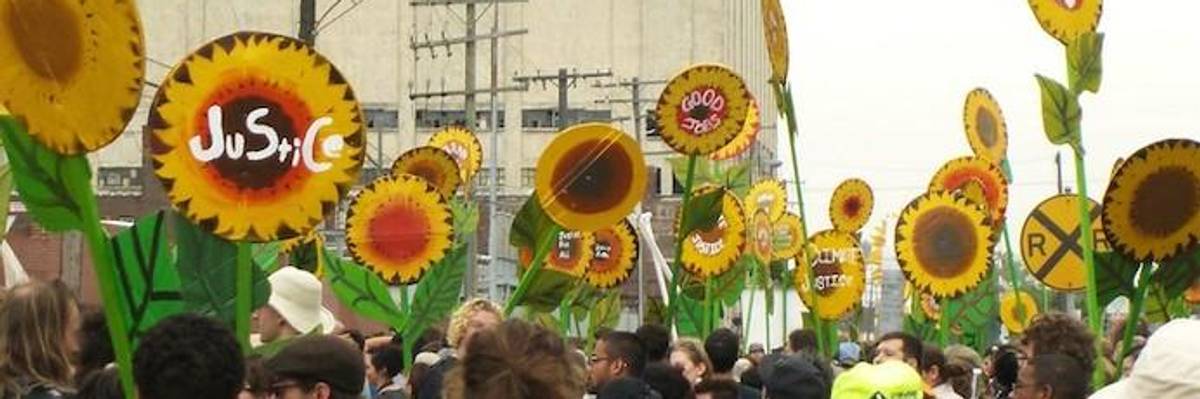
If you want to talk about the inequality in our economy, COVID-19, race, and silent violence in our cities, you need to start with environmental injustice to Black and brown families. (Photo: Marcus Johnstone/CC BY-NC 2.0)
Earlier this week, when Fox News announced the lineup of topics for the upcoming presidential debate, climate change and environmental justice were nowhere to be seen. Among the many lamentable things about that is that moderator Chris Wallace, who is scheduled for this Tuesday's debate, has shown that he is fully capable of asking sharp questions on the subject.
Setting the stage
Earlier this week, when Fox News announced the lineup of topics for the upcoming presidential debate, climate change and environmental justice were nowhere to be seen. Among the many lamentable things about that is that moderator Chris Wallace, who is scheduled for this Tuesday's debate, has shown that he is fully capable of asking sharp questions on the subject.
Setting the stage
In April 2017, the Fox News Sunday host grilled the then-new Environmental Protection Agency Administrator Scott Pruitt over the Trump administration's rollback of President Obama's Clean Power Plan. Wallace cited that the Clean Power Plan would not only cut carbon pollution to reduce greenhouse gases, but also generate projected annual benefits of 90,000 fewer asthma attacks, 300,000 fewer missed work and school days and 3,600 fewer premature deaths by 2030. "Without the Clean Power Plan, how are you going to prevent those terrible things?" Wallace asked Pruitt.
Pruitt, who had repeatedly sued the EPA on behalf of fossil fuel polluters as Oklahoma attorney general, refused to answer the question. Instead, he launched into rhetoric about government overreach. Wallace stopped him, saying: "Sir, you're giving me a regulatory answer, a political answer. You're not giving me a health answer."
When Wallace again pressed for a health answer, Pruitt said emissions were already falling in a growing economy. Wallace reminded Pruitt that, even with the reductions, 166 million people in the United States have unsafe air.
"If you do away with the Clean Power Plan and boost--as the president promises--coal production, then you're going to make the air even worse," Wallace said. "What about those 166 million people?" Pruitt never talked about those people.
Now we must.
Environmental justice at core of many crises
Pruitt is long gone from the EPA, but 100,000 Americans die every year from fine particulate pollution. And for all the false talking points about not sacrificing the economy to protect the environment, the climate change disasters of hurricanes, floods and wildfires cost the country $415 billion from 2016-2018 according to the investment house Morgan Stanley, hardly a radical source. The National Oceanographic and Atmospheric Administration says that the average annual number of "billion-dollar" weather and climate catastrophes has, in rounded figures, risen from three in the 1980s to 12 in the 2010s and 15 in the last three years. The cost of billion-dollar disasters has burgeoned four and a half times from the $177.2 billion spent in the 1980s to $807 billion spent in 2010s.
Environmental justice plays a massive role in all the major issues we face today, including the pandemic.The 40-year total now stands at nearly $1.8 trillion, nearly equal to the coronavirus stimulus package passed in the spring. With three more months to go, 2020 has already become the sixth straight year in which the United States has experienced at least ten billion-dollar disasters--an unprecedented streak. While weather and climate tragedies were responsible for an average of 287 annual deaths in the 1980s, that number too has risen four-fold in the last three years, to 1,190 per year.
Those enormous costs are just the beginning of the reasons why climate change, and very specifically, environmental justice, must be a significant part of the agenda for at least one of the three presidential debates between President Trump and challenger Joe Biden.
Environmental justice plays a massive role in all the major issues we face today, including the pandemic. More than 200,000 Americans are dead from COVID-19. If everyone died equally based on color, 21,000 African Americans, nearly 11,000 Latinx, and 700 Indigenous people would still be alive today, according to the APM Research Lab. The reasons for the disparities are systemic.
White households, with far higher levels of average wealth and consumption, disproportionately produce pollution while Black and Latinx disproportionately breathe in that pollution.
African American and Latinx families, still laboring under the legacy of legally enforced and long permitted bank-lending discrimination, are much more likely to live in crowded multi-family homes next to or near fossil fuel facilities, petrochemical plants, and other toxic industries that and waste sites. That triggers a disproportionate cascade of ailments, from asthma to neurological damage to cancer. Such families, in often-neglected parts of cities, send their children to schools too often shrouded in industrial dust and containing crumbling asbestos.
Many studies have shown a link between proximity to pollution and lower school achievement, limited job opportunities, and higher chances of being incarcerated. Because of life-chance barriers, Black and brown workers are significantly more likely to have lower-paying "essential" service jobs that put them at higher risk to contract COVID-19 while White workers disproportionately tap fingers on laptops at home. Black and brown workers often force themselves to work no matter how much their pre-existing conditions put them at risk for a tragic outcome from COVID-19.
"How are you going to prevent those terrible things?"
So, if you want to talk about the inequality in our economy, COVID-19, race, and silent violence in our cities, you need to start with environmental injustice to Black and brown families. COVID-19 is now at the core of issues threatening the integrity of our election, with controversies around mail-in voting and a dramatically reduced number of voting sites that force people--often in places where Black and brown turnout makes a major difference--to stand in long lines, risking their health to physically vote.
Environmental justice looms large in discussions of the Supreme Court, especially with the death of Justice Ruth Bader Ginsberg. A conservative court that removed most restrictions for corporations to spend money on politics in the 2010 Citizens United decision now seems at risk of allowing corporations to gut the razor-thin 5-4 landmark, 2007 Massachusetts v. EPA. Ginsberg voted with the majority in that decision to rule that the Environmental Protection Agency has the authority under the Clean Air Act to regulate greenhouse gases to combat climate change.
It's a shocking reality that no moderator asked about climate change in the 2016 presidential debates. Three weeks ago, the Union of Concerned Scientists joined nearly four dozen groups in writing a letter to the moderators of the three upcoming presidential and one vice presidential debates, reminding them that, in a Stanford University poll, a record 82 percent of people said they thought government should do at least a moderate amount to blunt the effects of climate change. The letter called for the candidates to be asked about "how they will combat the environmental injustice that has plagued Black and brown communities for decades."
That environmental injustice has been exposed not just in COVID-19, but in a mounting number of climate disasters such as Hurricanes Katrina, Harvey, Matthew, Maria and Sandy. Studies have documented how Black and Latinx households are systematically sidelined from the same relief and recovery funds that White households get, contributing to gross disparities in home displacement.
All this means that climate change has been displaced far too long from the presidential debates. A moderator needs to put the issue of environmental justice front and center so the US public can hear about the candidates' records and plans and policy promises. The moderator needs to ask both candidates the same question Chris Wallace asked Scott Pruitt about the toll of pollution: "How are you going to prevent those terrible things?"
Dear Common Dreams reader, It’s been nearly 30 years since I co-founded Common Dreams with my late wife, Lina Newhouser. We had the radical notion that journalism should serve the public good, not corporate profits. It was clear to us from the outset what it would take to build such a project. No paid advertisements. No corporate sponsors. No millionaire publisher telling us what to think or do. Many people said we wouldn't last a year, but we proved those doubters wrong. Together with a tremendous team of journalists and dedicated staff, we built an independent media outlet free from the constraints of profits and corporate control. Our mission has always been simple: To inform. To inspire. To ignite change for the common good. Building Common Dreams was not easy. Our survival was never guaranteed. When you take on the most powerful forces—Wall Street greed, fossil fuel industry destruction, Big Tech lobbyists, and uber-rich oligarchs who have spent billions upon billions rigging the economy and democracy in their favor—the only bulwark you have is supporters who believe in your work. But here’s the urgent message from me today. It's never been this bad out there. And it's never been this hard to keep us going. At the very moment Common Dreams is most needed, the threats we face are intensifying. We need your support now more than ever. We don't accept corporate advertising and never will. We don't have a paywall because we don't think people should be blocked from critical news based on their ability to pay. Everything we do is funded by the donations of readers like you. When everyone does the little they can afford, we are strong. But if that support retreats or dries up, so do we. Will you donate now to make sure Common Dreams not only survives but thrives? —Craig Brown, Co-founder |
Earlier this week, when Fox News announced the lineup of topics for the upcoming presidential debate, climate change and environmental justice were nowhere to be seen. Among the many lamentable things about that is that moderator Chris Wallace, who is scheduled for this Tuesday's debate, has shown that he is fully capable of asking sharp questions on the subject.
Setting the stage
In April 2017, the Fox News Sunday host grilled the then-new Environmental Protection Agency Administrator Scott Pruitt over the Trump administration's rollback of President Obama's Clean Power Plan. Wallace cited that the Clean Power Plan would not only cut carbon pollution to reduce greenhouse gases, but also generate projected annual benefits of 90,000 fewer asthma attacks, 300,000 fewer missed work and school days and 3,600 fewer premature deaths by 2030. "Without the Clean Power Plan, how are you going to prevent those terrible things?" Wallace asked Pruitt.
Pruitt, who had repeatedly sued the EPA on behalf of fossil fuel polluters as Oklahoma attorney general, refused to answer the question. Instead, he launched into rhetoric about government overreach. Wallace stopped him, saying: "Sir, you're giving me a regulatory answer, a political answer. You're not giving me a health answer."
When Wallace again pressed for a health answer, Pruitt said emissions were already falling in a growing economy. Wallace reminded Pruitt that, even with the reductions, 166 million people in the United States have unsafe air.
"If you do away with the Clean Power Plan and boost--as the president promises--coal production, then you're going to make the air even worse," Wallace said. "What about those 166 million people?" Pruitt never talked about those people.
Now we must.
Environmental justice at core of many crises
Pruitt is long gone from the EPA, but 100,000 Americans die every year from fine particulate pollution. And for all the false talking points about not sacrificing the economy to protect the environment, the climate change disasters of hurricanes, floods and wildfires cost the country $415 billion from 2016-2018 according to the investment house Morgan Stanley, hardly a radical source. The National Oceanographic and Atmospheric Administration says that the average annual number of "billion-dollar" weather and climate catastrophes has, in rounded figures, risen from three in the 1980s to 12 in the 2010s and 15 in the last three years. The cost of billion-dollar disasters has burgeoned four and a half times from the $177.2 billion spent in the 1980s to $807 billion spent in 2010s.
Environmental justice plays a massive role in all the major issues we face today, including the pandemic.The 40-year total now stands at nearly $1.8 trillion, nearly equal to the coronavirus stimulus package passed in the spring. With three more months to go, 2020 has already become the sixth straight year in which the United States has experienced at least ten billion-dollar disasters--an unprecedented streak. While weather and climate tragedies were responsible for an average of 287 annual deaths in the 1980s, that number too has risen four-fold in the last three years, to 1,190 per year.
Those enormous costs are just the beginning of the reasons why climate change, and very specifically, environmental justice, must be a significant part of the agenda for at least one of the three presidential debates between President Trump and challenger Joe Biden.
Environmental justice plays a massive role in all the major issues we face today, including the pandemic. More than 200,000 Americans are dead from COVID-19. If everyone died equally based on color, 21,000 African Americans, nearly 11,000 Latinx, and 700 Indigenous people would still be alive today, according to the APM Research Lab. The reasons for the disparities are systemic.
White households, with far higher levels of average wealth and consumption, disproportionately produce pollution while Black and Latinx disproportionately breathe in that pollution.
African American and Latinx families, still laboring under the legacy of legally enforced and long permitted bank-lending discrimination, are much more likely to live in crowded multi-family homes next to or near fossil fuel facilities, petrochemical plants, and other toxic industries that and waste sites. That triggers a disproportionate cascade of ailments, from asthma to neurological damage to cancer. Such families, in often-neglected parts of cities, send their children to schools too often shrouded in industrial dust and containing crumbling asbestos.
Many studies have shown a link between proximity to pollution and lower school achievement, limited job opportunities, and higher chances of being incarcerated. Because of life-chance barriers, Black and brown workers are significantly more likely to have lower-paying "essential" service jobs that put them at higher risk to contract COVID-19 while White workers disproportionately tap fingers on laptops at home. Black and brown workers often force themselves to work no matter how much their pre-existing conditions put them at risk for a tragic outcome from COVID-19.
"How are you going to prevent those terrible things?"
So, if you want to talk about the inequality in our economy, COVID-19, race, and silent violence in our cities, you need to start with environmental injustice to Black and brown families. COVID-19 is now at the core of issues threatening the integrity of our election, with controversies around mail-in voting and a dramatically reduced number of voting sites that force people--often in places where Black and brown turnout makes a major difference--to stand in long lines, risking their health to physically vote.
Environmental justice looms large in discussions of the Supreme Court, especially with the death of Justice Ruth Bader Ginsberg. A conservative court that removed most restrictions for corporations to spend money on politics in the 2010 Citizens United decision now seems at risk of allowing corporations to gut the razor-thin 5-4 landmark, 2007 Massachusetts v. EPA. Ginsberg voted with the majority in that decision to rule that the Environmental Protection Agency has the authority under the Clean Air Act to regulate greenhouse gases to combat climate change.
It's a shocking reality that no moderator asked about climate change in the 2016 presidential debates. Three weeks ago, the Union of Concerned Scientists joined nearly four dozen groups in writing a letter to the moderators of the three upcoming presidential and one vice presidential debates, reminding them that, in a Stanford University poll, a record 82 percent of people said they thought government should do at least a moderate amount to blunt the effects of climate change. The letter called for the candidates to be asked about "how they will combat the environmental injustice that has plagued Black and brown communities for decades."
That environmental injustice has been exposed not just in COVID-19, but in a mounting number of climate disasters such as Hurricanes Katrina, Harvey, Matthew, Maria and Sandy. Studies have documented how Black and Latinx households are systematically sidelined from the same relief and recovery funds that White households get, contributing to gross disparities in home displacement.
All this means that climate change has been displaced far too long from the presidential debates. A moderator needs to put the issue of environmental justice front and center so the US public can hear about the candidates' records and plans and policy promises. The moderator needs to ask both candidates the same question Chris Wallace asked Scott Pruitt about the toll of pollution: "How are you going to prevent those terrible things?"
Earlier this week, when Fox News announced the lineup of topics for the upcoming presidential debate, climate change and environmental justice were nowhere to be seen. Among the many lamentable things about that is that moderator Chris Wallace, who is scheduled for this Tuesday's debate, has shown that he is fully capable of asking sharp questions on the subject.
Setting the stage
In April 2017, the Fox News Sunday host grilled the then-new Environmental Protection Agency Administrator Scott Pruitt over the Trump administration's rollback of President Obama's Clean Power Plan. Wallace cited that the Clean Power Plan would not only cut carbon pollution to reduce greenhouse gases, but also generate projected annual benefits of 90,000 fewer asthma attacks, 300,000 fewer missed work and school days and 3,600 fewer premature deaths by 2030. "Without the Clean Power Plan, how are you going to prevent those terrible things?" Wallace asked Pruitt.
Pruitt, who had repeatedly sued the EPA on behalf of fossil fuel polluters as Oklahoma attorney general, refused to answer the question. Instead, he launched into rhetoric about government overreach. Wallace stopped him, saying: "Sir, you're giving me a regulatory answer, a political answer. You're not giving me a health answer."
When Wallace again pressed for a health answer, Pruitt said emissions were already falling in a growing economy. Wallace reminded Pruitt that, even with the reductions, 166 million people in the United States have unsafe air.
"If you do away with the Clean Power Plan and boost--as the president promises--coal production, then you're going to make the air even worse," Wallace said. "What about those 166 million people?" Pruitt never talked about those people.
Now we must.
Environmental justice at core of many crises
Pruitt is long gone from the EPA, but 100,000 Americans die every year from fine particulate pollution. And for all the false talking points about not sacrificing the economy to protect the environment, the climate change disasters of hurricanes, floods and wildfires cost the country $415 billion from 2016-2018 according to the investment house Morgan Stanley, hardly a radical source. The National Oceanographic and Atmospheric Administration says that the average annual number of "billion-dollar" weather and climate catastrophes has, in rounded figures, risen from three in the 1980s to 12 in the 2010s and 15 in the last three years. The cost of billion-dollar disasters has burgeoned four and a half times from the $177.2 billion spent in the 1980s to $807 billion spent in 2010s.
Environmental justice plays a massive role in all the major issues we face today, including the pandemic.The 40-year total now stands at nearly $1.8 trillion, nearly equal to the coronavirus stimulus package passed in the spring. With three more months to go, 2020 has already become the sixth straight year in which the United States has experienced at least ten billion-dollar disasters--an unprecedented streak. While weather and climate tragedies were responsible for an average of 287 annual deaths in the 1980s, that number too has risen four-fold in the last three years, to 1,190 per year.
Those enormous costs are just the beginning of the reasons why climate change, and very specifically, environmental justice, must be a significant part of the agenda for at least one of the three presidential debates between President Trump and challenger Joe Biden.
Environmental justice plays a massive role in all the major issues we face today, including the pandemic. More than 200,000 Americans are dead from COVID-19. If everyone died equally based on color, 21,000 African Americans, nearly 11,000 Latinx, and 700 Indigenous people would still be alive today, according to the APM Research Lab. The reasons for the disparities are systemic.
White households, with far higher levels of average wealth and consumption, disproportionately produce pollution while Black and Latinx disproportionately breathe in that pollution.
African American and Latinx families, still laboring under the legacy of legally enforced and long permitted bank-lending discrimination, are much more likely to live in crowded multi-family homes next to or near fossil fuel facilities, petrochemical plants, and other toxic industries that and waste sites. That triggers a disproportionate cascade of ailments, from asthma to neurological damage to cancer. Such families, in often-neglected parts of cities, send their children to schools too often shrouded in industrial dust and containing crumbling asbestos.
Many studies have shown a link between proximity to pollution and lower school achievement, limited job opportunities, and higher chances of being incarcerated. Because of life-chance barriers, Black and brown workers are significantly more likely to have lower-paying "essential" service jobs that put them at higher risk to contract COVID-19 while White workers disproportionately tap fingers on laptops at home. Black and brown workers often force themselves to work no matter how much their pre-existing conditions put them at risk for a tragic outcome from COVID-19.
"How are you going to prevent those terrible things?"
So, if you want to talk about the inequality in our economy, COVID-19, race, and silent violence in our cities, you need to start with environmental injustice to Black and brown families. COVID-19 is now at the core of issues threatening the integrity of our election, with controversies around mail-in voting and a dramatically reduced number of voting sites that force people--often in places where Black and brown turnout makes a major difference--to stand in long lines, risking their health to physically vote.
Environmental justice looms large in discussions of the Supreme Court, especially with the death of Justice Ruth Bader Ginsberg. A conservative court that removed most restrictions for corporations to spend money on politics in the 2010 Citizens United decision now seems at risk of allowing corporations to gut the razor-thin 5-4 landmark, 2007 Massachusetts v. EPA. Ginsberg voted with the majority in that decision to rule that the Environmental Protection Agency has the authority under the Clean Air Act to regulate greenhouse gases to combat climate change.
It's a shocking reality that no moderator asked about climate change in the 2016 presidential debates. Three weeks ago, the Union of Concerned Scientists joined nearly four dozen groups in writing a letter to the moderators of the three upcoming presidential and one vice presidential debates, reminding them that, in a Stanford University poll, a record 82 percent of people said they thought government should do at least a moderate amount to blunt the effects of climate change. The letter called for the candidates to be asked about "how they will combat the environmental injustice that has plagued Black and brown communities for decades."
That environmental injustice has been exposed not just in COVID-19, but in a mounting number of climate disasters such as Hurricanes Katrina, Harvey, Matthew, Maria and Sandy. Studies have documented how Black and Latinx households are systematically sidelined from the same relief and recovery funds that White households get, contributing to gross disparities in home displacement.
All this means that climate change has been displaced far too long from the presidential debates. A moderator needs to put the issue of environmental justice front and center so the US public can hear about the candidates' records and plans and policy promises. The moderator needs to ask both candidates the same question Chris Wallace asked Scott Pruitt about the toll of pollution: "How are you going to prevent those terrible things?"