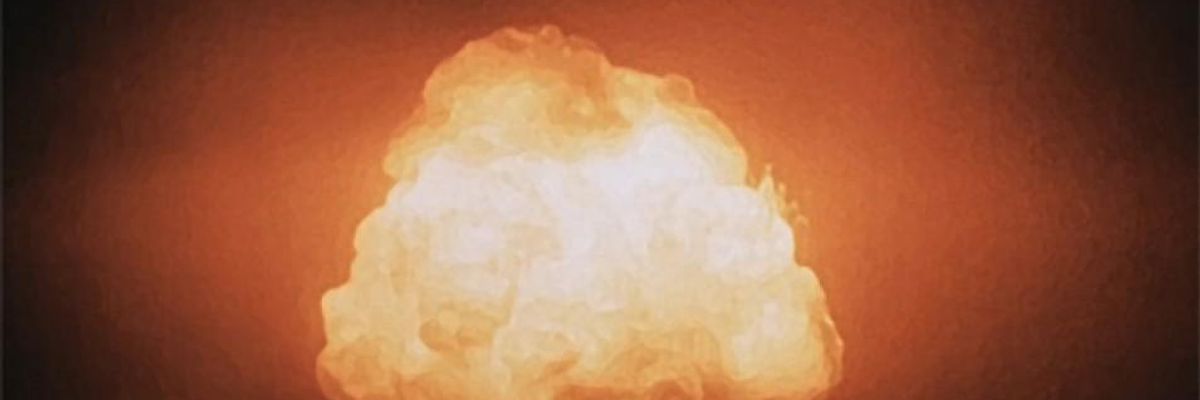
Mushroom cloud seconds after detonation of "the Gadget" by the U.S. military in 1945 at testing range in New Mexico. (Photo: Department of Defense)
Time to Put an End to the Nuclear Age
2020 has been hard enough. The last thing the world needs this year is nuclear weapons.
On September 26, 1983, Soviet military officer Stanislav Petrov got an alert that a U.S. missile attack was imminent.
Faced with the choice of whether to launch a submarine nuclear missile, Petrov made the split-second decision that the alert must have been an error. His choice not to launch a nuclear weapon saved the world from the dreadful prospect of nuclear war.
In Petrov's honor, the world marks September 26 as the International Day for the Total Elimination of Nuclear Weapons.
In 2020, we've dealt with everything from gender reveal parties sparking deadly wildfires to locust swarms, murder hornets, and a global pandemic. So it may feel like talking about nuclear weapons is just the radioactive frosting on an apocalyptic cake.
But nuclear weapons pose one of the gravest threats to human survival, and there are concrete actions world leaders can take right now to make sure they're never used again and eliminated for good.
One such measure is for the United States to officially enact a "No First Use" policy, which would mean that the United States would never launch a nuclear weapon first in a nuclear conflict.
It's far from a symbolic gesture.
In the time that it took me to type those first few paragraphs, a sitting U.S. president could unilaterally decide to launch a nuclear weapon on a whim, without anyone else's authority or approval.
Our current president has gleefully expressed his willingness to use nuclear weapons against both foreign adversaries and hurricanes. He's also expressed a desire to take the nuclear arms race to a new, deadlier stratosphere.
Most Americans don't spend a lot of time worrying about nuclear weapons, even though millions of us live near nuclear facilities or even missiles themselves.
Right now, the risk of nuclear war is the greatest it has been since the height of the Cold War. The Bulletin of Atomic Scientists' Doomsday Clock is set at just 100 seconds to midnight, the closest we've ever been to a nuclear apocalypse in the clock's history.
It doesn't help that President Trump has withdrawn the United States from most of the international arms control agreements that have deescalated tensions and prevented nuclear conflict -- including the Joint Comprehensive Plan of Action (aka the Iran Deal), the Intermediate-Range Nuclear Forces (INF) Treaty, and the Open Skies Treaty.
He's also planning to let the New START Treaty between Russia and the United States expire in February 2021. To top it off, the Trump administration has even reportedly discussed conducting live nuclear tests for the first time since 1992.
Nuclear weapons put us all in danger. We've all got a stake in ensuring that the one planet we've got isn't destroyed in a nuclear holocaust. Even just the smoke and soot from a nuclear war would plunge the world into darkness, causing plummeting global temperatures and the end of life on the planet.
Like Stanislav Petrov, we can save the world from the prospect of nuclear war.
Not everything in the current state of global nuclear weapons policy is doomsday and gloom. We've made some incredible progress in the past couple years.
The historic UN Treaty on the Prohibition of Nuclear Weapons, known as the nuclear ban treaty, was approved by 122 nations in 2017. To date, 84 nations have signed the treaty, and 45 have ratified it. Once 50 nations have ratified the treaty, it officially enters into force.
In honor of Stanislav Petrov, atomic veterans, and survivors and victims of Hiroshima, Nagasaki, and nuclear testing all over the world, let's make 2020 the year when we eliminate nuclear weapons, for good.
We are at a crossroads
This country and this world are at a monumental crossroads. In a few short weeks, US voters will have an opportunity to beat back the forces of fascism and confront the billionaires who are rigging the economy, our media system, and our democracy, making it increasingly impossible for ordinary people to get by. We’re not just talking about the election. We’re talking about what must be done once these fascist elements are vanquished from power. We need a bolder set of solutions than what either major party has so far been willing to offer and a working-class movement ready to fight like hell for it. Trump didn't emerge from nowhere. The conditions that fueled MAGA authoritarianism were created by decades of radical neoliberal economic policies and a corrupt political system dominated by corporate interests. They slashed taxes on the super-rich, promising that the benefits would trickle down. They said giveaways to the corporate titans would make life more affordable for the rest of us. It was all bullshit. And when a bitter, betrayed populace searches for someone to blame, right-wing demagogues have little trouble finding scapegoats. People know when they're being lied to, but you won't hear any of this from the corporate media. Only independent journalism—powered and funded by people who believe in building a better world—can deliver truly trustworthy daily news. Our Fall Campaign is underway, and we need your help. To power our newsroom through the rest of the year, we need to raise $125,000 by midnight on October 31. So if you share our vision, please contribute whatever you can to sustain our work. |
On September 26, 1983, Soviet military officer Stanislav Petrov got an alert that a U.S. missile attack was imminent.
Faced with the choice of whether to launch a submarine nuclear missile, Petrov made the split-second decision that the alert must have been an error. His choice not to launch a nuclear weapon saved the world from the dreadful prospect of nuclear war.
In Petrov's honor, the world marks September 26 as the International Day for the Total Elimination of Nuclear Weapons.
In 2020, we've dealt with everything from gender reveal parties sparking deadly wildfires to locust swarms, murder hornets, and a global pandemic. So it may feel like talking about nuclear weapons is just the radioactive frosting on an apocalyptic cake.
But nuclear weapons pose one of the gravest threats to human survival, and there are concrete actions world leaders can take right now to make sure they're never used again and eliminated for good.
One such measure is for the United States to officially enact a "No First Use" policy, which would mean that the United States would never launch a nuclear weapon first in a nuclear conflict.
It's far from a symbolic gesture.
In the time that it took me to type those first few paragraphs, a sitting U.S. president could unilaterally decide to launch a nuclear weapon on a whim, without anyone else's authority or approval.
Our current president has gleefully expressed his willingness to use nuclear weapons against both foreign adversaries and hurricanes. He's also expressed a desire to take the nuclear arms race to a new, deadlier stratosphere.
Most Americans don't spend a lot of time worrying about nuclear weapons, even though millions of us live near nuclear facilities or even missiles themselves.
Right now, the risk of nuclear war is the greatest it has been since the height of the Cold War. The Bulletin of Atomic Scientists' Doomsday Clock is set at just 100 seconds to midnight, the closest we've ever been to a nuclear apocalypse in the clock's history.
It doesn't help that President Trump has withdrawn the United States from most of the international arms control agreements that have deescalated tensions and prevented nuclear conflict -- including the Joint Comprehensive Plan of Action (aka the Iran Deal), the Intermediate-Range Nuclear Forces (INF) Treaty, and the Open Skies Treaty.
He's also planning to let the New START Treaty between Russia and the United States expire in February 2021. To top it off, the Trump administration has even reportedly discussed conducting live nuclear tests for the first time since 1992.
Nuclear weapons put us all in danger. We've all got a stake in ensuring that the one planet we've got isn't destroyed in a nuclear holocaust. Even just the smoke and soot from a nuclear war would plunge the world into darkness, causing plummeting global temperatures and the end of life on the planet.
Like Stanislav Petrov, we can save the world from the prospect of nuclear war.
Not everything in the current state of global nuclear weapons policy is doomsday and gloom. We've made some incredible progress in the past couple years.
The historic UN Treaty on the Prohibition of Nuclear Weapons, known as the nuclear ban treaty, was approved by 122 nations in 2017. To date, 84 nations have signed the treaty, and 45 have ratified it. Once 50 nations have ratified the treaty, it officially enters into force.
In honor of Stanislav Petrov, atomic veterans, and survivors and victims of Hiroshima, Nagasaki, and nuclear testing all over the world, let's make 2020 the year when we eliminate nuclear weapons, for good.
On September 26, 1983, Soviet military officer Stanislav Petrov got an alert that a U.S. missile attack was imminent.
Faced with the choice of whether to launch a submarine nuclear missile, Petrov made the split-second decision that the alert must have been an error. His choice not to launch a nuclear weapon saved the world from the dreadful prospect of nuclear war.
In Petrov's honor, the world marks September 26 as the International Day for the Total Elimination of Nuclear Weapons.
In 2020, we've dealt with everything from gender reveal parties sparking deadly wildfires to locust swarms, murder hornets, and a global pandemic. So it may feel like talking about nuclear weapons is just the radioactive frosting on an apocalyptic cake.
But nuclear weapons pose one of the gravest threats to human survival, and there are concrete actions world leaders can take right now to make sure they're never used again and eliminated for good.
One such measure is for the United States to officially enact a "No First Use" policy, which would mean that the United States would never launch a nuclear weapon first in a nuclear conflict.
It's far from a symbolic gesture.
In the time that it took me to type those first few paragraphs, a sitting U.S. president could unilaterally decide to launch a nuclear weapon on a whim, without anyone else's authority or approval.
Our current president has gleefully expressed his willingness to use nuclear weapons against both foreign adversaries and hurricanes. He's also expressed a desire to take the nuclear arms race to a new, deadlier stratosphere.
Most Americans don't spend a lot of time worrying about nuclear weapons, even though millions of us live near nuclear facilities or even missiles themselves.
Right now, the risk of nuclear war is the greatest it has been since the height of the Cold War. The Bulletin of Atomic Scientists' Doomsday Clock is set at just 100 seconds to midnight, the closest we've ever been to a nuclear apocalypse in the clock's history.
It doesn't help that President Trump has withdrawn the United States from most of the international arms control agreements that have deescalated tensions and prevented nuclear conflict -- including the Joint Comprehensive Plan of Action (aka the Iran Deal), the Intermediate-Range Nuclear Forces (INF) Treaty, and the Open Skies Treaty.
He's also planning to let the New START Treaty between Russia and the United States expire in February 2021. To top it off, the Trump administration has even reportedly discussed conducting live nuclear tests for the first time since 1992.
Nuclear weapons put us all in danger. We've all got a stake in ensuring that the one planet we've got isn't destroyed in a nuclear holocaust. Even just the smoke and soot from a nuclear war would plunge the world into darkness, causing plummeting global temperatures and the end of life on the planet.
Like Stanislav Petrov, we can save the world from the prospect of nuclear war.
Not everything in the current state of global nuclear weapons policy is doomsday and gloom. We've made some incredible progress in the past couple years.
The historic UN Treaty on the Prohibition of Nuclear Weapons, known as the nuclear ban treaty, was approved by 122 nations in 2017. To date, 84 nations have signed the treaty, and 45 have ratified it. Once 50 nations have ratified the treaty, it officially enters into force.
In honor of Stanislav Petrov, atomic veterans, and survivors and victims of Hiroshima, Nagasaki, and nuclear testing all over the world, let's make 2020 the year when we eliminate nuclear weapons, for good.