SUBSCRIBE TO OUR FREE NEWSLETTER
Daily news & progressive opinion—funded by the people, not the corporations—delivered straight to your inbox.
5
#000000
#FFFFFF
To donate by check, phone, or other method, see our More Ways to Give page.
Daily news & progressive opinion—funded by the people, not the corporations—delivered straight to your inbox.
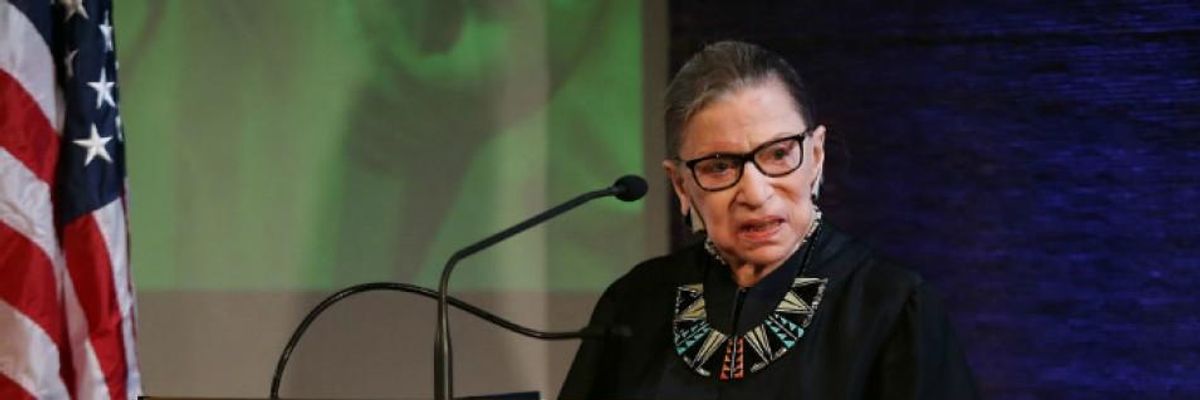
Supreme Court Justice Ruth Bader Ginsburg prepares to administer the Oath of Allegiance to candidates for U.S. citizenship at the New-York Historical Society on April 10, 2018 in New York City. (Photo: Spencer Platt/Getty Images)
It is less than 50 days until Election Day. If Senate Majority Leader McConnell follows through on his pledge that he will consider a nominee by President Trump to succeed Justice Ruth Bader Ginsburg it will be more than rank hypocrisy. It will be a full-on crisis for the country, the Supreme Court, and our democracy.
The court touches virtually every aspect of our lives--from marriage, to healthcare, to the right to vote. Whoever is appointed to succeed Ginsburg will either cement conservative dominance on the court for the next generation or play a critical role in countering that trend.
Of course, many will remember that there is a recent precedent for the loss of a justice in an election year. Justice Antonin Scalia died on February 13, 2016, opening a vacancy on the Supreme Court nearly nine months before the 2016 presidential election.
Less than an hour after Scalia's death had been confirmed, McConnell announced that the Senate should not confirm a replacement justice until after the 2016 election. "The American people should have a voice in the selection of their next Supreme Court justice," he declared. When President Obama nominated Judge Merrick Garland to fill Scalia's seat the next month, McConnell reiterated, "Let's let the American people decide."
Other Republican leaders echoed McConnell. "The American people shouldn't be denied a voice," opined Sen. Chuck Grassley (R-Iowa). Sen. John Cornyn (R-Texas) said that "the only way to empower the American people and ensure they have a voice is for the next president to make the nomination to fill this vacancy." Sen. Ted Cruz (R-Texas) argued, "There is a long tradition that you don't do this in an election year. And what this means ... is we ought to make the 2016 election a referendum on the Supreme Court."
Many observers, including at the Brennan Center, called out Republican senators for creating a new principle out of whole cloth. But the fact is that a new principle was created--one that gave President Trump an extra vacancy to fill and conservatives an opportunity to maintain and solidify their majority on the Supreme Court, with huge ramifications for the country.
In more recent statements, McConnell has tried to redefine what he did, suggesting that the issue in 2016 was that the Senate was controlled by a different party than the president. But there's no clear historical precedent for any such rule--it has almost never come up in modern history. Forcing through a successor to Ginsburg would be an exercise of raw power, plain and simple.
The Supreme Court doesn't have an army, and it has no power of the purse. Its power comes from the fact that the public accepts its decisions, even when it disagrees with them. The Supreme Court has of course always been a political institution, but if it's going to retain its public legitimacy it can't be seen as simply another wing of partisan politics.
Supreme Court nominations have become far too politicized, but packing the Supreme Court weeks before a presidential election is different in kind. It's not simply another stress test for our institution--there's a real risk it will break them. That is genuinely scary--not just for the Supreme Court, but for the basic functioning of our country and the rule of law.
It doesn't have to be this way. McConnell and other Republican senators should respect the rules they set out four years ago and, as they put it, let the American people decide.
Dear Common Dreams reader, It’s been nearly 30 years since I co-founded Common Dreams with my late wife, Lina Newhouser. We had the radical notion that journalism should serve the public good, not corporate profits. It was clear to us from the outset what it would take to build such a project. No paid advertisements. No corporate sponsors. No millionaire publisher telling us what to think or do. Many people said we wouldn't last a year, but we proved those doubters wrong. Together with a tremendous team of journalists and dedicated staff, we built an independent media outlet free from the constraints of profits and corporate control. Our mission has always been simple: To inform. To inspire. To ignite change for the common good. Building Common Dreams was not easy. Our survival was never guaranteed. When you take on the most powerful forces—Wall Street greed, fossil fuel industry destruction, Big Tech lobbyists, and uber-rich oligarchs who have spent billions upon billions rigging the economy and democracy in their favor—the only bulwark you have is supporters who believe in your work. But here’s the urgent message from me today. It's never been this bad out there. And it's never been this hard to keep us going. At the very moment Common Dreams is most needed, the threats we face are intensifying. We need your support now more than ever. We don't accept corporate advertising and never will. We don't have a paywall because we don't think people should be blocked from critical news based on their ability to pay. Everything we do is funded by the donations of readers like you. When everyone does the little they can afford, we are strong. But if that support retreats or dries up, so do we. Will you donate now to make sure Common Dreams not only survives but thrives? —Craig Brown, Co-founder |
It is less than 50 days until Election Day. If Senate Majority Leader McConnell follows through on his pledge that he will consider a nominee by President Trump to succeed Justice Ruth Bader Ginsburg it will be more than rank hypocrisy. It will be a full-on crisis for the country, the Supreme Court, and our democracy.
The court touches virtually every aspect of our lives--from marriage, to healthcare, to the right to vote. Whoever is appointed to succeed Ginsburg will either cement conservative dominance on the court for the next generation or play a critical role in countering that trend.
Of course, many will remember that there is a recent precedent for the loss of a justice in an election year. Justice Antonin Scalia died on February 13, 2016, opening a vacancy on the Supreme Court nearly nine months before the 2016 presidential election.
Less than an hour after Scalia's death had been confirmed, McConnell announced that the Senate should not confirm a replacement justice until after the 2016 election. "The American people should have a voice in the selection of their next Supreme Court justice," he declared. When President Obama nominated Judge Merrick Garland to fill Scalia's seat the next month, McConnell reiterated, "Let's let the American people decide."
Other Republican leaders echoed McConnell. "The American people shouldn't be denied a voice," opined Sen. Chuck Grassley (R-Iowa). Sen. John Cornyn (R-Texas) said that "the only way to empower the American people and ensure they have a voice is for the next president to make the nomination to fill this vacancy." Sen. Ted Cruz (R-Texas) argued, "There is a long tradition that you don't do this in an election year. And what this means ... is we ought to make the 2016 election a referendum on the Supreme Court."
Many observers, including at the Brennan Center, called out Republican senators for creating a new principle out of whole cloth. But the fact is that a new principle was created--one that gave President Trump an extra vacancy to fill and conservatives an opportunity to maintain and solidify their majority on the Supreme Court, with huge ramifications for the country.
In more recent statements, McConnell has tried to redefine what he did, suggesting that the issue in 2016 was that the Senate was controlled by a different party than the president. But there's no clear historical precedent for any such rule--it has almost never come up in modern history. Forcing through a successor to Ginsburg would be an exercise of raw power, plain and simple.
The Supreme Court doesn't have an army, and it has no power of the purse. Its power comes from the fact that the public accepts its decisions, even when it disagrees with them. The Supreme Court has of course always been a political institution, but if it's going to retain its public legitimacy it can't be seen as simply another wing of partisan politics.
Supreme Court nominations have become far too politicized, but packing the Supreme Court weeks before a presidential election is different in kind. It's not simply another stress test for our institution--there's a real risk it will break them. That is genuinely scary--not just for the Supreme Court, but for the basic functioning of our country and the rule of law.
It doesn't have to be this way. McConnell and other Republican senators should respect the rules they set out four years ago and, as they put it, let the American people decide.
It is less than 50 days until Election Day. If Senate Majority Leader McConnell follows through on his pledge that he will consider a nominee by President Trump to succeed Justice Ruth Bader Ginsburg it will be more than rank hypocrisy. It will be a full-on crisis for the country, the Supreme Court, and our democracy.
The court touches virtually every aspect of our lives--from marriage, to healthcare, to the right to vote. Whoever is appointed to succeed Ginsburg will either cement conservative dominance on the court for the next generation or play a critical role in countering that trend.
Of course, many will remember that there is a recent precedent for the loss of a justice in an election year. Justice Antonin Scalia died on February 13, 2016, opening a vacancy on the Supreme Court nearly nine months before the 2016 presidential election.
Less than an hour after Scalia's death had been confirmed, McConnell announced that the Senate should not confirm a replacement justice until after the 2016 election. "The American people should have a voice in the selection of their next Supreme Court justice," he declared. When President Obama nominated Judge Merrick Garland to fill Scalia's seat the next month, McConnell reiterated, "Let's let the American people decide."
Other Republican leaders echoed McConnell. "The American people shouldn't be denied a voice," opined Sen. Chuck Grassley (R-Iowa). Sen. John Cornyn (R-Texas) said that "the only way to empower the American people and ensure they have a voice is for the next president to make the nomination to fill this vacancy." Sen. Ted Cruz (R-Texas) argued, "There is a long tradition that you don't do this in an election year. And what this means ... is we ought to make the 2016 election a referendum on the Supreme Court."
Many observers, including at the Brennan Center, called out Republican senators for creating a new principle out of whole cloth. But the fact is that a new principle was created--one that gave President Trump an extra vacancy to fill and conservatives an opportunity to maintain and solidify their majority on the Supreme Court, with huge ramifications for the country.
In more recent statements, McConnell has tried to redefine what he did, suggesting that the issue in 2016 was that the Senate was controlled by a different party than the president. But there's no clear historical precedent for any such rule--it has almost never come up in modern history. Forcing through a successor to Ginsburg would be an exercise of raw power, plain and simple.
The Supreme Court doesn't have an army, and it has no power of the purse. Its power comes from the fact that the public accepts its decisions, even when it disagrees with them. The Supreme Court has of course always been a political institution, but if it's going to retain its public legitimacy it can't be seen as simply another wing of partisan politics.
Supreme Court nominations have become far too politicized, but packing the Supreme Court weeks before a presidential election is different in kind. It's not simply another stress test for our institution--there's a real risk it will break them. That is genuinely scary--not just for the Supreme Court, but for the basic functioning of our country and the rule of law.
It doesn't have to be this way. McConnell and other Republican senators should respect the rules they set out four years ago and, as they put it, let the American people decide.