SUBSCRIBE TO OUR FREE NEWSLETTER
Daily news & progressive opinion—funded by the people, not the corporations—delivered straight to your inbox.
5
#000000
#FFFFFF
To donate by check, phone, or other method, see our More Ways to Give page.
Daily news & progressive opinion—funded by the people, not the corporations—delivered straight to your inbox.
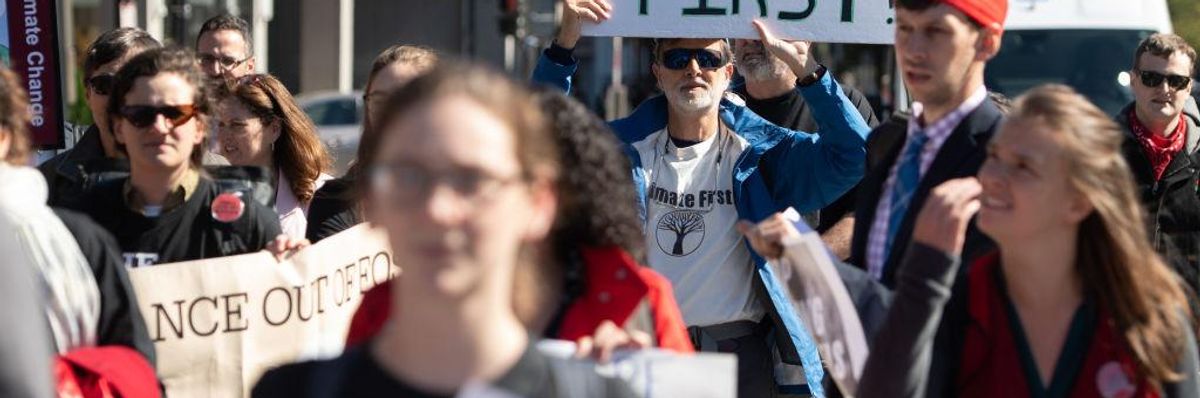
Demonstrators march outside the World Bank and IMF Headquarters during the organizations, Annual Meetings in Washington, DC, October 18, 2019. (Photo: Saul Loeb/AFP via Getty Images)
On August 27, the World Bank announced it will "pause" the Doing Business Report (DBR) after a number of "irregularities" were found regarding data used in the 2018 and 2020 reports. In order to conduct a "systematic review and assessment of data changes," the Bank has mobilized its independent Internal Audit function. This suspension, which could spell the end to nearly twenty years of the DBR, is good news for the people, the climate, and the planet.
Since DBR's launch in 2002, the World Bank ranks countries on the "ease of doing business," i.e. on regulatory changes and reforms that make them more attractive to private investors. These include cutting administrative procedures, lowering corporate taxes, environmental safeguards, social and labor standards, and removing restrictions to trade and business. By treating public regulations as obstacles to economic growth, the rankings neglect issues such as human rights, the right to food, the protection of workers, and the sustainable use of natural resources.
The disastrous impact of these regulatory changes at the country level in dozens of countries has been extensively documented. For instance, the DBR report has greatly impacted the agricultural sector at the expense of family farmers by favoring foreign 'investors' who seek quick profits through the violations of peoples' land rights, the extraction of natural resources, and the exploitation of cheap labor. The DBR drives an insidious race to the bottom where policy makers around the world compete to be more attractive to private investment instead of protecting the environment and the well being of their citizens. Worse yet, is the political manipulation of the data, revealed by the World Bank's former Chief Economist Paul Romer, who exposed how Chile's ranking was deliberately lowered after social democratic President Michelle Bachelet assumed power in 2018. While Romer admitted "business conditions did not get worse in Chile" under Bachelet, the country's DBR rank fell from 25th to 57th while she was in power.
It is therefore not surprising that the suspension of the DBR is welcome news for the 280-organization strong Our Land Our Business campaign, comprised of NGOs, unions, farmers, and consumer groups from over 80 countries that have called for the end of the rankings. Focused on promoting corporate interests, the DBR has encouraged destructive practices that favor multinational corporations instead of policies that put people and planet first. Civil society's concerns are backed by an independent panel of experts who recommended an end to the DBR's country rankings in 2013. Noting the lack of scientific evidence to support the indicators, the panel criticized the DBR for not recognizing the socio-economic benefits of regulation, including environmental protection, safety, and worker protection. The Bank however, blatantly ignored these recommendations.
For nearly two decades, the Bank has wielded its influence and power to push its neo-liberal pro-corporate agenda on governments around the world--willfully ignoring the social, economic, and environmental devastation it has caused. The world needs development policies that serve people and planet first, not policies that focus on economic growth at all costs. Regardless of the findings of the internal review and audit, the Doing Business rankings are fundamentally flawed and must be permanently ended.
This country and this world are at a monumental crossroads. US voters have an opportunity to beat back the forces of fascism and confront the billionaires who are rigging the economy, our media system, and our democracy, making it increasingly impossible for ordinary people to get by. We’re not just talking about the election. We’re talking about what must be done once these fascist elements are vanquished from power. We need a bolder set of solutions than what either major party has so far been willing to offer and a working-class movement ready to fight like hell for it. Trump didn't emerge from nowhere. The conditions that fueled MAGA authoritarianism were created by decades of radical neoliberal economic policies and a corrupt political system dominated by corporate interests. They slashed taxes on the super-rich, promising that the benefits would trickle down. They said giveaways to the corporate titans would make life more affordable for the rest of us. It was all bullshit. And when a bitter, betrayed populace searches for someone to blame, right-wing demagogues have little trouble finding scapegoats. People know when they're being lied to, but you won't hear any of this from the corporate media. Only independent journalism—powered and funded by people who believe in building a better world—can deliver truly trustworthy daily news. If you share our vision, please contribute whatever you can to sustain our work. |
On August 27, the World Bank announced it will "pause" the Doing Business Report (DBR) after a number of "irregularities" were found regarding data used in the 2018 and 2020 reports. In order to conduct a "systematic review and assessment of data changes," the Bank has mobilized its independent Internal Audit function. This suspension, which could spell the end to nearly twenty years of the DBR, is good news for the people, the climate, and the planet.
Since DBR's launch in 2002, the World Bank ranks countries on the "ease of doing business," i.e. on regulatory changes and reforms that make them more attractive to private investors. These include cutting administrative procedures, lowering corporate taxes, environmental safeguards, social and labor standards, and removing restrictions to trade and business. By treating public regulations as obstacles to economic growth, the rankings neglect issues such as human rights, the right to food, the protection of workers, and the sustainable use of natural resources.
The disastrous impact of these regulatory changes at the country level in dozens of countries has been extensively documented. For instance, the DBR report has greatly impacted the agricultural sector at the expense of family farmers by favoring foreign 'investors' who seek quick profits through the violations of peoples' land rights, the extraction of natural resources, and the exploitation of cheap labor. The DBR drives an insidious race to the bottom where policy makers around the world compete to be more attractive to private investment instead of protecting the environment and the well being of their citizens. Worse yet, is the political manipulation of the data, revealed by the World Bank's former Chief Economist Paul Romer, who exposed how Chile's ranking was deliberately lowered after social democratic President Michelle Bachelet assumed power in 2018. While Romer admitted "business conditions did not get worse in Chile" under Bachelet, the country's DBR rank fell from 25th to 57th while she was in power.
It is therefore not surprising that the suspension of the DBR is welcome news for the 280-organization strong Our Land Our Business campaign, comprised of NGOs, unions, farmers, and consumer groups from over 80 countries that have called for the end of the rankings. Focused on promoting corporate interests, the DBR has encouraged destructive practices that favor multinational corporations instead of policies that put people and planet first. Civil society's concerns are backed by an independent panel of experts who recommended an end to the DBR's country rankings in 2013. Noting the lack of scientific evidence to support the indicators, the panel criticized the DBR for not recognizing the socio-economic benefits of regulation, including environmental protection, safety, and worker protection. The Bank however, blatantly ignored these recommendations.
For nearly two decades, the Bank has wielded its influence and power to push its neo-liberal pro-corporate agenda on governments around the world--willfully ignoring the social, economic, and environmental devastation it has caused. The world needs development policies that serve people and planet first, not policies that focus on economic growth at all costs. Regardless of the findings of the internal review and audit, the Doing Business rankings are fundamentally flawed and must be permanently ended.