SUBSCRIBE TO OUR FREE NEWSLETTER
Daily news & progressive opinion—funded by the people, not the corporations—delivered straight to your inbox.
5
#000000
#FFFFFF
To donate by check, phone, or other method, see our More Ways to Give page.
Daily news & progressive opinion—funded by the people, not the corporations—delivered straight to your inbox.
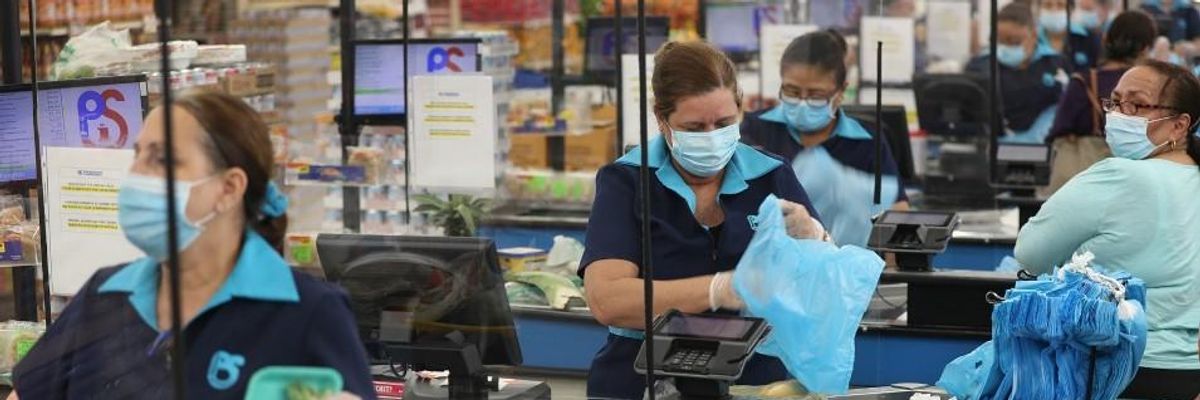
A cashier stands behind a partial protective plastic screen and wears a mask and gloves at the Presidente Supermarket on April 13, 2020 in Miami. (Photo: Joe Raedle/Getty Images)
From windows and rooftops through the early months of the COVID-19 pandemic, millions around the world cheered essential workers on the frontlines who daily risked contracting this highly contagious disease. Janitors, grocery store workers, drivers, warehouse workers, letter carriers, food delivery people, teachers and transit workers, along with the doctors, nurses, and hospital staff caring for patients, all became heroes as the worst pandemic in a century swept the planet. Thousands of these frontline workers died.
As we celebrate Labor Day, traditionally marked by cookouts and beaches followed by the return to school, we should honor these fallen heroes--by wearing masks, social distancing, and fighting for a science-driven course correction to this country's catastrophic pandemic response. President Donald Trump must invoke the Defense Production Act, making hundreds of millions of free masks and tests available, coupled with contact tracing, isolation and quarantine.
Kaiser Health News and The Guardian built a regularly updated database of frontline U.S. healthcare workers who died of COVID-19; as of this week, 1,079 were on that list.
Among them, 39-year-old Adiel Montgomery, a security guard at Kingsbrook Jewish Medical Center in Brooklyn. In late March, he lost his sense of taste and smell and had flu-like symptoms. Two weeks later, he suffered acute chest pain and died suddenly. He had complained about the lack of personal protective equipment (PPE), which eventually arrived, just not in time to save him.
In Arizona, Cheryl and Corinna Thinn, sisters from the Navajo Nation, both worked at Tuba City Regional Health Care as an administrator and a social worker, respectively. Before they both became ill around March 20th, each, without facemasks, had interacted with patients, and had expressed concerns about the PPE shortage. Cheryl succumbed to COVID-19 on April 11th, Corinna on April 29th. The Navajo Nation's per capita coronavirus infection rate is among the highest in the United States, with over 500 deaths at last count.
Meatpacking workers toil shoulder-to-shoulder, exacerbating the risk of infection. At a JBS plant in Greeley, Colorado, an ongoing COVID-19 outbreak has infected close to 300 out of 3,000 workers, killing six of them--all immigrants. Tin Aye, 60 years old, fled Burma and lived in a refugee camp in Thailand before making it to the U.S. The day after she became a grandmother in late March, she was put on a ventilator. She died on May 17th.
Stories like these dot the nation, as the number of COVID-19 deaths nears 200,000 with no signs of slowing. The true number of essential workers who have died will never be known, as they are not tracked by any federal agency. Trump has consistently downplayed the numbers of cases and victims, pushing false cures and conspiracy theories instead of leading a coordinated response.
Around the country, thousands of meatpacking plant workers have become infected; scores have died. UFCW, the United Food and Commercial Workers union, criticizes the failure to compel corporations that employ its members to report COVID-19 deaths: meat processors JBS, Tyson Foods, Cargill, and Smithfield Foods, and retailers like Walmart, grocery chains like Albertsons and Kroger, and many more.
Frontline, essential workers are disproportionately people of color, with many sectors staffed predominantly by immigrants. They drive the economy, grow and deliver food, clean and care for the elderly and provide childcare. Few have the luxury to decide to work from home. They don't have sick days, or access to affordable health care. Medical workers still report PPE shortages.
The United States, the wealthiest nation in history, has just over 4% of the world's population but over 20% of the recorded COVID-19 deaths. Trump's abdication of responsibility, rushing to reopen the economy while downplaying the pandemic as an election year strategy, has been stunning, deadly and potentially criminal.
Worker resistance to Trump's lethal pandemic response is growing. Teachers around the country have been pushing back against plans to reopen schools quickly without plans and equipment in place to protect them, their students or staff, in a number of cases threatening to strike.
In Detroit, 1,600 nursing home workers represented by the Service Employees International Union, SEIU, are threatening to strike as well, demanding a living wage, PPE, and better staffing levels to properly handle the threat of the coronavirus to nursing home residents and staff.
As you celebrate this Labor Day, also commit to solidarity with our essential workers. The shouts of support for them from the windows and rooftops may have diminished as the pandemic drags on, but the risks they face every day have not.
Dear Common Dreams reader, It’s been nearly 30 years since I co-founded Common Dreams with my late wife, Lina Newhouser. We had the radical notion that journalism should serve the public good, not corporate profits. It was clear to us from the outset what it would take to build such a project. No paid advertisements. No corporate sponsors. No millionaire publisher telling us what to think or do. Many people said we wouldn't last a year, but we proved those doubters wrong. Together with a tremendous team of journalists and dedicated staff, we built an independent media outlet free from the constraints of profits and corporate control. Our mission has always been simple: To inform. To inspire. To ignite change for the common good. Building Common Dreams was not easy. Our survival was never guaranteed. When you take on the most powerful forces—Wall Street greed, fossil fuel industry destruction, Big Tech lobbyists, and uber-rich oligarchs who have spent billions upon billions rigging the economy and democracy in their favor—the only bulwark you have is supporters who believe in your work. But here’s the urgent message from me today. It's never been this bad out there. And it's never been this hard to keep us going. At the very moment Common Dreams is most needed, the threats we face are intensifying. We need your support now more than ever. We don't accept corporate advertising and never will. We don't have a paywall because we don't think people should be blocked from critical news based on their ability to pay. Everything we do is funded by the donations of readers like you. When everyone does the little they can afford, we are strong. But if that support retreats or dries up, so do we. Will you donate now to make sure Common Dreams not only survives but thrives? —Craig Brown, Co-founder |
From windows and rooftops through the early months of the COVID-19 pandemic, millions around the world cheered essential workers on the frontlines who daily risked contracting this highly contagious disease. Janitors, grocery store workers, drivers, warehouse workers, letter carriers, food delivery people, teachers and transit workers, along with the doctors, nurses, and hospital staff caring for patients, all became heroes as the worst pandemic in a century swept the planet. Thousands of these frontline workers died.
As we celebrate Labor Day, traditionally marked by cookouts and beaches followed by the return to school, we should honor these fallen heroes--by wearing masks, social distancing, and fighting for a science-driven course correction to this country's catastrophic pandemic response. President Donald Trump must invoke the Defense Production Act, making hundreds of millions of free masks and tests available, coupled with contact tracing, isolation and quarantine.
Kaiser Health News and The Guardian built a regularly updated database of frontline U.S. healthcare workers who died of COVID-19; as of this week, 1,079 were on that list.
Among them, 39-year-old Adiel Montgomery, a security guard at Kingsbrook Jewish Medical Center in Brooklyn. In late March, he lost his sense of taste and smell and had flu-like symptoms. Two weeks later, he suffered acute chest pain and died suddenly. He had complained about the lack of personal protective equipment (PPE), which eventually arrived, just not in time to save him.
In Arizona, Cheryl and Corinna Thinn, sisters from the Navajo Nation, both worked at Tuba City Regional Health Care as an administrator and a social worker, respectively. Before they both became ill around March 20th, each, without facemasks, had interacted with patients, and had expressed concerns about the PPE shortage. Cheryl succumbed to COVID-19 on April 11th, Corinna on April 29th. The Navajo Nation's per capita coronavirus infection rate is among the highest in the United States, with over 500 deaths at last count.
Meatpacking workers toil shoulder-to-shoulder, exacerbating the risk of infection. At a JBS plant in Greeley, Colorado, an ongoing COVID-19 outbreak has infected close to 300 out of 3,000 workers, killing six of them--all immigrants. Tin Aye, 60 years old, fled Burma and lived in a refugee camp in Thailand before making it to the U.S. The day after she became a grandmother in late March, she was put on a ventilator. She died on May 17th.
Stories like these dot the nation, as the number of COVID-19 deaths nears 200,000 with no signs of slowing. The true number of essential workers who have died will never be known, as they are not tracked by any federal agency. Trump has consistently downplayed the numbers of cases and victims, pushing false cures and conspiracy theories instead of leading a coordinated response.
Around the country, thousands of meatpacking plant workers have become infected; scores have died. UFCW, the United Food and Commercial Workers union, criticizes the failure to compel corporations that employ its members to report COVID-19 deaths: meat processors JBS, Tyson Foods, Cargill, and Smithfield Foods, and retailers like Walmart, grocery chains like Albertsons and Kroger, and many more.
Frontline, essential workers are disproportionately people of color, with many sectors staffed predominantly by immigrants. They drive the economy, grow and deliver food, clean and care for the elderly and provide childcare. Few have the luxury to decide to work from home. They don't have sick days, or access to affordable health care. Medical workers still report PPE shortages.
The United States, the wealthiest nation in history, has just over 4% of the world's population but over 20% of the recorded COVID-19 deaths. Trump's abdication of responsibility, rushing to reopen the economy while downplaying the pandemic as an election year strategy, has been stunning, deadly and potentially criminal.
Worker resistance to Trump's lethal pandemic response is growing. Teachers around the country have been pushing back against plans to reopen schools quickly without plans and equipment in place to protect them, their students or staff, in a number of cases threatening to strike.
In Detroit, 1,600 nursing home workers represented by the Service Employees International Union, SEIU, are threatening to strike as well, demanding a living wage, PPE, and better staffing levels to properly handle the threat of the coronavirus to nursing home residents and staff.
As you celebrate this Labor Day, also commit to solidarity with our essential workers. The shouts of support for them from the windows and rooftops may have diminished as the pandemic drags on, but the risks they face every day have not.
From windows and rooftops through the early months of the COVID-19 pandemic, millions around the world cheered essential workers on the frontlines who daily risked contracting this highly contagious disease. Janitors, grocery store workers, drivers, warehouse workers, letter carriers, food delivery people, teachers and transit workers, along with the doctors, nurses, and hospital staff caring for patients, all became heroes as the worst pandemic in a century swept the planet. Thousands of these frontline workers died.
As we celebrate Labor Day, traditionally marked by cookouts and beaches followed by the return to school, we should honor these fallen heroes--by wearing masks, social distancing, and fighting for a science-driven course correction to this country's catastrophic pandemic response. President Donald Trump must invoke the Defense Production Act, making hundreds of millions of free masks and tests available, coupled with contact tracing, isolation and quarantine.
Kaiser Health News and The Guardian built a regularly updated database of frontline U.S. healthcare workers who died of COVID-19; as of this week, 1,079 were on that list.
Among them, 39-year-old Adiel Montgomery, a security guard at Kingsbrook Jewish Medical Center in Brooklyn. In late March, he lost his sense of taste and smell and had flu-like symptoms. Two weeks later, he suffered acute chest pain and died suddenly. He had complained about the lack of personal protective equipment (PPE), which eventually arrived, just not in time to save him.
In Arizona, Cheryl and Corinna Thinn, sisters from the Navajo Nation, both worked at Tuba City Regional Health Care as an administrator and a social worker, respectively. Before they both became ill around March 20th, each, without facemasks, had interacted with patients, and had expressed concerns about the PPE shortage. Cheryl succumbed to COVID-19 on April 11th, Corinna on April 29th. The Navajo Nation's per capita coronavirus infection rate is among the highest in the United States, with over 500 deaths at last count.
Meatpacking workers toil shoulder-to-shoulder, exacerbating the risk of infection. At a JBS plant in Greeley, Colorado, an ongoing COVID-19 outbreak has infected close to 300 out of 3,000 workers, killing six of them--all immigrants. Tin Aye, 60 years old, fled Burma and lived in a refugee camp in Thailand before making it to the U.S. The day after she became a grandmother in late March, she was put on a ventilator. She died on May 17th.
Stories like these dot the nation, as the number of COVID-19 deaths nears 200,000 with no signs of slowing. The true number of essential workers who have died will never be known, as they are not tracked by any federal agency. Trump has consistently downplayed the numbers of cases and victims, pushing false cures and conspiracy theories instead of leading a coordinated response.
Around the country, thousands of meatpacking plant workers have become infected; scores have died. UFCW, the United Food and Commercial Workers union, criticizes the failure to compel corporations that employ its members to report COVID-19 deaths: meat processors JBS, Tyson Foods, Cargill, and Smithfield Foods, and retailers like Walmart, grocery chains like Albertsons and Kroger, and many more.
Frontline, essential workers are disproportionately people of color, with many sectors staffed predominantly by immigrants. They drive the economy, grow and deliver food, clean and care for the elderly and provide childcare. Few have the luxury to decide to work from home. They don't have sick days, or access to affordable health care. Medical workers still report PPE shortages.
The United States, the wealthiest nation in history, has just over 4% of the world's population but over 20% of the recorded COVID-19 deaths. Trump's abdication of responsibility, rushing to reopen the economy while downplaying the pandemic as an election year strategy, has been stunning, deadly and potentially criminal.
Worker resistance to Trump's lethal pandemic response is growing. Teachers around the country have been pushing back against plans to reopen schools quickly without plans and equipment in place to protect them, their students or staff, in a number of cases threatening to strike.
In Detroit, 1,600 nursing home workers represented by the Service Employees International Union, SEIU, are threatening to strike as well, demanding a living wage, PPE, and better staffing levels to properly handle the threat of the coronavirus to nursing home residents and staff.
As you celebrate this Labor Day, also commit to solidarity with our essential workers. The shouts of support for them from the windows and rooftops may have diminished as the pandemic drags on, but the risks they face every day have not.