SUBSCRIBE TO OUR FREE NEWSLETTER
Daily news & progressive opinion—funded by the people, not the corporations—delivered straight to your inbox.
5
#000000
#FFFFFF
To donate by check, phone, or other method, see our More Ways to Give page.
Daily news & progressive opinion—funded by the people, not the corporations—delivered straight to your inbox.
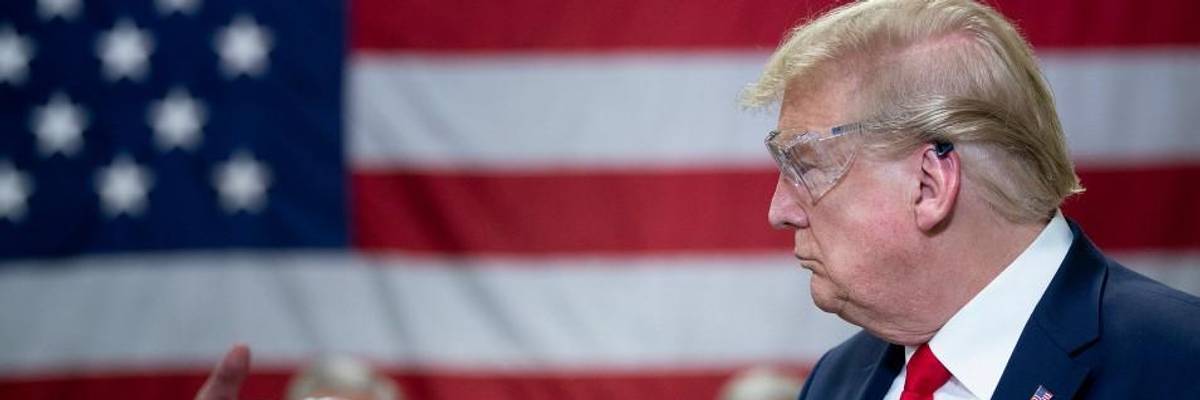
US President Donald Trump tours a Honeywell International Inc. factory producing N95 masks during his first trip since widespread COVID-19 related lockdowns went into effect May 5, 2020, in Phoenix, Arizona. (Photo: Brendan Smialowski / AFP via Getty Images)
Future historians will study how the Trump administration failed to summon the national will to contain the pandemic, as done in other, more functional democracies. They will parse how the president, Republican governors, and their bleating friends at Fox News infected the country with misinformation about Covid-19. They will count the thousands of Americans ushered into an early grave, and likely puzzle over the debate about wearing a mask. According to Robert Redfield, director of the Centers for Disease Control and Prevention, if everyone wore a mask, the virus would be contained in four to six weeks.
Anti-maskers wrap their reasoning in a delusional web of individual rights, independence from the state, and the magical positive thinking that anyone can triumph over adversity if they have the will. So how should we protect ourselves from breathing the aerosolized spittle of these Typhoid Marys?
"Left out of this mask-wearing debate is a nod to the fact that the social and economic wreckage the pandemic has wrought, along with other plagues upon our house--inequality, racism, and climate change--cannot be contained by people acting alone." Appeals to personal responsibility have proven not to work. States should mandate that people must wear masks in all buildings and in outdoor spaces that don't permit social distancing. A July 22 Politico/ Morning Consult poll found that 86 percent of Democrats--but only 58 percent of Republicans--support a mask-wearing mandate.
The differing attitudes toward masks reflect two worldviews: one collective, protective and generous; the other, more self-focused and suspicious.
Left out of this mask-wearing debate is a nod to the fact that the social and economic wreckage the pandemic has wrought, along with other plagues upon our house--inequality, racism, and climate change--cannot be contained by people acting alone. The situation is similar to recycling, which, as currently practiced, fails to address attacks on Earth's environment in a systemic way: At best, recycling creates environmental awareness; at worst, it lulls us into a complacency that prevents us from demanding necessary, large-scale policy changes.
By presenting collective, structural crises as separate, individual problems with separate, individualized solutions, the government abdicates its responsibility to meaningfully intervene.
The pressure to reopen the economy comes from the business sector and from working people who face penury. Axios reports that Forbes Editor-in-Chief Steve Forbes and Club for Growth founder Stephen Moore lobbied Trump to reject any Covid-19 legislation that would extend CARES Act federal unemployment benefits, which expired in July. Republicans are trying to literally starve the American people into joining their push for a hasty (and dangerous) reopening; having no alternative, many people are.
Countering this push is a patchwork of ever-changing executive orders from Democratic governors and mayors trying to thread the needle between economic ruin and viral spread. But what good is staying home when your rent depends on you going to work?
In the same way we individually wear masks to protect others, we can collectively demand that our government provide high-quality public goods to the American people. But today, because Democrats already control the House of Representatives, we must demand House leaders present to the American public what a capable and active government could look like. Democrats should use every ounce of their considerable leverage to ensure pandemic relief includes the paycheck guarantees proposed by Rep. Pramila Jayapal (D-Wash.), a co-chair of the Congressional Progressive Caucus; an extension of enhanced unemployment benefits; resources for local testing and contact tracing; $2,000 per month for every person 16 and older as proposed by Reps. Tim Ryan (D-Ohio) and Ro Khanna (D-Calif.); and eviction moratoriums and rent cancellation programs to avoid up to 23million people losing their homes by September 30.
If their plans die in the Senate, so be it. They will have at least shown what a capable and active government could look like--a government that treats the individual crises faced by each of us as the urgent collective responsibility of us all.
Dear Common Dreams reader, It’s been nearly 30 years since I co-founded Common Dreams with my late wife, Lina Newhouser. We had the radical notion that journalism should serve the public good, not corporate profits. It was clear to us from the outset what it would take to build such a project. No paid advertisements. No corporate sponsors. No millionaire publisher telling us what to think or do. Many people said we wouldn't last a year, but we proved those doubters wrong. Together with a tremendous team of journalists and dedicated staff, we built an independent media outlet free from the constraints of profits and corporate control. Our mission has always been simple: To inform. To inspire. To ignite change for the common good. Building Common Dreams was not easy. Our survival was never guaranteed. When you take on the most powerful forces—Wall Street greed, fossil fuel industry destruction, Big Tech lobbyists, and uber-rich oligarchs who have spent billions upon billions rigging the economy and democracy in their favor—the only bulwark you have is supporters who believe in your work. But here’s the urgent message from me today. It's never been this bad out there. And it's never been this hard to keep us going. At the very moment Common Dreams is most needed, the threats we face are intensifying. We need your support now more than ever. We don't accept corporate advertising and never will. We don't have a paywall because we don't think people should be blocked from critical news based on their ability to pay. Everything we do is funded by the donations of readers like you. When everyone does the little they can afford, we are strong. But if that support retreats or dries up, so do we. Will you donate now to make sure Common Dreams not only survives but thrives? —Craig Brown, Co-founder |
Future historians will study how the Trump administration failed to summon the national will to contain the pandemic, as done in other, more functional democracies. They will parse how the president, Republican governors, and their bleating friends at Fox News infected the country with misinformation about Covid-19. They will count the thousands of Americans ushered into an early grave, and likely puzzle over the debate about wearing a mask. According to Robert Redfield, director of the Centers for Disease Control and Prevention, if everyone wore a mask, the virus would be contained in four to six weeks.
Anti-maskers wrap their reasoning in a delusional web of individual rights, independence from the state, and the magical positive thinking that anyone can triumph over adversity if they have the will. So how should we protect ourselves from breathing the aerosolized spittle of these Typhoid Marys?
"Left out of this mask-wearing debate is a nod to the fact that the social and economic wreckage the pandemic has wrought, along with other plagues upon our house--inequality, racism, and climate change--cannot be contained by people acting alone." Appeals to personal responsibility have proven not to work. States should mandate that people must wear masks in all buildings and in outdoor spaces that don't permit social distancing. A July 22 Politico/ Morning Consult poll found that 86 percent of Democrats--but only 58 percent of Republicans--support a mask-wearing mandate.
The differing attitudes toward masks reflect two worldviews: one collective, protective and generous; the other, more self-focused and suspicious.
Left out of this mask-wearing debate is a nod to the fact that the social and economic wreckage the pandemic has wrought, along with other plagues upon our house--inequality, racism, and climate change--cannot be contained by people acting alone. The situation is similar to recycling, which, as currently practiced, fails to address attacks on Earth's environment in a systemic way: At best, recycling creates environmental awareness; at worst, it lulls us into a complacency that prevents us from demanding necessary, large-scale policy changes.
By presenting collective, structural crises as separate, individual problems with separate, individualized solutions, the government abdicates its responsibility to meaningfully intervene.
The pressure to reopen the economy comes from the business sector and from working people who face penury. Axios reports that Forbes Editor-in-Chief Steve Forbes and Club for Growth founder Stephen Moore lobbied Trump to reject any Covid-19 legislation that would extend CARES Act federal unemployment benefits, which expired in July. Republicans are trying to literally starve the American people into joining their push for a hasty (and dangerous) reopening; having no alternative, many people are.
Countering this push is a patchwork of ever-changing executive orders from Democratic governors and mayors trying to thread the needle between economic ruin and viral spread. But what good is staying home when your rent depends on you going to work?
In the same way we individually wear masks to protect others, we can collectively demand that our government provide high-quality public goods to the American people. But today, because Democrats already control the House of Representatives, we must demand House leaders present to the American public what a capable and active government could look like. Democrats should use every ounce of their considerable leverage to ensure pandemic relief includes the paycheck guarantees proposed by Rep. Pramila Jayapal (D-Wash.), a co-chair of the Congressional Progressive Caucus; an extension of enhanced unemployment benefits; resources for local testing and contact tracing; $2,000 per month for every person 16 and older as proposed by Reps. Tim Ryan (D-Ohio) and Ro Khanna (D-Calif.); and eviction moratoriums and rent cancellation programs to avoid up to 23million people losing their homes by September 30.
If their plans die in the Senate, so be it. They will have at least shown what a capable and active government could look like--a government that treats the individual crises faced by each of us as the urgent collective responsibility of us all.
Future historians will study how the Trump administration failed to summon the national will to contain the pandemic, as done in other, more functional democracies. They will parse how the president, Republican governors, and their bleating friends at Fox News infected the country with misinformation about Covid-19. They will count the thousands of Americans ushered into an early grave, and likely puzzle over the debate about wearing a mask. According to Robert Redfield, director of the Centers for Disease Control and Prevention, if everyone wore a mask, the virus would be contained in four to six weeks.
Anti-maskers wrap their reasoning in a delusional web of individual rights, independence from the state, and the magical positive thinking that anyone can triumph over adversity if they have the will. So how should we protect ourselves from breathing the aerosolized spittle of these Typhoid Marys?
"Left out of this mask-wearing debate is a nod to the fact that the social and economic wreckage the pandemic has wrought, along with other plagues upon our house--inequality, racism, and climate change--cannot be contained by people acting alone." Appeals to personal responsibility have proven not to work. States should mandate that people must wear masks in all buildings and in outdoor spaces that don't permit social distancing. A July 22 Politico/ Morning Consult poll found that 86 percent of Democrats--but only 58 percent of Republicans--support a mask-wearing mandate.
The differing attitudes toward masks reflect two worldviews: one collective, protective and generous; the other, more self-focused and suspicious.
Left out of this mask-wearing debate is a nod to the fact that the social and economic wreckage the pandemic has wrought, along with other plagues upon our house--inequality, racism, and climate change--cannot be contained by people acting alone. The situation is similar to recycling, which, as currently practiced, fails to address attacks on Earth's environment in a systemic way: At best, recycling creates environmental awareness; at worst, it lulls us into a complacency that prevents us from demanding necessary, large-scale policy changes.
By presenting collective, structural crises as separate, individual problems with separate, individualized solutions, the government abdicates its responsibility to meaningfully intervene.
The pressure to reopen the economy comes from the business sector and from working people who face penury. Axios reports that Forbes Editor-in-Chief Steve Forbes and Club for Growth founder Stephen Moore lobbied Trump to reject any Covid-19 legislation that would extend CARES Act federal unemployment benefits, which expired in July. Republicans are trying to literally starve the American people into joining their push for a hasty (and dangerous) reopening; having no alternative, many people are.
Countering this push is a patchwork of ever-changing executive orders from Democratic governors and mayors trying to thread the needle between economic ruin and viral spread. But what good is staying home when your rent depends on you going to work?
In the same way we individually wear masks to protect others, we can collectively demand that our government provide high-quality public goods to the American people. But today, because Democrats already control the House of Representatives, we must demand House leaders present to the American public what a capable and active government could look like. Democrats should use every ounce of their considerable leverage to ensure pandemic relief includes the paycheck guarantees proposed by Rep. Pramila Jayapal (D-Wash.), a co-chair of the Congressional Progressive Caucus; an extension of enhanced unemployment benefits; resources for local testing and contact tracing; $2,000 per month for every person 16 and older as proposed by Reps. Tim Ryan (D-Ohio) and Ro Khanna (D-Calif.); and eviction moratoriums and rent cancellation programs to avoid up to 23million people losing their homes by September 30.
If their plans die in the Senate, so be it. They will have at least shown what a capable and active government could look like--a government that treats the individual crises faced by each of us as the urgent collective responsibility of us all.