SUBSCRIBE TO OUR FREE NEWSLETTER
Daily news & progressive opinion—funded by the people, not the corporations—delivered straight to your inbox.
5
#000000
#FFFFFF
To donate by check, phone, or other method, see our More Ways to Give page.
Daily news & progressive opinion—funded by the people, not the corporations—delivered straight to your inbox.
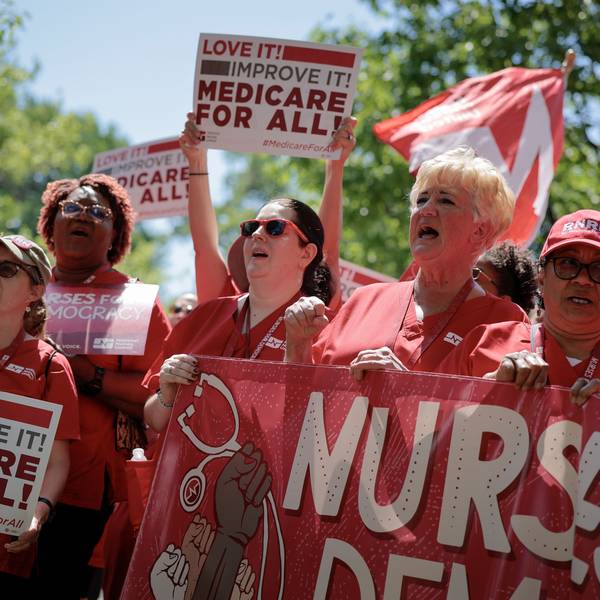
I can think of no better argument for Medicare for All than the freeing of the noble employer from the dreadful moral quandary of birth control. Great job, team. Drinks are on Kavanaugh. (Photo: National Nurses United/flickr/cc)
People of the menstruating persuasion: how dare you.
The highest court in the land demands to know.
On July 8th, 2020, the Supreme Court of the United States decided that the President, who does not have a uterus, was quite right to object to Obama-era ACA rules that allowed Americans who do have uteri access to free birth control through their employer-provided health insurance plans. Specifically, NPR reports, the Supreme Court upheld a Trump administration rule that "would give broad exemptions from the birth control mandate to nonprofits and some for-profit companies that object to birth control on religious or moral grounds" (emphasis NPR's).
So even if you determine that Jesus is cool with it, if you have personal moral quandaries with the people in your employ taking birth control, you're free to cut your workers off from essential medications.
And I do mean absolutely essential. While some of us use ACA-covered birth control like the "Pill" or an intrauterine device (IUD) as an optional measure to prevent pregnancy, many of us depend on it to treat hormonal conditions. Birth control is commonly used to help manage pre-menstrual syndrome and painful periods. Doctors prescribe it to control the growth of painful ovarian cysts that can lead to life-threatening complications if left untreated. It helps those with challenges like depression level out the hormonal fluctuations that can trigger cyclical mood changes around menstruation. And for one in 10 of us, it is the best line of defense, short of surgery, against endometriosis, a debilitating condition that many struggle to manage without birth control.
But perhaps that's not the point. Plenty of us have made this medical appeal before to no avail. Medicine doesn't seem to matter to those employers who deem themselves religiously or morally opposed to "providing" birth control to their employees -- as if employers are handing out pill packs at the reception desk like free swag at Comic Con.
Maybe, as always, this is about the medical-industrial complex.
In this country, where health insurance is frequently tied to employment, employers often take the position that they are "giving" their employees healthcare, and therefore, that they are entitled to some say over what that healthcare entails. That's nonsense, but that's not the real problem here. Instead of squabbling over birth control in employer-provided health insurance, we should focus on the part of the system where access to healthcare is tied to employment and insurance in the first place -- because that's even more nonsense, and that's something we can actually fix.
Politicians who oppose Medicare for All like to cite the concerns of voters who, allegedly, love their employer-provided health insurance. But July 8th's SCOTUS decision proves what most of us, I bet, already know: health insurance isn't all that great. It doesn't cover everything you need it to cover, it's beholden to the whims of the employers who provide it, it's expensive for the self-employed who purchase it on their own, it prioritizes profit over care yet still never seems to get the billing done right...it sucks. As Sen. Elizabeth Warren said at the third Democratic primary debate in September 2019 about ten thousand years ago, "Let's be clear: I've never actually met anybody who likes their health insurance company."
So fine. Refuse to offer health insurance plans that cover birth control, if you must. I'm not happy about it, especially as I write this an hour before an appointment with my OBGYN to talk about birth control and endometriosis. But I won't fight you either, because I think you've done my fighting for me -- I can think of no better argument for Medicare for All than the freeing of the noble employer from the dreadful moral quandary of birth control. Great job, team. Drinks are on Kavanaugh.
Dear Common Dreams reader, It’s been nearly 30 years since I co-founded Common Dreams with my late wife, Lina Newhouser. We had the radical notion that journalism should serve the public good, not corporate profits. It was clear to us from the outset what it would take to build such a project. No paid advertisements. No corporate sponsors. No millionaire publisher telling us what to think or do. Many people said we wouldn't last a year, but we proved those doubters wrong. Together with a tremendous team of journalists and dedicated staff, we built an independent media outlet free from the constraints of profits and corporate control. Our mission has always been simple: To inform. To inspire. To ignite change for the common good. Building Common Dreams was not easy. Our survival was never guaranteed. When you take on the most powerful forces—Wall Street greed, fossil fuel industry destruction, Big Tech lobbyists, and uber-rich oligarchs who have spent billions upon billions rigging the economy and democracy in their favor—the only bulwark you have is supporters who believe in your work. But here’s the urgent message from me today. It's never been this bad out there. And it's never been this hard to keep us going. At the very moment Common Dreams is most needed, the threats we face are intensifying. We need your support now more than ever. We don't accept corporate advertising and never will. We don't have a paywall because we don't think people should be blocked from critical news based on their ability to pay. Everything we do is funded by the donations of readers like you. When everyone does the little they can afford, we are strong. But if that support retreats or dries up, so do we. Will you donate now to make sure Common Dreams not only survives but thrives? —Craig Brown, Co-founder |
People of the menstruating persuasion: how dare you.
The highest court in the land demands to know.
On July 8th, 2020, the Supreme Court of the United States decided that the President, who does not have a uterus, was quite right to object to Obama-era ACA rules that allowed Americans who do have uteri access to free birth control through their employer-provided health insurance plans. Specifically, NPR reports, the Supreme Court upheld a Trump administration rule that "would give broad exemptions from the birth control mandate to nonprofits and some for-profit companies that object to birth control on religious or moral grounds" (emphasis NPR's).
So even if you determine that Jesus is cool with it, if you have personal moral quandaries with the people in your employ taking birth control, you're free to cut your workers off from essential medications.
And I do mean absolutely essential. While some of us use ACA-covered birth control like the "Pill" or an intrauterine device (IUD) as an optional measure to prevent pregnancy, many of us depend on it to treat hormonal conditions. Birth control is commonly used to help manage pre-menstrual syndrome and painful periods. Doctors prescribe it to control the growth of painful ovarian cysts that can lead to life-threatening complications if left untreated. It helps those with challenges like depression level out the hormonal fluctuations that can trigger cyclical mood changes around menstruation. And for one in 10 of us, it is the best line of defense, short of surgery, against endometriosis, a debilitating condition that many struggle to manage without birth control.
But perhaps that's not the point. Plenty of us have made this medical appeal before to no avail. Medicine doesn't seem to matter to those employers who deem themselves religiously or morally opposed to "providing" birth control to their employees -- as if employers are handing out pill packs at the reception desk like free swag at Comic Con.
Maybe, as always, this is about the medical-industrial complex.
In this country, where health insurance is frequently tied to employment, employers often take the position that they are "giving" their employees healthcare, and therefore, that they are entitled to some say over what that healthcare entails. That's nonsense, but that's not the real problem here. Instead of squabbling over birth control in employer-provided health insurance, we should focus on the part of the system where access to healthcare is tied to employment and insurance in the first place -- because that's even more nonsense, and that's something we can actually fix.
Politicians who oppose Medicare for All like to cite the concerns of voters who, allegedly, love their employer-provided health insurance. But July 8th's SCOTUS decision proves what most of us, I bet, already know: health insurance isn't all that great. It doesn't cover everything you need it to cover, it's beholden to the whims of the employers who provide it, it's expensive for the self-employed who purchase it on their own, it prioritizes profit over care yet still never seems to get the billing done right...it sucks. As Sen. Elizabeth Warren said at the third Democratic primary debate in September 2019 about ten thousand years ago, "Let's be clear: I've never actually met anybody who likes their health insurance company."
So fine. Refuse to offer health insurance plans that cover birth control, if you must. I'm not happy about it, especially as I write this an hour before an appointment with my OBGYN to talk about birth control and endometriosis. But I won't fight you either, because I think you've done my fighting for me -- I can think of no better argument for Medicare for All than the freeing of the noble employer from the dreadful moral quandary of birth control. Great job, team. Drinks are on Kavanaugh.
People of the menstruating persuasion: how dare you.
The highest court in the land demands to know.
On July 8th, 2020, the Supreme Court of the United States decided that the President, who does not have a uterus, was quite right to object to Obama-era ACA rules that allowed Americans who do have uteri access to free birth control through their employer-provided health insurance plans. Specifically, NPR reports, the Supreme Court upheld a Trump administration rule that "would give broad exemptions from the birth control mandate to nonprofits and some for-profit companies that object to birth control on religious or moral grounds" (emphasis NPR's).
So even if you determine that Jesus is cool with it, if you have personal moral quandaries with the people in your employ taking birth control, you're free to cut your workers off from essential medications.
And I do mean absolutely essential. While some of us use ACA-covered birth control like the "Pill" or an intrauterine device (IUD) as an optional measure to prevent pregnancy, many of us depend on it to treat hormonal conditions. Birth control is commonly used to help manage pre-menstrual syndrome and painful periods. Doctors prescribe it to control the growth of painful ovarian cysts that can lead to life-threatening complications if left untreated. It helps those with challenges like depression level out the hormonal fluctuations that can trigger cyclical mood changes around menstruation. And for one in 10 of us, it is the best line of defense, short of surgery, against endometriosis, a debilitating condition that many struggle to manage without birth control.
But perhaps that's not the point. Plenty of us have made this medical appeal before to no avail. Medicine doesn't seem to matter to those employers who deem themselves religiously or morally opposed to "providing" birth control to their employees -- as if employers are handing out pill packs at the reception desk like free swag at Comic Con.
Maybe, as always, this is about the medical-industrial complex.
In this country, where health insurance is frequently tied to employment, employers often take the position that they are "giving" their employees healthcare, and therefore, that they are entitled to some say over what that healthcare entails. That's nonsense, but that's not the real problem here. Instead of squabbling over birth control in employer-provided health insurance, we should focus on the part of the system where access to healthcare is tied to employment and insurance in the first place -- because that's even more nonsense, and that's something we can actually fix.
Politicians who oppose Medicare for All like to cite the concerns of voters who, allegedly, love their employer-provided health insurance. But July 8th's SCOTUS decision proves what most of us, I bet, already know: health insurance isn't all that great. It doesn't cover everything you need it to cover, it's beholden to the whims of the employers who provide it, it's expensive for the self-employed who purchase it on their own, it prioritizes profit over care yet still never seems to get the billing done right...it sucks. As Sen. Elizabeth Warren said at the third Democratic primary debate in September 2019 about ten thousand years ago, "Let's be clear: I've never actually met anybody who likes their health insurance company."
So fine. Refuse to offer health insurance plans that cover birth control, if you must. I'm not happy about it, especially as I write this an hour before an appointment with my OBGYN to talk about birth control and endometriosis. But I won't fight you either, because I think you've done my fighting for me -- I can think of no better argument for Medicare for All than the freeing of the noble employer from the dreadful moral quandary of birth control. Great job, team. Drinks are on Kavanaugh.