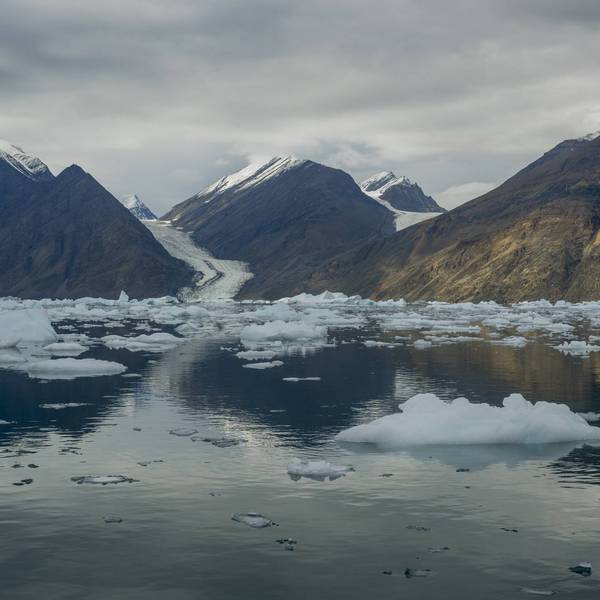

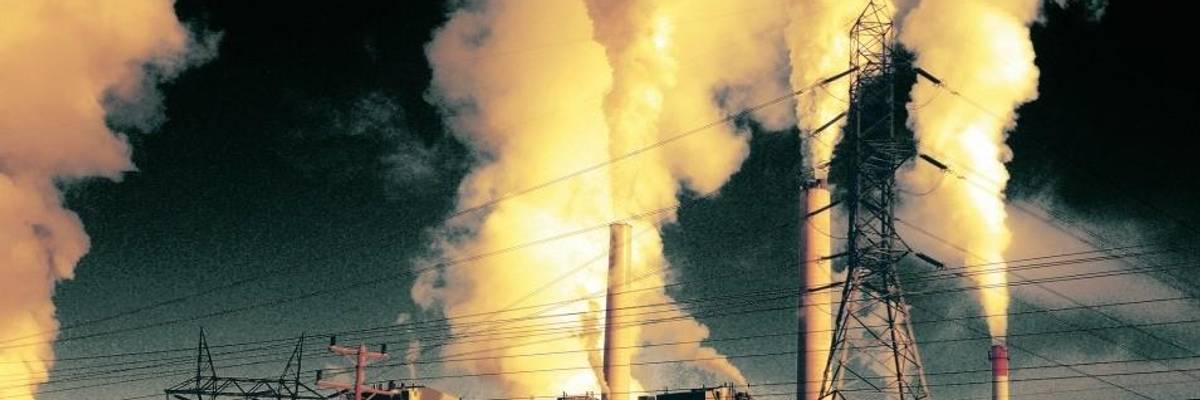
It is clear that nobody should be bailing out the polluters when their profits are evaporating, when they are laying off workers and their pipelines cannot get built. (Photo: Andrew Hart/flickr/cc)
As Arctic Temperatures Soar, Trump Lavishes Fossil Fuel Industry With Billions in Bailouts
We should not be propping up a dying industry.
The Arctic is once again on fire. And the extremely warm temperatures in the region--and concurrent wildfires--are another urgent reminder that we need to divest from fossil fuels as soon as possible.
They are a pressing reminder that any post COVID-19 bailout should be focused on an immediate just recovery toward industry workers, renewables, and clean energy.
However, the opposite is happening. New research shows that the Trump administration is giving billions in bailouts to the fossil fuel industry.
The news from the Arctic is deeply worrying. On Tuesday, scientists at the European Copernicus Climate Change Service reported that the unusually warm spell in the Arctic, which has seen record temperatures, continues.
They reported that "global temperatures for June were on par with 2019's record temperatures for the same month. But the most striking regional feature was exceptional warmth over Arctic Siberia, where average temperatures reached as high as 10degC above normal for June."
They again reiterated that the Arctic "as a whole has been warming substantially faster than the rest of the world." This heat has consequences, with fires burning across the region since last month.
"For the second year in a row, June saw widespread fires flaring up across the far northeast of Siberia and in the Arctic Circle," said the scientists.
The fires are so bad they are beginning to make the news. Also this week, National Geographic reported that the "heat has fueled an enormous outbreak of wildfires, including fires on tundra underpinned by permafrost -- normally frigid soil that is likely becoming even less frozen this year."
The journal noted that the recent spread of fires, which is normally too wet, cold, or icy to burn, is "raising alarms for ecologists and climate scientists" who fear that the fires could disrupt "entire ecosystems," and "exacerbate global warming by burning deep into the soil and releasing carbon that has accumulated as frozen organic matter over hundreds of years."
The scientists are alarmed at how far north the fires are burning and the fact that they are burning on permafrost--frozen ground--which in turn releases more carbon and methane into the atmosphere.
They are also alarmed at the scale of the fires. According to Russia's forest fire agency, an estimated 3.4 million acres are burning.
The Washington Post adds that, "the fires that have erupted in Siberia this summer have been massive, sending out plumes of smoke that have covered a swath of land spanning about 1,000 miles at times...Satellite observations of Arctic wildfires in June also showed that fires this year are emitting more greenhouse gases than the record Arctic fires in 2019."
With the smoke comes pollution. In June, the fires released more polluting gases into the atmosphere than any other month in 18 years of data collection, according to scientists.
But alarming scientists the most is that everything is happening much faster and quicker than scientists had predicted. Jessica McCarty, a fire researcher at Miami University in Ohio, told National Geographic, "when I went into fire science as an undergraduate student, if someone had told me I'd be studying fire regimes in Greenland and the Arctic, I would have laughed at them."
The burning, melting, and warming Arctic is clearly a sign that something is wrong and we need to stop investing in fossil fuels now. It is a timely reminder that there should not be a big polluter bailout in any COVID-19 recovery plan.
Walt Meier, a senior research scientist at the National Snow and Ice Data Center at the University of Colorado at Boulder, said to the Post, "We always expected the Arctic to change faster than the rest of the globe. But I don't think anyone expected the changes to happen as fast as we are seeing them happen."
His colleague, Merritt Turetsky, director of the Institute for Arctic and Alpine Research at the University of Colorado at Boulder, added, "when we develop a fever, it's a sign. It's a warning sign that something is wrong and we stop and we take note. Literally, the Arctic is on fire. It has a fever right now, and so it's a good warning sign that we need to stop, take note and figure out what's going on."
The burning, melting, and warming Arctic is clearly a sign that something is wrong and we need to stop investing in fossil fuels now. It is a timely reminder that there should not be a big polluter bailout in any COVID-19 recovery plan. It is a reminder that we should be investing rapidly in renewables.
Unfortunately this is not the case. Yesterday, a joint investigation by Documented and the Guardian reported that "over 5,600 fossil fuel companies have taken at least USD 3 billion in COVID-19 aid from the United States government."
The paper reported that "the businesses include oil and gas drillers and coal mine operators, as well as refiners, pipeline companies and firms that provide services to the industry." Worryingly, the USD 3 billion figure is probably "far less than the companies actually received," noted the Guardian.
The Trump Administration is bailing out polluters as the warning signs from the Arctic get worse. It is clear that nobody should be bailing out the polluters when their profits are evaporating, when they are laying off workers and their pipelines cannot get built. We should not be propping up a dying industry.
Jesse Coleman, a researcher for Documented, told the Guardian, "we should not be wasting taxpayer dollars on an industry that's in a tailspin of its own making, especially when it seems intent on bringing the whole planet down with it."
An Urgent Message From Our Co-Founder
Dear Common Dreams reader, It’s been nearly 30 years since I co-founded Common Dreams with my late wife, Lina Newhouser. We had the radical notion that journalism should serve the public good, not corporate profits. It was clear to us from the outset what it would take to build such a project. No paid advertisements. No corporate sponsors. No millionaire publisher telling us what to think or do. Many people said we wouldn't last a year, but we proved those doubters wrong. Together with a tremendous team of journalists and dedicated staff, we built an independent media outlet free from the constraints of profits and corporate control. Our mission has always been simple: To inform. To inspire. To ignite change for the common good. Building Common Dreams was not easy. Our survival was never guaranteed. When you take on the most powerful forces—Wall Street greed, fossil fuel industry destruction, Big Tech lobbyists, and uber-rich oligarchs who have spent billions upon billions rigging the economy and democracy in their favor—the only bulwark you have is supporters who believe in your work. But here’s the urgent message from me today. It's never been this bad out there. And it's never been this hard to keep us going. At the very moment Common Dreams is most needed, the threats we face are intensifying. We need your support now more than ever. We don't accept corporate advertising and never will. We don't have a paywall because we don't think people should be blocked from critical news based on their ability to pay. Everything we do is funded by the donations of readers like you. When everyone does the little they can afford, we are strong. But if that support retreats or dries up, so do we. Will you donate now to make sure Common Dreams not only survives but thrives? —Craig Brown, Co-founder |
The Arctic is once again on fire. And the extremely warm temperatures in the region--and concurrent wildfires--are another urgent reminder that we need to divest from fossil fuels as soon as possible.
They are a pressing reminder that any post COVID-19 bailout should be focused on an immediate just recovery toward industry workers, renewables, and clean energy.
However, the opposite is happening. New research shows that the Trump administration is giving billions in bailouts to the fossil fuel industry.
The news from the Arctic is deeply worrying. On Tuesday, scientists at the European Copernicus Climate Change Service reported that the unusually warm spell in the Arctic, which has seen record temperatures, continues.
They reported that "global temperatures for June were on par with 2019's record temperatures for the same month. But the most striking regional feature was exceptional warmth over Arctic Siberia, where average temperatures reached as high as 10degC above normal for June."
They again reiterated that the Arctic "as a whole has been warming substantially faster than the rest of the world." This heat has consequences, with fires burning across the region since last month.
"For the second year in a row, June saw widespread fires flaring up across the far northeast of Siberia and in the Arctic Circle," said the scientists.
The fires are so bad they are beginning to make the news. Also this week, National Geographic reported that the "heat has fueled an enormous outbreak of wildfires, including fires on tundra underpinned by permafrost -- normally frigid soil that is likely becoming even less frozen this year."
The journal noted that the recent spread of fires, which is normally too wet, cold, or icy to burn, is "raising alarms for ecologists and climate scientists" who fear that the fires could disrupt "entire ecosystems," and "exacerbate global warming by burning deep into the soil and releasing carbon that has accumulated as frozen organic matter over hundreds of years."
The scientists are alarmed at how far north the fires are burning and the fact that they are burning on permafrost--frozen ground--which in turn releases more carbon and methane into the atmosphere.
They are also alarmed at the scale of the fires. According to Russia's forest fire agency, an estimated 3.4 million acres are burning.
The Washington Post adds that, "the fires that have erupted in Siberia this summer have been massive, sending out plumes of smoke that have covered a swath of land spanning about 1,000 miles at times...Satellite observations of Arctic wildfires in June also showed that fires this year are emitting more greenhouse gases than the record Arctic fires in 2019."
With the smoke comes pollution. In June, the fires released more polluting gases into the atmosphere than any other month in 18 years of data collection, according to scientists.
But alarming scientists the most is that everything is happening much faster and quicker than scientists had predicted. Jessica McCarty, a fire researcher at Miami University in Ohio, told National Geographic, "when I went into fire science as an undergraduate student, if someone had told me I'd be studying fire regimes in Greenland and the Arctic, I would have laughed at them."
The burning, melting, and warming Arctic is clearly a sign that something is wrong and we need to stop investing in fossil fuels now. It is a timely reminder that there should not be a big polluter bailout in any COVID-19 recovery plan.
Walt Meier, a senior research scientist at the National Snow and Ice Data Center at the University of Colorado at Boulder, said to the Post, "We always expected the Arctic to change faster than the rest of the globe. But I don't think anyone expected the changes to happen as fast as we are seeing them happen."
His colleague, Merritt Turetsky, director of the Institute for Arctic and Alpine Research at the University of Colorado at Boulder, added, "when we develop a fever, it's a sign. It's a warning sign that something is wrong and we stop and we take note. Literally, the Arctic is on fire. It has a fever right now, and so it's a good warning sign that we need to stop, take note and figure out what's going on."
The burning, melting, and warming Arctic is clearly a sign that something is wrong and we need to stop investing in fossil fuels now. It is a timely reminder that there should not be a big polluter bailout in any COVID-19 recovery plan. It is a reminder that we should be investing rapidly in renewables.
Unfortunately this is not the case. Yesterday, a joint investigation by Documented and the Guardian reported that "over 5,600 fossil fuel companies have taken at least USD 3 billion in COVID-19 aid from the United States government."
The paper reported that "the businesses include oil and gas drillers and coal mine operators, as well as refiners, pipeline companies and firms that provide services to the industry." Worryingly, the USD 3 billion figure is probably "far less than the companies actually received," noted the Guardian.
The Trump Administration is bailing out polluters as the warning signs from the Arctic get worse. It is clear that nobody should be bailing out the polluters when their profits are evaporating, when they are laying off workers and their pipelines cannot get built. We should not be propping up a dying industry.
Jesse Coleman, a researcher for Documented, told the Guardian, "we should not be wasting taxpayer dollars on an industry that's in a tailspin of its own making, especially when it seems intent on bringing the whole planet down with it."
The Arctic is once again on fire. And the extremely warm temperatures in the region--and concurrent wildfires--are another urgent reminder that we need to divest from fossil fuels as soon as possible.
They are a pressing reminder that any post COVID-19 bailout should be focused on an immediate just recovery toward industry workers, renewables, and clean energy.
However, the opposite is happening. New research shows that the Trump administration is giving billions in bailouts to the fossil fuel industry.
The news from the Arctic is deeply worrying. On Tuesday, scientists at the European Copernicus Climate Change Service reported that the unusually warm spell in the Arctic, which has seen record temperatures, continues.
They reported that "global temperatures for June were on par with 2019's record temperatures for the same month. But the most striking regional feature was exceptional warmth over Arctic Siberia, where average temperatures reached as high as 10degC above normal for June."
They again reiterated that the Arctic "as a whole has been warming substantially faster than the rest of the world." This heat has consequences, with fires burning across the region since last month.
"For the second year in a row, June saw widespread fires flaring up across the far northeast of Siberia and in the Arctic Circle," said the scientists.
The fires are so bad they are beginning to make the news. Also this week, National Geographic reported that the "heat has fueled an enormous outbreak of wildfires, including fires on tundra underpinned by permafrost -- normally frigid soil that is likely becoming even less frozen this year."
The journal noted that the recent spread of fires, which is normally too wet, cold, or icy to burn, is "raising alarms for ecologists and climate scientists" who fear that the fires could disrupt "entire ecosystems," and "exacerbate global warming by burning deep into the soil and releasing carbon that has accumulated as frozen organic matter over hundreds of years."
The scientists are alarmed at how far north the fires are burning and the fact that they are burning on permafrost--frozen ground--which in turn releases more carbon and methane into the atmosphere.
They are also alarmed at the scale of the fires. According to Russia's forest fire agency, an estimated 3.4 million acres are burning.
The Washington Post adds that, "the fires that have erupted in Siberia this summer have been massive, sending out plumes of smoke that have covered a swath of land spanning about 1,000 miles at times...Satellite observations of Arctic wildfires in June also showed that fires this year are emitting more greenhouse gases than the record Arctic fires in 2019."
With the smoke comes pollution. In June, the fires released more polluting gases into the atmosphere than any other month in 18 years of data collection, according to scientists.
But alarming scientists the most is that everything is happening much faster and quicker than scientists had predicted. Jessica McCarty, a fire researcher at Miami University in Ohio, told National Geographic, "when I went into fire science as an undergraduate student, if someone had told me I'd be studying fire regimes in Greenland and the Arctic, I would have laughed at them."
The burning, melting, and warming Arctic is clearly a sign that something is wrong and we need to stop investing in fossil fuels now. It is a timely reminder that there should not be a big polluter bailout in any COVID-19 recovery plan.
Walt Meier, a senior research scientist at the National Snow and Ice Data Center at the University of Colorado at Boulder, said to the Post, "We always expected the Arctic to change faster than the rest of the globe. But I don't think anyone expected the changes to happen as fast as we are seeing them happen."
His colleague, Merritt Turetsky, director of the Institute for Arctic and Alpine Research at the University of Colorado at Boulder, added, "when we develop a fever, it's a sign. It's a warning sign that something is wrong and we stop and we take note. Literally, the Arctic is on fire. It has a fever right now, and so it's a good warning sign that we need to stop, take note and figure out what's going on."
The burning, melting, and warming Arctic is clearly a sign that something is wrong and we need to stop investing in fossil fuels now. It is a timely reminder that there should not be a big polluter bailout in any COVID-19 recovery plan. It is a reminder that we should be investing rapidly in renewables.
Unfortunately this is not the case. Yesterday, a joint investigation by Documented and the Guardian reported that "over 5,600 fossil fuel companies have taken at least USD 3 billion in COVID-19 aid from the United States government."
The paper reported that "the businesses include oil and gas drillers and coal mine operators, as well as refiners, pipeline companies and firms that provide services to the industry." Worryingly, the USD 3 billion figure is probably "far less than the companies actually received," noted the Guardian.
The Trump Administration is bailing out polluters as the warning signs from the Arctic get worse. It is clear that nobody should be bailing out the polluters when their profits are evaporating, when they are laying off workers and their pipelines cannot get built. We should not be propping up a dying industry.
Jesse Coleman, a researcher for Documented, told the Guardian, "we should not be wasting taxpayer dollars on an industry that's in a tailspin of its own making, especially when it seems intent on bringing the whole planet down with it."