SUBSCRIBE TO OUR FREE NEWSLETTER
Daily news & progressive opinion—funded by the people, not the corporations—delivered straight to your inbox.
5
#000000
#FFFFFF
To donate by check, phone, or other method, see our More Ways to Give page.


Daily news & progressive opinion—funded by the people, not the corporations—delivered straight to your inbox.

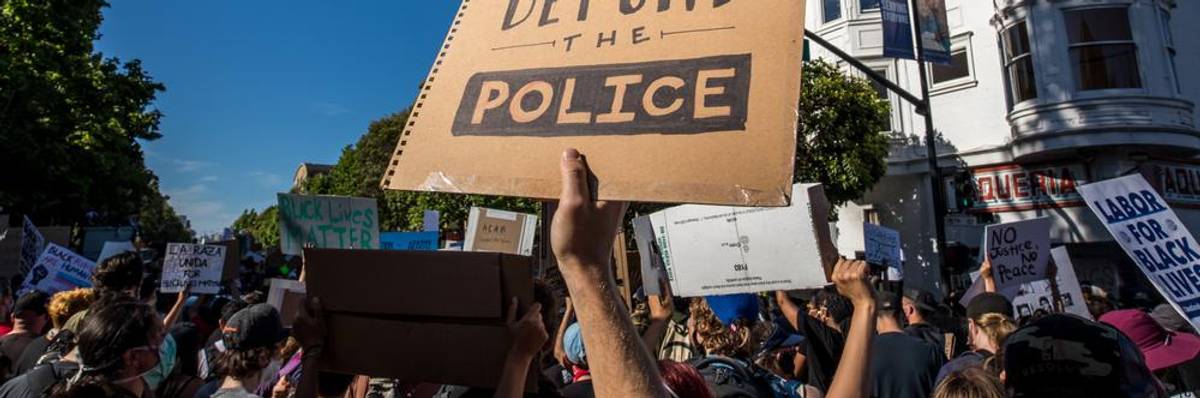
It's time to divest resources from law enforcement, and put them into services that prioritize the community at large, like education. (Photo: Shutterstock)
Five years ago, the U.S. Department of Justice's Civil Rights Division released a damning report on the Ferguson, Missouri police department.
"Ferguson's law enforcement practices are shaped by the city's focus on revenue rather than by public safety needs," the report summary concluded, "contributing to a pattern of unconstitutional policing" and practices that "both reflect and exacerbate existing racial bias" against African Americans.
The details were so devastating that they led to resignations from Ferguson's police chief and city manager. Ferguson's top court clerk and two officers who were found to have shared racist emails also resigned.
Ferguson was just one town, where the police killing of unarmed teenager Michael Brown led to some of the first mass "Black Lives Matter" demonstrations. But it showed a national problem: Police were aggressively initiating conflicts with residents to seek revenue for the city.
Now, in the wake of the murder of George Floyd and other black Americans by police, activists and experts across the country have a simple solution for the revenue problem and the police problem: Defund the police.
A few years ago, a collaboration between The Center for Popular Democracy, Law For Black Lives, and Black Youth Project 100 yielded a fascinating report into "reimagining safety and security in our communities."
Entitled Freedom to Thrive, the report analyzed police spending in metropolitan cities. Most of those cities spent anywhere from 25 to over 40 percent of their general funds on policing, and far smaller sums on other social needs.
A different report from the Urban Institute found that, from 1977 to 2017, state and local governments went from spending $60 billion a year on police and corrections in 1977 to $194 billion in 2017. Those inflation-adjusted numbers don't even include settlements paid out to victims and families who suffer from police brutality.
In a country over where 40 million people are unemployed and, even before the pandemic, one in nine people officially lived in poverty, we must shift our focus.
That's a lot of revenue that could otherwise be spent on services, social workers, teachers, and others. Combined with a downward-trending violent crime rate over the last 20 to 30 years, that level of spending is unconscionable. In a country over where 40 million people are unemployed and, even before the pandemic, one in nine people officially lived in poverty, we must shift our focus.
It's time to divest resources from law enforcement, and put them into services that prioritize the community at large, like education.
It's no surprise, after George Floyd's murder, that the public school district in Minneapolis and the University of Minnesota both made moves to cut their contracts with local police. Those decisions were made to protect students, but it's also true that education and policing are old rivals for state and local tax dollars.
Police funds could also be moved into transit, health care, and nutrition, particularly after COVID-19 brought attention to both food and health care deserts in U.S. communities -- and especially in light of the pandemic's devastating effect on black Americans.
And don't forget mental health and social work. Professional social workers would be much better first responders to people experiencing mental health crises than armed police officers.
These conversations need to happen now, and they should happen all over the country. We have the knowledge and the resources to replace aggressive policing with investments in the services that will actually keep our communities safe. We also need legislation such as Sen. Brian Schatz's proposal to stop transferring military weapons to police departments.
When we depower--and defund--the police, then we can truly have "power to the people."

Dear Common Dreams reader, It’s been nearly 30 years since I co-founded Common Dreams with my late wife, Lina Newhouser. We had the radical notion that journalism should serve the public good, not corporate profits. It was clear to us from the outset what it would take to build such a project. No paid advertisements. No corporate sponsors. No millionaire publisher telling us what to think or do. Many people said we wouldn't last a year, but we proved those doubters wrong. Together with a tremendous team of journalists and dedicated staff, we built an independent media outlet free from the constraints of profits and corporate control. Our mission has always been simple: To inform. To inspire. To ignite change for the common good. Building Common Dreams was not easy. Our survival was never guaranteed. When you take on the most powerful forces—Wall Street greed, fossil fuel industry destruction, Big Tech lobbyists, and uber-rich oligarchs who have spent billions upon billions rigging the economy and democracy in their favor—the only bulwark you have is supporters who believe in your work. But here’s the urgent message from me today. It's never been this bad out there. And it's never been this hard to keep us going. At the very moment Common Dreams is most needed, the threats we face are intensifying. We need your support now more than ever. We don't accept corporate advertising and never will. We don't have a paywall because we don't think people should be blocked from critical news based on their ability to pay. Everything we do is funded by the donations of readers like you. When everyone does the little they can afford, we are strong. But if that support retreats or dries up, so do we. Will you donate now to make sure Common Dreams not only survives but thrives? —Craig Brown, Co-founder |
Five years ago, the U.S. Department of Justice's Civil Rights Division released a damning report on the Ferguson, Missouri police department.
"Ferguson's law enforcement practices are shaped by the city's focus on revenue rather than by public safety needs," the report summary concluded, "contributing to a pattern of unconstitutional policing" and practices that "both reflect and exacerbate existing racial bias" against African Americans.
The details were so devastating that they led to resignations from Ferguson's police chief and city manager. Ferguson's top court clerk and two officers who were found to have shared racist emails also resigned.
Ferguson was just one town, where the police killing of unarmed teenager Michael Brown led to some of the first mass "Black Lives Matter" demonstrations. But it showed a national problem: Police were aggressively initiating conflicts with residents to seek revenue for the city.
Now, in the wake of the murder of George Floyd and other black Americans by police, activists and experts across the country have a simple solution for the revenue problem and the police problem: Defund the police.
A few years ago, a collaboration between The Center for Popular Democracy, Law For Black Lives, and Black Youth Project 100 yielded a fascinating report into "reimagining safety and security in our communities."
Entitled Freedom to Thrive, the report analyzed police spending in metropolitan cities. Most of those cities spent anywhere from 25 to over 40 percent of their general funds on policing, and far smaller sums on other social needs.
A different report from the Urban Institute found that, from 1977 to 2017, state and local governments went from spending $60 billion a year on police and corrections in 1977 to $194 billion in 2017. Those inflation-adjusted numbers don't even include settlements paid out to victims and families who suffer from police brutality.
In a country over where 40 million people are unemployed and, even before the pandemic, one in nine people officially lived in poverty, we must shift our focus.
That's a lot of revenue that could otherwise be spent on services, social workers, teachers, and others. Combined with a downward-trending violent crime rate over the last 20 to 30 years, that level of spending is unconscionable. In a country over where 40 million people are unemployed and, even before the pandemic, one in nine people officially lived in poverty, we must shift our focus.
It's time to divest resources from law enforcement, and put them into services that prioritize the community at large, like education.
It's no surprise, after George Floyd's murder, that the public school district in Minneapolis and the University of Minnesota both made moves to cut their contracts with local police. Those decisions were made to protect students, but it's also true that education and policing are old rivals for state and local tax dollars.
Police funds could also be moved into transit, health care, and nutrition, particularly after COVID-19 brought attention to both food and health care deserts in U.S. communities -- and especially in light of the pandemic's devastating effect on black Americans.
And don't forget mental health and social work. Professional social workers would be much better first responders to people experiencing mental health crises than armed police officers.
These conversations need to happen now, and they should happen all over the country. We have the knowledge and the resources to replace aggressive policing with investments in the services that will actually keep our communities safe. We also need legislation such as Sen. Brian Schatz's proposal to stop transferring military weapons to police departments.
When we depower--and defund--the police, then we can truly have "power to the people."
Five years ago, the U.S. Department of Justice's Civil Rights Division released a damning report on the Ferguson, Missouri police department.
"Ferguson's law enforcement practices are shaped by the city's focus on revenue rather than by public safety needs," the report summary concluded, "contributing to a pattern of unconstitutional policing" and practices that "both reflect and exacerbate existing racial bias" against African Americans.
The details were so devastating that they led to resignations from Ferguson's police chief and city manager. Ferguson's top court clerk and two officers who were found to have shared racist emails also resigned.
Ferguson was just one town, where the police killing of unarmed teenager Michael Brown led to some of the first mass "Black Lives Matter" demonstrations. But it showed a national problem: Police were aggressively initiating conflicts with residents to seek revenue for the city.
Now, in the wake of the murder of George Floyd and other black Americans by police, activists and experts across the country have a simple solution for the revenue problem and the police problem: Defund the police.
A few years ago, a collaboration between The Center for Popular Democracy, Law For Black Lives, and Black Youth Project 100 yielded a fascinating report into "reimagining safety and security in our communities."
Entitled Freedom to Thrive, the report analyzed police spending in metropolitan cities. Most of those cities spent anywhere from 25 to over 40 percent of their general funds on policing, and far smaller sums on other social needs.
A different report from the Urban Institute found that, from 1977 to 2017, state and local governments went from spending $60 billion a year on police and corrections in 1977 to $194 billion in 2017. Those inflation-adjusted numbers don't even include settlements paid out to victims and families who suffer from police brutality.
In a country over where 40 million people are unemployed and, even before the pandemic, one in nine people officially lived in poverty, we must shift our focus.
That's a lot of revenue that could otherwise be spent on services, social workers, teachers, and others. Combined with a downward-trending violent crime rate over the last 20 to 30 years, that level of spending is unconscionable. In a country over where 40 million people are unemployed and, even before the pandemic, one in nine people officially lived in poverty, we must shift our focus.
It's time to divest resources from law enforcement, and put them into services that prioritize the community at large, like education.
It's no surprise, after George Floyd's murder, that the public school district in Minneapolis and the University of Minnesota both made moves to cut their contracts with local police. Those decisions were made to protect students, but it's also true that education and policing are old rivals for state and local tax dollars.
Police funds could also be moved into transit, health care, and nutrition, particularly after COVID-19 brought attention to both food and health care deserts in U.S. communities -- and especially in light of the pandemic's devastating effect on black Americans.
And don't forget mental health and social work. Professional social workers would be much better first responders to people experiencing mental health crises than armed police officers.
These conversations need to happen now, and they should happen all over the country. We have the knowledge and the resources to replace aggressive policing with investments in the services that will actually keep our communities safe. We also need legislation such as Sen. Brian Schatz's proposal to stop transferring military weapons to police departments.
When we depower--and defund--the police, then we can truly have "power to the people."