SUBSCRIBE TO OUR FREE NEWSLETTER
Daily news & progressive opinion—funded by the people, not the corporations—delivered straight to your inbox.
5
#000000
#FFFFFF
To donate by check, phone, or other method, see our More Ways to Give page.
Daily news & progressive opinion—funded by the people, not the corporations—delivered straight to your inbox.
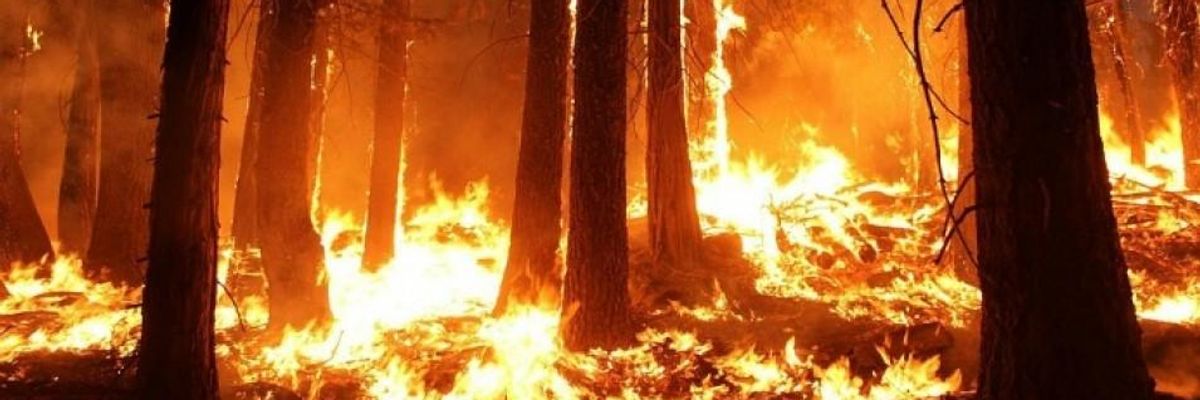
Wildfires similarly show how our remaking of the natural world has had disastrous consequences. (Photo: Pixabay/CC)
About 12,000 years ago, human domestication of the natural world began in earnest with the intentional cultivation of wild plants and animals. Fast forward to today and our dominion over the planet appears complete, as 7.8 billion of us multiply across its surface and our reach extends from the deep-sea beds, which are being mined, to the heavens, where we are, according to Donald Trump, dispatching a space force.
Yet as has been made clear by a recent litany of disasters - from the coronavirus pandemic to America's deadliest wildfire in a century - there are forces that cannot be domesticated. Indeed, our interference with the natural world is making them more liable to flare up into tragedy. We created the Anthropocene, and the Anthropocene is biting back.
Covid-19 appears to have emerged in a Wuhan seafood and wild animal market, yet some scientists argue that its true origin story lies in the disruption of ecosystems. Genetic testing indicates that the virus probably came from bats, and at some point may have been transmitted via an intermediate species such as the pangolin, the most trafficked animal in the world. Although pangolins were not - officially - listed as traded at the market, it was certainly host to other wild animals such as wolf pups, crocodiles and civets.
We know there will be more outbreaks, as a consequence of extreme weather, biodiversity destruction, political instability.
"Wild animals carry their own unique viruses," David Quammen, the author of Spillover: Animal Infections and the Next Human Pandemic, told Yale Environment 360. "When we go into a tropical forest with its great diversity, and we start cutting down trees, and capturing animals, or killing animals for food" - or sending them to markets where they can mix with farm animals and humans - "then we offer those viruses the opportunity to become our viruses, to jump into us and find a new host, a much more abundant host".
The risk of diseases spreading from animals to humans is in fact greatest when the animals concerned are endangered and in decline owing to trafficking and habitat destruction, a recent study found. The climate crisis and human population growth are "disease amplifiers", according to the World Health Organization.
Wildfires similarly show how our remaking of the natural world has had disastrous consequences. In our new book Fire in Paradise, which is based on our extensive reporting for the Guardian and published today, we document the destruction of an entire California city in 2018 by a fire of unprecedented severity in modern times. Claiming 85 lives, it is the deadliest ever wildfire in the state.
We know there will be more outbreaks, as a consequence of extreme weather, biodiversity destruction, political instability.
Wildfires are native to the western US in the same way that monsoons or hurricanes are native to other places. Yet a century of efforts to stamp them out and protect human lives and property in California has left the state's forests and grasslands unnaturally dense with flammable vegetation that would otherwise have burned off in semi-regular but low-intensity burns. To make matters worse, global heating is rendering California's wild places ever drier.
Paradise's residents knew of the sword that hung over their heads. The town had an evacuation plan and an emergency robocall system. In the summer of 2018, a horrifying and awe-inspiring fire tornado 1,000ft wide had laid waste to an area just 80 miles away. "It's not a matter of if," one longtime resident, Iris Natividad, told us. "It's a matter of when."
Even so, no one imagined how bad it would be on that morning in early November, when a spark from a PG&E transmission tower ignited the brush that surrounded it, at one point consuming nearly 400 American football fields' worth of vegetation a minute on its sprint into Paradise. Flames that burned as hot as a crematorium melted cars and blowtorched thousands of homes. The fire trapped people in town and caught many unaware.
Paradise suffered total devastation, and the images of neighborhoods reduced to nothing but piles of ash shocked the world.
We'd say this was the new normal - except that actually "it would be a mistake to assume that the region has reached any semblance of a stable plateau", three wildfire scientists wrote for the Guardian only a few months before the Paradise fire. We know there will continue to be huge fires. We also know there will be more outbreaks, as a consequence of extreme weather, biodiversity destruction, political instability, and expanded ranges for mosquitoes and ticks.
Yet one optimistic lesson from the Covid-19 tragedy is that we can act. We will heed the calls to stay home, and we will condemn the economy in the process, if it means saving lives. And we will do it overnight.
On our part-domesticated, still-wild planet, in the geologic era that bears our name, we've learned that we do indeed possess the willpower to prevent another pandemic, and another Paradise.
Dear Common Dreams reader, It’s been nearly 30 years since I co-founded Common Dreams with my late wife, Lina Newhouser. We had the radical notion that journalism should serve the public good, not corporate profits. It was clear to us from the outset what it would take to build such a project. No paid advertisements. No corporate sponsors. No millionaire publisher telling us what to think or do. Many people said we wouldn't last a year, but we proved those doubters wrong. Together with a tremendous team of journalists and dedicated staff, we built an independent media outlet free from the constraints of profits and corporate control. Our mission has always been simple: To inform. To inspire. To ignite change for the common good. Building Common Dreams was not easy. Our survival was never guaranteed. When you take on the most powerful forces—Wall Street greed, fossil fuel industry destruction, Big Tech lobbyists, and uber-rich oligarchs who have spent billions upon billions rigging the economy and democracy in their favor—the only bulwark you have is supporters who believe in your work. But here’s the urgent message from me today. It's never been this bad out there. And it's never been this hard to keep us going. At the very moment Common Dreams is most needed, the threats we face are intensifying. We need your support now more than ever. We don't accept corporate advertising and never will. We don't have a paywall because we don't think people should be blocked from critical news based on their ability to pay. Everything we do is funded by the donations of readers like you. When everyone does the little they can afford, we are strong. But if that support retreats or dries up, so do we. Will you donate now to make sure Common Dreams not only survives but thrives? —Craig Brown, Co-founder |
About 12,000 years ago, human domestication of the natural world began in earnest with the intentional cultivation of wild plants and animals. Fast forward to today and our dominion over the planet appears complete, as 7.8 billion of us multiply across its surface and our reach extends from the deep-sea beds, which are being mined, to the heavens, where we are, according to Donald Trump, dispatching a space force.
Yet as has been made clear by a recent litany of disasters - from the coronavirus pandemic to America's deadliest wildfire in a century - there are forces that cannot be domesticated. Indeed, our interference with the natural world is making them more liable to flare up into tragedy. We created the Anthropocene, and the Anthropocene is biting back.
Covid-19 appears to have emerged in a Wuhan seafood and wild animal market, yet some scientists argue that its true origin story lies in the disruption of ecosystems. Genetic testing indicates that the virus probably came from bats, and at some point may have been transmitted via an intermediate species such as the pangolin, the most trafficked animal in the world. Although pangolins were not - officially - listed as traded at the market, it was certainly host to other wild animals such as wolf pups, crocodiles and civets.
We know there will be more outbreaks, as a consequence of extreme weather, biodiversity destruction, political instability.
"Wild animals carry their own unique viruses," David Quammen, the author of Spillover: Animal Infections and the Next Human Pandemic, told Yale Environment 360. "When we go into a tropical forest with its great diversity, and we start cutting down trees, and capturing animals, or killing animals for food" - or sending them to markets where they can mix with farm animals and humans - "then we offer those viruses the opportunity to become our viruses, to jump into us and find a new host, a much more abundant host".
The risk of diseases spreading from animals to humans is in fact greatest when the animals concerned are endangered and in decline owing to trafficking and habitat destruction, a recent study found. The climate crisis and human population growth are "disease amplifiers", according to the World Health Organization.
Wildfires similarly show how our remaking of the natural world has had disastrous consequences. In our new book Fire in Paradise, which is based on our extensive reporting for the Guardian and published today, we document the destruction of an entire California city in 2018 by a fire of unprecedented severity in modern times. Claiming 85 lives, it is the deadliest ever wildfire in the state.
We know there will be more outbreaks, as a consequence of extreme weather, biodiversity destruction, political instability.
Wildfires are native to the western US in the same way that monsoons or hurricanes are native to other places. Yet a century of efforts to stamp them out and protect human lives and property in California has left the state's forests and grasslands unnaturally dense with flammable vegetation that would otherwise have burned off in semi-regular but low-intensity burns. To make matters worse, global heating is rendering California's wild places ever drier.
Paradise's residents knew of the sword that hung over their heads. The town had an evacuation plan and an emergency robocall system. In the summer of 2018, a horrifying and awe-inspiring fire tornado 1,000ft wide had laid waste to an area just 80 miles away. "It's not a matter of if," one longtime resident, Iris Natividad, told us. "It's a matter of when."
Even so, no one imagined how bad it would be on that morning in early November, when a spark from a PG&E transmission tower ignited the brush that surrounded it, at one point consuming nearly 400 American football fields' worth of vegetation a minute on its sprint into Paradise. Flames that burned as hot as a crematorium melted cars and blowtorched thousands of homes. The fire trapped people in town and caught many unaware.
Paradise suffered total devastation, and the images of neighborhoods reduced to nothing but piles of ash shocked the world.
We'd say this was the new normal - except that actually "it would be a mistake to assume that the region has reached any semblance of a stable plateau", three wildfire scientists wrote for the Guardian only a few months before the Paradise fire. We know there will continue to be huge fires. We also know there will be more outbreaks, as a consequence of extreme weather, biodiversity destruction, political instability, and expanded ranges for mosquitoes and ticks.
Yet one optimistic lesson from the Covid-19 tragedy is that we can act. We will heed the calls to stay home, and we will condemn the economy in the process, if it means saving lives. And we will do it overnight.
On our part-domesticated, still-wild planet, in the geologic era that bears our name, we've learned that we do indeed possess the willpower to prevent another pandemic, and another Paradise.
About 12,000 years ago, human domestication of the natural world began in earnest with the intentional cultivation of wild plants and animals. Fast forward to today and our dominion over the planet appears complete, as 7.8 billion of us multiply across its surface and our reach extends from the deep-sea beds, which are being mined, to the heavens, where we are, according to Donald Trump, dispatching a space force.
Yet as has been made clear by a recent litany of disasters - from the coronavirus pandemic to America's deadliest wildfire in a century - there are forces that cannot be domesticated. Indeed, our interference with the natural world is making them more liable to flare up into tragedy. We created the Anthropocene, and the Anthropocene is biting back.
Covid-19 appears to have emerged in a Wuhan seafood and wild animal market, yet some scientists argue that its true origin story lies in the disruption of ecosystems. Genetic testing indicates that the virus probably came from bats, and at some point may have been transmitted via an intermediate species such as the pangolin, the most trafficked animal in the world. Although pangolins were not - officially - listed as traded at the market, it was certainly host to other wild animals such as wolf pups, crocodiles and civets.
We know there will be more outbreaks, as a consequence of extreme weather, biodiversity destruction, political instability.
"Wild animals carry their own unique viruses," David Quammen, the author of Spillover: Animal Infections and the Next Human Pandemic, told Yale Environment 360. "When we go into a tropical forest with its great diversity, and we start cutting down trees, and capturing animals, or killing animals for food" - or sending them to markets where they can mix with farm animals and humans - "then we offer those viruses the opportunity to become our viruses, to jump into us and find a new host, a much more abundant host".
The risk of diseases spreading from animals to humans is in fact greatest when the animals concerned are endangered and in decline owing to trafficking and habitat destruction, a recent study found. The climate crisis and human population growth are "disease amplifiers", according to the World Health Organization.
Wildfires similarly show how our remaking of the natural world has had disastrous consequences. In our new book Fire in Paradise, which is based on our extensive reporting for the Guardian and published today, we document the destruction of an entire California city in 2018 by a fire of unprecedented severity in modern times. Claiming 85 lives, it is the deadliest ever wildfire in the state.
We know there will be more outbreaks, as a consequence of extreme weather, biodiversity destruction, political instability.
Wildfires are native to the western US in the same way that monsoons or hurricanes are native to other places. Yet a century of efforts to stamp them out and protect human lives and property in California has left the state's forests and grasslands unnaturally dense with flammable vegetation that would otherwise have burned off in semi-regular but low-intensity burns. To make matters worse, global heating is rendering California's wild places ever drier.
Paradise's residents knew of the sword that hung over their heads. The town had an evacuation plan and an emergency robocall system. In the summer of 2018, a horrifying and awe-inspiring fire tornado 1,000ft wide had laid waste to an area just 80 miles away. "It's not a matter of if," one longtime resident, Iris Natividad, told us. "It's a matter of when."
Even so, no one imagined how bad it would be on that morning in early November, when a spark from a PG&E transmission tower ignited the brush that surrounded it, at one point consuming nearly 400 American football fields' worth of vegetation a minute on its sprint into Paradise. Flames that burned as hot as a crematorium melted cars and blowtorched thousands of homes. The fire trapped people in town and caught many unaware.
Paradise suffered total devastation, and the images of neighborhoods reduced to nothing but piles of ash shocked the world.
We'd say this was the new normal - except that actually "it would be a mistake to assume that the region has reached any semblance of a stable plateau", three wildfire scientists wrote for the Guardian only a few months before the Paradise fire. We know there will continue to be huge fires. We also know there will be more outbreaks, as a consequence of extreme weather, biodiversity destruction, political instability, and expanded ranges for mosquitoes and ticks.
Yet one optimistic lesson from the Covid-19 tragedy is that we can act. We will heed the calls to stay home, and we will condemn the economy in the process, if it means saving lives. And we will do it overnight.
On our part-domesticated, still-wild planet, in the geologic era that bears our name, we've learned that we do indeed possess the willpower to prevent another pandemic, and another Paradise.