SUBSCRIBE TO OUR FREE NEWSLETTER
Daily news & progressive opinion—funded by the people, not the corporations—delivered straight to your inbox.
5
#000000
#FFFFFF
To donate by check, phone, or other method, see our More Ways to Give page.
Daily news & progressive opinion—funded by the people, not the corporations—delivered straight to your inbox.
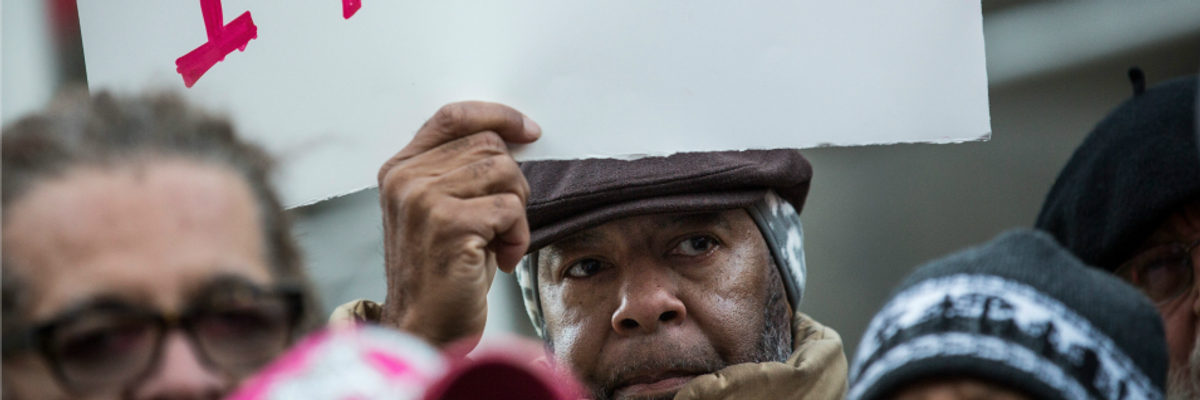
past presidents and congresses have failed for decades to mobilize the resources and make the wrenching changes needed to end the virus of white racism, and finally create an equal playing field for all in America. (Photo: Andrew Burton/Getty Images)
The media has just discovered that the coronavirus is far more deadly to blacks and Latinos than to whites. Twice as deadly in New York City, according to the New York Times. Seventy-two percent of the fatalities in Chicago are blacks who constitute about 30 percent of the population. The news is treated as a shocking revelation on the BBC, CNN and CBS and in newspapers across the country.
Why should anyone be shocked? Over 150 years after the abolition of slavery, and over six decades since the end of legal apartheid in this country, America still remains, as the Kerner Commission concluded in 1968, "two societies, one black, one white, separate and unequal."
The coronavirus does not discriminate, but people do. African Americans and Hispanics are more likely to die because we bear the pre-existing condition known as race.
The reality is harsh and inescapable. African Americans are more likely to be poor, more likely to be unemployed, more likely to lack health insurance, more likely to be arrested, jailed and incarcerated. We live lives of greater stress, in neighborhoods too often scarred by gun violence. The result is a lower life expectancy even before the virus hit. This discrepancy is structural, and it is not accidental. It is, as the Kerner Commission concluded, the direct result of public policy and private prejudice.
Blacks and Hispanics also constitute a disproportionate number of the frontline workers -- the bus drivers and grocery clerks, janitors and mass transit workers, child care and nursing home staffs.
African Americans are more likely to be afflicted with pre-existing health conditions that make the virus particularly fatal: heart disease, diabetes, asthma, obesity. According to the Centers of Disease Control and Prevention, we are 50 percent more likely to have heart disease and 40 percent more likely to die at an early age. Nineteen percent of us can't afford to see a doctor. The majority of us live in the South where many Republican governors have refused to extend Medicaid under the Affordable Care Act. Anti-immigration rhetoric and policing make many Hispanics reluctant to go to the hospital or see a doctor, even if they can afford it.
Blacks and Hispanics also constitute a disproportionate number of the frontline workers -- the bus drivers and grocery clerks, janitors and mass transit workers, child care and nursing home staffs. They take the early bus. They do not have the luxury of "social distancing." They can't work from home and can't afford not to work.
These realities are pre-existing conditions that make us more vulnerable to the virus. They aren't a secret, even though they are seldom discussed. Now the virus is bringing them to public attention once more. The question is whether anything will be done this time.
If the president or Congress were serious, they would create a new Kerner Commission, an independent commission to document the structures of racism and discrimination built into our public policies. And then they would act on the recommendations - many of which no doubt would be no different than those of the Kerner Commission itself over half a century ago. If they fail to act, governors could create similar investigations for their own states, and act upon the recommendations.
Donald Trump has failed to mobilize adequately the federal resources needed to combat the coronavirus effectively. But past presidents and congresses have failed for decades to mobilize the resources and make the wrenching changes needed to end the virus of white racism, and finally create an equal playing field for all in America. The coronavirus only serves to once more draw attention to the terrible human costs of that failure.
Dear Common Dreams reader, It’s been nearly 30 years since I co-founded Common Dreams with my late wife, Lina Newhouser. We had the radical notion that journalism should serve the public good, not corporate profits. It was clear to us from the outset what it would take to build such a project. No paid advertisements. No corporate sponsors. No millionaire publisher telling us what to think or do. Many people said we wouldn't last a year, but we proved those doubters wrong. Together with a tremendous team of journalists and dedicated staff, we built an independent media outlet free from the constraints of profits and corporate control. Our mission has always been simple: To inform. To inspire. To ignite change for the common good. Building Common Dreams was not easy. Our survival was never guaranteed. When you take on the most powerful forces—Wall Street greed, fossil fuel industry destruction, Big Tech lobbyists, and uber-rich oligarchs who have spent billions upon billions rigging the economy and democracy in their favor—the only bulwark you have is supporters who believe in your work. But here’s the urgent message from me today. It's never been this bad out there. And it's never been this hard to keep us going. At the very moment Common Dreams is most needed, the threats we face are intensifying. We need your support now more than ever. We don't accept corporate advertising and never will. We don't have a paywall because we don't think people should be blocked from critical news based on their ability to pay. Everything we do is funded by the donations of readers like you. When everyone does the little they can afford, we are strong. But if that support retreats or dries up, so do we. Will you donate now to make sure Common Dreams not only survives but thrives? —Craig Brown, Co-founder |
The media has just discovered that the coronavirus is far more deadly to blacks and Latinos than to whites. Twice as deadly in New York City, according to the New York Times. Seventy-two percent of the fatalities in Chicago are blacks who constitute about 30 percent of the population. The news is treated as a shocking revelation on the BBC, CNN and CBS and in newspapers across the country.
Why should anyone be shocked? Over 150 years after the abolition of slavery, and over six decades since the end of legal apartheid in this country, America still remains, as the Kerner Commission concluded in 1968, "two societies, one black, one white, separate and unequal."
The coronavirus does not discriminate, but people do. African Americans and Hispanics are more likely to die because we bear the pre-existing condition known as race.
The reality is harsh and inescapable. African Americans are more likely to be poor, more likely to be unemployed, more likely to lack health insurance, more likely to be arrested, jailed and incarcerated. We live lives of greater stress, in neighborhoods too often scarred by gun violence. The result is a lower life expectancy even before the virus hit. This discrepancy is structural, and it is not accidental. It is, as the Kerner Commission concluded, the direct result of public policy and private prejudice.
Blacks and Hispanics also constitute a disproportionate number of the frontline workers -- the bus drivers and grocery clerks, janitors and mass transit workers, child care and nursing home staffs.
African Americans are more likely to be afflicted with pre-existing health conditions that make the virus particularly fatal: heart disease, diabetes, asthma, obesity. According to the Centers of Disease Control and Prevention, we are 50 percent more likely to have heart disease and 40 percent more likely to die at an early age. Nineteen percent of us can't afford to see a doctor. The majority of us live in the South where many Republican governors have refused to extend Medicaid under the Affordable Care Act. Anti-immigration rhetoric and policing make many Hispanics reluctant to go to the hospital or see a doctor, even if they can afford it.
Blacks and Hispanics also constitute a disproportionate number of the frontline workers -- the bus drivers and grocery clerks, janitors and mass transit workers, child care and nursing home staffs. They take the early bus. They do not have the luxury of "social distancing." They can't work from home and can't afford not to work.
These realities are pre-existing conditions that make us more vulnerable to the virus. They aren't a secret, even though they are seldom discussed. Now the virus is bringing them to public attention once more. The question is whether anything will be done this time.
If the president or Congress were serious, they would create a new Kerner Commission, an independent commission to document the structures of racism and discrimination built into our public policies. And then they would act on the recommendations - many of which no doubt would be no different than those of the Kerner Commission itself over half a century ago. If they fail to act, governors could create similar investigations for their own states, and act upon the recommendations.
Donald Trump has failed to mobilize adequately the federal resources needed to combat the coronavirus effectively. But past presidents and congresses have failed for decades to mobilize the resources and make the wrenching changes needed to end the virus of white racism, and finally create an equal playing field for all in America. The coronavirus only serves to once more draw attention to the terrible human costs of that failure.
The media has just discovered that the coronavirus is far more deadly to blacks and Latinos than to whites. Twice as deadly in New York City, according to the New York Times. Seventy-two percent of the fatalities in Chicago are blacks who constitute about 30 percent of the population. The news is treated as a shocking revelation on the BBC, CNN and CBS and in newspapers across the country.
Why should anyone be shocked? Over 150 years after the abolition of slavery, and over six decades since the end of legal apartheid in this country, America still remains, as the Kerner Commission concluded in 1968, "two societies, one black, one white, separate and unequal."
The coronavirus does not discriminate, but people do. African Americans and Hispanics are more likely to die because we bear the pre-existing condition known as race.
The reality is harsh and inescapable. African Americans are more likely to be poor, more likely to be unemployed, more likely to lack health insurance, more likely to be arrested, jailed and incarcerated. We live lives of greater stress, in neighborhoods too often scarred by gun violence. The result is a lower life expectancy even before the virus hit. This discrepancy is structural, and it is not accidental. It is, as the Kerner Commission concluded, the direct result of public policy and private prejudice.
Blacks and Hispanics also constitute a disproportionate number of the frontline workers -- the bus drivers and grocery clerks, janitors and mass transit workers, child care and nursing home staffs.
African Americans are more likely to be afflicted with pre-existing health conditions that make the virus particularly fatal: heart disease, diabetes, asthma, obesity. According to the Centers of Disease Control and Prevention, we are 50 percent more likely to have heart disease and 40 percent more likely to die at an early age. Nineteen percent of us can't afford to see a doctor. The majority of us live in the South where many Republican governors have refused to extend Medicaid under the Affordable Care Act. Anti-immigration rhetoric and policing make many Hispanics reluctant to go to the hospital or see a doctor, even if they can afford it.
Blacks and Hispanics also constitute a disproportionate number of the frontline workers -- the bus drivers and grocery clerks, janitors and mass transit workers, child care and nursing home staffs. They take the early bus. They do not have the luxury of "social distancing." They can't work from home and can't afford not to work.
These realities are pre-existing conditions that make us more vulnerable to the virus. They aren't a secret, even though they are seldom discussed. Now the virus is bringing them to public attention once more. The question is whether anything will be done this time.
If the president or Congress were serious, they would create a new Kerner Commission, an independent commission to document the structures of racism and discrimination built into our public policies. And then they would act on the recommendations - many of which no doubt would be no different than those of the Kerner Commission itself over half a century ago. If they fail to act, governors could create similar investigations for their own states, and act upon the recommendations.
Donald Trump has failed to mobilize adequately the federal resources needed to combat the coronavirus effectively. But past presidents and congresses have failed for decades to mobilize the resources and make the wrenching changes needed to end the virus of white racism, and finally create an equal playing field for all in America. The coronavirus only serves to once more draw attention to the terrible human costs of that failure.