SUBSCRIBE TO OUR FREE NEWSLETTER
Daily news & progressive opinion—funded by the people, not the corporations—delivered straight to your inbox.
5
#000000
#FFFFFF
To donate by check, phone, or other method, see our More Ways to Give page.
Daily news & progressive opinion—funded by the people, not the corporations—delivered straight to your inbox.
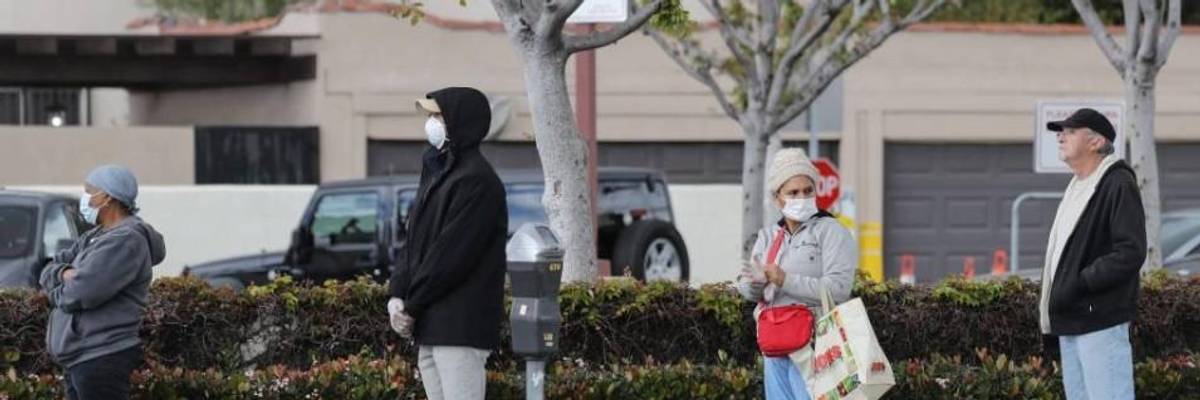
This millennium has wired us into a pervasive system of individuated connection, making it a perfect precursor to the requisite high-tech sequestration at hand. (Photo: Mario Tama/Getty Images)
It's the end of the world, but you might hardly know it. Sure, there's the inconvenience of being mostly stuck at home, making do with a bit less and rationing a bit more, and foregoing most of our exterior social interactions. But let's face it: for many people right now, our streaming services are intact and just about anything still can be delivered to your doorstep. If this is the apocalypse, or even just a preview, then it's a high-functioning one. So it's fair to wonder: is this societal demise, or technological ascent?
For the so-called "middle class" (which by definition or perception incorporates a surprisingly large percentage of the population) this might feel like a moment of relative inconvenience wrapped around lives of on-demand convenience. Entertainment, communication, and myriad cultural diversions have already been thoroughly digitized by now, as have an expanding array of economic and work-related activities. Social engagement has lagged a bit, but rapidly is catching up in this time of imposed distance.
Yes, this is a catastrophic moment, but more so for those already vulnerable and marginalized.
All the while, the capacity to realize "social distancing" (bound up with notions of doing one's civic duty) remains a function of power and privilege. Isolation isn't much of an option for people experiencing homelessness, incarcerated populations, or communities marked by concentrated poverty. Endemic conditions of structural violence, obscured by the "bootstraps" mythology of free-market meritocracy, have yielded starkly disparate lives for people coexisting within proximity but often living worlds apart.
Despite the disparities, there's a tendency (especially in times of crisis) to seek bonds of connection and solidarity with a sense that "we're all in this together." On many levels this is indeed true, and always has been: our lives are intertwined and mutually interdependent in ways that are rarely acknowledged. But that organic realization doesn't account for a constructed reality in which benefits and burdens skew heavily based on demographic factors, and disasters notoriously exacerbate those preexisting inequities.
Yes, this is a catastrophic moment, but more so for those already vulnerable and marginalized. Frontline workers, people with underlying medical conditions and limited access to good healthcare, communities suffering long-term exposure to environmental toxins, those on the other side of the "digital divide," and more are disproportionately reflected in the infection and casualty rates accruing in this pandemic. The correlates of race and class reveal themselves starkly in crisis, belying axioms of equal opportunity.
Whether through a stratified lens or taken in the aggregate, this is a calamitous time. But catastrophe is only half of the definition of apocalypse, deriving from a Greek word meaning uncovering or disclosure. This revelatory aspect of apocalypse is palpable right now, laying bare our utter dependence on digital modalities and remote fulfillment centers to meet basic needs. Perhaps this reliance gives us a modicum of pause--but the larger mindset is one of reveling in the values and virtues of a technotopian promise.
Education at all levels? They've got platforms in place. Consumer goods, from apples to automobiles? Delivered right to your door (and you don't even have to see the deliverer). Cultural engagement? Now available via livestream. Exercise, intimacy, investments, spirituality? There's an app for that. Work? Zoom it. Media? Binge it. Politics? Tweet it. This millennium has wired us into a pervasive system of individuated connection, making it a perfect precursor to the requisite high-tech sequestration at hand.
And perhaps, after all, this has always been the ultimate demand of an on-demand society: catastrophic convenience, filling the experiential void with ostensible plenty. Maybe seeing it unvarnished and living with its implications can be a wake-up call? If so, the lingering effects might yield more sustainable and scalable lives, reclaiming lost skills and abilities, appreciating nature, and embracing community. If not, then the realization of marked digital dependency might be the fulfillment of our unnatural social order.
Dear Common Dreams reader, It’s been nearly 30 years since I co-founded Common Dreams with my late wife, Lina Newhouser. We had the radical notion that journalism should serve the public good, not corporate profits. It was clear to us from the outset what it would take to build such a project. No paid advertisements. No corporate sponsors. No millionaire publisher telling us what to think or do. Many people said we wouldn't last a year, but we proved those doubters wrong. Together with a tremendous team of journalists and dedicated staff, we built an independent media outlet free from the constraints of profits and corporate control. Our mission has always been simple: To inform. To inspire. To ignite change for the common good. Building Common Dreams was not easy. Our survival was never guaranteed. When you take on the most powerful forces—Wall Street greed, fossil fuel industry destruction, Big Tech lobbyists, and uber-rich oligarchs who have spent billions upon billions rigging the economy and democracy in their favor—the only bulwark you have is supporters who believe in your work. But here’s the urgent message from me today. It's never been this bad out there. And it's never been this hard to keep us going. At the very moment Common Dreams is most needed, the threats we face are intensifying. We need your support now more than ever. We don't accept corporate advertising and never will. We don't have a paywall because we don't think people should be blocked from critical news based on their ability to pay. Everything we do is funded by the donations of readers like you. When everyone does the little they can afford, we are strong. But if that support retreats or dries up, so do we. Will you donate now to make sure Common Dreams not only survives but thrives? —Craig Brown, Co-founder |
It's the end of the world, but you might hardly know it. Sure, there's the inconvenience of being mostly stuck at home, making do with a bit less and rationing a bit more, and foregoing most of our exterior social interactions. But let's face it: for many people right now, our streaming services are intact and just about anything still can be delivered to your doorstep. If this is the apocalypse, or even just a preview, then it's a high-functioning one. So it's fair to wonder: is this societal demise, or technological ascent?
For the so-called "middle class" (which by definition or perception incorporates a surprisingly large percentage of the population) this might feel like a moment of relative inconvenience wrapped around lives of on-demand convenience. Entertainment, communication, and myriad cultural diversions have already been thoroughly digitized by now, as have an expanding array of economic and work-related activities. Social engagement has lagged a bit, but rapidly is catching up in this time of imposed distance.
Yes, this is a catastrophic moment, but more so for those already vulnerable and marginalized.
All the while, the capacity to realize "social distancing" (bound up with notions of doing one's civic duty) remains a function of power and privilege. Isolation isn't much of an option for people experiencing homelessness, incarcerated populations, or communities marked by concentrated poverty. Endemic conditions of structural violence, obscured by the "bootstraps" mythology of free-market meritocracy, have yielded starkly disparate lives for people coexisting within proximity but often living worlds apart.
Despite the disparities, there's a tendency (especially in times of crisis) to seek bonds of connection and solidarity with a sense that "we're all in this together." On many levels this is indeed true, and always has been: our lives are intertwined and mutually interdependent in ways that are rarely acknowledged. But that organic realization doesn't account for a constructed reality in which benefits and burdens skew heavily based on demographic factors, and disasters notoriously exacerbate those preexisting inequities.
Yes, this is a catastrophic moment, but more so for those already vulnerable and marginalized. Frontline workers, people with underlying medical conditions and limited access to good healthcare, communities suffering long-term exposure to environmental toxins, those on the other side of the "digital divide," and more are disproportionately reflected in the infection and casualty rates accruing in this pandemic. The correlates of race and class reveal themselves starkly in crisis, belying axioms of equal opportunity.
Whether through a stratified lens or taken in the aggregate, this is a calamitous time. But catastrophe is only half of the definition of apocalypse, deriving from a Greek word meaning uncovering or disclosure. This revelatory aspect of apocalypse is palpable right now, laying bare our utter dependence on digital modalities and remote fulfillment centers to meet basic needs. Perhaps this reliance gives us a modicum of pause--but the larger mindset is one of reveling in the values and virtues of a technotopian promise.
Education at all levels? They've got platforms in place. Consumer goods, from apples to automobiles? Delivered right to your door (and you don't even have to see the deliverer). Cultural engagement? Now available via livestream. Exercise, intimacy, investments, spirituality? There's an app for that. Work? Zoom it. Media? Binge it. Politics? Tweet it. This millennium has wired us into a pervasive system of individuated connection, making it a perfect precursor to the requisite high-tech sequestration at hand.
And perhaps, after all, this has always been the ultimate demand of an on-demand society: catastrophic convenience, filling the experiential void with ostensible plenty. Maybe seeing it unvarnished and living with its implications can be a wake-up call? If so, the lingering effects might yield more sustainable and scalable lives, reclaiming lost skills and abilities, appreciating nature, and embracing community. If not, then the realization of marked digital dependency might be the fulfillment of our unnatural social order.
It's the end of the world, but you might hardly know it. Sure, there's the inconvenience of being mostly stuck at home, making do with a bit less and rationing a bit more, and foregoing most of our exterior social interactions. But let's face it: for many people right now, our streaming services are intact and just about anything still can be delivered to your doorstep. If this is the apocalypse, or even just a preview, then it's a high-functioning one. So it's fair to wonder: is this societal demise, or technological ascent?
For the so-called "middle class" (which by definition or perception incorporates a surprisingly large percentage of the population) this might feel like a moment of relative inconvenience wrapped around lives of on-demand convenience. Entertainment, communication, and myriad cultural diversions have already been thoroughly digitized by now, as have an expanding array of economic and work-related activities. Social engagement has lagged a bit, but rapidly is catching up in this time of imposed distance.
Yes, this is a catastrophic moment, but more so for those already vulnerable and marginalized.
All the while, the capacity to realize "social distancing" (bound up with notions of doing one's civic duty) remains a function of power and privilege. Isolation isn't much of an option for people experiencing homelessness, incarcerated populations, or communities marked by concentrated poverty. Endemic conditions of structural violence, obscured by the "bootstraps" mythology of free-market meritocracy, have yielded starkly disparate lives for people coexisting within proximity but often living worlds apart.
Despite the disparities, there's a tendency (especially in times of crisis) to seek bonds of connection and solidarity with a sense that "we're all in this together." On many levels this is indeed true, and always has been: our lives are intertwined and mutually interdependent in ways that are rarely acknowledged. But that organic realization doesn't account for a constructed reality in which benefits and burdens skew heavily based on demographic factors, and disasters notoriously exacerbate those preexisting inequities.
Yes, this is a catastrophic moment, but more so for those already vulnerable and marginalized. Frontline workers, people with underlying medical conditions and limited access to good healthcare, communities suffering long-term exposure to environmental toxins, those on the other side of the "digital divide," and more are disproportionately reflected in the infection and casualty rates accruing in this pandemic. The correlates of race and class reveal themselves starkly in crisis, belying axioms of equal opportunity.
Whether through a stratified lens or taken in the aggregate, this is a calamitous time. But catastrophe is only half of the definition of apocalypse, deriving from a Greek word meaning uncovering or disclosure. This revelatory aspect of apocalypse is palpable right now, laying bare our utter dependence on digital modalities and remote fulfillment centers to meet basic needs. Perhaps this reliance gives us a modicum of pause--but the larger mindset is one of reveling in the values and virtues of a technotopian promise.
Education at all levels? They've got platforms in place. Consumer goods, from apples to automobiles? Delivered right to your door (and you don't even have to see the deliverer). Cultural engagement? Now available via livestream. Exercise, intimacy, investments, spirituality? There's an app for that. Work? Zoom it. Media? Binge it. Politics? Tweet it. This millennium has wired us into a pervasive system of individuated connection, making it a perfect precursor to the requisite high-tech sequestration at hand.
And perhaps, after all, this has always been the ultimate demand of an on-demand society: catastrophic convenience, filling the experiential void with ostensible plenty. Maybe seeing it unvarnished and living with its implications can be a wake-up call? If so, the lingering effects might yield more sustainable and scalable lives, reclaiming lost skills and abilities, appreciating nature, and embracing community. If not, then the realization of marked digital dependency might be the fulfillment of our unnatural social order.