SUBSCRIBE TO OUR FREE NEWSLETTER
Daily news & progressive opinion—funded by the people, not the corporations—delivered straight to your inbox.
5
#000000
#FFFFFF
To donate by check, phone, or other method, see our More Ways to Give page.
Daily news & progressive opinion—funded by the people, not the corporations—delivered straight to your inbox.
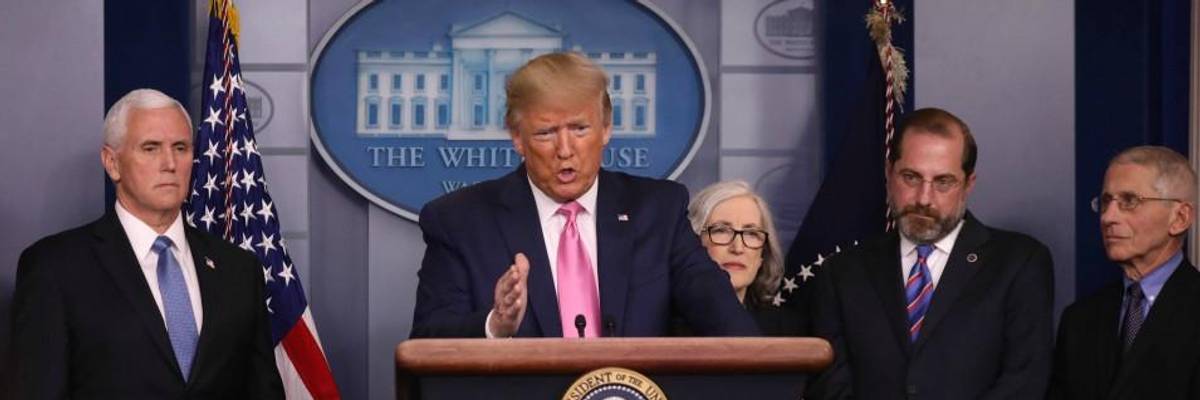
President Donald Trump holds a press conference announcing Vice President Mike Pence will lead the effort combating the spread of the coronavirus in Washington, D.C. on February 26, 2020. (Photo: Yasin Ozturk/Anadolu Agency via Getty Images)
Donald Trump has consistently been failing the country in dealing with the coronavirus. Due to Trump's failed public health response, even Treasury Secretary Steve Mnuchin acknowledges that we are facing the worst economic collapse since the Great Depression. This is in addition to the prospect of tens of millions of people getting the coronavirus and hundreds of thousands, or even millions, dying.
It is encouraging that the Trump administration is now taking steps to respond to the economic damage, but from what has been disclosed, its plan is poorly designed. First and foremost, we have heard no discussion of the federal government taking a direct role in providing the resources needed to deal with the crisis.
This would mean, for example, having the Army Corps of Engineers establish emergency hospital facilities to house the large number of patients needing care. It would also mean increasing the supply of ventilators and other medical equipment, with the government prepared to work directly with factories here and elsewhere to remove obstacles to ramping up production. Apparently, Trump has told the governors to find such equipment on their own.
Incredibly, tests are still not widely available and many at-risk people are unable to be tested. The government should also be training new health care workers to carry through more easily mastered tasks, such as taking temperature and blood pressure readings, changing bedding, and cleaning surfaces to required standard to free up time for nurses and other more highly trained professionals, who will be hugely overworked.
The centerpiece of the Trump stimulus package is apparently sending out checks on the order of $2,000 to every adult in the United States. Such a payment may be helpful to many people who have lost their jobs or seen a decline in hours, but it will not be effective as a form of stimulus to sustain the economy through the downturn.
In the Great Recession, as well as in prior downturns, sending money to people was a good way to boost the economy, since most people would spend most of the money. That is unlikely to be the case this time. The reason people are not spending is because they are scared to spend it. They don't want to go to restaurants, movies, or take plane trips. And this will be true even if we give everyone an extra $2,000.
On the other hand, as people lose their jobs, tens of millions of people will not have enough money to pay their rent or their mortgage or buy food. For these people, $2,000 will not go very far. It is equal to just two-and-a-half week's pay for someone earning $20 an hour, roughly the median wage in the economy. Without other assistance, these people will risk losing their house or apartment.
It would be far more helpful to have a stimulus package focused on keeping people employed. Denmark provides a useful model for such a policy. The government will pick up 75 percent of workers pay in industries seeing a collapse in demand, such as airlines or restaurants. The company must make up the other 25 percent, so the worker is left whole.
This system has the great advantage that workers maintain their ties to companies. As a result, when the worst of the pandemic has passed, businesses will be able to quickly ramp up to capacity, instead of having to hire and train a new workforce. The percentages of pay supported by the government and contributed by employers may be different for the US than what Denmark is using, but the principle is a sound one.
The Trump administration apparently also wants to bail out the airline industry, and perhaps others as well. Congress should reject such proposals out of hand. American airlines spent 96 percent of free cash flow the past decade buying back shares and 0 percent insuring themselves against a pandemic. The taxpayers should not be asked to pick up the tab for this failure of corporate leadership.
If the sort of support described above is not sufficient to allow the airline industry to survive through the crisis, the route of relief should be a prepackaged bankruptcy, as was done with the auto industry in the Great Recession. This would mean that shareholders would lose their equity. Workers should have their benefits, such as pensions, union membership, and retiree health care benefits, protected.
In exchange for government money being used to support this sort of bankruptcy, there should be other conditions imposed, such as caps on CEO pay. The government should not be in the business of subsidizing the obscene levels of inequality that we see in the economy today.
We should be thinking about a stimulus package that first and foremost does everything we can to limit the spread of the virus and minimizes the suffering, as well as deaths, of the people who contract the disease. Second, we should be focused on minimizing the pain suffered by workers who face the loss of jobs and income through no fault of their own. Finally, we should try to reverse the sort of corruption that has led to such a massive upward redistribution of income over the last four decades. The Trump plan fails in all three areas.
Dear Common Dreams reader, It’s been nearly 30 years since I co-founded Common Dreams with my late wife, Lina Newhouser. We had the radical notion that journalism should serve the public good, not corporate profits. It was clear to us from the outset what it would take to build such a project. No paid advertisements. No corporate sponsors. No millionaire publisher telling us what to think or do. Many people said we wouldn't last a year, but we proved those doubters wrong. Together with a tremendous team of journalists and dedicated staff, we built an independent media outlet free from the constraints of profits and corporate control. Our mission has always been simple: To inform. To inspire. To ignite change for the common good. Building Common Dreams was not easy. Our survival was never guaranteed. When you take on the most powerful forces—Wall Street greed, fossil fuel industry destruction, Big Tech lobbyists, and uber-rich oligarchs who have spent billions upon billions rigging the economy and democracy in their favor—the only bulwark you have is supporters who believe in your work. But here’s the urgent message from me today. It's never been this bad out there. And it's never been this hard to keep us going. At the very moment Common Dreams is most needed, the threats we face are intensifying. We need your support now more than ever. We don't accept corporate advertising and never will. We don't have a paywall because we don't think people should be blocked from critical news based on their ability to pay. Everything we do is funded by the donations of readers like you. When everyone does the little they can afford, we are strong. But if that support retreats or dries up, so do we. Will you donate now to make sure Common Dreams not only survives but thrives? —Craig Brown, Co-founder |
Donald Trump has consistently been failing the country in dealing with the coronavirus. Due to Trump's failed public health response, even Treasury Secretary Steve Mnuchin acknowledges that we are facing the worst economic collapse since the Great Depression. This is in addition to the prospect of tens of millions of people getting the coronavirus and hundreds of thousands, or even millions, dying.
It is encouraging that the Trump administration is now taking steps to respond to the economic damage, but from what has been disclosed, its plan is poorly designed. First and foremost, we have heard no discussion of the federal government taking a direct role in providing the resources needed to deal with the crisis.
This would mean, for example, having the Army Corps of Engineers establish emergency hospital facilities to house the large number of patients needing care. It would also mean increasing the supply of ventilators and other medical equipment, with the government prepared to work directly with factories here and elsewhere to remove obstacles to ramping up production. Apparently, Trump has told the governors to find such equipment on their own.
Incredibly, tests are still not widely available and many at-risk people are unable to be tested. The government should also be training new health care workers to carry through more easily mastered tasks, such as taking temperature and blood pressure readings, changing bedding, and cleaning surfaces to required standard to free up time for nurses and other more highly trained professionals, who will be hugely overworked.
The centerpiece of the Trump stimulus package is apparently sending out checks on the order of $2,000 to every adult in the United States. Such a payment may be helpful to many people who have lost their jobs or seen a decline in hours, but it will not be effective as a form of stimulus to sustain the economy through the downturn.
In the Great Recession, as well as in prior downturns, sending money to people was a good way to boost the economy, since most people would spend most of the money. That is unlikely to be the case this time. The reason people are not spending is because they are scared to spend it. They don't want to go to restaurants, movies, or take plane trips. And this will be true even if we give everyone an extra $2,000.
On the other hand, as people lose their jobs, tens of millions of people will not have enough money to pay their rent or their mortgage or buy food. For these people, $2,000 will not go very far. It is equal to just two-and-a-half week's pay for someone earning $20 an hour, roughly the median wage in the economy. Without other assistance, these people will risk losing their house or apartment.
It would be far more helpful to have a stimulus package focused on keeping people employed. Denmark provides a useful model for such a policy. The government will pick up 75 percent of workers pay in industries seeing a collapse in demand, such as airlines or restaurants. The company must make up the other 25 percent, so the worker is left whole.
This system has the great advantage that workers maintain their ties to companies. As a result, when the worst of the pandemic has passed, businesses will be able to quickly ramp up to capacity, instead of having to hire and train a new workforce. The percentages of pay supported by the government and contributed by employers may be different for the US than what Denmark is using, but the principle is a sound one.
The Trump administration apparently also wants to bail out the airline industry, and perhaps others as well. Congress should reject such proposals out of hand. American airlines spent 96 percent of free cash flow the past decade buying back shares and 0 percent insuring themselves against a pandemic. The taxpayers should not be asked to pick up the tab for this failure of corporate leadership.
If the sort of support described above is not sufficient to allow the airline industry to survive through the crisis, the route of relief should be a prepackaged bankruptcy, as was done with the auto industry in the Great Recession. This would mean that shareholders would lose their equity. Workers should have their benefits, such as pensions, union membership, and retiree health care benefits, protected.
In exchange for government money being used to support this sort of bankruptcy, there should be other conditions imposed, such as caps on CEO pay. The government should not be in the business of subsidizing the obscene levels of inequality that we see in the economy today.
We should be thinking about a stimulus package that first and foremost does everything we can to limit the spread of the virus and minimizes the suffering, as well as deaths, of the people who contract the disease. Second, we should be focused on minimizing the pain suffered by workers who face the loss of jobs and income through no fault of their own. Finally, we should try to reverse the sort of corruption that has led to such a massive upward redistribution of income over the last four decades. The Trump plan fails in all three areas.
Donald Trump has consistently been failing the country in dealing with the coronavirus. Due to Trump's failed public health response, even Treasury Secretary Steve Mnuchin acknowledges that we are facing the worst economic collapse since the Great Depression. This is in addition to the prospect of tens of millions of people getting the coronavirus and hundreds of thousands, or even millions, dying.
It is encouraging that the Trump administration is now taking steps to respond to the economic damage, but from what has been disclosed, its plan is poorly designed. First and foremost, we have heard no discussion of the federal government taking a direct role in providing the resources needed to deal with the crisis.
This would mean, for example, having the Army Corps of Engineers establish emergency hospital facilities to house the large number of patients needing care. It would also mean increasing the supply of ventilators and other medical equipment, with the government prepared to work directly with factories here and elsewhere to remove obstacles to ramping up production. Apparently, Trump has told the governors to find such equipment on their own.
Incredibly, tests are still not widely available and many at-risk people are unable to be tested. The government should also be training new health care workers to carry through more easily mastered tasks, such as taking temperature and blood pressure readings, changing bedding, and cleaning surfaces to required standard to free up time for nurses and other more highly trained professionals, who will be hugely overworked.
The centerpiece of the Trump stimulus package is apparently sending out checks on the order of $2,000 to every adult in the United States. Such a payment may be helpful to many people who have lost their jobs or seen a decline in hours, but it will not be effective as a form of stimulus to sustain the economy through the downturn.
In the Great Recession, as well as in prior downturns, sending money to people was a good way to boost the economy, since most people would spend most of the money. That is unlikely to be the case this time. The reason people are not spending is because they are scared to spend it. They don't want to go to restaurants, movies, or take plane trips. And this will be true even if we give everyone an extra $2,000.
On the other hand, as people lose their jobs, tens of millions of people will not have enough money to pay their rent or their mortgage or buy food. For these people, $2,000 will not go very far. It is equal to just two-and-a-half week's pay for someone earning $20 an hour, roughly the median wage in the economy. Without other assistance, these people will risk losing their house or apartment.
It would be far more helpful to have a stimulus package focused on keeping people employed. Denmark provides a useful model for such a policy. The government will pick up 75 percent of workers pay in industries seeing a collapse in demand, such as airlines or restaurants. The company must make up the other 25 percent, so the worker is left whole.
This system has the great advantage that workers maintain their ties to companies. As a result, when the worst of the pandemic has passed, businesses will be able to quickly ramp up to capacity, instead of having to hire and train a new workforce. The percentages of pay supported by the government and contributed by employers may be different for the US than what Denmark is using, but the principle is a sound one.
The Trump administration apparently also wants to bail out the airline industry, and perhaps others as well. Congress should reject such proposals out of hand. American airlines spent 96 percent of free cash flow the past decade buying back shares and 0 percent insuring themselves against a pandemic. The taxpayers should not be asked to pick up the tab for this failure of corporate leadership.
If the sort of support described above is not sufficient to allow the airline industry to survive through the crisis, the route of relief should be a prepackaged bankruptcy, as was done with the auto industry in the Great Recession. This would mean that shareholders would lose their equity. Workers should have their benefits, such as pensions, union membership, and retiree health care benefits, protected.
In exchange for government money being used to support this sort of bankruptcy, there should be other conditions imposed, such as caps on CEO pay. The government should not be in the business of subsidizing the obscene levels of inequality that we see in the economy today.
We should be thinking about a stimulus package that first and foremost does everything we can to limit the spread of the virus and minimizes the suffering, as well as deaths, of the people who contract the disease. Second, we should be focused on minimizing the pain suffered by workers who face the loss of jobs and income through no fault of their own. Finally, we should try to reverse the sort of corruption that has led to such a massive upward redistribution of income over the last four decades. The Trump plan fails in all three areas.