SUBSCRIBE TO OUR FREE NEWSLETTER
Daily news & progressive opinion—funded by the people, not the corporations—delivered straight to your inbox.
5
#000000
#FFFFFF
To donate by check, phone, or other method, see our More Ways to Give page.
Daily news & progressive opinion—funded by the people, not the corporations—delivered straight to your inbox.
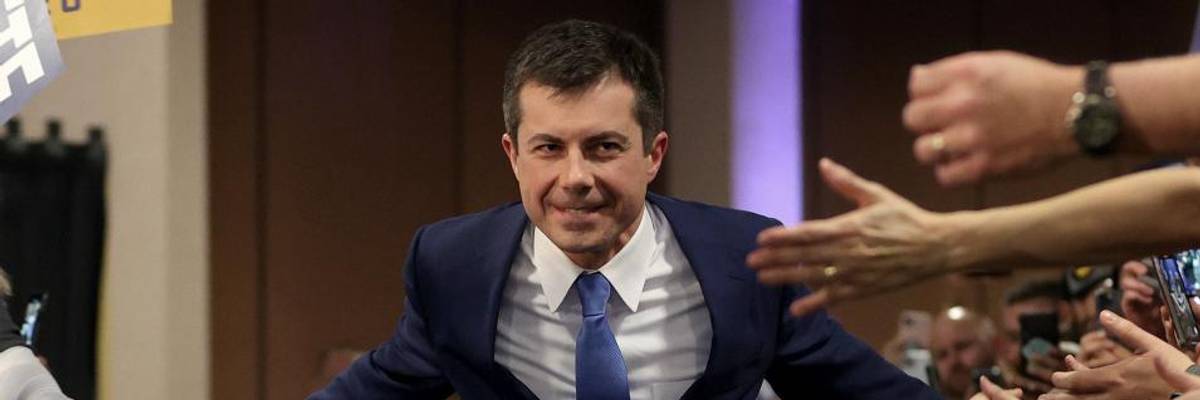
Democratic presidential candidate former South Bend, Indiana Mayor Pete Buttigieg greets supporters as he arrives at a town hall campaign event at the Denver Airport Convention Center February 22, 2020 in Denver, Colorado. Nevada held its presidential caucus earlier today. (Photo: Win McNamee/Getty Images)
Soon after his distant third-place finish in the Nevada caucuses, Pete Buttigieg sent out a mass email saying that "Senator Sanders believes in an inflexible, ideological revolution that leaves out most Democrats, not to mention most Americans." The blast depicted "the choice before us" in stark terms: "We can prioritize either ideological purity or inclusive victory. We can either call people names online or we can call them into our movement. We can either tighten a narrow and hardcore base or open the tent to a new, broad, big-hearted American coalition."
The bizarre accusations of being "narrow" and not "inclusive" were aimed at a candidate who'd just won a historic victory with one of the broadest coalitions in recent Democratic Party history.
Buttigieg has gone from pseudo-progressive to anti-progressive in the last year, and much of his current mission involves denouncing Bernie Sanders with attack lines that are corporate-media favorites ("ideological purity. . . call people names online. . . a narrow and hardcore base"). Buttigieg's chances of winning the 2020 presidential nomination are now tiny, but he might have a bright future as a rising leader of corporate Democrats.
Weirdly, Buttigieg's claim that Sanders has "a narrow and hardcore base" came from someone who appears to be almost incapable of getting votes from black people. In Nevada, columnist E.J. Dionne noted, Buttigieg "received virtually no African American votes." And Buttigieg made his claim in the midst of a Nevada vote count showing that Sanders received more than three times as many votes as he did. The Washington Post reported that Sanders "even narrowly prevailed among those who identified as moderate or conservative."
As chances that Buttigieg could win the nomination slip away--the latest polling in South Carolina indicates his vote total there on Saturday is unlikely to be any higher than it was in Nevada--his mission is being steadily repurposed. After increasingly aligning himself with the dominant corporate sectors of the party--vacuuming up millions of dollars in bundled checks along the way--Buttigieg is hurling an array of bogus accusations at Sanders.
Four months ago, while Buttigieg's poll numbers were spiking in Iowa and big donations from wealthy donors poured in, I wrote an article with a headline dubbing him a "Sharp Corporate Tool." The piece cited an influx of contributions to Buttigieg from the health insurance, pharmaceutical and hospital industries--while he executed a U-turn from proclaiming support for Medicare for All to touting a deceptive rhetorical concoction called "Medicare for all who want it." I concluded that Buttigieg is "a glib ally of corporate America posing as an advocate for working people and their families."
Since then, continuing his rightward swerve, Buttigieg has become even more glib, refining his campaign's creation myth and fine-tuning his capacity to combine corporate policy positions with wispy intimations of technocratic populism. Buttigieg is highly articulate, very shrewd--and now, in attack mode, more valuable than ever to corporate patrons who are feverishly trying to figure out how to prevent Sanders from winning the nomination. During last week's Nevada debate, Buttigieg warned that Sanders "wants to burn this party down."
Over the weekend, the Buttigieg campaign sent out email that tried to obscure its major support from extremely wealthy backers. "At the last debate," Buttigieg's deputy campaign manager Hari Sevugan wrote indignantly, "Senator Bernie Sanders condemned us for taking contributions from billionaires. That's interesting. Because what that tells us is in the eyes of Bernie Sanders, the donations of 45 folks (that's .0054% of our total donor base) are more important than the donations of nearly 1,000,000 grassroots supporters."
But Sevugan left out the pivotal roles that very rich contributors have played in launching and sustaining the Buttigieg campaign, with lobbyists and corporate executives serving as high-dollar collectors of bundled donations that add up to untold millions. Buttigieg's corresponding shifts in policy prescriptions make some sense if we follow the money.
In a detailed essay for Common Dreams that appeared last week, "Buttigieg Is a Wall Street Democrat Beholden to Corporate Interests," former Communications Workers of America chief economist Kenneth Peres summed up: "Buttigieg and his supporters like to portray him as a 'change agent.' However, he has proven to be a change agent that will not in any significant way challenge the current distribution of power, wealth and income in this country. Given his history, it is no surprise that Wall Street, Big Tech, Big Pharma, Health Insurers, Real Estate Developers and Private Equity have decided to invest millions of dollars into Buttigieg's campaign."
In the aftermath of the Nevada caucuses, Buttigieg is escalating his attacks on Sanders (who I actively support), in sync with "news" coverage that is especially virulent from some major corporate outlets. Consider, for example, the de facto smear article that the New York Times printed on Sunday. Or the venomous hostility toward Sanders that's routine on Comcast-owned MSNBC, which has stepped up its routine trashing of Sanders by journalists and invited guests.
More than ever, corporate Democrats and their media allies are freaking out about the grassroots momentum of the Bernie 2020 campaign. No one has figured out how to stop him. But Buttigieg is determined to do as much damage as he can.
Dear Common Dreams reader, It’s been nearly 30 years since I co-founded Common Dreams with my late wife, Lina Newhouser. We had the radical notion that journalism should serve the public good, not corporate profits. It was clear to us from the outset what it would take to build such a project. No paid advertisements. No corporate sponsors. No millionaire publisher telling us what to think or do. Many people said we wouldn't last a year, but we proved those doubters wrong. Together with a tremendous team of journalists and dedicated staff, we built an independent media outlet free from the constraints of profits and corporate control. Our mission has always been simple: To inform. To inspire. To ignite change for the common good. Building Common Dreams was not easy. Our survival was never guaranteed. When you take on the most powerful forces—Wall Street greed, fossil fuel industry destruction, Big Tech lobbyists, and uber-rich oligarchs who have spent billions upon billions rigging the economy and democracy in their favor—the only bulwark you have is supporters who believe in your work. But here’s the urgent message from me today. It's never been this bad out there. And it's never been this hard to keep us going. At the very moment Common Dreams is most needed, the threats we face are intensifying. We need your support now more than ever. We don't accept corporate advertising and never will. We don't have a paywall because we don't think people should be blocked from critical news based on their ability to pay. Everything we do is funded by the donations of readers like you. When everyone does the little they can afford, we are strong. But if that support retreats or dries up, so do we. Will you donate now to make sure Common Dreams not only survives but thrives? —Craig Brown, Co-founder |
Norman Solomon is the national director of RootsAction.org and executive director of the Institute for Public Accuracy. The paperback edition of his latest book, War Made Invisible: How America Hides the Human Toll of Its Military Machine, includes an afterword about the Gaza war.
Soon after his distant third-place finish in the Nevada caucuses, Pete Buttigieg sent out a mass email saying that "Senator Sanders believes in an inflexible, ideological revolution that leaves out most Democrats, not to mention most Americans." The blast depicted "the choice before us" in stark terms: "We can prioritize either ideological purity or inclusive victory. We can either call people names online or we can call them into our movement. We can either tighten a narrow and hardcore base or open the tent to a new, broad, big-hearted American coalition."
The bizarre accusations of being "narrow" and not "inclusive" were aimed at a candidate who'd just won a historic victory with one of the broadest coalitions in recent Democratic Party history.
Buttigieg has gone from pseudo-progressive to anti-progressive in the last year, and much of his current mission involves denouncing Bernie Sanders with attack lines that are corporate-media favorites ("ideological purity. . . call people names online. . . a narrow and hardcore base"). Buttigieg's chances of winning the 2020 presidential nomination are now tiny, but he might have a bright future as a rising leader of corporate Democrats.
Weirdly, Buttigieg's claim that Sanders has "a narrow and hardcore base" came from someone who appears to be almost incapable of getting votes from black people. In Nevada, columnist E.J. Dionne noted, Buttigieg "received virtually no African American votes." And Buttigieg made his claim in the midst of a Nevada vote count showing that Sanders received more than three times as many votes as he did. The Washington Post reported that Sanders "even narrowly prevailed among those who identified as moderate or conservative."
As chances that Buttigieg could win the nomination slip away--the latest polling in South Carolina indicates his vote total there on Saturday is unlikely to be any higher than it was in Nevada--his mission is being steadily repurposed. After increasingly aligning himself with the dominant corporate sectors of the party--vacuuming up millions of dollars in bundled checks along the way--Buttigieg is hurling an array of bogus accusations at Sanders.
Four months ago, while Buttigieg's poll numbers were spiking in Iowa and big donations from wealthy donors poured in, I wrote an article with a headline dubbing him a "Sharp Corporate Tool." The piece cited an influx of contributions to Buttigieg from the health insurance, pharmaceutical and hospital industries--while he executed a U-turn from proclaiming support for Medicare for All to touting a deceptive rhetorical concoction called "Medicare for all who want it." I concluded that Buttigieg is "a glib ally of corporate America posing as an advocate for working people and their families."
Since then, continuing his rightward swerve, Buttigieg has become even more glib, refining his campaign's creation myth and fine-tuning his capacity to combine corporate policy positions with wispy intimations of technocratic populism. Buttigieg is highly articulate, very shrewd--and now, in attack mode, more valuable than ever to corporate patrons who are feverishly trying to figure out how to prevent Sanders from winning the nomination. During last week's Nevada debate, Buttigieg warned that Sanders "wants to burn this party down."
Over the weekend, the Buttigieg campaign sent out email that tried to obscure its major support from extremely wealthy backers. "At the last debate," Buttigieg's deputy campaign manager Hari Sevugan wrote indignantly, "Senator Bernie Sanders condemned us for taking contributions from billionaires. That's interesting. Because what that tells us is in the eyes of Bernie Sanders, the donations of 45 folks (that's .0054% of our total donor base) are more important than the donations of nearly 1,000,000 grassroots supporters."
But Sevugan left out the pivotal roles that very rich contributors have played in launching and sustaining the Buttigieg campaign, with lobbyists and corporate executives serving as high-dollar collectors of bundled donations that add up to untold millions. Buttigieg's corresponding shifts in policy prescriptions make some sense if we follow the money.
In a detailed essay for Common Dreams that appeared last week, "Buttigieg Is a Wall Street Democrat Beholden to Corporate Interests," former Communications Workers of America chief economist Kenneth Peres summed up: "Buttigieg and his supporters like to portray him as a 'change agent.' However, he has proven to be a change agent that will not in any significant way challenge the current distribution of power, wealth and income in this country. Given his history, it is no surprise that Wall Street, Big Tech, Big Pharma, Health Insurers, Real Estate Developers and Private Equity have decided to invest millions of dollars into Buttigieg's campaign."
In the aftermath of the Nevada caucuses, Buttigieg is escalating his attacks on Sanders (who I actively support), in sync with "news" coverage that is especially virulent from some major corporate outlets. Consider, for example, the de facto smear article that the New York Times printed on Sunday. Or the venomous hostility toward Sanders that's routine on Comcast-owned MSNBC, which has stepped up its routine trashing of Sanders by journalists and invited guests.
More than ever, corporate Democrats and their media allies are freaking out about the grassroots momentum of the Bernie 2020 campaign. No one has figured out how to stop him. But Buttigieg is determined to do as much damage as he can.
Norman Solomon is the national director of RootsAction.org and executive director of the Institute for Public Accuracy. The paperback edition of his latest book, War Made Invisible: How America Hides the Human Toll of Its Military Machine, includes an afterword about the Gaza war.
Soon after his distant third-place finish in the Nevada caucuses, Pete Buttigieg sent out a mass email saying that "Senator Sanders believes in an inflexible, ideological revolution that leaves out most Democrats, not to mention most Americans." The blast depicted "the choice before us" in stark terms: "We can prioritize either ideological purity or inclusive victory. We can either call people names online or we can call them into our movement. We can either tighten a narrow and hardcore base or open the tent to a new, broad, big-hearted American coalition."
The bizarre accusations of being "narrow" and not "inclusive" were aimed at a candidate who'd just won a historic victory with one of the broadest coalitions in recent Democratic Party history.
Buttigieg has gone from pseudo-progressive to anti-progressive in the last year, and much of his current mission involves denouncing Bernie Sanders with attack lines that are corporate-media favorites ("ideological purity. . . call people names online. . . a narrow and hardcore base"). Buttigieg's chances of winning the 2020 presidential nomination are now tiny, but he might have a bright future as a rising leader of corporate Democrats.
Weirdly, Buttigieg's claim that Sanders has "a narrow and hardcore base" came from someone who appears to be almost incapable of getting votes from black people. In Nevada, columnist E.J. Dionne noted, Buttigieg "received virtually no African American votes." And Buttigieg made his claim in the midst of a Nevada vote count showing that Sanders received more than three times as many votes as he did. The Washington Post reported that Sanders "even narrowly prevailed among those who identified as moderate or conservative."
As chances that Buttigieg could win the nomination slip away--the latest polling in South Carolina indicates his vote total there on Saturday is unlikely to be any higher than it was in Nevada--his mission is being steadily repurposed. After increasingly aligning himself with the dominant corporate sectors of the party--vacuuming up millions of dollars in bundled checks along the way--Buttigieg is hurling an array of bogus accusations at Sanders.
Four months ago, while Buttigieg's poll numbers were spiking in Iowa and big donations from wealthy donors poured in, I wrote an article with a headline dubbing him a "Sharp Corporate Tool." The piece cited an influx of contributions to Buttigieg from the health insurance, pharmaceutical and hospital industries--while he executed a U-turn from proclaiming support for Medicare for All to touting a deceptive rhetorical concoction called "Medicare for all who want it." I concluded that Buttigieg is "a glib ally of corporate America posing as an advocate for working people and their families."
Since then, continuing his rightward swerve, Buttigieg has become even more glib, refining his campaign's creation myth and fine-tuning his capacity to combine corporate policy positions with wispy intimations of technocratic populism. Buttigieg is highly articulate, very shrewd--and now, in attack mode, more valuable than ever to corporate patrons who are feverishly trying to figure out how to prevent Sanders from winning the nomination. During last week's Nevada debate, Buttigieg warned that Sanders "wants to burn this party down."
Over the weekend, the Buttigieg campaign sent out email that tried to obscure its major support from extremely wealthy backers. "At the last debate," Buttigieg's deputy campaign manager Hari Sevugan wrote indignantly, "Senator Bernie Sanders condemned us for taking contributions from billionaires. That's interesting. Because what that tells us is in the eyes of Bernie Sanders, the donations of 45 folks (that's .0054% of our total donor base) are more important than the donations of nearly 1,000,000 grassroots supporters."
But Sevugan left out the pivotal roles that very rich contributors have played in launching and sustaining the Buttigieg campaign, with lobbyists and corporate executives serving as high-dollar collectors of bundled donations that add up to untold millions. Buttigieg's corresponding shifts in policy prescriptions make some sense if we follow the money.
In a detailed essay for Common Dreams that appeared last week, "Buttigieg Is a Wall Street Democrat Beholden to Corporate Interests," former Communications Workers of America chief economist Kenneth Peres summed up: "Buttigieg and his supporters like to portray him as a 'change agent.' However, he has proven to be a change agent that will not in any significant way challenge the current distribution of power, wealth and income in this country. Given his history, it is no surprise that Wall Street, Big Tech, Big Pharma, Health Insurers, Real Estate Developers and Private Equity have decided to invest millions of dollars into Buttigieg's campaign."
In the aftermath of the Nevada caucuses, Buttigieg is escalating his attacks on Sanders (who I actively support), in sync with "news" coverage that is especially virulent from some major corporate outlets. Consider, for example, the de facto smear article that the New York Times printed on Sunday. Or the venomous hostility toward Sanders that's routine on Comcast-owned MSNBC, which has stepped up its routine trashing of Sanders by journalists and invited guests.
More than ever, corporate Democrats and their media allies are freaking out about the grassroots momentum of the Bernie 2020 campaign. No one has figured out how to stop him. But Buttigieg is determined to do as much damage as he can.